SUBSCRIBE TO OUR FREE NEWSLETTER
Daily news & progressive opinion—funded by the people, not the corporations—delivered straight to your inbox.
5
#000000
#FFFFFF
To donate by check, phone, or other method, see our More Ways to Give page.


Daily news & progressive opinion—funded by the people, not the corporations—delivered straight to your inbox.
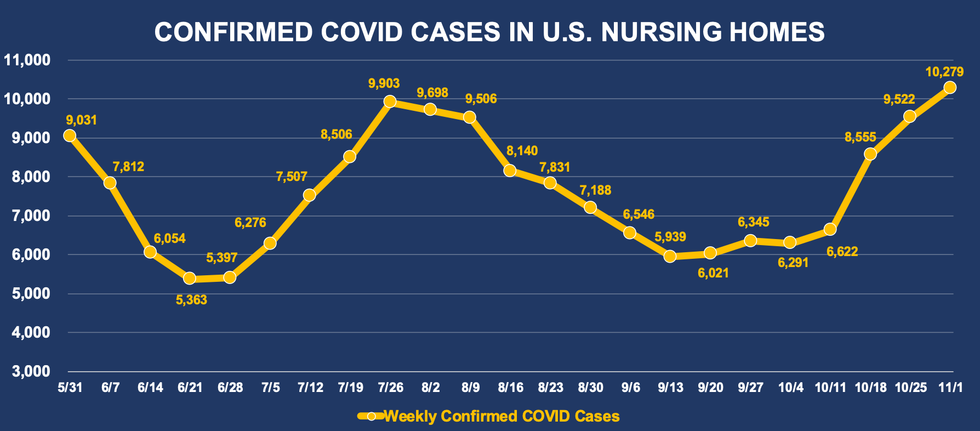
The American Health Care Association and National Center for Assisted Living (AHCA/NCAL), representing more than 14,000 nursing homes and assisted living communities across the country that provide care to approximately five million people each year, released a report today showing new COVID cases in nursing homes in the U.S. has now reached a record number of weekly new cases this month due to the community spread among the general population, surpassing previous peaks since the Centers for Medicare & Medicaid Services (CMS) started tracking cases in nursing homes.
Recent data released by Johns Hopkins University and the Centers for Medicare & Medicaid Services (CMS) show that with the recent spike in new COVID cases in the general U.S. population, weekly nursing home cases are also on the rise. According to Johns Hopkins University, weekly new COVID cases in the general U.S. population rose by 140 percent to 572,613,527 new cases the week of November 1. A correlating uptick in new cases in nursing homes occurred when cases in the surrounding community started rising back in mid-September.
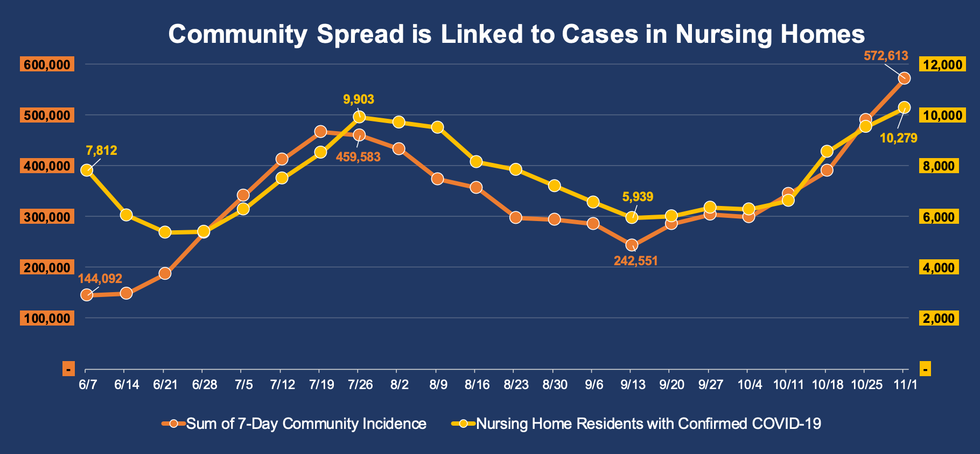
As experts have repeatedly noted, COVID-19 cases in a surrounding community is a top factor in outbreaks in nursing homes. University of Chicago's Tamara Konetzka, a nationally recognized expert on long-term care, recently said, "Trying to protect nursing home residents without controlling community spread is a losing battle." Dr. David Grabowski, professor of Health Care Policy, Harvard Medical School recently stated, "The strongest predictor of whether or not we'll see cases in [a particular setting] is community spread."
"Our worst fears have come true as COVID runs rampant among the general population, and long term care facilities are powerless to fully prevent it from entering due to its asymptomatic and pre-symptomatic spread," stated Mark Parkinson, President and CEO of AHCA/NCAL. "Our health care heroes are doing everything they can to prevent it from spreading further, but this level of COVID nationwide puts serious strain on our workforce, supplies, and testing capacity. If everybody would wear a mask and social distance to reduce the level of COVID in the community, we know we would dramatically reduce these rates in long term care facilities." (Video clip of AHCA/NCAL President/CEO Mark Parkinson's reaction to new report)
During the first week of November, nearly half (47 percent) of new COVID cases in nursing homes were from Midwest states with major spikes in community spread in the upper parts of the region. As a result, the Midwest region saw a 200 percent increase in weekly COVID cases in nursing homes since mid-September.
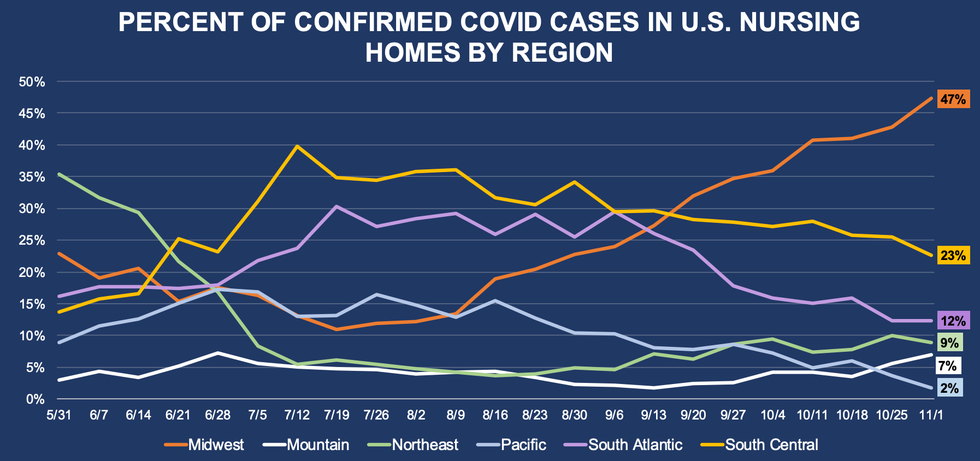
After seven weeks of declining cases in nursing homes through mid-September, nursing home cases began to increase as nearly all 50 states have started to see rising levels of COVID cases. New weekly cases in nursing homes grew by 73 percent nationwide between mid-September and the week of November 1.
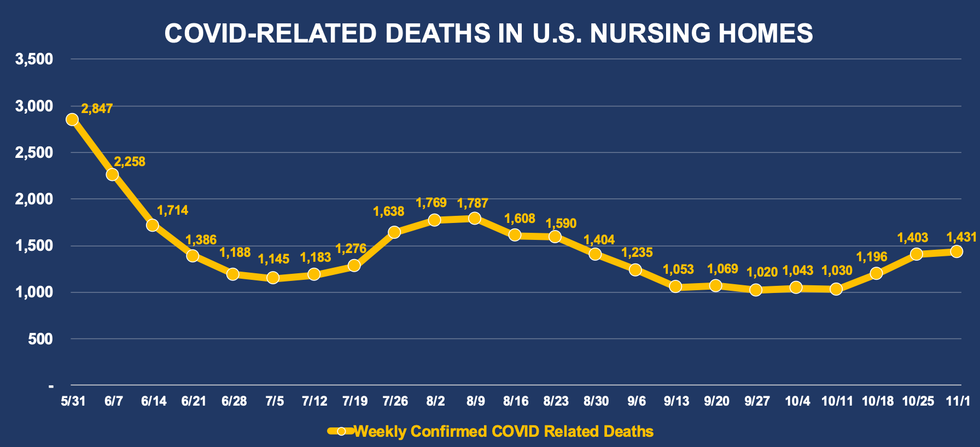
The report also showed COVID-related deaths in nursing homes have risen slightly. Nursing home residents are typically older adults with multiple chronic conditions, making them most vulnerable to COVID-19. Residents of long term care facilities account for only eight percent of the nation's cases, yet 40 percent of its deaths. While mortality rates have decreased compared to the spring due to a better understanding of the virus, better treatments, and government resources to help reduce spread, industry leaders remain deeply concerned that the rising number of new COVID cases in facilities will ultimately lead to an increasing number of deaths.
"We are especially concerned that this situation will only get worse with Thanksgiving just around the corner," continued Parkinson. "The public must realize that their actions not only endanger our nation's most vulnerable, but also trigger government lockdowns of facilities, keeping these residents from their loved ones. This is detrimental to their health, wellbeing and happiness. We urge everyone to do their part to slow the spread immediately and exercise caution when celebrating Thanksgiving."
With rising new COVID cases across the country, Parkinson said Congress must prioritize frontline health care workers and long term care residents during the lame duck session. This week AHCA/NCAL released a list of actions that Congress should urgently take to help nursing homes and assisted living communities respond to the uptick in new cases.
Most of the $175 billion Provider Relief Fund provided by the CARES Act back in April has already been distributed and Parkinson said health care providers, including long term care facilities, will need additional funds to continue the response to the COVID pandemic heading into the cold and flu season. The financial aid is crucial in helping long term care facilities acquire personal protective equipment, conduct regular testing, and hire additional staff or reward current caregivers for their heroic efforts.
"Congress must fulfill its duty," stated Parkinson. "Without adequate funding and resources, the U.S. is repeating the same mistakes made during the initial outbreak last spring and the major spike over the summer. We need Congress to prioritize our vulnerable seniors and their caregivers in long term care facilities, by passing another COVID relief package during the lame duck session on Congress."
For more information, please visit www.ahcancal.org/coronavirus.
"The United States must use the leverage we have—tens of billions in arms and military aid—to demand that Israel ends these atrocities," said Sen. Bernie Sanders.
US Sen. Bernie Sanders plans to force votes Wednesday on a pair of resolutions that, if enacted, would block the sale of roughly half a billion dollars of weaponry to the Israeli government, citing its bombardment and invasion of Lebanon, continued assault on the Gaza Strip, and accelerating annexation of the West Bank.
In a statement previewing the Senate votes, Sanders (I-Vt.) said that "US taxpayers have spent tens of billions of dollars in support of the racist, extremist Netanyahu government. Enough is enough."
"The United States must use the leverage we have—tens of billions in arms and military aid—to demand that Israel ends these atrocities," the senator continued.
Sanders' two resolutions would bar the sale of over $150 million worth of 1,000-pound gravity bombs and related support services, as well as the sale of nearly $300 million of Caterpillar bulldozers, which Israel uses to demolish homes in the illegally occupied Palestinian territories, Lebanon, and Syria.
"The arms sales in question violate the criteria laid out in the Foreign Assistance Act and the Arms Export Control Act," Sanders' office said Tuesday. "Secretary [of State] Marco Rubio signed an emergency determination just six days into the war with Iran in an attempt to bypass the statutory congressional notification period and immediately transfer these weapons."
The resolutions face long odds in the Republican-controlled US Senate. But last year, a majority of the Senate Democratic caucus backed Sanders-led resolutions aimed at blocking earlier Trump administration sales of 1,000-pound bombs, assault rifles, and other military equipment to Israel.
"Polls show that over 70% of Democratic voters want to halt arms sales to Israel," noted Dylan Williams, vice president for government affairs at the Center for International Policy. "Lawmakers should not be in positions of party leadership—or hope to be its presidential nominee—if they vote against their base to give Israel the bombs and bulldozers it uses to commit war crimes."
Elizabeth Rghebi, Middle East-North Africa advocacy director at Amnesty International USA, urged Americans to call their senators at 202-224-3121 and demand that they support the new Sanders resolutions.
"Amnesty International has documented a clear and ongoing pattern by Israeli forces committing serious violations of international law, including war crimes, genocide, and apartheid," Rghebi wrote Tuesday. "This includes evidence that Israeli forces have repeatedly carried out war crimes in Lebanon and Iran and the crime of genocide against Palestinians in the occupied Gaza Strip. Amnesty has also been able to identify the use of US-origin weapons, including a 1,000-pound bomb, in the occupied Gaza Strip."
"All senators must take urgent action to ensure that the U.S. immediately suspends the supply, sale, or transfer to Israel of all weapons, munitions, and other military and security equipment, including the provision of training and other military and security assistance," Rghebi added. "Supporting measures such as the Joint Resolutions of Disapproval is essential to stopping genocide and ensuring that the U.S. is not providing arms and equipment to Israel that can be used to carry out war crimes and genocide."
Sanders' resolutions have also received support from the pro-Israel liberal advocacy group J Street, which said in a policy memo earlier this week that "the United States should phase out direct financial support for arms sales to Israel and treat Israel as it does other wealthy US allies" rather than giving the country "unquestioning, blank-check support."
In a social media post endorsing Sanders' resolutions, J Street wrote that "at a moment of fragile ceasefires and continued violence across the region, approving these transfers would be seen as an American endorsement of the US and Israeli war with Iran and Israeli actions in Lebanon, Gaza, and the West Bank."
"The weapons transfers being voted on include 1,000-pound bombs and D-9 bulldozers, which have been used by the Israeli government in ways that raise serious legal and moral concerns," the group wrote. "Congress has a clear responsibility to ensure that US-supplied weapons are not contributing to civilian suffering or undermining the chances for diplomacy, de-escalation, and peace."
Governments gathering for International Monetary Fund and World Bank meetings "have a clear responsibility," said a 350.org leader. "End this illegal war, stop the flow of destruction, and make the profiteers pay."
As the Spring Meetings of the International Monetary Fund and World Bank Group were held in Washington, DC during a two-week ceasefire between the United States, Israel, and Iran, over 130 civil society groups this week urged global governments to "secure a permanent end to the wars in South West Asia and break the chains of fossil fuel dependence."
The joint statement was coordinated by Fight Inequality Alliance and 350.org, which has been advocating for a windfall profits tax on oil and gas giants since the US and Israel launched their illegal war on Iran in late February, and the Iranian government responded by restricting traffic through the Strait of Hormuz, which sent fossil fuel prices soaring worldwide.
"While people struggle to afford food, fuel, and basic necessities, fossil fuel companies are profiting massively from the chaos. The IMF itself has warned of the risk of a global recession," said 350.org managing director Savio Carvalho in a statement.
"Governments gathering in Washington have a clear responsibility: End this illegal war, stop the flow of destruction, and make the profiteers pay," Carvalho argued. "Taxing windfall oil and gas profits could provide immediate relief to families and invest in the clean, affordable energy systems we urgently need. They profit, we pay. It's time to fix it now: no bombs, no barrels."
A permanent end to the war—which has killed people across the region—is the first demand of the open letter. The second is a windfall profits tax on fossil fuel giants, with the revenue being used "to guarantee public services, and provide immediate support to families and precarious workers hit hardest by soaring food and fuel prices."
Martha Tukahirwa, Fight Inequality Alliance's Africa coordinator, explained that "while thousands are killed in the war in Iran, millions of people across Africa are being crushed by soaring fuel prices that have made even the simplest meal unaffordable. In Nigeria, diesel has surged over 60%. In Malawi, the poorest households are forced to choose between cooking and eating."
"In Zimbabwe, the cost of public transport has soared, making it impossible for working people to earn a living," Tukahirwa continued. "This is no accident—fossil fuel companies and commodity traders are reaping massive profits from this crisis while our governments stand idle. Tax these obscene profits and redirect the money to shield our people from hunger and hardship. The time for half measures is over, the time for bold action is now."
The letter's third demand is to "make food and energy secure for all." The war has impacted the availability of not only fuel but also fertilizer. The coalition called on governments to "invest public money in sustainable local farming and homegrown renewable energy, and stop harmful handouts to weapons, fossil fuels, and fossil fertilizer."
The groups—which also include ActionAid International, Corporate Europe Observatory, Council of Canadians, Friends of the Earth International, GreenFaith, Greenpeace Japan, Make Polluters Pay, Oxfam in the Pacific, War on Want, and more—called for urgently rolling out "renewable energy solutions for farms, homes, schools, and clinics to protect them from this and future energy crises."
Rev. Fletcher Harper, executive director of GreenFaith, said that "our faiths call us to make peace with people and the planet alike, and to hold the powerful to account. Letting fossil fuel giants pocket windfalls while families struggle is a moral failure. Taxing windfall profits to provide energy relief is not radical. It is basic justice."
The fourth and final demand is to cancel debt payments for Global South countries, and agree to fairer debt rules. The coalition stressed that "after paying interest to Wall Street lenders, bankers, and rich governments, many Global South countries have no money left over to protect their people from this crisis."
As part of the debt demand, the coalition also urged governments to "support informal workers, farm laborers, women, and older people, and guarantee universal access to healthcare, education, and public transport."
David Archer, head of programs and Influencing at ActionAid, pointed to civil society's push for a United Nations treaty for restructuring sovereign debt.
"Billions of people across the Global South are living in countries already facing a debt crisis. This war will make their lives even harder, leading to rising prices and rising interest rates," Archer said. "We need urgent action to cancel debt and to take the power over debt away from the IMF and rich countries—through developing a UN Framework Convention on Sovereign Debt."
"Great credit to the people and state legislators of Maine for being at the forefront of a large and swelling national movement to put a halt to the reckless, unchecked explosive growth of hyperscale AI data centers."
Democratic Maine Gov. Janet Mills is facing pressure to sign what would be the nation's first statewide moratorium on artificial intelligence data centers after state legislators passed the bill on Tuesday.
The Maine House of Representatives approved the bill 79-62, and then the state Senate sent it to Mills' desk with a 21-13 vote.
"The bill, LD 307, would create a limitation on data centers with electric loads of at least 20 megawatts by preventing the state, local governments, and quasi-governmental agencies from issuing permits or other approvals until November 2027," according to the Portland Press Herald. "In the meantime, a new Data Center Coordination Council—also created in the bill—would get time to study the centers' potential impact in Maine and issue policy recommendations."
In addition to calling for a national moratorium on constructing new AI data centers, the advocacy group Food & Water Watch (FWW) has fought for related proposals in not only Maine but also California, Michigan, New Jersey, New York, Ohio, and Pennsylvania.
"Great credit to the people and state legislators of Maine for being at the forefront of a large and swelling national movement to put a halt to the reckless, unchecked explosive growth of hyperscale AI data centers," Mitch Jones, FWW's managing director of policy and litigation, said in a Tuesday statement.
"These massive facilities suck up unimaginable amounts of water and electricity, and wreak havoc on the everyday Americans in nearby communities that are forced to foot the bills for this irresponsible, profit-hungry industry," Jones stressed. "Gov. Mills should listen to the people and legislators of Maine, and sign this smart, nation-leading bill into law immediately."
However, as Maine Public detailed on Monday:
Mills has said the measure needs to have an exemption for a proposed $550 million project at the former Androscoggin paper mill in Jay to get her support.
"The people of Jay need those jobs, with appropriate guardrails on preserving water resources, electricity resources, local generation and all those things," Mills told reporters during an event in Bangor last week.
Mills' office did not respond to an email Monday asking if the governor intends to veto the bill.
After the votes on Tuesday, The Washington Post similarly noted that legislators had rejected an amendment for the exception sought by Mills, and a spokesperson for the governor "did not immediately respond to a query about whether she plans to approve the legislation."
Mills is locked in an intense US Senate primary race with combat veteran and oyster farmer Graham Platner, who has been leading her in various polls. While the governor has released attack advertisements targeting her opponent, Platner has largely focused on his platform—which prioritizes the needs of the working class—and Sen. Susan Collins, the Republican trying to keep her seat in November.