SUBSCRIBE TO OUR FREE NEWSLETTER
Daily news & progressive opinion—funded by the people, not the corporations—delivered straight to your inbox.
5
#000000
#FFFFFF
To donate by check, phone, or other method, see our More Ways to Give page.
Daily news & progressive opinion—funded by the people, not the corporations—delivered straight to your inbox.
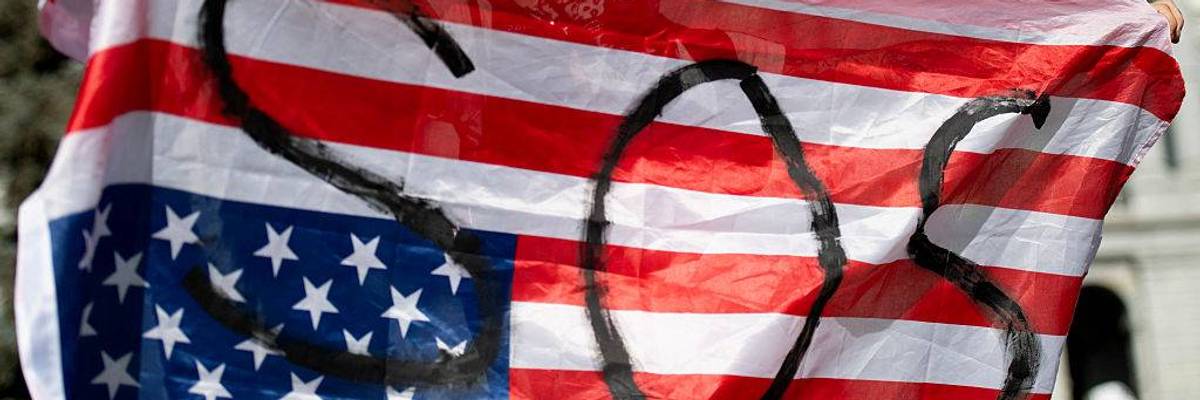
A demonstrator holds an upside-down US flag with the S.O.S. message while protesting the Trump administration during the "No Kings" national rally in Denver, Colorado on June 14, 2025.
"Americans are drowning under rising costs, flat wages, high unemployment, and historic layoffs—it’s no wonder they’re concerned about how they’re going to make ends meet."
Two recently released surveys revealed a significant drop in Americans' self-reported wellbeing as the Trump administration launches illegal and deadly military conflicts and plunges the global economy into chaos.
On Friday, the University of Michigan issued its monthly Survey of Consumers, which showed that consumer sentiment in the US hit an all-time low after dropping by 11% since March, amid President Donald Trump's war of choice in Iran.
The drop in consumer sentiment was almost universal, the survey found, as "demographic groups across age, income, and political party all posted setbacks in sentiment, as did every component of the index, reflecting the widespread nature of this month’s fall."
As for the reasons for the decline, the survey found "many consumers blame the Iran conflict for unfavorable changes to the economy," such as a major spike in gas prices, which the US Bureau of Labor Statistics reported on Friday increased by more than 20% in the month since the war began.
Heather Long, chief economist at Navy Federal Credit Union, noted that the latest consumer sentiment data showed Americans are even more sour on the economy now than they were in the summer of 2022, when the economy was dealing with the highest inflation it had seen in decades.
Kendall Witmer, rapid response director of the Democratic National Committee, seized on the consumer sentiment report and accused Trump of having "tanked the economy for working families."
"Americans are drowning under rising costs, flat wages, high unemployment, and historic layoffs," Witmer added. "It's no wonder they're concerned about how they’re going to make ends meet and Trump and [Vice President] JD Vance can’t be bothered to make life more affordable for them."
The record low in consumer sentiment comes just weeks after Gallup released its annual World Happiness Report, which showed that the US had fallen out of its rankings of the 20 happiest countries in the world.
The report says the decrease in US happiness largely came from "lower life evaluations among young adults," and points the finger at high social media use as a key factor in making young people miserable.
Specifically, the report finds "there is now overwhelming evidence of severe and widespread direct harms (such as sextortion and cyberbullying), and compelling evidence of troubling indirect harms (such as depression and anxiety)" from social media use, adding that "the harms and risks to individual users are so diverse and vast in scope that they justify the view that social media is causing harm at a population level."
Social media's impact on mental health has come into focus in recent weeks with juries in multiple states finding Big Tech companies liable for creating products that harm children.
In March, a New Mexico jury found social media giant Meta liable for harming children's mental health and safety, ordering the company to pay $375 million. A day later, a Los Angeles jury ordered Meta and Google to each pay $3 million in civil damages to a now-20-year-old woman who alleged harm and suffering caused by their products when she was an adolescent.
Journalist Derek Thompson took stock of the Gallup survey and the University of Michigan survey, as well as last year's General Social Survey that also documented a decline in US happiness, and declared, "America is not OK."
Dear Common Dreams reader, It’s been nearly 30 years since I co-founded Common Dreams with my late wife, Lina Newhouser. We had the radical notion that journalism should serve the public good, not corporate profits. It was clear to us from the outset what it would take to build such a project. No paid advertisements. No corporate sponsors. No millionaire publisher telling us what to think or do. Many people said we wouldn't last a year, but we proved those doubters wrong. Together with a tremendous team of journalists and dedicated staff, we built an independent media outlet free from the constraints of profits and corporate control. Our mission has always been simple: To inform. To inspire. To ignite change for the common good. Building Common Dreams was not easy. Our survival was never guaranteed. When you take on the most powerful forces—Wall Street greed, fossil fuel industry destruction, Big Tech lobbyists, and uber-rich oligarchs who have spent billions upon billions rigging the economy and democracy in their favor—the only bulwark you have is supporters who believe in your work. But here’s the urgent message from me today. It's never been this bad out there. And it's never been this hard to keep us going. At the very moment Common Dreams is most needed, the threats we face are intensifying. We need your support now more than ever. We don't accept corporate advertising and never will. We don't have a paywall because we don't think people should be blocked from critical news based on their ability to pay. Everything we do is funded by the donations of readers like you. When everyone does the little they can afford, we are strong. But if that support retreats or dries up, so do we. Will you donate now to make sure Common Dreams not only survives but thrives? —Craig Brown, Co-founder |
Two recently released surveys revealed a significant drop in Americans' self-reported wellbeing as the Trump administration launches illegal and deadly military conflicts and plunges the global economy into chaos.
On Friday, the University of Michigan issued its monthly Survey of Consumers, which showed that consumer sentiment in the US hit an all-time low after dropping by 11% since March, amid President Donald Trump's war of choice in Iran.
The drop in consumer sentiment was almost universal, the survey found, as "demographic groups across age, income, and political party all posted setbacks in sentiment, as did every component of the index, reflecting the widespread nature of this month’s fall."
As for the reasons for the decline, the survey found "many consumers blame the Iran conflict for unfavorable changes to the economy," such as a major spike in gas prices, which the US Bureau of Labor Statistics reported on Friday increased by more than 20% in the month since the war began.
Heather Long, chief economist at Navy Federal Credit Union, noted that the latest consumer sentiment data showed Americans are even more sour on the economy now than they were in the summer of 2022, when the economy was dealing with the highest inflation it had seen in decades.
Kendall Witmer, rapid response director of the Democratic National Committee, seized on the consumer sentiment report and accused Trump of having "tanked the economy for working families."
"Americans are drowning under rising costs, flat wages, high unemployment, and historic layoffs," Witmer added. "It's no wonder they're concerned about how they’re going to make ends meet and Trump and [Vice President] JD Vance can’t be bothered to make life more affordable for them."
The record low in consumer sentiment comes just weeks after Gallup released its annual World Happiness Report, which showed that the US had fallen out of its rankings of the 20 happiest countries in the world.
The report says the decrease in US happiness largely came from "lower life evaluations among young adults," and points the finger at high social media use as a key factor in making young people miserable.
Specifically, the report finds "there is now overwhelming evidence of severe and widespread direct harms (such as sextortion and cyberbullying), and compelling evidence of troubling indirect harms (such as depression and anxiety)" from social media use, adding that "the harms and risks to individual users are so diverse and vast in scope that they justify the view that social media is causing harm at a population level."
Social media's impact on mental health has come into focus in recent weeks with juries in multiple states finding Big Tech companies liable for creating products that harm children.
In March, a New Mexico jury found social media giant Meta liable for harming children's mental health and safety, ordering the company to pay $375 million. A day later, a Los Angeles jury ordered Meta and Google to each pay $3 million in civil damages to a now-20-year-old woman who alleged harm and suffering caused by their products when she was an adolescent.
Journalist Derek Thompson took stock of the Gallup survey and the University of Michigan survey, as well as last year's General Social Survey that also documented a decline in US happiness, and declared, "America is not OK."
Two recently released surveys revealed a significant drop in Americans' self-reported wellbeing as the Trump administration launches illegal and deadly military conflicts and plunges the global economy into chaos.
On Friday, the University of Michigan issued its monthly Survey of Consumers, which showed that consumer sentiment in the US hit an all-time low after dropping by 11% since March, amid President Donald Trump's war of choice in Iran.
The drop in consumer sentiment was almost universal, the survey found, as "demographic groups across age, income, and political party all posted setbacks in sentiment, as did every component of the index, reflecting the widespread nature of this month’s fall."
As for the reasons for the decline, the survey found "many consumers blame the Iran conflict for unfavorable changes to the economy," such as a major spike in gas prices, which the US Bureau of Labor Statistics reported on Friday increased by more than 20% in the month since the war began.
Heather Long, chief economist at Navy Federal Credit Union, noted that the latest consumer sentiment data showed Americans are even more sour on the economy now than they were in the summer of 2022, when the economy was dealing with the highest inflation it had seen in decades.
Kendall Witmer, rapid response director of the Democratic National Committee, seized on the consumer sentiment report and accused Trump of having "tanked the economy for working families."
"Americans are drowning under rising costs, flat wages, high unemployment, and historic layoffs," Witmer added. "It's no wonder they're concerned about how they’re going to make ends meet and Trump and [Vice President] JD Vance can’t be bothered to make life more affordable for them."
The record low in consumer sentiment comes just weeks after Gallup released its annual World Happiness Report, which showed that the US had fallen out of its rankings of the 20 happiest countries in the world.
The report says the decrease in US happiness largely came from "lower life evaluations among young adults," and points the finger at high social media use as a key factor in making young people miserable.
Specifically, the report finds "there is now overwhelming evidence of severe and widespread direct harms (such as sextortion and cyberbullying), and compelling evidence of troubling indirect harms (such as depression and anxiety)" from social media use, adding that "the harms and risks to individual users are so diverse and vast in scope that they justify the view that social media is causing harm at a population level."
Social media's impact on mental health has come into focus in recent weeks with juries in multiple states finding Big Tech companies liable for creating products that harm children.
In March, a New Mexico jury found social media giant Meta liable for harming children's mental health and safety, ordering the company to pay $375 million. A day later, a Los Angeles jury ordered Meta and Google to each pay $3 million in civil damages to a now-20-year-old woman who alleged harm and suffering caused by their products when she was an adolescent.
Journalist Derek Thompson took stock of the Gallup survey and the University of Michigan survey, as well as last year's General Social Survey that also documented a decline in US happiness, and declared, "America is not OK."