SUBSCRIBE TO OUR FREE NEWSLETTER
Daily news & progressive opinion—funded by the people, not the corporations—delivered straight to your inbox.
5
#000000
#FFFFFF
To donate by check, phone, or other method, see our More Ways to Give page.
Daily news & progressive opinion—funded by the people, not the corporations—delivered straight to your inbox.
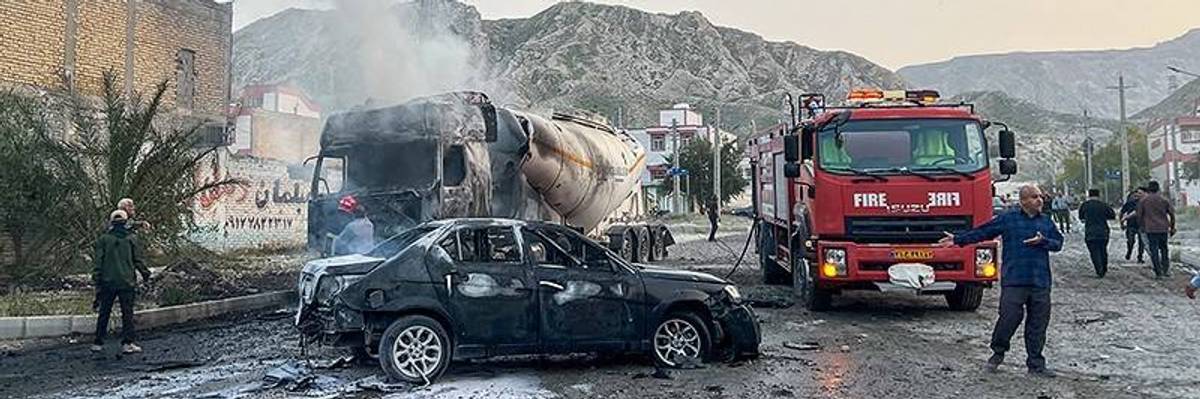
Fire and other emergency workers are seen at the site of a February 28, 2026 US missile strike on a residential area of Lamerd, Iran.
Munitions experts and The New York Times say a US missile designed to inflict maximum casualties was used in a February bombing that killed 21 people, including at least five children.
New information published Friday by the New York Times further suggests that the US military may have lied when it tried to pin the blame for a February airstrike that killed 21 people in Iran on the Iranian government, with evidence indicating that the US carried out the attack with a new missile designed to inflict maximum casualties.
While much of the world knows about the February 28 massacre of around 175 children and staff at the Shajareh Tayyebeh girls’ elementary school in Minab—and about how President Donald Trump initially blamed Iran for the slaughter—the strike that hit a sports hall and playground in Lamerd on the same day, the first day of the war, received far less media coverage.
Munitions experts and the Times concluded that US-made Precision Strike Missiles, or PrSMs—pronounced "prism"—struck the residential area of the southern Iranian city. Developed by Lockheed Martin, PrSMs are airburst weapons, exploding above their targets and blasting 180,000 lethal tungsten pellets in every direction. Video footage of the Lamerd strike shows multiple airbursts.
Pete Hegseth's Defense Dept appears to be caught in a lie.It involves deaths of 21 people (including at least 5 children), injuring 110 in Lamerd, Iran with sports hall and school.By a U.S. missile (PrSM) never before used in combat.NYT sources include: 3 US officials!1/
[image or embed]
— Ryan Goodman (@rgoodlaw.bsky.social) April 10, 2026 at 5:48 PM
The Times verified the identities of 21 people killed in the strike. At least five victims were children, the youngest of them just 2 years old. Helma Ahmadizadeh, 10, and Elham Zaeri, 11, were attending volleyball practice at the sports hall when it was bombed. Helma survived the strike with no visible injuries. However, she told her coach that she felt something enter her body. A medical examination at a local hospital revealed a small object in her body. She subsequently died.
"A young boy, Ilia Khatami, was killed alongside his coach, Mahmoud Najaf," the newspaper said. "The Times confirmed their deaths, and the death of a second boy, Abdul Mosavar Rahmani, who was from Afghanistan."
The 2-year-old, Avina Barzegar, was mortally wounded by a small object while she was playing outside her home. Video posted on Telegram shows her being treated in a local hospital before she died.
Local officials said 100 other people were injured in the attack.
Pentagon officials previously denied US responsibility for the attack following the March 29 publication of a Times investigation that used video analysis to identify PrSMs as the missiles used in the strike. US Central Command (CENTCOM) spokesperson Capt. Tim Hawkins issued a statement on March 31 calling reports that the US carried out the attack "false" and suggesting that weapon used in the strike was an Iranian Hoveyzeh cruise missile.
The Times' latest analysis is "based on new video footage of detonations, new photo evidence of the damage, a missile-trajectory assessment, and the perspectives of multiple experts, including three US government officials."
Findings include distinctive damage patterns consistent with tungsten pellet dispersion from a PrSM airburst, the discovery of a third detonation site consistent with a PrSM, a strike trajectory indicating the missile was launched from where US forces are based, and the sports hall's proximity to an Islamic Revolutionary Guards Corps base. The Minab girls' school is also located very close to an IRGC base.
Critically, Iran does not have any missiles in its arsenal that function in a similar manner to PrSMs.
“The problem is that CENTCOM chose as an alternative a very identifiable missile,” Amaël Kotlarski, who leads the weapons team at the defense intelligence firm Janes, told the Times. "And the Hoveyzeh’s distinct features aren’t seen in the video."
Shahryar Pasandideh, another military analyst consulted by the Times, said "there is no public information to suggest that Iranian cruise missiles, including the Hoveyzeh, are equipped with an airburst fuse, let alone an airburst fuse and pre-formed tungsten pellets."
After the Minab massacre, Trump claimed that Iran had somehow acquired a US Tomahawk missile and used it to blow up the school.
An earlier investigation by the BBC Verify also concluded that the Lamerd strike was carried out using US PrSM missiles.
VIDEO | According to a report from BBC Verify, video evidence and expert assessment suggest a US Precision Strike Missile (PrSM) was likely involved in an attack on a sports hall in Lamerd, southwestern Iran on 28 February. The attack killed at least 21 people, including… pic.twitter.com/alZ25dVMl6
— The Cradle (@TheCradleMedia) March 29, 2026
More than 3,000 people have been killed over 42 days of US and Israeli strikes on Iran, according to medical officials there. This figure reportedly includes over 1,300 civilians, hundreds of whom are women and children.
Dear Common Dreams reader, It’s been nearly 30 years since I co-founded Common Dreams with my late wife, Lina Newhouser. We had the radical notion that journalism should serve the public good, not corporate profits. It was clear to us from the outset what it would take to build such a project. No paid advertisements. No corporate sponsors. No millionaire publisher telling us what to think or do. Many people said we wouldn't last a year, but we proved those doubters wrong. Together with a tremendous team of journalists and dedicated staff, we built an independent media outlet free from the constraints of profits and corporate control. Our mission has always been simple: To inform. To inspire. To ignite change for the common good. Building Common Dreams was not easy. Our survival was never guaranteed. When you take on the most powerful forces—Wall Street greed, fossil fuel industry destruction, Big Tech lobbyists, and uber-rich oligarchs who have spent billions upon billions rigging the economy and democracy in their favor—the only bulwark you have is supporters who believe in your work. But here’s the urgent message from me today. It's never been this bad out there. And it's never been this hard to keep us going. At the very moment Common Dreams is most needed, the threats we face are intensifying. We need your support now more than ever. We don't accept corporate advertising and never will. We don't have a paywall because we don't think people should be blocked from critical news based on their ability to pay. Everything we do is funded by the donations of readers like you. When everyone does the little they can afford, we are strong. But if that support retreats or dries up, so do we. Will you donate now to make sure Common Dreams not only survives but thrives? —Craig Brown, Co-founder |
New information published Friday by the New York Times further suggests that the US military may have lied when it tried to pin the blame for a February airstrike that killed 21 people in Iran on the Iranian government, with evidence indicating that the US carried out the attack with a new missile designed to inflict maximum casualties.
While much of the world knows about the February 28 massacre of around 175 children and staff at the Shajareh Tayyebeh girls’ elementary school in Minab—and about how President Donald Trump initially blamed Iran for the slaughter—the strike that hit a sports hall and playground in Lamerd on the same day, the first day of the war, received far less media coverage.
Munitions experts and the Times concluded that US-made Precision Strike Missiles, or PrSMs—pronounced "prism"—struck the residential area of the southern Iranian city. Developed by Lockheed Martin, PrSMs are airburst weapons, exploding above their targets and blasting 180,000 lethal tungsten pellets in every direction. Video footage of the Lamerd strike shows multiple airbursts.
Pete Hegseth's Defense Dept appears to be caught in a lie.It involves deaths of 21 people (including at least 5 children), injuring 110 in Lamerd, Iran with sports hall and school.By a U.S. missile (PrSM) never before used in combat.NYT sources include: 3 US officials!1/
[image or embed]
— Ryan Goodman (@rgoodlaw.bsky.social) April 10, 2026 at 5:48 PM
The Times verified the identities of 21 people killed in the strike. At least five victims were children, the youngest of them just 2 years old. Helma Ahmadizadeh, 10, and Elham Zaeri, 11, were attending volleyball practice at the sports hall when it was bombed. Helma survived the strike with no visible injuries. However, she told her coach that she felt something enter her body. A medical examination at a local hospital revealed a small object in her body. She subsequently died.
"A young boy, Ilia Khatami, was killed alongside his coach, Mahmoud Najaf," the newspaper said. "The Times confirmed their deaths, and the death of a second boy, Abdul Mosavar Rahmani, who was from Afghanistan."
The 2-year-old, Avina Barzegar, was mortally wounded by a small object while she was playing outside her home. Video posted on Telegram shows her being treated in a local hospital before she died.
Local officials said 100 other people were injured in the attack.
Pentagon officials previously denied US responsibility for the attack following the March 29 publication of a Times investigation that used video analysis to identify PrSMs as the missiles used in the strike. US Central Command (CENTCOM) spokesperson Capt. Tim Hawkins issued a statement on March 31 calling reports that the US carried out the attack "false" and suggesting that weapon used in the strike was an Iranian Hoveyzeh cruise missile.
The Times' latest analysis is "based on new video footage of detonations, new photo evidence of the damage, a missile-trajectory assessment, and the perspectives of multiple experts, including three US government officials."
Findings include distinctive damage patterns consistent with tungsten pellet dispersion from a PrSM airburst, the discovery of a third detonation site consistent with a PrSM, a strike trajectory indicating the missile was launched from where US forces are based, and the sports hall's proximity to an Islamic Revolutionary Guards Corps base. The Minab girls' school is also located very close to an IRGC base.
Critically, Iran does not have any missiles in its arsenal that function in a similar manner to PrSMs.
“The problem is that CENTCOM chose as an alternative a very identifiable missile,” Amaël Kotlarski, who leads the weapons team at the defense intelligence firm Janes, told the Times. "And the Hoveyzeh’s distinct features aren’t seen in the video."
Shahryar Pasandideh, another military analyst consulted by the Times, said "there is no public information to suggest that Iranian cruise missiles, including the Hoveyzeh, are equipped with an airburst fuse, let alone an airburst fuse and pre-formed tungsten pellets."
After the Minab massacre, Trump claimed that Iran had somehow acquired a US Tomahawk missile and used it to blow up the school.
An earlier investigation by the BBC Verify also concluded that the Lamerd strike was carried out using US PrSM missiles.
VIDEO | According to a report from BBC Verify, video evidence and expert assessment suggest a US Precision Strike Missile (PrSM) was likely involved in an attack on a sports hall in Lamerd, southwestern Iran on 28 February. The attack killed at least 21 people, including… pic.twitter.com/alZ25dVMl6
— The Cradle (@TheCradleMedia) March 29, 2026
More than 3,000 people have been killed over 42 days of US and Israeli strikes on Iran, according to medical officials there. This figure reportedly includes over 1,300 civilians, hundreds of whom are women and children.
New information published Friday by the New York Times further suggests that the US military may have lied when it tried to pin the blame for a February airstrike that killed 21 people in Iran on the Iranian government, with evidence indicating that the US carried out the attack with a new missile designed to inflict maximum casualties.
While much of the world knows about the February 28 massacre of around 175 children and staff at the Shajareh Tayyebeh girls’ elementary school in Minab—and about how President Donald Trump initially blamed Iran for the slaughter—the strike that hit a sports hall and playground in Lamerd on the same day, the first day of the war, received far less media coverage.
Munitions experts and the Times concluded that US-made Precision Strike Missiles, or PrSMs—pronounced "prism"—struck the residential area of the southern Iranian city. Developed by Lockheed Martin, PrSMs are airburst weapons, exploding above their targets and blasting 180,000 lethal tungsten pellets in every direction. Video footage of the Lamerd strike shows multiple airbursts.
Pete Hegseth's Defense Dept appears to be caught in a lie.It involves deaths of 21 people (including at least 5 children), injuring 110 in Lamerd, Iran with sports hall and school.By a U.S. missile (PrSM) never before used in combat.NYT sources include: 3 US officials!1/
[image or embed]
— Ryan Goodman (@rgoodlaw.bsky.social) April 10, 2026 at 5:48 PM
The Times verified the identities of 21 people killed in the strike. At least five victims were children, the youngest of them just 2 years old. Helma Ahmadizadeh, 10, and Elham Zaeri, 11, were attending volleyball practice at the sports hall when it was bombed. Helma survived the strike with no visible injuries. However, she told her coach that she felt something enter her body. A medical examination at a local hospital revealed a small object in her body. She subsequently died.
"A young boy, Ilia Khatami, was killed alongside his coach, Mahmoud Najaf," the newspaper said. "The Times confirmed their deaths, and the death of a second boy, Abdul Mosavar Rahmani, who was from Afghanistan."
The 2-year-old, Avina Barzegar, was mortally wounded by a small object while she was playing outside her home. Video posted on Telegram shows her being treated in a local hospital before she died.
Local officials said 100 other people were injured in the attack.
Pentagon officials previously denied US responsibility for the attack following the March 29 publication of a Times investigation that used video analysis to identify PrSMs as the missiles used in the strike. US Central Command (CENTCOM) spokesperson Capt. Tim Hawkins issued a statement on March 31 calling reports that the US carried out the attack "false" and suggesting that weapon used in the strike was an Iranian Hoveyzeh cruise missile.
The Times' latest analysis is "based on new video footage of detonations, new photo evidence of the damage, a missile-trajectory assessment, and the perspectives of multiple experts, including three US government officials."
Findings include distinctive damage patterns consistent with tungsten pellet dispersion from a PrSM airburst, the discovery of a third detonation site consistent with a PrSM, a strike trajectory indicating the missile was launched from where US forces are based, and the sports hall's proximity to an Islamic Revolutionary Guards Corps base. The Minab girls' school is also located very close to an IRGC base.
Critically, Iran does not have any missiles in its arsenal that function in a similar manner to PrSMs.
“The problem is that CENTCOM chose as an alternative a very identifiable missile,” Amaël Kotlarski, who leads the weapons team at the defense intelligence firm Janes, told the Times. "And the Hoveyzeh’s distinct features aren’t seen in the video."
Shahryar Pasandideh, another military analyst consulted by the Times, said "there is no public information to suggest that Iranian cruise missiles, including the Hoveyzeh, are equipped with an airburst fuse, let alone an airburst fuse and pre-formed tungsten pellets."
After the Minab massacre, Trump claimed that Iran had somehow acquired a US Tomahawk missile and used it to blow up the school.
An earlier investigation by the BBC Verify also concluded that the Lamerd strike was carried out using US PrSM missiles.
VIDEO | According to a report from BBC Verify, video evidence and expert assessment suggest a US Precision Strike Missile (PrSM) was likely involved in an attack on a sports hall in Lamerd, southwestern Iran on 28 February. The attack killed at least 21 people, including… pic.twitter.com/alZ25dVMl6
— The Cradle (@TheCradleMedia) March 29, 2026
More than 3,000 people have been killed over 42 days of US and Israeli strikes on Iran, according to medical officials there. This figure reportedly includes over 1,300 civilians, hundreds of whom are women and children.