

SUBSCRIBE TO OUR FREE NEWSLETTER
Daily news & progressive opinion—funded by the people, not the corporations—delivered straight to your inbox.
5
#000000
#FFFFFF
To donate by check, phone, or other method, see our More Ways to Give page.
Daily news & progressive opinion—funded by the people, not the corporations—delivered straight to your inbox.
Samantha Gordon
202-973-3032
NARAL Pro-Choice America and NARAL Pro-Choice America Foundation today released the 22nd edition of Who Decides? The Status of Women's Reproductive Rights in the United States, the nation's most comprehensive report on choice-related legislation. This report shows a mix of progress and setbacks for women's reproductive freedom across the country.
NARAL Pro-Choice America and NARAL Pro-Choice America Foundation today released the 22nd edition of Who Decides? The Status of Women's Reproductive Rights in the United States, the nation's most comprehensive report on choice-related legislation. This report shows a mix of progress and setbacks for women's reproductive freedom across the country.
Nancy Keenan, president of NARAL Pro-Choice America and NARAL Pro-Choice America Foundation, said that 2012 was a remarkable year for pro-choice Americans.
"In 2012, pro-choice voters and activists worked together to reject the extreme anti-choice tactics which are completely out of touch with our values and priorities," said Keenan. "Unfortunately, anti-choice politicians didn't get that memo. These politicians continue to put forth legislation to roll back a woman's constitutionally guaranteed right to choose. As we celebrate the 40th anniversary of the Supreme Court's Roe v. Wade decision, anti-choice politicians remind us that we must fight to defend our rights every day, in every state. Met with this challenge, we will continue to stick together and work to protect our right to reproductive freedom and privacy."
NARAL Pro-Choice America is proud to also release its 2012 Congressional Record on Choice, which details the choice-related votes Congress took in the second session of the 112th Congress. In 2012 the House continued to attack women's reproductive rights by unsuccessfully bringing two anti-choice bills to the floor for votes - a bill that would criminalize a doctor for the reasons a woman seeks abortion care, and another that singles out the District of Columbia for an outright ban on abortion care after 20 weeks. In total, the 112th Congress (2011-2012) took 14 votes on choice: 10 in the House of Representatives and four in the Senate. Thankfully, the pro-choice-controlled Senate and President Barack Obama served as firewalls and blocked many anti-choice measures from advancing, most notably defeating Sen. Roy Blunt's (R-MO) attempt to undermine the nation's new contraceptive-coverage policy.
At the state level, states continue to impose record numbers of anti-choice laws on women's reproductive freedom. Among the 42 anti-choice measures newly enacted in 2012, the most prominent trends were: bans on abortion care after 20 weeks; laws prohibiting abortion coverage in state health-insurance exchanges; and laws that defund family-planning centers.
Since 1995, states have enacted more than 700 anti-choice measures cumulatively. Each of these measures interferes with a woman's right to make her own private, personal decisions about her reproductive health. And state governments continue to be dominated by anti-choice politicians, which likely means the trend of legislative attacks on reproductive freedom will continue in the year ahead.
Keenan said the report outlines a similar combination of progress and setbacks at the state level, including the following highlights:
Anti-Choice Attacks:
Pro-Choice Progress:
Keenan also pointed out states like Arizona, Georgia, and Louisiana enacted bans on abortion care after 20 weeks that are clearly unconstitutional and designed as a challenge to Roe v. Wade. And states like Alabama, South Carolina, South Dakota, and Wisconsin enacted abortion-coverage bans in the states' health-insurance exchanges.
"This is why elections matter," Keenan continued. "Women continue to face legislative hostility in states dominated by anti-choice politicians. We may have won some battles but anti-choice politicians attack this right relentlessly - if we allow them. It is incumbent upon us to educate the public on these anti-choice tactics and hold these extreme politicians accountable."
Keenan also noted that this edition of the Who Decides? is dedicated to women of the Obama administration, whose courage, political savvy, and tenacity helped to improve the status of women. Among these leaders are: Hillary Rodham Clinton, secretary of state; Kathleen Sebelius, secretary of the Department of Health and Human Services; Valerie Jarrett, senior advisor to the president; Melody Barnes and Cecilia Munoz, directors of the domestic policy council; Tina Tchen, chief of staff to the first lady; and Nancy-Ann DeParle, deputy chief of staff for policy.
Who Decides?, which includes a summary of federal and state laws as well as state rankings and states, may be found at: www.WhoDecides.org. The Congressional Record on Choice, which includes a record of choice-related votes taken in the 112th Congress, may be found at: www.ProChoiceAmerica.org/CongressionalRecord.
For over 50 years, Reproductive Freedom for All (formerly NARAL Pro-Choice America) has fought to protect and advance reproductive freedom at the federal and state levels—including access to abortion care, birth control, pregnancy and post-partum care, and paid family leave—for everybody. Reproductive Freedom for All is powered by its more than 4 million members from every state and congressional district in the country, representing the 8 in 10 Americans who support legal abortion.
202.973.3000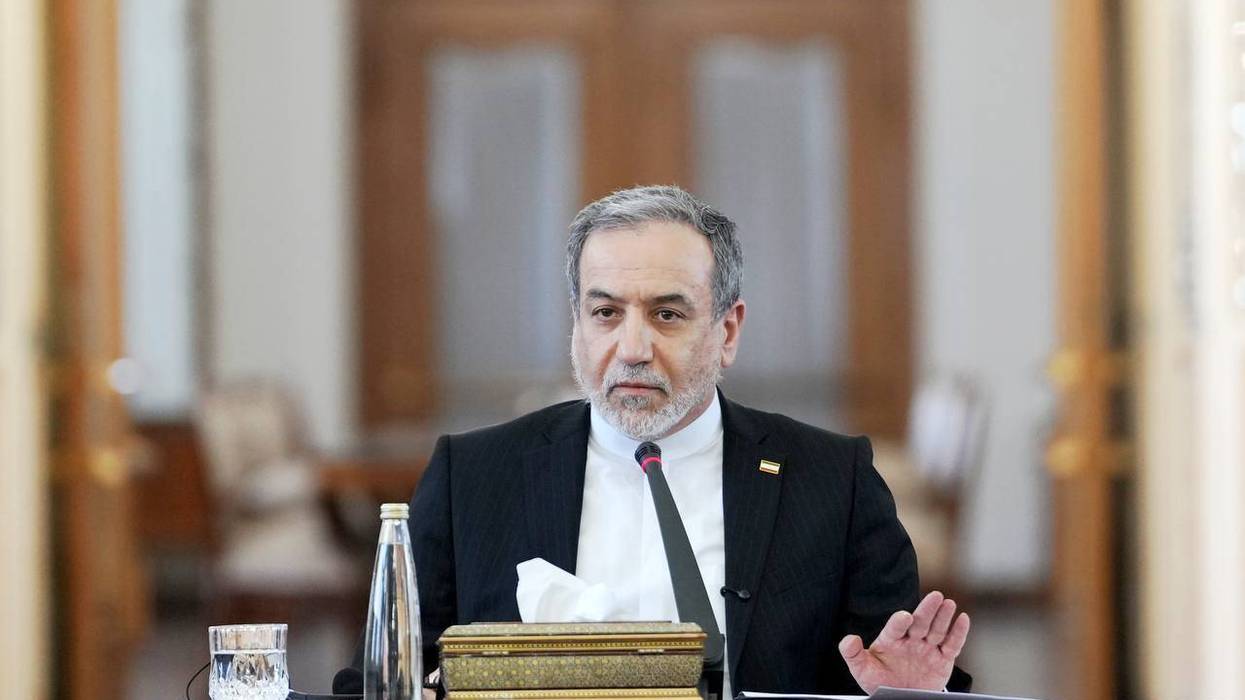
Trump now faces a choice: Ending the war or giving Israel what it wants.
President Donald Trump is facing a choice: Ending the war with Iran, which is tanking his popularity and the economy, or continuing his deference to Israel.
Iranian Foreign Minister Abbas Araghchi made it clear on Tuesday that he cannot have both.
Following assertions from Israeli leaders that it would not end its occupation of Lebanon, Araghchi reiterated that the memorandum of understanding signed virtually by the US and Iran required in no uncertain terms that "war will be ending everywhere, on all fronts, including Lebanon."
"Due to the relations between war in Lebanon and the aggression of Israel on south Lebanon and the war on Iran, these two fronts—Iran and Lebanon—are quite connected to each other," he said.
“End of the war will be the end of the occupation,” he continued. “And without retreating and withdrawing from the Lebanese occupied territories, then there will not be an end to the war.”
"So any military attack from the Zionist entity against Lebanon will never be accepted," he said. "The continuation of the Israeli occupation of the Lebanese territories is a violation of the memorandum of understanding."
It was a shot across the bow from Tehran following Israeli Prime Minister Benjamin Netanyahu’s assertion the day before that Israeli forces would remain in Lebanon "for as long as necessary” regardless of any US-Iran agreement.
“We established deep security zones around the state of Israel," he said, referring to the roughly 230 square mile occupation area where Israel has forcibly expelled more than 1 million Lebanese civilians and systematically demolished dozens of villages. "I want to make it clear: We will remain in these security zones… to protect our country.”
Other ministers were even blunter. Security Minister Itamar Ben-Gvir said flatly that “Trump’s agreement does not bind us. Israel is not subordinate to the United States. We are an independent and sovereign country.”
Defense Minister Israel Katz said the occupation would go on “without any time limit" while villages would continue to be “cleared of local residents.” He said there would be no withdrawal "despite all the existing pressures" from the US, adding that, "we are committed only to our citizens and to the security of the state of Israel."
Trump has regularly deferred to Israel's preferences and sided with Netanyahu as he's derailed previous ceasefire talks. But during a news conference at the Group of Seven summit in France on Tuesday, Trump took a noticeably different tone with his obstinate ally.
Trump: "Without me, there would be no Israel ... I've had a great relationship with Bibi, but now Bibi has to be more responsible with respect to Lebanon ... I'm not happy with the way Israel has handled themselves with Lebanon and Hezbollah." pic.twitter.com/xvLlEhYqWj
— Aaron Rupar (@atrupar) June 16, 2026
Trump criticizes Netanyahu and Israel: "Israel has been fighting Hezbollah too long and too many people are being killed. You don't need to knock down an apartment every time you're looking for somebody. I suggested to Israel to let Syria take care of Hezbollah, because too be… pic.twitter.com/NAmqoNkhpj
— Aaron Rupar (@atrupar) June 16, 2026
The president said he "didn't like" the attack Netanyahu launched against the southern suburbs of Beirut on Sunday, where Israeli forces bombed a five-story apartment building, killing three people. "I saw that attack. I saw where that bomb went," he said, describing the attack as "vicious" and "too much."
"You don't need to knock down an apartment every time you're looking for somebody," he said, making perhaps his most forceful criticism ever of Israel's rampant attacks on civilian infrastructure. He continued that "if Israel can't do the job without killing everyone else, Syria should do the job" of fighting Hezbollah.
"Without the United States, there would be no Israel," he went on. "Without me, there would be no Israel, because no other president was willing to do what I did."
Referring to Netanyahu, he said, "I've had a great relationship with Bibi, but now Bibi has to be more responsible with respect to Lebanon," adding that the ongoing invasion "throws a negative light on the big deal, and that's the deal with Iran."
Commentators noted this is hardly the first time a US president has vented their anger with Netanyahu, only for nothing to materially change.
Noting Trump's previous description of Netanyahu as a "very difficult guy" after he attempted to blow up ceasefire talks on Sunday, Kenneth Roth, the former executive director of Human Rights Watch, said, "The question is: why does Trump facilitate this obstruction by continuing to provide Israel with arms and military aid?"
Zeteo News editor Mehdi Hasan said: “Such is the madly erratic nature of Trump, that he can go from sounding like the most hawkish, pro-Israel president one day, to the most dovish, anti-Israel president the next day. Which is why listening to Trump is pointless; what matters is paying attention to what he does.”
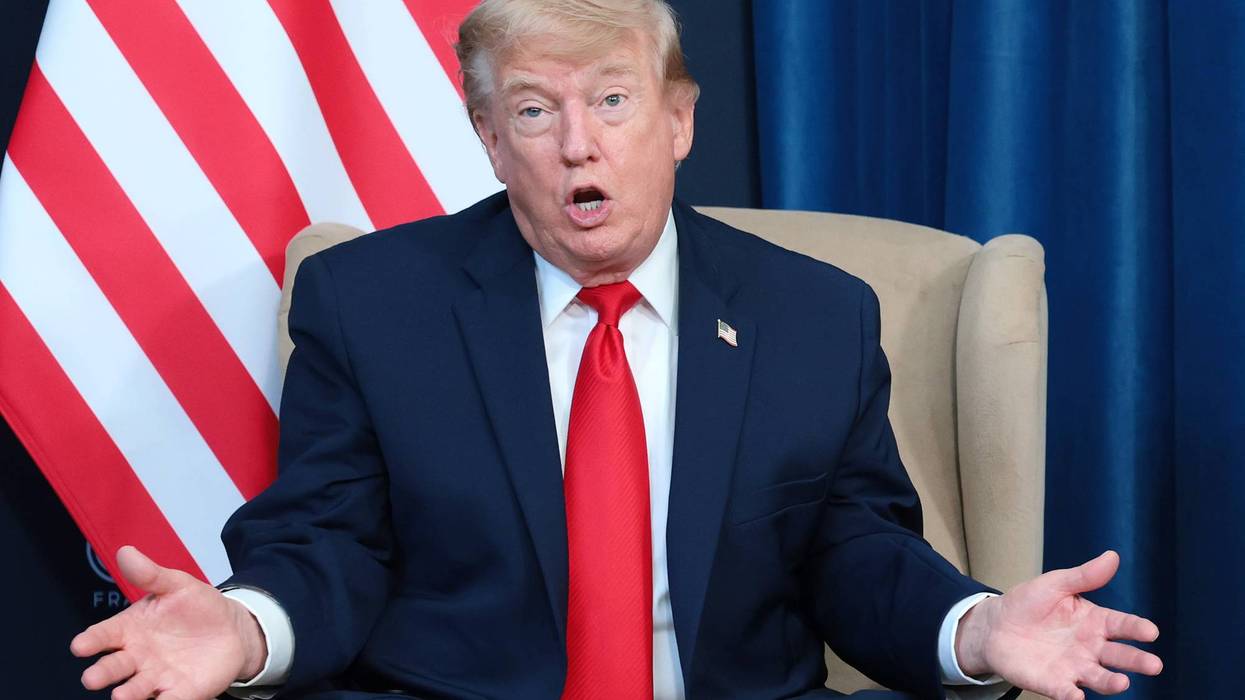
Trump's comments served as an admission, said one observer, that "the uranium was a false justification for war."
President Donald Trump and his top advisers have spent months insisting that extracting and confiscating highly enriched uranium from Iran was the top objective of the unprovoked war he and Israeli Prime Minister Benjamin Netanyahu began in February—but on Tuesday at the Group of Seven summit in France, he shrugged off the need to rapidly obtain the nuclear reactor component.
There is "no rush" to retrieve uranium from nuclear sites the US bombed in June 2025, Trump said, adding that taking the highly enriched uranium is something the US wants "psychologically," but not enough to prioritize extracting it right away.
One could make the argument, he said, that it wasn't worth the effort to take the material at all.
"Frankly, to go get it—we're going to go get it—but to go get it is a big deal, because they say only China and us have the equipment," said the president. "You could make the case, 'Why do you even bother?' because it's not very valuable, you know. It's probably half a million dollars worth, it's not very valuable stuff."
Trump is backing away from getting Iran's enriched material: "You could make the case, why even bother? It's not very valuable stuff." pic.twitter.com/CgNgnZCaMQ
— Aaron Rupar (@atrupar) June 16, 2026
Trump's comments came a day after he and the Iranian government announced they had reached a memorandum of understanding (MOU) to end the war. The president told The New York Times that the agreement includes a requirement that Iran will be limited to enriching uranium only to levels that "could never be used by the military."
White House officials, though, told The Washington Post that details of Iran's nuclear program will be subject to negotiations over the next two months. The question of whether talks on the nuclear program could be held separately, after a deal to end the war was reached, had been a major sticking point for the US leading up to the MOU.
Trump brushed off suggestions that the deal to end the war, in which Iran demonstrated its economic might by effectively closing the Strait of Hormuz and sending energy prices skyrocketing—obtained no guarantees on Iran's nuclear program that hadn't already been secured in 2015 in the Joint Comprehensive Plan of Action, which was brokered by the Obama administration and which limited Iran's nuclear program in exchange for sanctions relief. Trump exited the JCPOA during his first term.
Iran will only be able to enrich uranium “for nonmilitary purposes. Forever," said Trump on Monday.
On Fox News on Monday, former National Security Council chief of staff Alex Gray insisted the president had secured a deal that, for the first time, would stop Iran from developing a nuclear weapon. Before the US and Israel began attacking Iran in February, the Middle Eastern country maintained that its nuclear power program was not for military purposes.
While Trump's supporters insisted the war and the MOU had made clear Trump had drawn a hard line on Iran's nuclear capacity, his comments on Tuesday were taken by foreign policy analyst Logan McMillen as an admission that "the uranium was a false justification for war."
"The real purpose was to punish Iran for the crime of being an independent economic power that refused to participate in America’s petro economy," said McMillen.
At CNN, Aaron Blake noted that Trump has spent weeks sending inconsistent messages about his demand that Iran end its nuclear program.
Late last month, the president said on social media that Iran's uranium "will be unearthed by the United States... in close coordination and conjunction with the Islamic Republic of Iran, plus the International Atomic Energy Agency, and DESTROYED.”
But in April, Trump told Reuters that US strikes last year had left Iran's uranium "so far underground, I don’t care about that."
Two weeks later, he again said that the US had "to take that nuclear dust," before telling Fox News last month that destroying the uranium was not "necessary except from a public relations standpoint."
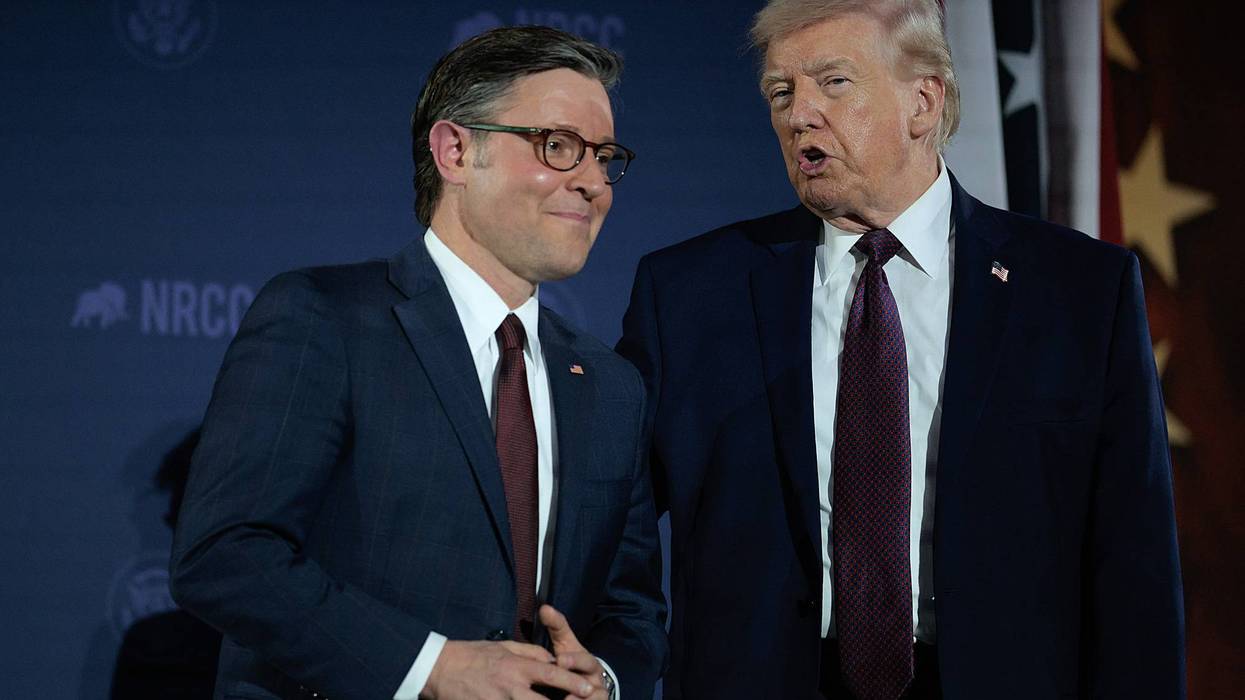
A group of Democratic lawmakers pushed President Donald Trump on whether he would veto legislation that cuts Social Security.
A group of Democratic US senators warned Monday that congressional Republicans and President Donald Trump could be gearing up for a push for raise the retirement age as part of a broader—and deeply unpopular—effort to slash Social Security benefits after the 2026 midterm elections.
Sens. Elizabeth Warren (D-Mass.), Tammy Duckworth (D-Ill.), and Richard Blumenthal (D-Conn.) wrote in a letter to Trump that they have "renewed concerns" that his administration is "considering raising the retirement age, cutting the earned benefits of millions of Americans," despite the president's repeated vows to shield the program.
"Republicans have a history of attempting to increase the retirement age, privatize Social Security, or otherwise cut Social Security benefits, and some congressional Republicans have called to raise the retirement age or means-test benefits," the lawmakers wrote, emphasizing that GOP lawmakers "are not alone."
"In an interview this past fall, [Social Security Administration] Commissioner Frank Bisignano said—and later attempted to retract after public outcry—that your administration was considering this idea," the Democratic senators wrote of raising the retirement age, which would cut Social Security benefits across the board.
The nonpartisan Congressional Budget Office analysis of a 2024 Republican proposal to raise Social Security's full retirement age found that doing so would cut benefits by an average of 13% for people born after 1971.
The Democratic senators sent their letter to Trump days after Social Security's trustees said in their annual report that the program will be unable to pay out full benefits by the end of 2032—a quarter earlier than projected last year—unless Congress takes action. The finding was seen as evidence of the damage inflicted by Trump's policies, including his tariffs and tax cuts for the rich.
Ahead of the trustees report's release, House Speaker Mike Johnson declared that Social Security needs to be "adjusted and fixed" and said Republicans would release their plan "next year," without specifying what the proposal would entail.
Mike Johnson admits Republicans will cut Medicaid, Medicare, and Social Security next year pic.twitter.com/bgyAb4ppyw
— FactPost (@factpostnews) June 8, 2026
In their letter to Trump on Monday, the trio of Democratic senators demanded to know if the president is aware of "Republican plans to cut Medicare, Medicaid, or Social Security benefits" and whether he would veto GOP legislation that slashes those programs.
"Raising the retirement age—or otherwise cutting benefits—only worsens the looming retirement income crisis," the lawmakers wrote. "Doing so hurts older Americans, cutting monthly benefits and forcing millions into poverty."