SUBSCRIBE TO OUR FREE NEWSLETTER
Daily news & progressive opinion—funded by the people, not the corporations—delivered straight to your inbox.
5
#000000
#FFFFFF
To donate by check, phone, or other method, see our More Ways to Give page.


Daily news & progressive opinion—funded by the people, not the corporations—delivered straight to your inbox.

Jen Nessel, 212.614.6449, jnessel@ccr-ny.org
David Lerner, Riptide Communications, 212.260.5000
Today, a federal Court of Appeals dismissed Canadian citizen
Maher Arar's case against U.S. officials for their role in sending him to
Syria to be tortured and interrogated for a year. Arar is represented by the
Center for Constitutional Rights (CCR). The court concluded that Arar's
case raised too many sensitive foreign policy and secrecy issues to permit
relief. It leaves the federal officials involved free of any legal
accountability for what they did.
Maher
Arar
is not available to comment in person, but is issuing the following statement:
"After seven years of pain and hard struggle it was my hope that the
court system would listen to my plea and act as an independent body from the
executive branch. Unfortunately, this recent decision and decisions taken on
other similar cases, prove that the court system in the United States has
become more or less a tool that the executive branch can easily
manipulate through unfounded allegations and fear mongering. If anything, this
decision is a loss to all Americans and to the rule of law."
Said Georgetown law professor and CCR cooperating
attorney David Cole, who argued the case, "This
decision says that U.S. officials can intentionally send a man to be tortured
abroad, bar him from any access to the courts while doing so, and then avoid
any legal accountability thereafter. It effectively places executive officials
above the law, even when accused of a conscious conspiracy to torture. If the
rule of law means anything, it must mean that courts can hear the claim of an
innocent man subjected to torture that violates our most basic constitutional
commitments."
CCR Senior Staff Attorney
Maria LaHood said, "With this decision, we have lost much more than
Maher Arar's case against torture - we have lost the rule of law,
the moral high ground, our independent judiciary, and our commitment to the
Constitution of the United States."
The
case was re-heard before twelve Second Circuit judges after a rare decision in
August 2008 to rehear the case sua sponte, that is, of their own accord
before Arar had even sought rehearing.
Mr. Arar, a Syrian-born
Canadian citizen, was detained at JFK Airport in September 2002 while
changing planes on his way home to Canada. The Bush administration labeled him
a member of Al Qaeda and sent him not to Canada, his home and country of
citizenship, but against his will to Syrian intelligence authorities renowned
for torture. He was tortured, interrogated and detained in a tiny underground
cell for nearly a year before the Syrian government released him, stating they
had found no connection to any criminal or terrorist organization or activity.
In January 2004, just three months after he returned home to
Canada from his ordeal, CCR filed a suit on Mr. Arar's behalf against
John Ashcroft and other U.S. officials, the first to challenge the
government's policy of "extraordinary rendition," also known
as "outsourcing torture."
The Canadian government, after an exhaustive public inquiry,
found that Mr. Arar had no connection to terrorism and, in January 2007,
apologized to Mr. Arar for Canada's role in his rendition and awarded him
a multi-million-dollar settlement. The contrast between the two
governments' responses to their mistakes could not be more stark, say Mr.
Arar's attorneys. Both the Executive and Judicial branches of the United
States government have barred inquiry and refused to hold anyone accountable
for ruining the life of an innocent man.
Two Congressional hearings in
October 2007 dealt with his case. On October 18, 2007 Mr. Arar testified via
video at a House Joint Committee Hearing
convened to discuss his rendition by the U.S. to Syria for interrogation under
torture. During that hearing - the first time Mr. Arar
testified before any U.S. governmental body - individual members of
Congress publicly apologized to him, though the government still has not issued
a formal apology. The next week, on October 24,
Secretary of State Condoleezza Rice admitted during a House Foreign
Affairs Committee Hearing that the U.S. government mishandled his case.
In a strongly worded dissent, Judge Guido Calabresi wrote,
"I believe that when the history of this distinguished court is written,
today's majority decision will be viewed with dismay."
Joshua Sohn of DLA Piper US LLP, Katherine Gallagher of CCR, and Jules
Lobel, professor at University of Pittsburgh Law School and CCR cooperating
attorney, are co-counsel in Mr. Arar's case.
The Center for Constitutional
Rights represents other victims of the Bush administration's programs,
from Iraqis tortured and abused at Abu Ghraib prison to Muslim and Arab men
rounded up and abused in immigration sweeps in the U.S. in the aftermath of
9/11, to Guantanamo detainees in the recent Supreme Court case.
For more on Mr. Arar's case, including a timeline,
court papers and other documents, go to https://ccrjustice.org/ourcases/current-cases/arar-v.-ashcroft.
Additional information may be found by entering the search term
"Arar" at the Center for Constitutional Rights website, www.ccrjustice.org.
The Center for Constitutional Rights is dedicated to advancing and protecting the rights guaranteed by the United States Constitution and the Universal Declaration of Human Rights. CCR is committed to the creative use of law as a positive force for social change.
(212) 614-6464"I will give," said the Republican mega-donor with a smile.
Billionaire Miram Adelson on Tuesday night suggested the legal obstacles for President Donald Trump to serve an additional term in office after 2028 are not insurmountable as the far-right Republican megadonor vowed another $250 million to bolster a run that experts say would be unlawful and unconstitutional on its face.
Adelson, a hardline Zionist who, along with her now deceased husband, Sheldon Adelson, has given hundreds of millions to US lawmakers who back a strong relationship between the US and Israeli governments, was sharing the podium with Trump during a Hanukkah candlelighting event at the White House when she made the remarks.
With a reference to Harvard law professor Alan Dershowitz, Adelson said they had discussed "the legal thing of four more years"—something Trump has repeatedly gestured toward and many of his backers have called for—and told Trump, “So, we can do it, think about it.”
A chant in the crowd then broke out for "For four more years!" as Adelson whispered something in Trump's ear.
“She said, ‘Think about it, I’ll give you another $250 million,’” Trump then said into the microphone. "I will give," Adelson said with a smile.
Watch the exchange:
Adelson: I met Alan Dershowitz.. he said.. four more years. We can do it. Think about it.
Crowd: *chants four more years*
Trump: She said think about it, I’ll give you another 250 million pic.twitter.com/eOc7Zazyns
— Acyn (@Acyn) December 17, 2025
For Trump's 2024 presidential campaign alone, Adelson gave at least $100 million to support the Republican candidate with Super PAC she established, according to federal filings.
In his remarks on Tuesday, Trump credited Adelson with providing him $250 million overall—"directly and indirectly"—during his 2024 bid.
"When someone can you $250 million, I think that we should give her the opportunity to say hello," Trump said, when introducing her. "And Miriam, make it quick, because $250 million is not what it used to be."
"This is the Iraq War 2.0 with a South American flavor to it," warned one Democratic senator.
US President Donald Trump late Tuesday declared a blockade on "all sanctioned oil tankers" approaching and leaving Venezuela, a major escalation in what's widely seen as an accelerating march to war with the South American country.
The "total and complete blockade," Trump wrote on his social media platform, will only be lifted when Venezuela returns to the US "all of the Oil, Land, and other Assets that they previously stole from us."
"Venezuela is completely surrounded by the largest Armada ever assembled in the History of South America," Trump wrote, referring to the massive US military buildup in the Caribbean. "It will only get bigger, and the shock to them will be like nothing they have ever seen before."
The government of Venezuelan President Nicolás Maduro, which has mobilized its military in response to the US president's warmongering, denounced Trump's comments as a "grotesque threat" aimed at "stealing the riches that belong to our homeland."
The US-based anti-war group CodePink said in a statement that "Trump’s assertion that Venezuela must 'return' oil, land, and other assets to the United States exposes the true objective" of his military campaign.
"Venezuela did not steal anything from the United States. What Trump describes as 'theft' is Venezuela’s lawful assertion of sovereignty over its own natural resources and its refusal to allow US corporations to control its economy," said CodePink. "A blockade, a terrorist designation, and a military buildup are steps toward war. Congress must act immediately to stop this escalation, and the international community must reject this lawless threat."
The announced naval blockade—an act of aggression under international law—came a week after the Trump administration seized an oil tanker off the coast of Venezuela and made clear that it intends to intercept more.
US Rep. Joaquin Castro (D-Texas), one of the leaders of a war powers resolution aimed at preventing the Trump administration from launching a war on Venezuela without congressional approval, said Tuesday that "a naval blockade is unquestionably an act of war."
"A war that the Congress never authorized and the American people do not want," Castro added, noting that a vote on his resolution is set for Thursday. "Every member of the House of Representatives will have the opportunity to decide if they support sending Americans into yet another regime change war."
"This is absolutely an effort to get us involved in a war in Venezuela."
Human rights organizations have accused the Republican-controlled Congress of abdicating its responsibilities as the Trump administration takes belligerent and illegal actions in international waters and against Venezuela directly, claiming without evidence to be combating drug trafficking.
Last month, Senate Republicans—some of whom are publicly clamoring for the US military to overthrow Maduro's government—voted down a Venezuela war powers resolution. Two GOP senators, Rand Paul of Kentucky and Lisa Murkowski of Alaska, joined Democrats in supporting the resolution.
Dylan Williams, vice president for government affairs at the Center for International Policy, wrote Tuesday that "the White House minimized Republican 'yes' votes by promising that Trump would seek Congress’ authorization before initiating hostilities against Venezuela itself."
"Trump today broke that promise to his own party’s lawmakers by ordering a partial blockade on Venezuelan ships," wrote Williams. "A blockade, including a partial one, definitively constitutes an act of war. Trump is starting a war against Venezuela without congressional authorization."
Sen. Ruben Gallego (D-Ariz.) warned in a television appearance late Monday that members of the Trump administration are "going to do everything they can to get us into this war."
"This is the Iraq War 2.0 with a South American flavor to it," he added. "This is absolutely an effort to get us involved in a war in Venezuela."
"Obviously, they have issues with what is in that video, and that’s why they don’t want everybody to see it," Sen. Mark Kelly said of administration officials after the meeting.
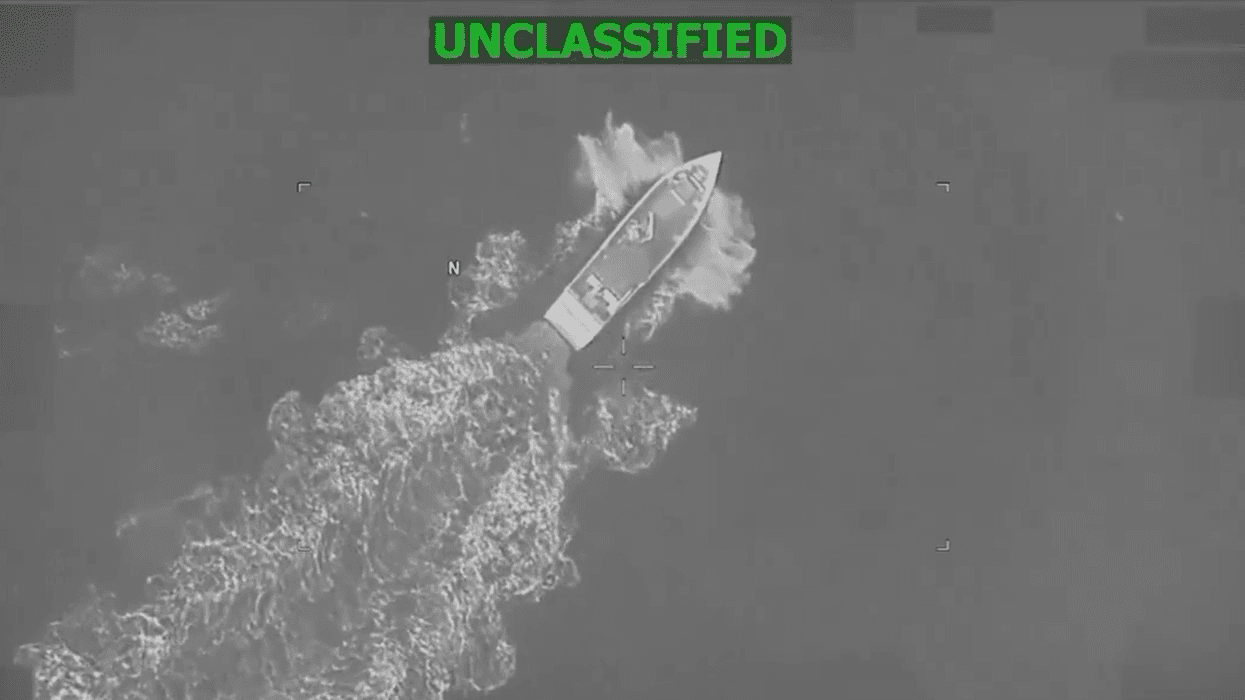
US Defense Secretary Pete Hegseth said Tuesday that the Pentagon will not release unedited video footage of a September airstrike that killed two men who survived an initial strike on a boat allegedly carrying drugs in the Caribbean Sea, a move that followed a briefing with congressional lawmakers described by one Democrat as an "exercise in futility" and by another as "a joke."
Hegseth said that members of the House and Senate Armed Services committees would be given a chance to view video of the September 2 "double-tap" strike, which experts said was illegal like all the other boat bombings. The secretary did not say whether all congressional lawmakers would be provided access to the footage.
“Of course we’re not going to release a top secret, full, unedited video of that to the general public,” Hegseth told reporters following a closed-door briefing during which he and Secretary of State Marco Rubio fielded questions from lawmakers.
As with a similar briefing earlier this month, Tuesday's meeting left some Democrat attendees with more questions than answers.
“The administration came to this briefing empty-handed,” Senate Minority Leader Chuck Schumer (D-NY) told reporters. “If they can’t be transparent on this, how can you trust their transparency on all the other issues swirling about in the Caribbean?”
That includes preparations for a possible attack on oil-rich Venezuela, which include the deployment of US warships and thousands of troops to the region and the authorization of covert action aimed at toppling the government of longtime Venezuelan President Nicolás Maduro.
Tuesday's briefing came as House lawmakers prepare to vote this week on a pair of war powers resolutions aimed at preventing President Donald Trump from waging war on Venezuela. A similar bipartisan resolution recently failed in the Senate.
Rep. Gregory Meeks (D-NY), the ranking member of the House Foreign Affairs Committee and co-author of one of the new war powers resolution, said in a statement: “Today’s briefing from Secretaries Rubio and Hegseth was an exercise in futility. It did nothing to address the serious legal, strategic, and moral concerns surrounding the administration’s unprecedented use of US military force in the Caribbean and Pacific."
"As of today, the administration has already carried out 25 such strikes over three months, extrajudicially killing 95 people," Meeks noted. "That this briefing to members of Congress only occurred more than three months since the strikes began—despite numerous requests for classified and public briefings—further proves these operations are unable to withstand scrutiny and lack a defensible legal rationale."
Briefing attendee Sen. Mark Kelly (D-Ariz.)—who is in the administration's crosshairs for reminding US troops that military rules and international law require them to disobey illegal orders—said of Trump officials, "Obviously, they have issues with what is in that video, and that’s why they don’t want everybody to see it."
Defending Hegseth's decision to not make the boat strike video public, Sen. Markwayne Mullin (R-Okla.) argued that “there’s a lot of members that’s gonna walk out there and that’s gonna leak classified information and there’s gonna be certain ones that you hold accountable."
Mullin singled out Rep. Ilhan Omar (D-Minn.), who, along with the Somalian American community at large, has been the target of mounting Islamophobic and racist abuse by Trump and his supporters.
“Not everybody can go through the same background checks that need to be cleared on this,” he said. “Do you think Omar needs all this information? I will say no.”
Rejecting GOP arguments against releasing the video, Sen. Adam Schiff (D-Calif.) said after attending Tuesday's briefing: “I found the legal explanations and the strategic explanations incoherent, but I think the American people should see this video. And all members of Congress should have that opportunity. I certainly want it for myself.”