

SUBSCRIBE TO OUR FREE NEWSLETTER
Daily news & progressive opinion—funded by the people, not the corporations—delivered straight to your inbox.
5
#000000
#FFFFFF
To donate by check, phone, or other method, see our More Ways to Give page.
Daily news & progressive opinion—funded by the people, not the corporations—delivered straight to your inbox.
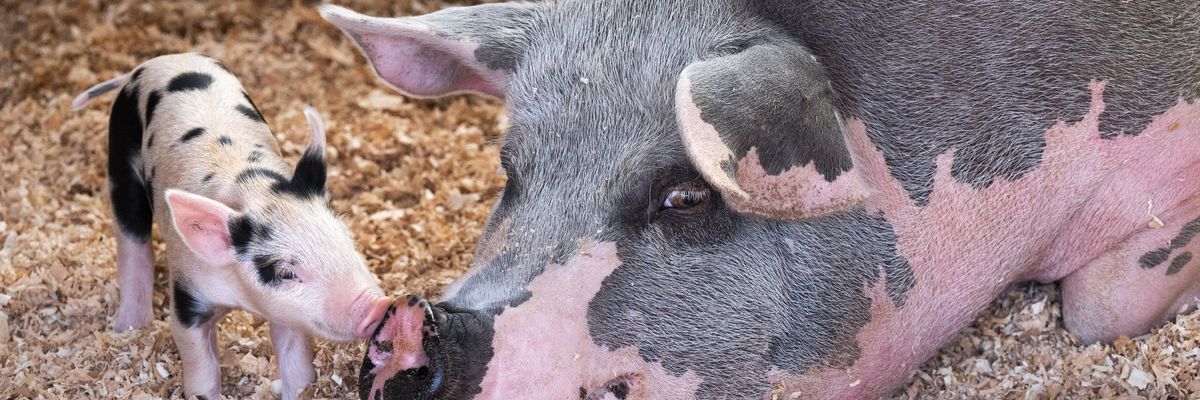
A piglet goes nose-to-nose with its mom at the Orange County Fair in Costa Mesa, California on July 28, 2021.
One advocate called the ruling a "victory for sustainable, humane farming against giant corporations that prioritize cost-cutting and profit margins over the environment, food safety, and animal welfare."
In what sustainable agriculture, public health, and animal rights champions celebrated as a major victory, the U.S. Supreme Court on Thursday upheld a California law prohibiting the in-state sale of pork, eggs, and veal derived from creatures "confined in a cruel manner."
The law, known as Proposition 12, was challenged by the National Pork Producers Council and the American Farm Bureau Federation. The organizations claimed that "because of California's huge market share... pork producers elsewhere would be required to abide by" its rules, and they argued unsuccessfully that this would violate the U.S. Constitution's "restraints on the authority of states to regulate industry beyond their borders," The Washington Post reported.
Writing the majority opinion for the 5-4 decision in National Pork Producers v. Ross, Justice Neil Gorsuch rejected what he described as the plaintiffs' request for the court to "fashion two new and more aggressive constitutional restrictions on the ability of states to regulate goods sold within their borders."
"While the Constitution addresses many weighty issues, the type of pork chops California merchants may sell is not on that list," Gorsuch wrote on behalf of himself and Justices Clarence Thomas, Sonia Sotomayor, Elena Kagan, and Amy Coney Barrett.
"A major victory for animal welfare and a more regenerative, healthful, and humane future of our food."
Chief Justice John Roberts and Justices Samuel Alito, Brett Kavanaugh, and Ketanji Brown Jackson "would have kept the case involving California's humane pork production laws alive but sent it back to a lower court for more work," the Post noted.
Food & Water Watch legal director Tarah Heinzen called the ruling "a rightful victory for sustainable, humane farming against giant corporations that prioritize cost-cutting and profit margins over the environment, food safety, and animal welfare."
"It is also a critical victory for the rights of states that seek to do better on those issues than some of their neighbors, or the country at large," she added.
George Kimbrell, legal director at the Center for Food Safety, which filed a brief in support of California last year, also welcomed Thursday's decision as "a major victory for animal welfare and a more regenerative, healthful, and humane future of our food."
"The Supreme Court rejected industrial agriculture's far-reaching efforts to curtail states' rights to enact laws governing farming to prevent animal cruelty and to protect the public health. Instead, the court properly recognized the value and benefits of such laws," said Kimbrell. "Intensive confinement of pigs poses profound danger to food safety and the public health such as foodborne illness and disease and pathogen transmission, and important laws like Prop 12 mitigate those risks."
As the advocacy group Animal Outlook explained in a statement:
Proposition 12 sets minimum space requirements for egg-laying hens, mother pigs, and baby cows raised for veal in California, such that these animals cannot be confined in the industry-standard cages, which are barely bigger than their bodies. Prop 12 also requires that any eggs, pork, or veal sold in the state comply with these space requirements, regardless of where those products were produced.
After Prop 12 was approved by nearly two-thirds of California voters in 2018, the meat industry proceeded to challenge the law in four separate lawsuits.
"Every court to consider each of the cases, at both the trial and appellate level, has ruled against the industry," Animal Outlook pointed out. "Today's Supreme Court ruling is the industry's latest in that string of losses."
"No matter how cruel or painful a practice is, the animal agriculture industry has fought against laws to prohibit it—in this case, all the way to the Supreme Court," said Cheryl Leahy, the group's executive director. "When a powerful industry will stop at nothing to make complicity in cruelty mandatory, it's a clear sign that the cruelty is part and parcel of that industry, and the only way to refuse to be a part of it is to not eat animals altogether."
Dear Common Dreams reader, It’s been nearly 30 years since I co-founded Common Dreams with my late wife, Lina Newhouser. We had the radical notion that journalism should serve the public good, not corporate profits. It was clear to us from the outset what it would take to build such a project. No paid advertisements. No corporate sponsors. No millionaire publisher telling us what to think or do. Many people said we wouldn't last a year, but we proved those doubters wrong. Together with a tremendous team of journalists and dedicated staff, we built an independent media outlet free from the constraints of profits and corporate control. Our mission has always been simple: To inform. To inspire. To ignite change for the common good. Building Common Dreams was not easy. Our survival was never guaranteed. When you take on the most powerful forces—Wall Street greed, fossil fuel industry destruction, Big Tech lobbyists, and uber-rich oligarchs who have spent billions upon billions rigging the economy and democracy in their favor—the only bulwark you have is supporters who believe in your work. But here’s the urgent message from me today. It's never been this bad out there. And it's never been this hard to keep us going. At the very moment Common Dreams is most needed, the threats we face are intensifying. We need your support now more than ever. We don't accept corporate advertising and never will. We don't have a paywall because we don't think people should be blocked from critical news based on their ability to pay. Everything we do is funded by the donations of readers like you. When everyone does the little they can afford, we are strong. But if that support retreats or dries up, so do we. Will you donate now to make sure Common Dreams not only survives but thrives? —Craig Brown, Co-founder |
In what sustainable agriculture, public health, and animal rights champions celebrated as a major victory, the U.S. Supreme Court on Thursday upheld a California law prohibiting the in-state sale of pork, eggs, and veal derived from creatures "confined in a cruel manner."
The law, known as Proposition 12, was challenged by the National Pork Producers Council and the American Farm Bureau Federation. The organizations claimed that "because of California's huge market share... pork producers elsewhere would be required to abide by" its rules, and they argued unsuccessfully that this would violate the U.S. Constitution's "restraints on the authority of states to regulate industry beyond their borders," The Washington Post reported.
Writing the majority opinion for the 5-4 decision in National Pork Producers v. Ross, Justice Neil Gorsuch rejected what he described as the plaintiffs' request for the court to "fashion two new and more aggressive constitutional restrictions on the ability of states to regulate goods sold within their borders."
"While the Constitution addresses many weighty issues, the type of pork chops California merchants may sell is not on that list," Gorsuch wrote on behalf of himself and Justices Clarence Thomas, Sonia Sotomayor, Elena Kagan, and Amy Coney Barrett.
"A major victory for animal welfare and a more regenerative, healthful, and humane future of our food."
Chief Justice John Roberts and Justices Samuel Alito, Brett Kavanaugh, and Ketanji Brown Jackson "would have kept the case involving California's humane pork production laws alive but sent it back to a lower court for more work," the Post noted.
Food & Water Watch legal director Tarah Heinzen called the ruling "a rightful victory for sustainable, humane farming against giant corporations that prioritize cost-cutting and profit margins over the environment, food safety, and animal welfare."
"It is also a critical victory for the rights of states that seek to do better on those issues than some of their neighbors, or the country at large," she added.
George Kimbrell, legal director at the Center for Food Safety, which filed a brief in support of California last year, also welcomed Thursday's decision as "a major victory for animal welfare and a more regenerative, healthful, and humane future of our food."
"The Supreme Court rejected industrial agriculture's far-reaching efforts to curtail states' rights to enact laws governing farming to prevent animal cruelty and to protect the public health. Instead, the court properly recognized the value and benefits of such laws," said Kimbrell. "Intensive confinement of pigs poses profound danger to food safety and the public health such as foodborne illness and disease and pathogen transmission, and important laws like Prop 12 mitigate those risks."
As the advocacy group Animal Outlook explained in a statement:
Proposition 12 sets minimum space requirements for egg-laying hens, mother pigs, and baby cows raised for veal in California, such that these animals cannot be confined in the industry-standard cages, which are barely bigger than their bodies. Prop 12 also requires that any eggs, pork, or veal sold in the state comply with these space requirements, regardless of where those products were produced.
After Prop 12 was approved by nearly two-thirds of California voters in 2018, the meat industry proceeded to challenge the law in four separate lawsuits.
"Every court to consider each of the cases, at both the trial and appellate level, has ruled against the industry," Animal Outlook pointed out. "Today's Supreme Court ruling is the industry's latest in that string of losses."
"No matter how cruel or painful a practice is, the animal agriculture industry has fought against laws to prohibit it—in this case, all the way to the Supreme Court," said Cheryl Leahy, the group's executive director. "When a powerful industry will stop at nothing to make complicity in cruelty mandatory, it's a clear sign that the cruelty is part and parcel of that industry, and the only way to refuse to be a part of it is to not eat animals altogether."
In what sustainable agriculture, public health, and animal rights champions celebrated as a major victory, the U.S. Supreme Court on Thursday upheld a California law prohibiting the in-state sale of pork, eggs, and veal derived from creatures "confined in a cruel manner."
The law, known as Proposition 12, was challenged by the National Pork Producers Council and the American Farm Bureau Federation. The organizations claimed that "because of California's huge market share... pork producers elsewhere would be required to abide by" its rules, and they argued unsuccessfully that this would violate the U.S. Constitution's "restraints on the authority of states to regulate industry beyond their borders," The Washington Post reported.
Writing the majority opinion for the 5-4 decision in National Pork Producers v. Ross, Justice Neil Gorsuch rejected what he described as the plaintiffs' request for the court to "fashion two new and more aggressive constitutional restrictions on the ability of states to regulate goods sold within their borders."
"While the Constitution addresses many weighty issues, the type of pork chops California merchants may sell is not on that list," Gorsuch wrote on behalf of himself and Justices Clarence Thomas, Sonia Sotomayor, Elena Kagan, and Amy Coney Barrett.
"A major victory for animal welfare and a more regenerative, healthful, and humane future of our food."
Chief Justice John Roberts and Justices Samuel Alito, Brett Kavanaugh, and Ketanji Brown Jackson "would have kept the case involving California's humane pork production laws alive but sent it back to a lower court for more work," the Post noted.
Food & Water Watch legal director Tarah Heinzen called the ruling "a rightful victory for sustainable, humane farming against giant corporations that prioritize cost-cutting and profit margins over the environment, food safety, and animal welfare."
"It is also a critical victory for the rights of states that seek to do better on those issues than some of their neighbors, or the country at large," she added.
George Kimbrell, legal director at the Center for Food Safety, which filed a brief in support of California last year, also welcomed Thursday's decision as "a major victory for animal welfare and a more regenerative, healthful, and humane future of our food."
"The Supreme Court rejected industrial agriculture's far-reaching efforts to curtail states' rights to enact laws governing farming to prevent animal cruelty and to protect the public health. Instead, the court properly recognized the value and benefits of such laws," said Kimbrell. "Intensive confinement of pigs poses profound danger to food safety and the public health such as foodborne illness and disease and pathogen transmission, and important laws like Prop 12 mitigate those risks."
As the advocacy group Animal Outlook explained in a statement:
Proposition 12 sets minimum space requirements for egg-laying hens, mother pigs, and baby cows raised for veal in California, such that these animals cannot be confined in the industry-standard cages, which are barely bigger than their bodies. Prop 12 also requires that any eggs, pork, or veal sold in the state comply with these space requirements, regardless of where those products were produced.
After Prop 12 was approved by nearly two-thirds of California voters in 2018, the meat industry proceeded to challenge the law in four separate lawsuits.
"Every court to consider each of the cases, at both the trial and appellate level, has ruled against the industry," Animal Outlook pointed out. "Today's Supreme Court ruling is the industry's latest in that string of losses."
"No matter how cruel or painful a practice is, the animal agriculture industry has fought against laws to prohibit it—in this case, all the way to the Supreme Court," said Cheryl Leahy, the group's executive director. "When a powerful industry will stop at nothing to make complicity in cruelty mandatory, it's a clear sign that the cruelty is part and parcel of that industry, and the only way to refuse to be a part of it is to not eat animals altogether."

