SUBSCRIBE TO OUR FREE NEWSLETTER
Daily news & progressive opinion—funded by the people, not the corporations—delivered straight to your inbox.
5
#000000
#FFFFFF
To donate by check, phone, or other method, see our More Ways to Give page.
Daily news & progressive opinion—funded by the people, not the corporations—delivered straight to your inbox.
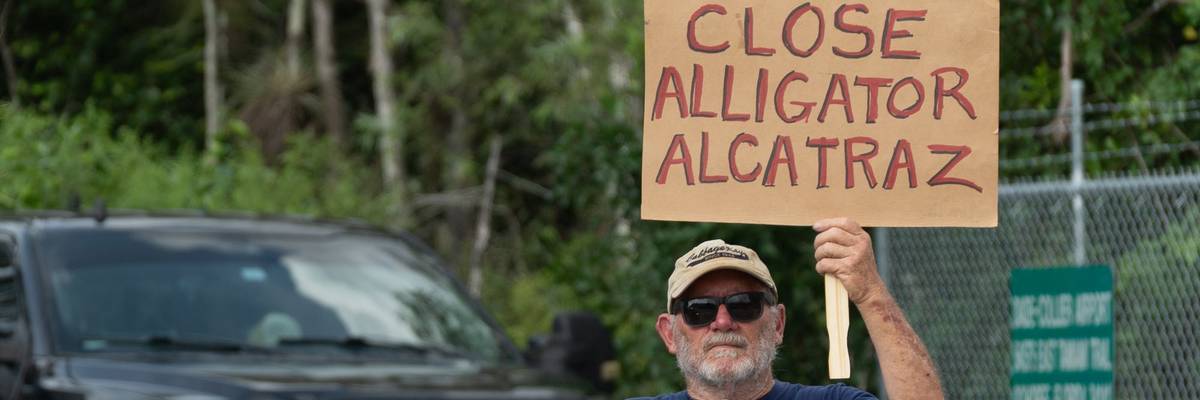
A protester holds a sign against "Alligator Alcatraz" during a rally at the entrance to the detention center in the Everglades, Florida, United States, on August 24, 2025.
Conditions at Florida detention facilities "represent a deliberate system of cruelty designed to punish people seeking to build a new life in the US,” said an official at Amnesty International.
Two immigration detention centers in Florida have gained notoriety for inhumane conditions since Republican Gov. Ron DeSantis, in close alignment with President Donald Trump's anti-immigrant agenda, has rapidly scaled up mass detention in the state, and a report released Thursday detailed how human rights violations at the two facilities amount to torture in some cases.
Amnesty International published the report, Torture and Enforced Disappearances in the Sunshine State, with a focus on Krome North Service Processing Center and the Everglades Detention Facility, also known by its nickname, "Alligator Alcatraz."
As Common Dreams has reported, many of the people detained at the facilities have been arbitrarily rounded up by immigration agents, with a majority of the roughly 1,000 people being held at Alligator Alcatraz having been convicted of no criminal offense as of July.
Amnesty's report described unsanitary conditions, with fecal matter overflowing from toilets in detainees' sleeping areas, authorities granting only limited access to showers, and poor quality food and water.
Some of the treatment amounts to torture, the report says, including Alligator Alcatraz's use of "the box"—a 2x2 foot "cage-like structure people are put in as punishment—which inmates have been placed in for hours at a time with their hands and feet attached to restraints on the ground.
“These despicable and nauseating conditions at Alligator Alcatraz reflect a pattern of deliberate neglect designed to dehumanize and punish those detained there,” said Amy Fischer, director of refugee and migrant rights with Amnesty International USA. “This is unreal—where’s the oversight?”
At Krome, detainees have been arbitrarily placed in prolonged solitary confinement—defined as lasting longer than 15 days—which is prohibited under international law.
"The use of prolonged solitary confinement at Krome and the use of the ‘box’ at 'Alligator Alcatraz' amount to torture or other ill-treatment," said Amnesty.
The report elevates concerns raised in September by immigrant rights advocates regarding the lack of federal oversight at Alligator Alcatraz, with nearly 1,000 men detained at the prison having been "administratively disappeared"—their names absent from US Immigration and Customs Enforcement's detainee locator system.
"The absence of registration or tracking mechanisms for those detained at Alligator Alcatraz facilitates incommunicado detention and constitutes enforced disappearances when the whereabouts of a person being detained there is denied to their family, and they are not allowed to contact their lawyer," said Amnesty.
The state of Florida has not publicly confirmed the number of people detained at Alligator Alcatraz.
One man told Amnesty, "My lawyers tried to visit me, but they weren’t let in. They were told that they had to fill out a form, which they did, but nothing happened. I was never able to speak with them confidentially.”
At Krome, detainees described overcrowding, medical neglect, and abuse by guards when Amnesty researchers visited in September. ICE has constructed tents and other semi-permanent structures to hold more people than the facility is designed to detain.
The Amnesty researchers were given a tour of relatively extensive medical facilities at Krome, including a dialysis clinic, dental clinic, and a "state-of-the-art" mental health facility—but despite these resources, detainees described officials' failure to provide medical treatment and delays in health assessments. Four people—Ramesh Amechand, Genry Ruiz Guillen, Maksym Chernyak, and Isidro Pérez—have died this year while detained at Krome.
"It’s a disaster if you want to see the doctor," one man told Amnesty. "I once asked to see the doctor, and it took two weeks for me to finally see him. It’s very slow.”
Researchers with the organization witnessed "a guard violently slam a metal flap of a door to a solitary confinement room against a man’s injured hand," and people reported being "hit and punched" by officials at Krome.
In line with the Trump administration, DeSantis and Republican state lawmakers have sought to make Florida "a testing ground for abusive immigration enforcement policies," said Amnesty, with the state deputizing local law enforcement to make immigration arrests and issuing 34 no-bid contracts totaling more than $360 million for the operation of Alligator Alcatraz—while slashing spending on healthcare, food assistance, and disaster relief. Florida has increased the number of people in immigration detention by more than 50% since Trump took office in January.
The organization called on Florida to redirect detention funding toward healthcare, housing, and other public spending, and to ban "shackling, solitary confinement, and punitive outdoor confinement" in line with international standards.
"At the federal level, the US government must end its cruel mass immigration detention machine, stop the criminalization of migration, and bar the use of state-owned facilities for federal immigration custody," said Amnesty.
Fischer emphasized that the chaotic and abusive conditions Amnesty observed at Alligator Alcatraz and Krome "are not isolated."
"They represent a deliberate system of cruelty designed to punish people seeking to build a new life in the US,” said Fischer. “We must stop detaining our immigrant community members and people seeking safety and instead work toward humane, rights-respecting migration policies.”
Dear Common Dreams reader, It’s been nearly 30 years since I co-founded Common Dreams with my late wife, Lina Newhouser. We had the radical notion that journalism should serve the public good, not corporate profits. It was clear to us from the outset what it would take to build such a project. No paid advertisements. No corporate sponsors. No millionaire publisher telling us what to think or do. Many people said we wouldn't last a year, but we proved those doubters wrong. Together with a tremendous team of journalists and dedicated staff, we built an independent media outlet free from the constraints of profits and corporate control. Our mission has always been simple: To inform. To inspire. To ignite change for the common good. Building Common Dreams was not easy. Our survival was never guaranteed. When you take on the most powerful forces—Wall Street greed, fossil fuel industry destruction, Big Tech lobbyists, and uber-rich oligarchs who have spent billions upon billions rigging the economy and democracy in their favor—the only bulwark you have is supporters who believe in your work. But here’s the urgent message from me today. It's never been this bad out there. And it's never been this hard to keep us going. At the very moment Common Dreams is most needed, the threats we face are intensifying. We need your support now more than ever. We don't accept corporate advertising and never will. We don't have a paywall because we don't think people should be blocked from critical news based on their ability to pay. Everything we do is funded by the donations of readers like you. When everyone does the little they can afford, we are strong. But if that support retreats or dries up, so do we. Will you donate now to make sure Common Dreams not only survives but thrives? —Craig Brown, Co-founder |
Two immigration detention centers in Florida have gained notoriety for inhumane conditions since Republican Gov. Ron DeSantis, in close alignment with President Donald Trump's anti-immigrant agenda, has rapidly scaled up mass detention in the state, and a report released Thursday detailed how human rights violations at the two facilities amount to torture in some cases.
Amnesty International published the report, Torture and Enforced Disappearances in the Sunshine State, with a focus on Krome North Service Processing Center and the Everglades Detention Facility, also known by its nickname, "Alligator Alcatraz."
As Common Dreams has reported, many of the people detained at the facilities have been arbitrarily rounded up by immigration agents, with a majority of the roughly 1,000 people being held at Alligator Alcatraz having been convicted of no criminal offense as of July.
Amnesty's report described unsanitary conditions, with fecal matter overflowing from toilets in detainees' sleeping areas, authorities granting only limited access to showers, and poor quality food and water.
Some of the treatment amounts to torture, the report says, including Alligator Alcatraz's use of "the box"—a 2x2 foot "cage-like structure people are put in as punishment—which inmates have been placed in for hours at a time with their hands and feet attached to restraints on the ground.
“These despicable and nauseating conditions at Alligator Alcatraz reflect a pattern of deliberate neglect designed to dehumanize and punish those detained there,” said Amy Fischer, director of refugee and migrant rights with Amnesty International USA. “This is unreal—where’s the oversight?”
At Krome, detainees have been arbitrarily placed in prolonged solitary confinement—defined as lasting longer than 15 days—which is prohibited under international law.
"The use of prolonged solitary confinement at Krome and the use of the ‘box’ at 'Alligator Alcatraz' amount to torture or other ill-treatment," said Amnesty.
The report elevates concerns raised in September by immigrant rights advocates regarding the lack of federal oversight at Alligator Alcatraz, with nearly 1,000 men detained at the prison having been "administratively disappeared"—their names absent from US Immigration and Customs Enforcement's detainee locator system.
"The absence of registration or tracking mechanisms for those detained at Alligator Alcatraz facilitates incommunicado detention and constitutes enforced disappearances when the whereabouts of a person being detained there is denied to their family, and they are not allowed to contact their lawyer," said Amnesty.
The state of Florida has not publicly confirmed the number of people detained at Alligator Alcatraz.
One man told Amnesty, "My lawyers tried to visit me, but they weren’t let in. They were told that they had to fill out a form, which they did, but nothing happened. I was never able to speak with them confidentially.”
At Krome, detainees described overcrowding, medical neglect, and abuse by guards when Amnesty researchers visited in September. ICE has constructed tents and other semi-permanent structures to hold more people than the facility is designed to detain.
The Amnesty researchers were given a tour of relatively extensive medical facilities at Krome, including a dialysis clinic, dental clinic, and a "state-of-the-art" mental health facility—but despite these resources, detainees described officials' failure to provide medical treatment and delays in health assessments. Four people—Ramesh Amechand, Genry Ruiz Guillen, Maksym Chernyak, and Isidro Pérez—have died this year while detained at Krome.
"It’s a disaster if you want to see the doctor," one man told Amnesty. "I once asked to see the doctor, and it took two weeks for me to finally see him. It’s very slow.”
Researchers with the organization witnessed "a guard violently slam a metal flap of a door to a solitary confinement room against a man’s injured hand," and people reported being "hit and punched" by officials at Krome.
In line with the Trump administration, DeSantis and Republican state lawmakers have sought to make Florida "a testing ground for abusive immigration enforcement policies," said Amnesty, with the state deputizing local law enforcement to make immigration arrests and issuing 34 no-bid contracts totaling more than $360 million for the operation of Alligator Alcatraz—while slashing spending on healthcare, food assistance, and disaster relief. Florida has increased the number of people in immigration detention by more than 50% since Trump took office in January.
The organization called on Florida to redirect detention funding toward healthcare, housing, and other public spending, and to ban "shackling, solitary confinement, and punitive outdoor confinement" in line with international standards.
"At the federal level, the US government must end its cruel mass immigration detention machine, stop the criminalization of migration, and bar the use of state-owned facilities for federal immigration custody," said Amnesty.
Fischer emphasized that the chaotic and abusive conditions Amnesty observed at Alligator Alcatraz and Krome "are not isolated."
"They represent a deliberate system of cruelty designed to punish people seeking to build a new life in the US,” said Fischer. “We must stop detaining our immigrant community members and people seeking safety and instead work toward humane, rights-respecting migration policies.”
Two immigration detention centers in Florida have gained notoriety for inhumane conditions since Republican Gov. Ron DeSantis, in close alignment with President Donald Trump's anti-immigrant agenda, has rapidly scaled up mass detention in the state, and a report released Thursday detailed how human rights violations at the two facilities amount to torture in some cases.
Amnesty International published the report, Torture and Enforced Disappearances in the Sunshine State, with a focus on Krome North Service Processing Center and the Everglades Detention Facility, also known by its nickname, "Alligator Alcatraz."
As Common Dreams has reported, many of the people detained at the facilities have been arbitrarily rounded up by immigration agents, with a majority of the roughly 1,000 people being held at Alligator Alcatraz having been convicted of no criminal offense as of July.
Amnesty's report described unsanitary conditions, with fecal matter overflowing from toilets in detainees' sleeping areas, authorities granting only limited access to showers, and poor quality food and water.
Some of the treatment amounts to torture, the report says, including Alligator Alcatraz's use of "the box"—a 2x2 foot "cage-like structure people are put in as punishment—which inmates have been placed in for hours at a time with their hands and feet attached to restraints on the ground.
“These despicable and nauseating conditions at Alligator Alcatraz reflect a pattern of deliberate neglect designed to dehumanize and punish those detained there,” said Amy Fischer, director of refugee and migrant rights with Amnesty International USA. “This is unreal—where’s the oversight?”
At Krome, detainees have been arbitrarily placed in prolonged solitary confinement—defined as lasting longer than 15 days—which is prohibited under international law.
"The use of prolonged solitary confinement at Krome and the use of the ‘box’ at 'Alligator Alcatraz' amount to torture or other ill-treatment," said Amnesty.
The report elevates concerns raised in September by immigrant rights advocates regarding the lack of federal oversight at Alligator Alcatraz, with nearly 1,000 men detained at the prison having been "administratively disappeared"—their names absent from US Immigration and Customs Enforcement's detainee locator system.
"The absence of registration or tracking mechanisms for those detained at Alligator Alcatraz facilitates incommunicado detention and constitutes enforced disappearances when the whereabouts of a person being detained there is denied to their family, and they are not allowed to contact their lawyer," said Amnesty.
The state of Florida has not publicly confirmed the number of people detained at Alligator Alcatraz.
One man told Amnesty, "My lawyers tried to visit me, but they weren’t let in. They were told that they had to fill out a form, which they did, but nothing happened. I was never able to speak with them confidentially.”
At Krome, detainees described overcrowding, medical neglect, and abuse by guards when Amnesty researchers visited in September. ICE has constructed tents and other semi-permanent structures to hold more people than the facility is designed to detain.
The Amnesty researchers were given a tour of relatively extensive medical facilities at Krome, including a dialysis clinic, dental clinic, and a "state-of-the-art" mental health facility—but despite these resources, detainees described officials' failure to provide medical treatment and delays in health assessments. Four people—Ramesh Amechand, Genry Ruiz Guillen, Maksym Chernyak, and Isidro Pérez—have died this year while detained at Krome.
"It’s a disaster if you want to see the doctor," one man told Amnesty. "I once asked to see the doctor, and it took two weeks for me to finally see him. It’s very slow.”
Researchers with the organization witnessed "a guard violently slam a metal flap of a door to a solitary confinement room against a man’s injured hand," and people reported being "hit and punched" by officials at Krome.
In line with the Trump administration, DeSantis and Republican state lawmakers have sought to make Florida "a testing ground for abusive immigration enforcement policies," said Amnesty, with the state deputizing local law enforcement to make immigration arrests and issuing 34 no-bid contracts totaling more than $360 million for the operation of Alligator Alcatraz—while slashing spending on healthcare, food assistance, and disaster relief. Florida has increased the number of people in immigration detention by more than 50% since Trump took office in January.
The organization called on Florida to redirect detention funding toward healthcare, housing, and other public spending, and to ban "shackling, solitary confinement, and punitive outdoor confinement" in line with international standards.
"At the federal level, the US government must end its cruel mass immigration detention machine, stop the criminalization of migration, and bar the use of state-owned facilities for federal immigration custody," said Amnesty.
Fischer emphasized that the chaotic and abusive conditions Amnesty observed at Alligator Alcatraz and Krome "are not isolated."
"They represent a deliberate system of cruelty designed to punish people seeking to build a new life in the US,” said Fischer. “We must stop detaining our immigrant community members and people seeking safety and instead work toward humane, rights-respecting migration policies.”