SUBSCRIBE TO OUR FREE NEWSLETTER
Daily news & progressive opinion—funded by the people, not the corporations—delivered straight to your inbox.
5
#000000
#FFFFFF
To donate by check, phone, or other method, see our More Ways to Give page.
Daily news & progressive opinion—funded by the people, not the corporations—delivered straight to your inbox.
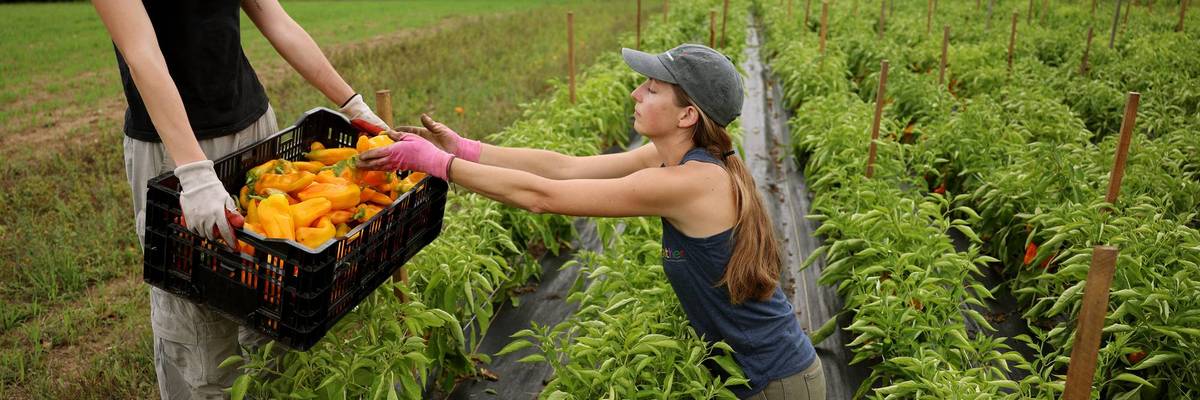
Farmers gather sweet peppers at Hungry Heart Farm in Kingston, New Hampshire, on September 23, 2025.
"Chairman Thompson appears poised to check off industry's cruel wish list," one critic warned.
Advocates for animal welfare, environmental protection, public health, and small family farms fiercely condemned various "industry-backed poison pills" in the long-awaited Farm Bill draft unveiled Friday by a key Republican in the US House of Representatives.
"A new Farm Bill is long overdue, and the Farm, Food, and National Security Act of 2026 is an important step forward in providing certainty to our farmers, ranchers, and rural communities," said House Committee on Agriculture Chair Glenn "GT" Thompson (R-Pa.) in a statement.
While Thompson has scheduled a markup of the 802-page proposal for February 23, critics aren't waiting to pick apart the bill, which aligns with a 2024 GOP proposal that was also sharply rebuked. The panel's ranking member, Rep. Angie Craig (D-Minn.), said that from what she has seen so far, the new legislation "fails to meet the moment facing farmers and working people."
"Farmers need Congress to act swiftly to end inflationary tariffs, stabilize trade relationships, expand domestic market opportunities like year-round E15, and help lower input costs," Craig stressed. "The Republican majority instead chose to ignore Democratic priorities and focus on pushing a shell of a farm bill with poison pills that complicates if not derails chances of getting anything done. I strongly urge my Republican colleagues to drop the political charade and work with House Democrats on a truly bipartisan bill to address the very real problems farm country is experiencing right now—before it's too late."
Brett Hartl, government affairs director at the Center for Biological Diversity, similarly blasted the GOP legislation on Friday, declaring that "this Republican Farm Bill proposal is a grotesque, record-breaking giveaway to the pesticide industry that will free Big Ag to accelerate the flow of dangerous poisons into our nation's food supply and waterways."
"This bill would block people suffering from pesticide-linked cancers from suing pesticide makers, eviscerate the EPA's ability to protect rivers and streams from direct pesticide pollution, and give the pesticide industry an unprecedented veto over extinction-preventing safeguards for our nation's most endangered wildlife," he said, referring to the Environmental Protection Agency.
"If Congress passes this monstrosity, it will speed our march toward the dawn of a very real silent spring, a day without fluttering butterflies, chirping frogs, or the chorus of birds at sunrise," Hartl warned. "No one voted for Republicans to allow foreign-owned pesticide conglomerates to dominate the policies that impact the safety of the food every American eats. But this bill leaves no doubt that's exactly who is calling all the shots."
Food & Water Watch (FWW) managing director of policy and litigation Mitch Jones also sounded the alarm about industry-friendly poison pills, arguing that any draft containing the "Cancer Gag Act" that would shield pesticide companies from liability or the Ending Agricultural Trade Suppression Act—which would block state and local policies designed to protect animal welfare, farm workers, and food safety—"must be dead on arrival."
Sara Amundson, president of Humane World Action Fund—formerly called Humane Society Legislative Fund—also made a case against targeting state restrictions for animals like Proposition 12 in California, which the US Supreme Court let stand in 2023, in response to a challenge by the National Pork Producers Council and the American Farm Bureau Federation.
"Once again, the House Agriculture Committee Republican majority is bending to the will of a backwards-facing segment of the pork industry by trying to force through a measure to override the preferences of voters in more than a dozen states, upend the decisions of courts all the way up to the Supreme Court, and trample states' rights all at the same time," Amundson said Friday.
The National Family Farm Coalition highlighted that "instead of addressing the widespread concerns of family-scale farmers—ensuring fair prices for farmers, improving credit access, addressing corporate land consolidation, and creating a trade environment that benefits producers—this draft perpetuates the status quo that enriches and empowers corporate agribusiness. The result is an accelerating farm crisis that continues to hollow out rural communities across the US."
Thompson also faced outrage over other policies left out of the GOP legislation—particularly from those calling for the restoration of $187 billion in cuts to the Supplemental Nutrition Assistance Program (SNAP) that congressional Republicans and President Donald Trump forced through last year with their so-called One Big Beautiful Bill Act (HR 1).
"HR 1 shifts unprecedented costs to already cash-strapped states, expands time limits, and strips food benefits away from caregivers, veterans, older workers, people experiencing homelessness, and humanitarian-based noncitizens," noted Crystal FitzSimons, president of the Food Research & Action Center.
"HR 1 is an unforgiving assault on America's hungry, deliberately dismantling our nation's first line of defense against hunger," she continued. "Yet, when given the opportunity to correct this harm in the latest Farm Bill proposal, Chairman Thompson unveiled a package that will only deepen hunger instead of fixing it. Hunger is not something Congress can afford to ignore."
Jones of FWW said that "families and farmers are hungry for federal policy that supports small- and mid-sized producers and keeps food affordable. Instead, Chairman Thompson appears poised to check off industry's cruel wish list."
"America needs a fair Farm Bill," he emphasized. "It is imperative that this Farm Bill repeal all Trump SNAP cuts and restore full funding to this critical nutrition program; stop the proliferation of factory farms; and support the transition to sustainable, affordable food."
Dear Common Dreams reader, It’s been nearly 30 years since I co-founded Common Dreams with my late wife, Lina Newhouser. We had the radical notion that journalism should serve the public good, not corporate profits. It was clear to us from the outset what it would take to build such a project. No paid advertisements. No corporate sponsors. No millionaire publisher telling us what to think or do. Many people said we wouldn't last a year, but we proved those doubters wrong. Together with a tremendous team of journalists and dedicated staff, we built an independent media outlet free from the constraints of profits and corporate control. Our mission has always been simple: To inform. To inspire. To ignite change for the common good. Building Common Dreams was not easy. Our survival was never guaranteed. When you take on the most powerful forces—Wall Street greed, fossil fuel industry destruction, Big Tech lobbyists, and uber-rich oligarchs who have spent billions upon billions rigging the economy and democracy in their favor—the only bulwark you have is supporters who believe in your work. But here’s the urgent message from me today. It's never been this bad out there. And it's never been this hard to keep us going. At the very moment Common Dreams is most needed, the threats we face are intensifying. We need your support now more than ever. We don't accept corporate advertising and never will. We don't have a paywall because we don't think people should be blocked from critical news based on their ability to pay. Everything we do is funded by the donations of readers like you. When everyone does the little they can afford, we are strong. But if that support retreats or dries up, so do we. Will you donate now to make sure Common Dreams not only survives but thrives? —Craig Brown, Co-founder |
Advocates for animal welfare, environmental protection, public health, and small family farms fiercely condemned various "industry-backed poison pills" in the long-awaited Farm Bill draft unveiled Friday by a key Republican in the US House of Representatives.
"A new Farm Bill is long overdue, and the Farm, Food, and National Security Act of 2026 is an important step forward in providing certainty to our farmers, ranchers, and rural communities," said House Committee on Agriculture Chair Glenn "GT" Thompson (R-Pa.) in a statement.
While Thompson has scheduled a markup of the 802-page proposal for February 23, critics aren't waiting to pick apart the bill, which aligns with a 2024 GOP proposal that was also sharply rebuked. The panel's ranking member, Rep. Angie Craig (D-Minn.), said that from what she has seen so far, the new legislation "fails to meet the moment facing farmers and working people."
"Farmers need Congress to act swiftly to end inflationary tariffs, stabilize trade relationships, expand domestic market opportunities like year-round E15, and help lower input costs," Craig stressed. "The Republican majority instead chose to ignore Democratic priorities and focus on pushing a shell of a farm bill with poison pills that complicates if not derails chances of getting anything done. I strongly urge my Republican colleagues to drop the political charade and work with House Democrats on a truly bipartisan bill to address the very real problems farm country is experiencing right now—before it's too late."
Brett Hartl, government affairs director at the Center for Biological Diversity, similarly blasted the GOP legislation on Friday, declaring that "this Republican Farm Bill proposal is a grotesque, record-breaking giveaway to the pesticide industry that will free Big Ag to accelerate the flow of dangerous poisons into our nation's food supply and waterways."
"This bill would block people suffering from pesticide-linked cancers from suing pesticide makers, eviscerate the EPA's ability to protect rivers and streams from direct pesticide pollution, and give the pesticide industry an unprecedented veto over extinction-preventing safeguards for our nation's most endangered wildlife," he said, referring to the Environmental Protection Agency.
"If Congress passes this monstrosity, it will speed our march toward the dawn of a very real silent spring, a day without fluttering butterflies, chirping frogs, or the chorus of birds at sunrise," Hartl warned. "No one voted for Republicans to allow foreign-owned pesticide conglomerates to dominate the policies that impact the safety of the food every American eats. But this bill leaves no doubt that's exactly who is calling all the shots."
Food & Water Watch (FWW) managing director of policy and litigation Mitch Jones also sounded the alarm about industry-friendly poison pills, arguing that any draft containing the "Cancer Gag Act" that would shield pesticide companies from liability or the Ending Agricultural Trade Suppression Act—which would block state and local policies designed to protect animal welfare, farm workers, and food safety—"must be dead on arrival."
Sara Amundson, president of Humane World Action Fund—formerly called Humane Society Legislative Fund—also made a case against targeting state restrictions for animals like Proposition 12 in California, which the US Supreme Court let stand in 2023, in response to a challenge by the National Pork Producers Council and the American Farm Bureau Federation.
"Once again, the House Agriculture Committee Republican majority is bending to the will of a backwards-facing segment of the pork industry by trying to force through a measure to override the preferences of voters in more than a dozen states, upend the decisions of courts all the way up to the Supreme Court, and trample states' rights all at the same time," Amundson said Friday.
The National Family Farm Coalition highlighted that "instead of addressing the widespread concerns of family-scale farmers—ensuring fair prices for farmers, improving credit access, addressing corporate land consolidation, and creating a trade environment that benefits producers—this draft perpetuates the status quo that enriches and empowers corporate agribusiness. The result is an accelerating farm crisis that continues to hollow out rural communities across the US."
Thompson also faced outrage over other policies left out of the GOP legislation—particularly from those calling for the restoration of $187 billion in cuts to the Supplemental Nutrition Assistance Program (SNAP) that congressional Republicans and President Donald Trump forced through last year with their so-called One Big Beautiful Bill Act (HR 1).
"HR 1 shifts unprecedented costs to already cash-strapped states, expands time limits, and strips food benefits away from caregivers, veterans, older workers, people experiencing homelessness, and humanitarian-based noncitizens," noted Crystal FitzSimons, president of the Food Research & Action Center.
"HR 1 is an unforgiving assault on America's hungry, deliberately dismantling our nation's first line of defense against hunger," she continued. "Yet, when given the opportunity to correct this harm in the latest Farm Bill proposal, Chairman Thompson unveiled a package that will only deepen hunger instead of fixing it. Hunger is not something Congress can afford to ignore."
Jones of FWW said that "families and farmers are hungry for federal policy that supports small- and mid-sized producers and keeps food affordable. Instead, Chairman Thompson appears poised to check off industry's cruel wish list."
"America needs a fair Farm Bill," he emphasized. "It is imperative that this Farm Bill repeal all Trump SNAP cuts and restore full funding to this critical nutrition program; stop the proliferation of factory farms; and support the transition to sustainable, affordable food."
Advocates for animal welfare, environmental protection, public health, and small family farms fiercely condemned various "industry-backed poison pills" in the long-awaited Farm Bill draft unveiled Friday by a key Republican in the US House of Representatives.
"A new Farm Bill is long overdue, and the Farm, Food, and National Security Act of 2026 is an important step forward in providing certainty to our farmers, ranchers, and rural communities," said House Committee on Agriculture Chair Glenn "GT" Thompson (R-Pa.) in a statement.
While Thompson has scheduled a markup of the 802-page proposal for February 23, critics aren't waiting to pick apart the bill, which aligns with a 2024 GOP proposal that was also sharply rebuked. The panel's ranking member, Rep. Angie Craig (D-Minn.), said that from what she has seen so far, the new legislation "fails to meet the moment facing farmers and working people."
"Farmers need Congress to act swiftly to end inflationary tariffs, stabilize trade relationships, expand domestic market opportunities like year-round E15, and help lower input costs," Craig stressed. "The Republican majority instead chose to ignore Democratic priorities and focus on pushing a shell of a farm bill with poison pills that complicates if not derails chances of getting anything done. I strongly urge my Republican colleagues to drop the political charade and work with House Democrats on a truly bipartisan bill to address the very real problems farm country is experiencing right now—before it's too late."
Brett Hartl, government affairs director at the Center for Biological Diversity, similarly blasted the GOP legislation on Friday, declaring that "this Republican Farm Bill proposal is a grotesque, record-breaking giveaway to the pesticide industry that will free Big Ag to accelerate the flow of dangerous poisons into our nation's food supply and waterways."
"This bill would block people suffering from pesticide-linked cancers from suing pesticide makers, eviscerate the EPA's ability to protect rivers and streams from direct pesticide pollution, and give the pesticide industry an unprecedented veto over extinction-preventing safeguards for our nation's most endangered wildlife," he said, referring to the Environmental Protection Agency.
"If Congress passes this monstrosity, it will speed our march toward the dawn of a very real silent spring, a day without fluttering butterflies, chirping frogs, or the chorus of birds at sunrise," Hartl warned. "No one voted for Republicans to allow foreign-owned pesticide conglomerates to dominate the policies that impact the safety of the food every American eats. But this bill leaves no doubt that's exactly who is calling all the shots."
Food & Water Watch (FWW) managing director of policy and litigation Mitch Jones also sounded the alarm about industry-friendly poison pills, arguing that any draft containing the "Cancer Gag Act" that would shield pesticide companies from liability or the Ending Agricultural Trade Suppression Act—which would block state and local policies designed to protect animal welfare, farm workers, and food safety—"must be dead on arrival."
Sara Amundson, president of Humane World Action Fund—formerly called Humane Society Legislative Fund—also made a case against targeting state restrictions for animals like Proposition 12 in California, which the US Supreme Court let stand in 2023, in response to a challenge by the National Pork Producers Council and the American Farm Bureau Federation.
"Once again, the House Agriculture Committee Republican majority is bending to the will of a backwards-facing segment of the pork industry by trying to force through a measure to override the preferences of voters in more than a dozen states, upend the decisions of courts all the way up to the Supreme Court, and trample states' rights all at the same time," Amundson said Friday.
The National Family Farm Coalition highlighted that "instead of addressing the widespread concerns of family-scale farmers—ensuring fair prices for farmers, improving credit access, addressing corporate land consolidation, and creating a trade environment that benefits producers—this draft perpetuates the status quo that enriches and empowers corporate agribusiness. The result is an accelerating farm crisis that continues to hollow out rural communities across the US."
Thompson also faced outrage over other policies left out of the GOP legislation—particularly from those calling for the restoration of $187 billion in cuts to the Supplemental Nutrition Assistance Program (SNAP) that congressional Republicans and President Donald Trump forced through last year with their so-called One Big Beautiful Bill Act (HR 1).
"HR 1 shifts unprecedented costs to already cash-strapped states, expands time limits, and strips food benefits away from caregivers, veterans, older workers, people experiencing homelessness, and humanitarian-based noncitizens," noted Crystal FitzSimons, president of the Food Research & Action Center.
"HR 1 is an unforgiving assault on America's hungry, deliberately dismantling our nation's first line of defense against hunger," she continued. "Yet, when given the opportunity to correct this harm in the latest Farm Bill proposal, Chairman Thompson unveiled a package that will only deepen hunger instead of fixing it. Hunger is not something Congress can afford to ignore."
Jones of FWW said that "families and farmers are hungry for federal policy that supports small- and mid-sized producers and keeps food affordable. Instead, Chairman Thompson appears poised to check off industry's cruel wish list."
"America needs a fair Farm Bill," he emphasized. "It is imperative that this Farm Bill repeal all Trump SNAP cuts and restore full funding to this critical nutrition program; stop the proliferation of factory farms; and support the transition to sustainable, affordable food."