SUBSCRIBE TO OUR FREE NEWSLETTER
Daily news & progressive opinion—funded by the people, not the corporations—delivered straight to your inbox.
5
#000000
#FFFFFF
To donate by check, phone, or other method, see our More Ways to Give page.
Daily news & progressive opinion—funded by the people, not the corporations—delivered straight to your inbox.
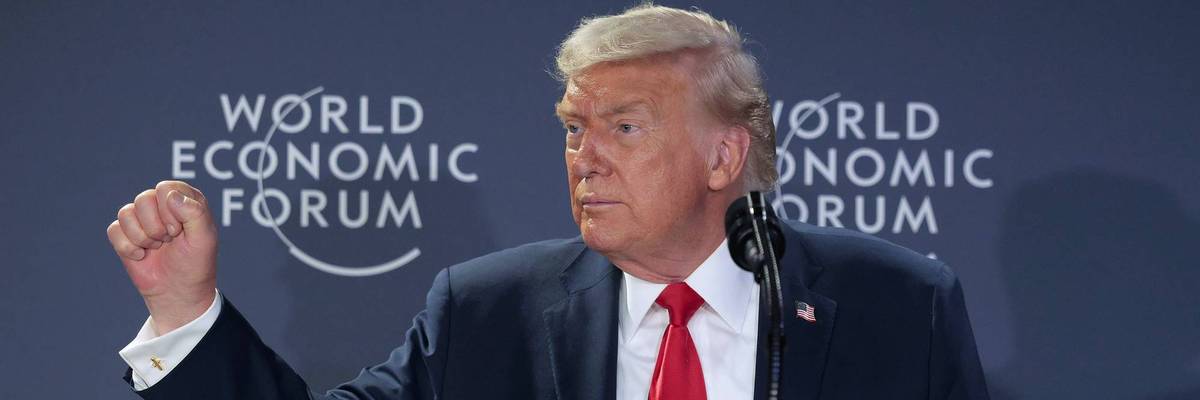
US President Donald Trump speaks during a reception for business leaders at the World Economic Forum Annual Meeting on January 21, 2026 in Davos, Switzerland.
Systems scientists have been warning for decades that the current growth-based world economic order is unsustainable. What is surprising is that its unraveling is accelerating so suddenly—and doing so largely thanks to just one man: Donald Trump.
In the wee hours of Monday, January 19, US President Donald Trump sent a now-infamous text message to the prime minister of Denmark:
Considering your Country decided not to give me the Nobel Peace Prize for having stopped 8 Wars PLUS, I no longer feel an obligation to think purely of Peace, although it will always be predominant, but can now think about what is good and proper for the United States of America... The World is not secure unless we have Complete and Total Control of Greenland. Thank you!
Trump’s brief, belligerent message (full text and analysis here) underscores a stark reality: One man is causing an acceleration of civilizational collapse.
Only hours later, at the annual gathering of world political and financial leaders at the World Economic Forum in Davos, Switzerland, a general sense of fear and dread enveloped the proceedings. Even Trump’s half-hearted announcement that he wouldn’t use force to acquire Greenland couldn’t lift the gloom. The most memorable speech was that of Canadian Prime Minister Mark Carney, who began by saying:
Today, I’ll talk about the rupture in the world order, the end of a nice story, and the beginning of a brutal reality where geopolitics among the great powers is not subject to any constraints... But let’s be clear-eyed about where this leads. A world of fortresses will be poorer, more fragile, and less sustainable...
Systems scientists have been warning for decades that the current growth-based world economic order is unsustainable, and that it will inevitably become smaller and more simplified during the remainder of the 21st century. This downsizing is likely to be messy and sometimes violent. Meanwhile, observers who focus on geopolitics have argued that the US, which built a global empire during the 20th century, is already showing signs of decline in several respects, and that China is poised to become the next global superpower, if only briefly (that is, until the viability of global superpowers is itself outworn).
What is surprising is that this unraveling of the old order is accelerating so suddenly—and doing so largely thanks to just one man. During the last couple of decades, experts on societal collapse discussed whether the “Great Unraveling” would be a slow erosion over decades or a fast disintegration over mere years. The latest evidence (including Trump’s Greenland text) tips the scales toward a faster collapse scenario.
Since this shift is being driven largely by Donald Trump, it’s natural to wonder whether international calm could be restored simply by shunting him aside. There is, after all, growing concern over Trump’s health. (His sleepiness during daytime, his slurred speech, and his frequent frustrated fumbling for the correct word—in his Davos speech he called Greenland “Iceland” four times—have raised questions about his fitness for the job). The US Constitution provides two methods for removing an unfit president: impeachment, and the invocation of the 25th Amendment. Few informed observers of the American political scene expect either of these remedies to be implemented soon. Even if they were, Trump’s actions in the past year have irrevocably undermined stability in the US and globally. If his second presidency were to end tomorrow, Trump likely will have had as decisive an influence on history as pivotal world leaders like Winston Churchill, FDR, Vladimir Lenin, Adolf Hitler, or Joseph Stalin.
In this article we’ll explore how and why the march toward collapse is hastening, and what this trend has to do with Trump’s failure to understand social power. We’ll also explore what individuals can do in response to increasing signs of societal instability.
The conclusions about Trump and accelerating societal unraveling stated above are rooted in my studies of the nature of power (see my book Power: Limits and Prospects for Human Survival and its related limited-run podcast). Every large society, from ancient kingdoms to modern industrial empires, has had to master three elements of social power—i.e., the ability to get other people to do things. The essential problem for would-be leaders of large societies is to enlist the populace to fight wars, build pyramids (or other significant structures and institutions), and increase economic activity. But what motivates people? Typically, they respond to coercion, enticements, and persuasion. If these are the three elements of social power, then it follows that the three main tools of social power are weapons, money, and communication technologies. In the book I trace the development of these tools, and the social consequences of their progressive development and use.
In Power I also point out that there are two basic types of social power—vertical and horizontal. Vertical power is top-down, exercised through threats and punishments: “You must do this, or else,” or “If you do this, I’ll give you that.” Horizontal power is mutual and cooperative: “We can do this together”; it arises through inspiration and negotiation. Democracies tend to rely more on horizontal social power, and autocracies more on vertical power; but durable large societies seem to demand both.
When we see the military of Canada (CANADA??!!) modeling war plans for inflicting maximum casualties on US troops in the event of an invasion, it’s fair to conclude that old alliances are coming unglued fast.
Trump seems reflexively to rely solely on vertical social power—the use of threats and bribes. With such means, he has taken control of the Republican Party, won the presidency twice, and dominated Congress to the point that it has become virtually inert. He has been successful largely because horizontal power relationships in the US have been under increasing strain during the last few decades for several reasons, notably fast-rising economic inequality. From one perspective, his achievements are remarkable. Trump seems to understand power better than any other leader on the national stage. But his understanding of power is one-dimensional.
Trump seems profoundly ignorant of, or indifferent to, horizontal power. He has squandered the goodwill of allies and needlessly created international enemies. Again, Carney at Davos:
The multilateral institutions on which the middle powers have relied—the WTO, the UN, the COP—the architecture, the very architecture of collective problem solving are under threat. And as a result, many countries are drawing the same conclusions: that they must develop greater strategic autonomy, in energy, food, critical minerals, in finance and supply chains... Call it what it is—a system of intensifying great power rivalry, where the most powerful pursue their interests, using economic integration as coercion.
Even authoritarian nations, if they’re to outlive their leader, need buy-in from citizens and allies. Chinese citizens, for example, expect stability and predictability while rapid economic growth improves their economic prospects. They also know that they will face severe penalties if they speak out against the regime, and they (mostly) willingly comply. Americans, however, thanks to Trump’s poor understanding of power, can now expect much less stability and predictability amid economic stagnation or even reversal. And many will be increasingly unwilling to comply.
Trump’s Deputy Chief of Staff Stephen Miller recently told CNN’s Jake Tapper,
...[Y]ou can talk all you want about international niceties and everything else, but we live in a world, in the real world... that is governed by strength, that is governed by force, that is governed by power. These are the iron laws of the world.
Trump is not the first world leader to rely almost exclusively on vertical social power. History is replete with authoritarian regimes and tyrants. Here’s an excerpt from a 3,000-year-old cuneiform text from the Assyrian Empire:
I am Tiglath Pileser the powerful king, the supreme King of Lashanan; King of the four regions, King of all Kings, Lord of Lords, the supreme Monarch of all Monarchs, the illustrious chief who under the auspices of the Sun god, being armed with the scepter and girt with the girdle of power over mankind, rules over all the people of Bel; the mighty Prince whose praise is blazoned forth among the Kings...
Pileser sounds positively Trumpian.
But vertical social power, on its own, often tends to lead to revolution, coup d-état, assassination, or war. Some historical authoritarian dynasties lasted centuries (China offers several examples). However, the lifetime of many modern authoritarian regimes has been brief (for example, Pol Pot ruled Cambodia for only four years). Concentrating the power of the state in one man often makes the glue that holds the nation together more brittle. What does the future hold for Russia after Putin? Why is the post-Gaddafi regime in Libya so frail? Strongmen tend to leave power vacuums in their wake, along with weakened social institutions. The fall of a strongman doesn’t always make way for a vibrant democracy; more often, it leads to chaos and a string of other short-term strongmen. In the case of Trump, the strongman is already old and (in many observers’ opinions) infirm. He’s not overwhelmingly popular, and his likely successors are even less so. The inevitable end of Trump’s rule, whether it occurs in days or years, will leave the US far more polarized and unruly than it was in 2016 when he was first elected.
Internationally, the US system of alliances that was patiently built over seven decades has not adapted well to Trump’s style of threats and bullying. When we see the military of Canada (CANADA??!!) modeling war plans for inflicting maximum casualties on US troops in the event of an invasion, it’s fair to conclude that old alliances are coming unglued fast. And that means global peril for both peace and trade. Trump is not a solely American problem.
In Donald Trump’s hands, the perennial tools of power are becoming engines of destruction.
As I explained at some length in a recent article (which includes lots of resources and advice), local action to build community resilience is the antidote to national and global unraveling. Notice the persistent bonds of horizontal power holding your community together and engage in activities that build social ties. Strengthen local institutions, from credit unions to food co-ops. Identify and participate in international networks of trust and mutual aid, such as the Global Democracy Coalition. And learn from people in other parts of the world who have lived through authoritarian takeovers or successfully opposed them.
Build community resilience wherever you are. My organization, Post Carbon Institute, has produced books, articles, reports, and podcasts—as well as webinars and an online course—to help, and there are other organizations working along complementary lines. Our friends at Shareable have developed a fantastic set of guides (Mutual Aid 101) for anyone interested in starting a mutual aid initiative in their own community.
Collapse is accelerating. So must our efforts to build personal and community resilience. Don’t cower in front of your screen. Get out and join with others in projects to make your town stronger and more socially and environmentally sustainable.
Dear Common Dreams reader, It’s been nearly 30 years since I co-founded Common Dreams with my late wife, Lina Newhouser. We had the radical notion that journalism should serve the public good, not corporate profits. It was clear to us from the outset what it would take to build such a project. No paid advertisements. No corporate sponsors. No millionaire publisher telling us what to think or do. Many people said we wouldn't last a year, but we proved those doubters wrong. Together with a tremendous team of journalists and dedicated staff, we built an independent media outlet free from the constraints of profits and corporate control. Our mission has always been simple: To inform. To inspire. To ignite change for the common good. Building Common Dreams was not easy. Our survival was never guaranteed. When you take on the most powerful forces—Wall Street greed, fossil fuel industry destruction, Big Tech lobbyists, and uber-rich oligarchs who have spent billions upon billions rigging the economy and democracy in their favor—the only bulwark you have is supporters who believe in your work. But here’s the urgent message from me today. It's never been this bad out there. And it's never been this hard to keep us going. At the very moment Common Dreams is most needed, the threats we face are intensifying. We need your support now more than ever. We don't accept corporate advertising and never will. We don't have a paywall because we don't think people should be blocked from critical news based on their ability to pay. Everything we do is funded by the donations of readers like you. When everyone does the little they can afford, we are strong. But if that support retreats or dries up, so do we. Will you donate now to make sure Common Dreams not only survives but thrives? —Craig Brown, Co-founder |
In the wee hours of Monday, January 19, US President Donald Trump sent a now-infamous text message to the prime minister of Denmark:
Considering your Country decided not to give me the Nobel Peace Prize for having stopped 8 Wars PLUS, I no longer feel an obligation to think purely of Peace, although it will always be predominant, but can now think about what is good and proper for the United States of America... The World is not secure unless we have Complete and Total Control of Greenland. Thank you!
Trump’s brief, belligerent message (full text and analysis here) underscores a stark reality: One man is causing an acceleration of civilizational collapse.
Only hours later, at the annual gathering of world political and financial leaders at the World Economic Forum in Davos, Switzerland, a general sense of fear and dread enveloped the proceedings. Even Trump’s half-hearted announcement that he wouldn’t use force to acquire Greenland couldn’t lift the gloom. The most memorable speech was that of Canadian Prime Minister Mark Carney, who began by saying:
Today, I’ll talk about the rupture in the world order, the end of a nice story, and the beginning of a brutal reality where geopolitics among the great powers is not subject to any constraints... But let’s be clear-eyed about where this leads. A world of fortresses will be poorer, more fragile, and less sustainable...
Systems scientists have been warning for decades that the current growth-based world economic order is unsustainable, and that it will inevitably become smaller and more simplified during the remainder of the 21st century. This downsizing is likely to be messy and sometimes violent. Meanwhile, observers who focus on geopolitics have argued that the US, which built a global empire during the 20th century, is already showing signs of decline in several respects, and that China is poised to become the next global superpower, if only briefly (that is, until the viability of global superpowers is itself outworn).
What is surprising is that this unraveling of the old order is accelerating so suddenly—and doing so largely thanks to just one man. During the last couple of decades, experts on societal collapse discussed whether the “Great Unraveling” would be a slow erosion over decades or a fast disintegration over mere years. The latest evidence (including Trump’s Greenland text) tips the scales toward a faster collapse scenario.
Since this shift is being driven largely by Donald Trump, it’s natural to wonder whether international calm could be restored simply by shunting him aside. There is, after all, growing concern over Trump’s health. (His sleepiness during daytime, his slurred speech, and his frequent frustrated fumbling for the correct word—in his Davos speech he called Greenland “Iceland” four times—have raised questions about his fitness for the job). The US Constitution provides two methods for removing an unfit president: impeachment, and the invocation of the 25th Amendment. Few informed observers of the American political scene expect either of these remedies to be implemented soon. Even if they were, Trump’s actions in the past year have irrevocably undermined stability in the US and globally. If his second presidency were to end tomorrow, Trump likely will have had as decisive an influence on history as pivotal world leaders like Winston Churchill, FDR, Vladimir Lenin, Adolf Hitler, or Joseph Stalin.
In this article we’ll explore how and why the march toward collapse is hastening, and what this trend has to do with Trump’s failure to understand social power. We’ll also explore what individuals can do in response to increasing signs of societal instability.
The conclusions about Trump and accelerating societal unraveling stated above are rooted in my studies of the nature of power (see my book Power: Limits and Prospects for Human Survival and its related limited-run podcast). Every large society, from ancient kingdoms to modern industrial empires, has had to master three elements of social power—i.e., the ability to get other people to do things. The essential problem for would-be leaders of large societies is to enlist the populace to fight wars, build pyramids (or other significant structures and institutions), and increase economic activity. But what motivates people? Typically, they respond to coercion, enticements, and persuasion. If these are the three elements of social power, then it follows that the three main tools of social power are weapons, money, and communication technologies. In the book I trace the development of these tools, and the social consequences of their progressive development and use.
In Power I also point out that there are two basic types of social power—vertical and horizontal. Vertical power is top-down, exercised through threats and punishments: “You must do this, or else,” or “If you do this, I’ll give you that.” Horizontal power is mutual and cooperative: “We can do this together”; it arises through inspiration and negotiation. Democracies tend to rely more on horizontal social power, and autocracies more on vertical power; but durable large societies seem to demand both.
When we see the military of Canada (CANADA??!!) modeling war plans for inflicting maximum casualties on US troops in the event of an invasion, it’s fair to conclude that old alliances are coming unglued fast.
Trump seems reflexively to rely solely on vertical social power—the use of threats and bribes. With such means, he has taken control of the Republican Party, won the presidency twice, and dominated Congress to the point that it has become virtually inert. He has been successful largely because horizontal power relationships in the US have been under increasing strain during the last few decades for several reasons, notably fast-rising economic inequality. From one perspective, his achievements are remarkable. Trump seems to understand power better than any other leader on the national stage. But his understanding of power is one-dimensional.
Trump seems profoundly ignorant of, or indifferent to, horizontal power. He has squandered the goodwill of allies and needlessly created international enemies. Again, Carney at Davos:
The multilateral institutions on which the middle powers have relied—the WTO, the UN, the COP—the architecture, the very architecture of collective problem solving are under threat. And as a result, many countries are drawing the same conclusions: that they must develop greater strategic autonomy, in energy, food, critical minerals, in finance and supply chains... Call it what it is—a system of intensifying great power rivalry, where the most powerful pursue their interests, using economic integration as coercion.
Even authoritarian nations, if they’re to outlive their leader, need buy-in from citizens and allies. Chinese citizens, for example, expect stability and predictability while rapid economic growth improves their economic prospects. They also know that they will face severe penalties if they speak out against the regime, and they (mostly) willingly comply. Americans, however, thanks to Trump’s poor understanding of power, can now expect much less stability and predictability amid economic stagnation or even reversal. And many will be increasingly unwilling to comply.
Trump’s Deputy Chief of Staff Stephen Miller recently told CNN’s Jake Tapper,
...[Y]ou can talk all you want about international niceties and everything else, but we live in a world, in the real world... that is governed by strength, that is governed by force, that is governed by power. These are the iron laws of the world.
Trump is not the first world leader to rely almost exclusively on vertical social power. History is replete with authoritarian regimes and tyrants. Here’s an excerpt from a 3,000-year-old cuneiform text from the Assyrian Empire:
I am Tiglath Pileser the powerful king, the supreme King of Lashanan; King of the four regions, King of all Kings, Lord of Lords, the supreme Monarch of all Monarchs, the illustrious chief who under the auspices of the Sun god, being armed with the scepter and girt with the girdle of power over mankind, rules over all the people of Bel; the mighty Prince whose praise is blazoned forth among the Kings...
Pileser sounds positively Trumpian.
But vertical social power, on its own, often tends to lead to revolution, coup d-état, assassination, or war. Some historical authoritarian dynasties lasted centuries (China offers several examples). However, the lifetime of many modern authoritarian regimes has been brief (for example, Pol Pot ruled Cambodia for only four years). Concentrating the power of the state in one man often makes the glue that holds the nation together more brittle. What does the future hold for Russia after Putin? Why is the post-Gaddafi regime in Libya so frail? Strongmen tend to leave power vacuums in their wake, along with weakened social institutions. The fall of a strongman doesn’t always make way for a vibrant democracy; more often, it leads to chaos and a string of other short-term strongmen. In the case of Trump, the strongman is already old and (in many observers’ opinions) infirm. He’s not overwhelmingly popular, and his likely successors are even less so. The inevitable end of Trump’s rule, whether it occurs in days or years, will leave the US far more polarized and unruly than it was in 2016 when he was first elected.
Internationally, the US system of alliances that was patiently built over seven decades has not adapted well to Trump’s style of threats and bullying. When we see the military of Canada (CANADA??!!) modeling war plans for inflicting maximum casualties on US troops in the event of an invasion, it’s fair to conclude that old alliances are coming unglued fast. And that means global peril for both peace and trade. Trump is not a solely American problem.
In Donald Trump’s hands, the perennial tools of power are becoming engines of destruction.
As I explained at some length in a recent article (which includes lots of resources and advice), local action to build community resilience is the antidote to national and global unraveling. Notice the persistent bonds of horizontal power holding your community together and engage in activities that build social ties. Strengthen local institutions, from credit unions to food co-ops. Identify and participate in international networks of trust and mutual aid, such as the Global Democracy Coalition. And learn from people in other parts of the world who have lived through authoritarian takeovers or successfully opposed them.
Build community resilience wherever you are. My organization, Post Carbon Institute, has produced books, articles, reports, and podcasts—as well as webinars and an online course—to help, and there are other organizations working along complementary lines. Our friends at Shareable have developed a fantastic set of guides (Mutual Aid 101) for anyone interested in starting a mutual aid initiative in their own community.
Collapse is accelerating. So must our efforts to build personal and community resilience. Don’t cower in front of your screen. Get out and join with others in projects to make your town stronger and more socially and environmentally sustainable.
In the wee hours of Monday, January 19, US President Donald Trump sent a now-infamous text message to the prime minister of Denmark:
Considering your Country decided not to give me the Nobel Peace Prize for having stopped 8 Wars PLUS, I no longer feel an obligation to think purely of Peace, although it will always be predominant, but can now think about what is good and proper for the United States of America... The World is not secure unless we have Complete and Total Control of Greenland. Thank you!
Trump’s brief, belligerent message (full text and analysis here) underscores a stark reality: One man is causing an acceleration of civilizational collapse.
Only hours later, at the annual gathering of world political and financial leaders at the World Economic Forum in Davos, Switzerland, a general sense of fear and dread enveloped the proceedings. Even Trump’s half-hearted announcement that he wouldn’t use force to acquire Greenland couldn’t lift the gloom. The most memorable speech was that of Canadian Prime Minister Mark Carney, who began by saying:
Today, I’ll talk about the rupture in the world order, the end of a nice story, and the beginning of a brutal reality where geopolitics among the great powers is not subject to any constraints... But let’s be clear-eyed about where this leads. A world of fortresses will be poorer, more fragile, and less sustainable...
Systems scientists have been warning for decades that the current growth-based world economic order is unsustainable, and that it will inevitably become smaller and more simplified during the remainder of the 21st century. This downsizing is likely to be messy and sometimes violent. Meanwhile, observers who focus on geopolitics have argued that the US, which built a global empire during the 20th century, is already showing signs of decline in several respects, and that China is poised to become the next global superpower, if only briefly (that is, until the viability of global superpowers is itself outworn).
What is surprising is that this unraveling of the old order is accelerating so suddenly—and doing so largely thanks to just one man. During the last couple of decades, experts on societal collapse discussed whether the “Great Unraveling” would be a slow erosion over decades or a fast disintegration over mere years. The latest evidence (including Trump’s Greenland text) tips the scales toward a faster collapse scenario.
Since this shift is being driven largely by Donald Trump, it’s natural to wonder whether international calm could be restored simply by shunting him aside. There is, after all, growing concern over Trump’s health. (His sleepiness during daytime, his slurred speech, and his frequent frustrated fumbling for the correct word—in his Davos speech he called Greenland “Iceland” four times—have raised questions about his fitness for the job). The US Constitution provides two methods for removing an unfit president: impeachment, and the invocation of the 25th Amendment. Few informed observers of the American political scene expect either of these remedies to be implemented soon. Even if they were, Trump’s actions in the past year have irrevocably undermined stability in the US and globally. If his second presidency were to end tomorrow, Trump likely will have had as decisive an influence on history as pivotal world leaders like Winston Churchill, FDR, Vladimir Lenin, Adolf Hitler, or Joseph Stalin.
In this article we’ll explore how and why the march toward collapse is hastening, and what this trend has to do with Trump’s failure to understand social power. We’ll also explore what individuals can do in response to increasing signs of societal instability.
The conclusions about Trump and accelerating societal unraveling stated above are rooted in my studies of the nature of power (see my book Power: Limits and Prospects for Human Survival and its related limited-run podcast). Every large society, from ancient kingdoms to modern industrial empires, has had to master three elements of social power—i.e., the ability to get other people to do things. The essential problem for would-be leaders of large societies is to enlist the populace to fight wars, build pyramids (or other significant structures and institutions), and increase economic activity. But what motivates people? Typically, they respond to coercion, enticements, and persuasion. If these are the three elements of social power, then it follows that the three main tools of social power are weapons, money, and communication technologies. In the book I trace the development of these tools, and the social consequences of their progressive development and use.
In Power I also point out that there are two basic types of social power—vertical and horizontal. Vertical power is top-down, exercised through threats and punishments: “You must do this, or else,” or “If you do this, I’ll give you that.” Horizontal power is mutual and cooperative: “We can do this together”; it arises through inspiration and negotiation. Democracies tend to rely more on horizontal social power, and autocracies more on vertical power; but durable large societies seem to demand both.
When we see the military of Canada (CANADA??!!) modeling war plans for inflicting maximum casualties on US troops in the event of an invasion, it’s fair to conclude that old alliances are coming unglued fast.
Trump seems reflexively to rely solely on vertical social power—the use of threats and bribes. With such means, he has taken control of the Republican Party, won the presidency twice, and dominated Congress to the point that it has become virtually inert. He has been successful largely because horizontal power relationships in the US have been under increasing strain during the last few decades for several reasons, notably fast-rising economic inequality. From one perspective, his achievements are remarkable. Trump seems to understand power better than any other leader on the national stage. But his understanding of power is one-dimensional.
Trump seems profoundly ignorant of, or indifferent to, horizontal power. He has squandered the goodwill of allies and needlessly created international enemies. Again, Carney at Davos:
The multilateral institutions on which the middle powers have relied—the WTO, the UN, the COP—the architecture, the very architecture of collective problem solving are under threat. And as a result, many countries are drawing the same conclusions: that they must develop greater strategic autonomy, in energy, food, critical minerals, in finance and supply chains... Call it what it is—a system of intensifying great power rivalry, where the most powerful pursue their interests, using economic integration as coercion.
Even authoritarian nations, if they’re to outlive their leader, need buy-in from citizens and allies. Chinese citizens, for example, expect stability and predictability while rapid economic growth improves their economic prospects. They also know that they will face severe penalties if they speak out against the regime, and they (mostly) willingly comply. Americans, however, thanks to Trump’s poor understanding of power, can now expect much less stability and predictability amid economic stagnation or even reversal. And many will be increasingly unwilling to comply.
Trump’s Deputy Chief of Staff Stephen Miller recently told CNN’s Jake Tapper,
...[Y]ou can talk all you want about international niceties and everything else, but we live in a world, in the real world... that is governed by strength, that is governed by force, that is governed by power. These are the iron laws of the world.
Trump is not the first world leader to rely almost exclusively on vertical social power. History is replete with authoritarian regimes and tyrants. Here’s an excerpt from a 3,000-year-old cuneiform text from the Assyrian Empire:
I am Tiglath Pileser the powerful king, the supreme King of Lashanan; King of the four regions, King of all Kings, Lord of Lords, the supreme Monarch of all Monarchs, the illustrious chief who under the auspices of the Sun god, being armed with the scepter and girt with the girdle of power over mankind, rules over all the people of Bel; the mighty Prince whose praise is blazoned forth among the Kings...
Pileser sounds positively Trumpian.
But vertical social power, on its own, often tends to lead to revolution, coup d-état, assassination, or war. Some historical authoritarian dynasties lasted centuries (China offers several examples). However, the lifetime of many modern authoritarian regimes has been brief (for example, Pol Pot ruled Cambodia for only four years). Concentrating the power of the state in one man often makes the glue that holds the nation together more brittle. What does the future hold for Russia after Putin? Why is the post-Gaddafi regime in Libya so frail? Strongmen tend to leave power vacuums in their wake, along with weakened social institutions. The fall of a strongman doesn’t always make way for a vibrant democracy; more often, it leads to chaos and a string of other short-term strongmen. In the case of Trump, the strongman is already old and (in many observers’ opinions) infirm. He’s not overwhelmingly popular, and his likely successors are even less so. The inevitable end of Trump’s rule, whether it occurs in days or years, will leave the US far more polarized and unruly than it was in 2016 when he was first elected.
Internationally, the US system of alliances that was patiently built over seven decades has not adapted well to Trump’s style of threats and bullying. When we see the military of Canada (CANADA??!!) modeling war plans for inflicting maximum casualties on US troops in the event of an invasion, it’s fair to conclude that old alliances are coming unglued fast. And that means global peril for both peace and trade. Trump is not a solely American problem.
In Donald Trump’s hands, the perennial tools of power are becoming engines of destruction.
As I explained at some length in a recent article (which includes lots of resources and advice), local action to build community resilience is the antidote to national and global unraveling. Notice the persistent bonds of horizontal power holding your community together and engage in activities that build social ties. Strengthen local institutions, from credit unions to food co-ops. Identify and participate in international networks of trust and mutual aid, such as the Global Democracy Coalition. And learn from people in other parts of the world who have lived through authoritarian takeovers or successfully opposed them.
Build community resilience wherever you are. My organization, Post Carbon Institute, has produced books, articles, reports, and podcasts—as well as webinars and an online course—to help, and there are other organizations working along complementary lines. Our friends at Shareable have developed a fantastic set of guides (Mutual Aid 101) for anyone interested in starting a mutual aid initiative in their own community.
Collapse is accelerating. So must our efforts to build personal and community resilience. Don’t cower in front of your screen. Get out and join with others in projects to make your town stronger and more socially and environmentally sustainable.