

5
#000000
#FFFFFF
To donate by check, phone, or other method, see our More Ways to Give page.

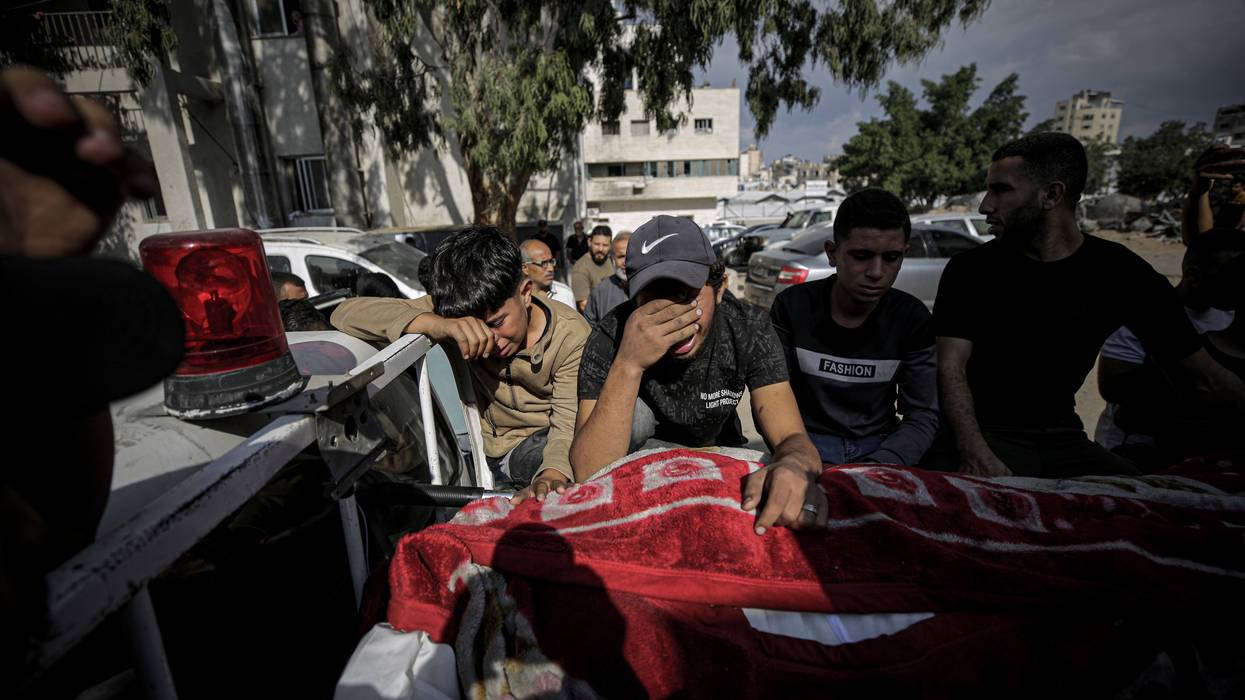

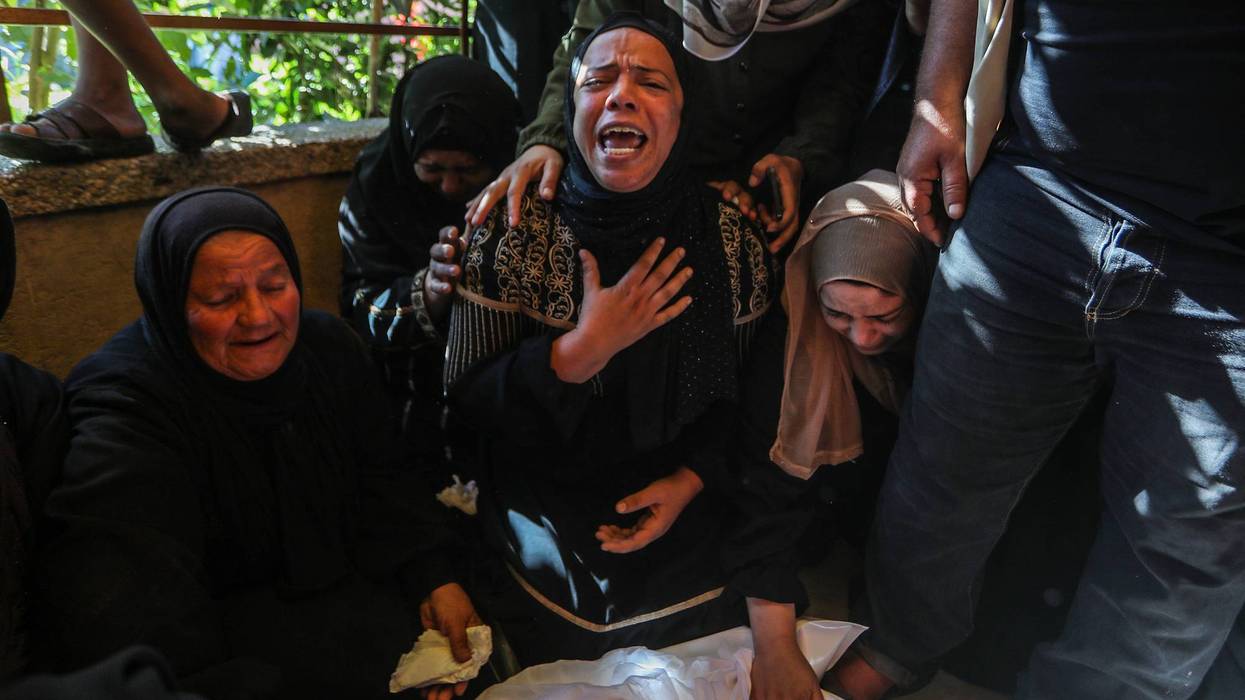
"It's really beyond what words can say, and it gives the sense that the destruction of Gaza is not over," the 49-year-old Italian jurist continued. "Seventy percent of the strip is under the control of the [Israeli] army, which is leveling as much as it can. There is an environmental catastrophe, a humanitarian catastrophe."
Israel's assault on Gaza began in the immediate aftermath of the Hamas-led attack of October 7, 2023, in which more than 1,100 Israelis and others were killed—at least some by so-called “friendly fire” and under the fratricidal Hannibal Directive—and over 240 people were abducted.
Prime Minister Benjamin Netanyahu and other Israeli officials soon began calling for the genocidal destruction of Gaza and its 2.2 million people. Netanyahu declared it a "holy mission" for Israel to fulfill a divine command to the Israelites to exterminate every man, woman, child, and animal in Amalek, the fictional archenemy of the ancient Jews.
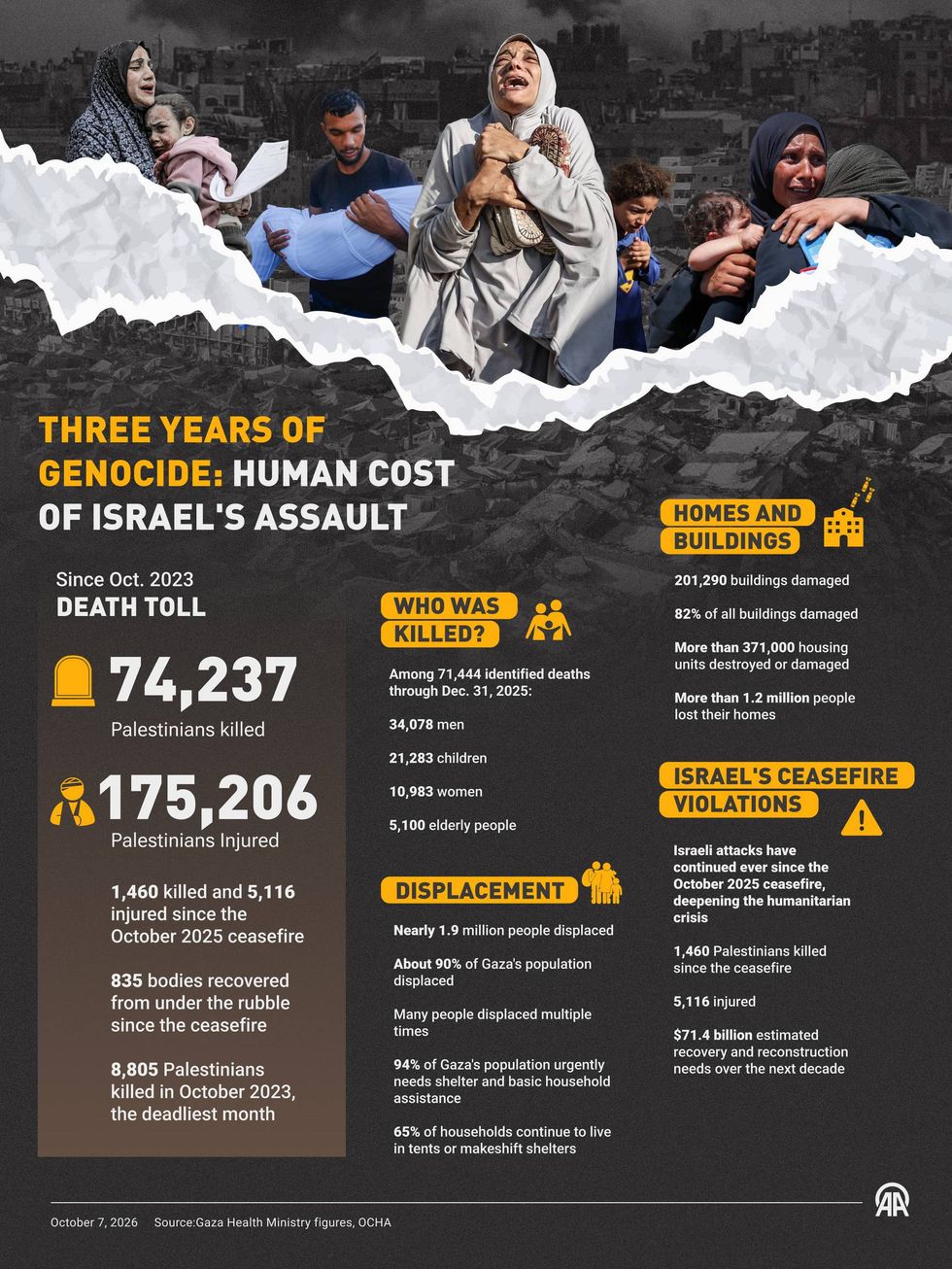
Over the past three years, Israeli forces have killed at least 74,237 Palestinians and wounded at least 175,206 others in Gaza, according to Gaza Health Ministry figures—which not only have been affirmed by senior Israeli military and intelligence officials, but are believed by the authors of multiple peer-reviewed scientific studies to be a significant undercount.
Tens of thousands of those injuries are classified as "life-altering," including thousands of amputations performed on adults and children, sometimes without anesthesia.
The Gaza Health Ministry says more than 10,000 of those killed were women, over 5,100 were elderly, and upward of 21,000 were children—figures supported by classified Israel Defense Forces intelligence data suggesting that 5 in 6 Palestinians killed by the IDF through the first 19 months of the onslaught were civilians.
Tens of thousands of children have also been left without one or both parents, with more than 2,700 families suffering so many deaths that they were erased from the civil registry in Gaza. The UN Children's Fund called the strip the "world's most dangerous place to be a child."
In the wake of the October 7 attack, the IDF dramatically loosened rules of engagement, effectively allowing an unlimited number of civilians to be killed when targeting a single Hamas member, no matter how low-ranking. The IDF’s use of massive ordnance, including US-supplied 1,000- and 2,000-pound “bunker buster” bombs, and the utilization of artificial intelligence to select targets, have resulted in staggering numbers of civilian deaths, including numerous instances of dozens or more people being massacred in single strikes.
At closer range, current and former IDF troops have accused their own of deliberately shooting Palestinian civilians, including children, sometimes out of sheer boredom. Palestinian medical professionals—who, like journalists and aid workers, have suffered hundreds of their ranks killed by Israeli bombs and bullets—have also described what they say is the deliberate shooting of Gazans, including children.
On October 8, 2023, then-Israeli Defense Minister Yoav Gallant ordered the "complete siege" of Gaza, explaining that "we are fighting human animals, and we are acting accordingly." The siege, which is actually a tightening of a decadeslong blockade of Gaza, fueled famine and disease that killed many of the most vulnerable people in the strip. Nothing was spared, including hospitals and other medical facilities, whose staff members were sometimes abducted and tortured—allegedly to death in at least one case—by their Israeli captors.
Around 90% of Gaza's population—around 1.9 million people—has been forcibly displaced, most of them multiple times. With the vast bulk of Gaza's buildings damaged or destroyed, nearly two-thirds of Gazans continue to live in tents or makeshift shelters as the war's fourth winter, and with it the prospect of more infants and newborns dying of hypothermia, approaches.
Despite a purported year-old ceasefire, Israeli forces continue to kill, wound, and displace Palestinians in Gaza to this day. Gaza officials say that at least 1,460 people have been killed and more than 5,100 others have been wounded since the ceasefire took effect. Israel is still blocking or delaying desperately needed humanitarian aid from entering Gaza, although there have been some improvements in delivery during the ceasefire period.
Meanwhile, Israeli calls for more ethnic cleansing, occupation, and possibly even the Jewish recolonization of Gaza continue. And while President Donald Trump no longer openly discusses a US takeover and redevelopment of the Mediterranean strip into the "Riviera of the Middle East," his administration is still trying to determine Gaza's future through vehicles like his widely derided "Board of Peace."
In November 2024, the International Criminal Court in The Hague, Netherlands issued arrest warrants for Netanyahu and Gallant for alleged war crimes and crimes against humanity in Gaza, including murder and forced starvation. The ICC simultaneously ordered the arrest of three senior Hamas officials, but Israel has since assassinated them.
The International Court of Justice (ICJ), also in The Hague, is currently in the written stage of a genocide case against Israel brought by South Africa and formally supported by more than 15 nations. While a ruling in the case isn't expected until at least the end of the decade, a UN commission of inquiry, the International Association of Genocide Scholars, and other experts—including many Israeli and international Jewish academics, jurists, human rights campaigners, and others—have already concluded that Israel is committing genocide in Gaza.
Yet genocide denial persists in Israel, the United States, and among supporters of Israel's destruction of Gaza around the world. And while numerous nations have severed diplomatic ties with Israel or imposed sanctions—sometimes both—the United States under both the Biden and Trump administrations has lavished the key Middle East ally with tens of billions of dollars in armed aid, as well as diplomatic cover including a string of vetoes of UN Security Council ceasefire resolutions.
Furthermore, the Trump administration has moved to punish members of the ICC, ICJ, and UN, including Albanese—who has been relentlessly critical of both Israel's genocide and Western complicity, especially by the United States.
On the other hand, increasing diplomatic recognition of Palestine by even Israel's allies and a worldwide wave of protests against the Gaza genocide—including numerous demonstrations organized and led by Jewish groups—has shown Palestinians that much of the world stands in solidarity with them.
"There are really these two forces... symbolically, fighting against each other," Albanese told Anadolu during Wednesday's interview. "Those who want to continue the genocide, the exploitation, and the erasure of Palestine, and those who want to stop it."

Israeli officials and Western supporters have trumpeted the IDF's list as a counter to findings by groups like International Federation of Journalists, which has described Israel's nearly three-year-old war in Gaza as “the deadliest period in the history of journalism" and cataloged at least 240 journalists and media workers killed.
Reporters Without Borders (RSF) has found dozens of cases in which it concluded journalists were targeted deliberately because of their reporting and filed multiple complaints with the International Criminal Court (ICC) alleging war crimes against the press.
The database, which the IDF refers to as the "Press Files," says "that claim does not tell the full story" and states that "individuals presented as innocent journalists were, in fact, militants in the military wings of Hamas, Palestinian Islamic Jihad (PIJ) and other terrorist organizations."
The IDF claims the list was the product of an “in-depth investigation” consisting of open-source information, documents recovered by Israeli forces in Gaza, interrogations of alleged Palestinian militants, and intelligence gathered during military operations.
But as Shehada explained in a thread posted to social media on Sunday, "In the overwhelming majority of those listed, the IDF presents ZERO credible evidence. In most of them, their pages are literally blank."
In 59 cases, Shehada found that the IDF did not provide any evidence for its claim that a journalist was a member of Hamas or PIJ other than that the claim was "based on multiple intelligence sources."
Shehada said this amounted to essentially saying "trust me, bro," which is especially insufficient given the numerous instances in which the IDF has been found to have misled the public about its responsibility for certain attacks, like the killing of 5-year-old Hind Rajab in 2024.
In another 42 cases, Shehada found, the IDF provided only decontextualized "snippets" of files, which were "undated and unspecified." Without more information, Shehada said, this is "not... evidence of anything."
"Those snippets could be taken from random files; they could be outdated or fabricated," Shehada said, pointing to previous cases in which purported Hamas intelligence circulated by Israeli sources was later revealed to be misleadingly presented as fabricated.
Shehada pointed to specific cases in which Israel's allegations against specific journalists have been undermined by the underlying evidence.
Israel claimed that Al Jazeera reporter Ismail al-Ghoul, whom the IDF killed in July 2024, was an operative with Hamas' elite Nukhba wing and released a supposed Hamas personnel document as proof.
But as Reporters Without Borders has previously explained, the document says al-Ghoul, born in 1997, received a military rank in 2007, when he was 10, while elsewhere saying he joined in 2014. It also identifies him as an engineer, contradicting the IDF’s description of him as a Nukhba fighter. Israeli troops also detained al-Ghoul at al-Shifa hospital months before he was killed but released him after 12 hours.
The case of Anas al-Sharif, another Al Jazeera journalist killed in 2025, is similar. As Shehada documented for +972 magazine last year, al-Sharif was seriously injured in 2017, listed in a military context in 2019, but described as “suspended” and “unassigned” by 2023—while another document nevertheless portrays him as an elite Nukhba fighter. He was also reportedly detained and released by Israeli forces during the 2024 al-Shifa raid.
In other cases, the IDF's evidence outright debunks the military's own claims. For instance, Israel labeled photojournalist Hassan Aslih—killed by an airstrike at Nasser Hospital in Khan Yunis in May 2025—as a "military operative." But the 2019 Hamas document provided as evidence for this lists him as a "photographer" involved with "media services."
While the document, if authentic, does establish a relationship between Aslih and Hamas' Qassam Brigades at least six years before his death, this does not make him a legitimate target under international humanitarian law, which distinguishes between those who have a “continuous combat function" and those who provide political or other indirect forms of support, like media coverage.
Shehada found at least seven cases in which the only evidence provided by the IDF was photos of slain journalists holding guns. In another 12 cases, the IDF provided undated photos of journalists allegedly taking part in Hamas or PIJ military activities.
Shehada noted that many prominent Israeli journalists also have past military service, such as Axios correspondent Barak Ravid, who was an IDF reservist until 2023. "Does that make him a 'legitimate target'? or a non-civilian forever?" Shehada asked.
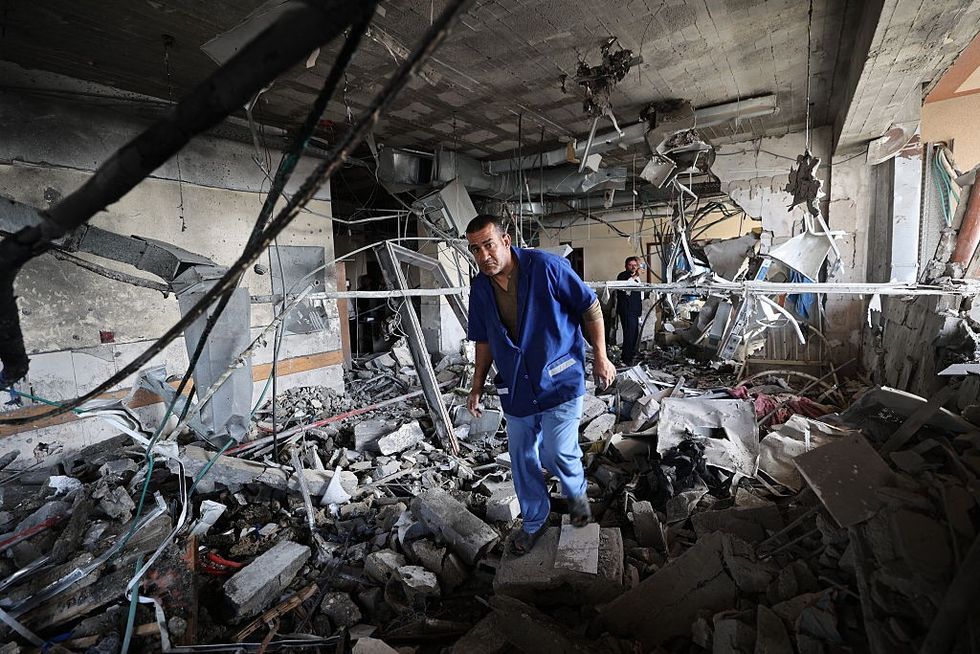 Palestinian hospital staff inspect the destruction inside Nasser hospital in Khan Yunis in the southern Gaza Strip, following an Israeli strike early on May 13, 2025 in which Palestinian journalist Hassan Aslih was killed along with several others. (Photo by Eyad Baba/AFP)
The distinction between past military affiliation and active combatant status has been a repeated source of dispute for press freedom groups that have attempted to tally the number of journalists killed.
Last month, the Committee to Protect Journalists (CPJ) completed a sweeping review of 229 deaths after Hamas and PIJ published obituaries identifying some people listed as journalists as members of armed groups.
CPJ ultimately removed 22 people from its list, including some it found had participated in combat—but retained others despite militant obituaries, gun photos, or past organizational ties when the evidence did not establish active combatant status.
The "Press Files" database contains 49 cases in which the main piece of evidence is one of these obituaries. Among them are people who CPJ examined and concluded were not active combatants, such as photojournalist Amr Abu Odeh—a 26-year-old freelance photographer for the Anadolu Agency and Reuters—whom the IDF database labels a Hamas "squad commander."
CPJ examined photos of Odeh wearing a military uniform, which came from a 2021 military training course with Gaza's Ministry of the Interior. The group noted that "No armed factions in Gaza have claimed Abu Odeh as being affiliated with them, and the IDF has not alleged he was involved in combat."
"In multiple cases, despite obituaries by Hamas/PIJ, the Committee to Protect Journalists investigated thoroughly and concluded those journalists were NOT engaged in any militant activity during the genocide," Shehada wrote. "They may have in the past. That doesn't make them combatants forever."
He added that the flimsiness of the IDF's evidence was more striking given the sophistication of the intelligence unit it uses to "dig up dirt" on journalists to provide post hoc justification for their killings, which has been referred to internally as the "Legitimization Cell," which was revealed in a +972 investigation.
"If that's all they can provide as "evidence" (e.g. blank pages, random snippets, outdated docs) despite having formidable resources," Shehada wrote, "then it's a vindication of Gaza's journalists!"