SUBSCRIBE TO OUR FREE NEWSLETTER
Daily news & progressive opinion—funded by the people, not the corporations—delivered straight to your inbox.
5
#000000
#FFFFFF
To donate by check, phone, or other method, see our More Ways to Give page.
Daily news & progressive opinion—funded by the people, not the corporations—delivered straight to your inbox.
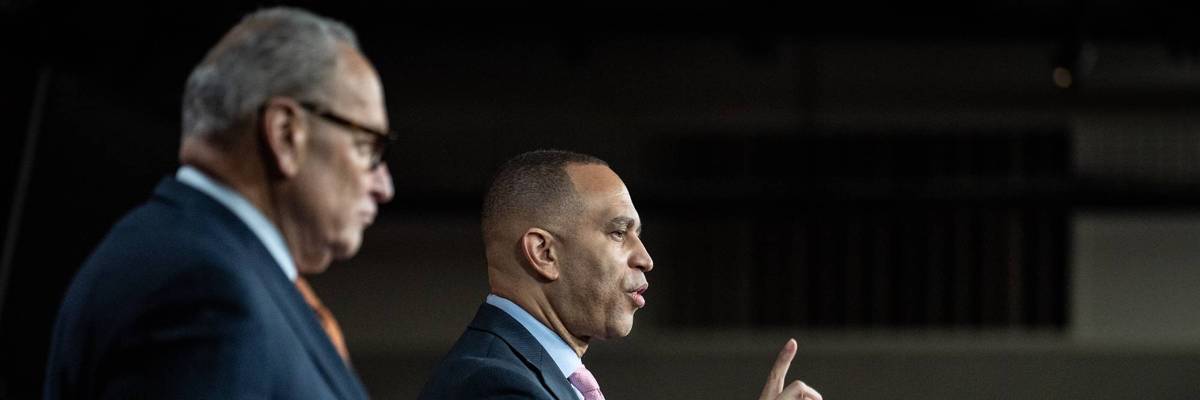
House Minority Leader Hakeem Jeffries (D-NY) and Senate Minority Leader Chuck Schumer (D-NY) hold a press conference on Thursday, January 8, 2026.
Rep. Ro Khanna said the Democrats trying to kill the bill were beholden to "powerful interests that are itching to have regime change in Iran."
Top Democrats are reportedly working behind the scenes to stop a vote that would force them to go on the record about whether they support a Trump administration attack on Iran.
As the president amasses an armada in the Middle East in apparent preparation for an unauthorized military action, Reps. Ro Khanna (D-Calif.) and Thomas Massie (R-Ky.) planned to force a vote this week on their war powers resolution, which would require congressional authorization for any attack.
The congressmen have emphasized that time is of the essence, as Trump has signaled that a strike may come any day, and Iran has indicated it may retaliate with devastating force.
A war with Iran is overwhelmingly unpopular with the American public: According to a YouGov poll published Tuesday, just 27% said they'd support military force while 49% oppose it. Democrats are even more united, with 76% saying they'd oppose a war and just 9% support.
And yet, as independent journalist Aída Chávez reported in her newsletter Capital & Empire, Democrats on the House Foreign Affairs Committee have tried to "dampen momentum and prevent the Iran war powers vote from advancing."
Multiple sources have told her that "a top Democratic HFAC staffer... deliberately inflated projections of opposition to the bipartisan measure—warning of 20 to 40 Democratic defections" in a bid to indicate the resolution would fail overwhelmingly.
She said a senior Democratic congressional staffer told her it’s “pretty clear” Democratic leadership is working to "delay or potentially sideline" the vote on the war powers resolution. “If you’ve been around the Hill, this is a familiar playbook," the staffer said.
“Leadership rarely comes out and says they oppose these votes outright, because they know the underlying issue is popular with the base,” said the staffer, who works on foreign policy. “Instead, you see process concerns, timing objections, and caucus-unity arguments used to slow things down or keep members off the record. We’ve seen the same approach on past war powers votes and foreign policy amendments that clash with the national security elite consensus.”
Democratic leaders have largely tempered their criticisms of Trump's buildup for what would be potentially the most consequential military action taken by the US in decades.
Schumer, one of the top recipients of funding from the American Israel Public Affairs Committee (AIPAC) and other pro-Israel donors, has limited his criticisms of Trump's war posturing to questions of procedure rather than policy.
Asked earlier this week about potential US strikes on Iran, Schumer lamented that discussion was being held in "closed-door briefings," saying that "the administration has to make its case to the American people as something as important as this."
Sen. Chris Coons (D-Del.), who sits on the Senate Foreign Relations Committee, issued a similar statement that did not object to war in principle but rather the fact that Trump's reasons for making war were unclear.
"The president and his administration have not tried to explain whether their goal is to destroy Iran's nuclear program, protect Iranian protestors, pursue regime change, or simply distract from hisfailure to deliver on his promises at home," Coons said in a statement posted to social media. "Congress and the American people need answers about what our objectives are in Iran."
President Donald Trump is reportedly weighing a massive military operation that could entail assassinating Iran's leaders. Meanwhile, Iran has said in the event of a massive attack, it would consider US military bases to be “legitimate targets,” meaning US servicemembers could be at risk.
As Drop Site News reported late last week, based on conversations with an unnamed aide to Schumer back in June—weeks before Trump attacked three nuclear sites in Iran—a number of important Senate Democrats believed that if Trump wants to start a war with Iran, they shouldn't stand in his way.
Not only did these Democrats believe that "Iran ultimately needed to be dealt with militarily," but they "also understood that going to war again in the Middle East would be a political catastrophe."
"That’s precisely why they wanted Trump to be the one to do it," the report continued. "The hope was that Iran would take a blow and so would Trump—a win-win for Democrats."
Other Capitol Hill sources told Chávez that, in the House, Minority Leader Hakeem Jeffries (D-NY) and other leaders have not been whipping support for the Khanna-Massie resolution, while few members have openly endorsed it, even as no other war powers resolutions are up for a vote.
Two leading pro-Israel Democrats, Rep. Jared Moskowitz (D-Fla.) and Josh Gottheimer (D-NJ), came out against the war powers resolution on Friday, with Moskowitz deriding it as the "Ayatollah Protection Act."
In a statement, they claimed that Iran was "still pursuing a nuclear weapon," even though US intelligence agencies and the United Nations' International Atomic Energy Agency (IAEA) have assessed the opposite.
Iran's leaders have expressed a willingness to reach an agreement with the United States that limits their ability to develop a nuclear weapon while allowing them to pursue peaceful nuclear technology in line with the terms of the Nuclear Nonproliferation Treaty.
The IAEA assessed that at the time Trump pulled the US out of a previous nuclear agreement in 2018, Iran was complying with its terms. Since the deal's collapse, it has begun to scale up uranium enrichment, according to a report by the agency last year.
During an interview on the podcast Breaking Points on Tuesday, Khanna said that the Democrats who have sought to kill his bill were being guided by "powerful interests that are itching to have regime change in Iran."
"This has been a long-term goal of AIPAC and other groups," Khanna said. "So when you stand up and say, 'I'm going to introduce legislation to uphold the Constitution and not get us into another war,' you make enemies."
He said pro-war Democrats were going along with Trump's push for the same reason they've resisted releasing the Democratic National Committee's report assessing that former Vice President Kamala Harris' position on Israel cost her votes in the 2024 election, and have balked at saying Israel is committing a "genocide" in Gaza.
"It's not that they may disagree with it," Khanna said. "It's just that they don't want billionaires and powerful people to be targeting them."
Khanna said he plans to meet with other House Democrats on Wednesday to rally the votes for his resolution. He says he believes he'll have enough support to force a vote on the resolution by next week, but that "it's taking work."
"There are a lot of people in Congress," he said, "who just would prefer that these issues go away."
Dear Common Dreams reader, It’s been nearly 30 years since I co-founded Common Dreams with my late wife, Lina Newhouser. We had the radical notion that journalism should serve the public good, not corporate profits. It was clear to us from the outset what it would take to build such a project. No paid advertisements. No corporate sponsors. No millionaire publisher telling us what to think or do. Many people said we wouldn't last a year, but we proved those doubters wrong. Together with a tremendous team of journalists and dedicated staff, we built an independent media outlet free from the constraints of profits and corporate control. Our mission has always been simple: To inform. To inspire. To ignite change for the common good. Building Common Dreams was not easy. Our survival was never guaranteed. When you take on the most powerful forces—Wall Street greed, fossil fuel industry destruction, Big Tech lobbyists, and uber-rich oligarchs who have spent billions upon billions rigging the economy and democracy in their favor—the only bulwark you have is supporters who believe in your work. But here’s the urgent message from me today. It's never been this bad out there. And it's never been this hard to keep us going. At the very moment Common Dreams is most needed, the threats we face are intensifying. We need your support now more than ever. We don't accept corporate advertising and never will. We don't have a paywall because we don't think people should be blocked from critical news based on their ability to pay. Everything we do is funded by the donations of readers like you. When everyone does the little they can afford, we are strong. But if that support retreats or dries up, so do we. Will you donate now to make sure Common Dreams not only survives but thrives? —Craig Brown, Co-founder |
Top Democrats are reportedly working behind the scenes to stop a vote that would force them to go on the record about whether they support a Trump administration attack on Iran.
As the president amasses an armada in the Middle East in apparent preparation for an unauthorized military action, Reps. Ro Khanna (D-Calif.) and Thomas Massie (R-Ky.) planned to force a vote this week on their war powers resolution, which would require congressional authorization for any attack.
The congressmen have emphasized that time is of the essence, as Trump has signaled that a strike may come any day, and Iran has indicated it may retaliate with devastating force.
A war with Iran is overwhelmingly unpopular with the American public: According to a YouGov poll published Tuesday, just 27% said they'd support military force while 49% oppose it. Democrats are even more united, with 76% saying they'd oppose a war and just 9% support.
And yet, as independent journalist Aída Chávez reported in her newsletter Capital & Empire, Democrats on the House Foreign Affairs Committee have tried to "dampen momentum and prevent the Iran war powers vote from advancing."
Multiple sources have told her that "a top Democratic HFAC staffer... deliberately inflated projections of opposition to the bipartisan measure—warning of 20 to 40 Democratic defections" in a bid to indicate the resolution would fail overwhelmingly.
She said a senior Democratic congressional staffer told her it’s “pretty clear” Democratic leadership is working to "delay or potentially sideline" the vote on the war powers resolution. “If you’ve been around the Hill, this is a familiar playbook," the staffer said.
“Leadership rarely comes out and says they oppose these votes outright, because they know the underlying issue is popular with the base,” said the staffer, who works on foreign policy. “Instead, you see process concerns, timing objections, and caucus-unity arguments used to slow things down or keep members off the record. We’ve seen the same approach on past war powers votes and foreign policy amendments that clash with the national security elite consensus.”
Democratic leaders have largely tempered their criticisms of Trump's buildup for what would be potentially the most consequential military action taken by the US in decades.
Schumer, one of the top recipients of funding from the American Israel Public Affairs Committee (AIPAC) and other pro-Israel donors, has limited his criticisms of Trump's war posturing to questions of procedure rather than policy.
Asked earlier this week about potential US strikes on Iran, Schumer lamented that discussion was being held in "closed-door briefings," saying that "the administration has to make its case to the American people as something as important as this."
Sen. Chris Coons (D-Del.), who sits on the Senate Foreign Relations Committee, issued a similar statement that did not object to war in principle but rather the fact that Trump's reasons for making war were unclear.
"The president and his administration have not tried to explain whether their goal is to destroy Iran's nuclear program, protect Iranian protestors, pursue regime change, or simply distract from hisfailure to deliver on his promises at home," Coons said in a statement posted to social media. "Congress and the American people need answers about what our objectives are in Iran."
President Donald Trump is reportedly weighing a massive military operation that could entail assassinating Iran's leaders. Meanwhile, Iran has said in the event of a massive attack, it would consider US military bases to be “legitimate targets,” meaning US servicemembers could be at risk.
As Drop Site News reported late last week, based on conversations with an unnamed aide to Schumer back in June—weeks before Trump attacked three nuclear sites in Iran—a number of important Senate Democrats believed that if Trump wants to start a war with Iran, they shouldn't stand in his way.
Not only did these Democrats believe that "Iran ultimately needed to be dealt with militarily," but they "also understood that going to war again in the Middle East would be a political catastrophe."
"That’s precisely why they wanted Trump to be the one to do it," the report continued. "The hope was that Iran would take a blow and so would Trump—a win-win for Democrats."
Other Capitol Hill sources told Chávez that, in the House, Minority Leader Hakeem Jeffries (D-NY) and other leaders have not been whipping support for the Khanna-Massie resolution, while few members have openly endorsed it, even as no other war powers resolutions are up for a vote.
Two leading pro-Israel Democrats, Rep. Jared Moskowitz (D-Fla.) and Josh Gottheimer (D-NJ), came out against the war powers resolution on Friday, with Moskowitz deriding it as the "Ayatollah Protection Act."
In a statement, they claimed that Iran was "still pursuing a nuclear weapon," even though US intelligence agencies and the United Nations' International Atomic Energy Agency (IAEA) have assessed the opposite.
Iran's leaders have expressed a willingness to reach an agreement with the United States that limits their ability to develop a nuclear weapon while allowing them to pursue peaceful nuclear technology in line with the terms of the Nuclear Nonproliferation Treaty.
The IAEA assessed that at the time Trump pulled the US out of a previous nuclear agreement in 2018, Iran was complying with its terms. Since the deal's collapse, it has begun to scale up uranium enrichment, according to a report by the agency last year.
During an interview on the podcast Breaking Points on Tuesday, Khanna said that the Democrats who have sought to kill his bill were being guided by "powerful interests that are itching to have regime change in Iran."
"This has been a long-term goal of AIPAC and other groups," Khanna said. "So when you stand up and say, 'I'm going to introduce legislation to uphold the Constitution and not get us into another war,' you make enemies."
He said pro-war Democrats were going along with Trump's push for the same reason they've resisted releasing the Democratic National Committee's report assessing that former Vice President Kamala Harris' position on Israel cost her votes in the 2024 election, and have balked at saying Israel is committing a "genocide" in Gaza.
"It's not that they may disagree with it," Khanna said. "It's just that they don't want billionaires and powerful people to be targeting them."
Khanna said he plans to meet with other House Democrats on Wednesday to rally the votes for his resolution. He says he believes he'll have enough support to force a vote on the resolution by next week, but that "it's taking work."
"There are a lot of people in Congress," he said, "who just would prefer that these issues go away."
Top Democrats are reportedly working behind the scenes to stop a vote that would force them to go on the record about whether they support a Trump administration attack on Iran.
As the president amasses an armada in the Middle East in apparent preparation for an unauthorized military action, Reps. Ro Khanna (D-Calif.) and Thomas Massie (R-Ky.) planned to force a vote this week on their war powers resolution, which would require congressional authorization for any attack.
The congressmen have emphasized that time is of the essence, as Trump has signaled that a strike may come any day, and Iran has indicated it may retaliate with devastating force.
A war with Iran is overwhelmingly unpopular with the American public: According to a YouGov poll published Tuesday, just 27% said they'd support military force while 49% oppose it. Democrats are even more united, with 76% saying they'd oppose a war and just 9% support.
And yet, as independent journalist Aída Chávez reported in her newsletter Capital & Empire, Democrats on the House Foreign Affairs Committee have tried to "dampen momentum and prevent the Iran war powers vote from advancing."
Multiple sources have told her that "a top Democratic HFAC staffer... deliberately inflated projections of opposition to the bipartisan measure—warning of 20 to 40 Democratic defections" in a bid to indicate the resolution would fail overwhelmingly.
She said a senior Democratic congressional staffer told her it’s “pretty clear” Democratic leadership is working to "delay or potentially sideline" the vote on the war powers resolution. “If you’ve been around the Hill, this is a familiar playbook," the staffer said.
“Leadership rarely comes out and says they oppose these votes outright, because they know the underlying issue is popular with the base,” said the staffer, who works on foreign policy. “Instead, you see process concerns, timing objections, and caucus-unity arguments used to slow things down or keep members off the record. We’ve seen the same approach on past war powers votes and foreign policy amendments that clash with the national security elite consensus.”
Democratic leaders have largely tempered their criticisms of Trump's buildup for what would be potentially the most consequential military action taken by the US in decades.
Schumer, one of the top recipients of funding from the American Israel Public Affairs Committee (AIPAC) and other pro-Israel donors, has limited his criticisms of Trump's war posturing to questions of procedure rather than policy.
Asked earlier this week about potential US strikes on Iran, Schumer lamented that discussion was being held in "closed-door briefings," saying that "the administration has to make its case to the American people as something as important as this."
Sen. Chris Coons (D-Del.), who sits on the Senate Foreign Relations Committee, issued a similar statement that did not object to war in principle but rather the fact that Trump's reasons for making war were unclear.
"The president and his administration have not tried to explain whether their goal is to destroy Iran's nuclear program, protect Iranian protestors, pursue regime change, or simply distract from hisfailure to deliver on his promises at home," Coons said in a statement posted to social media. "Congress and the American people need answers about what our objectives are in Iran."
President Donald Trump is reportedly weighing a massive military operation that could entail assassinating Iran's leaders. Meanwhile, Iran has said in the event of a massive attack, it would consider US military bases to be “legitimate targets,” meaning US servicemembers could be at risk.
As Drop Site News reported late last week, based on conversations with an unnamed aide to Schumer back in June—weeks before Trump attacked three nuclear sites in Iran—a number of important Senate Democrats believed that if Trump wants to start a war with Iran, they shouldn't stand in his way.
Not only did these Democrats believe that "Iran ultimately needed to be dealt with militarily," but they "also understood that going to war again in the Middle East would be a political catastrophe."
"That’s precisely why they wanted Trump to be the one to do it," the report continued. "The hope was that Iran would take a blow and so would Trump—a win-win for Democrats."
Other Capitol Hill sources told Chávez that, in the House, Minority Leader Hakeem Jeffries (D-NY) and other leaders have not been whipping support for the Khanna-Massie resolution, while few members have openly endorsed it, even as no other war powers resolutions are up for a vote.
Two leading pro-Israel Democrats, Rep. Jared Moskowitz (D-Fla.) and Josh Gottheimer (D-NJ), came out against the war powers resolution on Friday, with Moskowitz deriding it as the "Ayatollah Protection Act."
In a statement, they claimed that Iran was "still pursuing a nuclear weapon," even though US intelligence agencies and the United Nations' International Atomic Energy Agency (IAEA) have assessed the opposite.
Iran's leaders have expressed a willingness to reach an agreement with the United States that limits their ability to develop a nuclear weapon while allowing them to pursue peaceful nuclear technology in line with the terms of the Nuclear Nonproliferation Treaty.
The IAEA assessed that at the time Trump pulled the US out of a previous nuclear agreement in 2018, Iran was complying with its terms. Since the deal's collapse, it has begun to scale up uranium enrichment, according to a report by the agency last year.
During an interview on the podcast Breaking Points on Tuesday, Khanna said that the Democrats who have sought to kill his bill were being guided by "powerful interests that are itching to have regime change in Iran."
"This has been a long-term goal of AIPAC and other groups," Khanna said. "So when you stand up and say, 'I'm going to introduce legislation to uphold the Constitution and not get us into another war,' you make enemies."
He said pro-war Democrats were going along with Trump's push for the same reason they've resisted releasing the Democratic National Committee's report assessing that former Vice President Kamala Harris' position on Israel cost her votes in the 2024 election, and have balked at saying Israel is committing a "genocide" in Gaza.
"It's not that they may disagree with it," Khanna said. "It's just that they don't want billionaires and powerful people to be targeting them."
Khanna said he plans to meet with other House Democrats on Wednesday to rally the votes for his resolution. He says he believes he'll have enough support to force a vote on the resolution by next week, but that "it's taking work."
"There are a lot of people in Congress," he said, "who just would prefer that these issues go away."