

SUBSCRIBE TO OUR FREE NEWSLETTER
Daily news & progressive opinion—funded by the people, not the corporations—delivered straight to your inbox.
5
#000000
#FFFFFF
To donate by check, phone, or other method, see our More Ways to Give page.
Daily news & progressive opinion—funded by the people, not the corporations—delivered straight to your inbox.
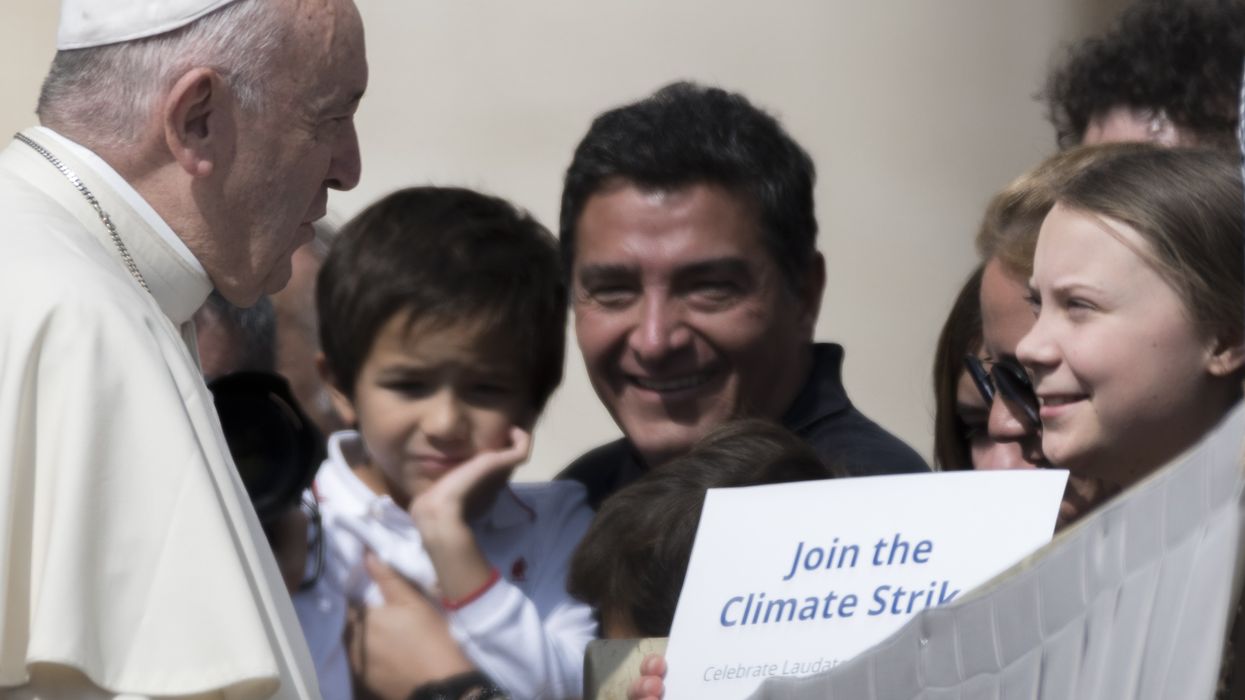
Francis’s project for the Earth—a recovery of fellow feeling, with a special attention to the poor—is the only thing that can save us over time.
Just in case I thought one couldn’t feel more forlorn right now, the word came this morning of the death of Pope Francis. It hit me hard—not because I’m a Catholic (I’m a Methodist) but because I had always felt buoyed by his remarkable spirit. If he could bring new hope and energy to an institution as hidebound as the Vatican, there was reason for all of us to go on working on our own hidebound institutions—and if he could stand so completely in solidarity with the world’s poor and vulnerable, then it gave the rest of us something to aim for.
I thought this from the start, when he became the first pope to choose the name of Francis—that countercultural blaze of possibility in a dark time—and when he showed his mastery of the art of gesture, washing the feet of women, of prisoners, of Muslim refugees. (Only Greta Thunberg, with her school strike, has so mastered the power of gesture in modern politics).
But he brought that moral resolve to the question of climate change, making it the subject of his 2015 encyclical “Laudato Si,” the most important document of his papacy and arguably the most important piece of writing so far this millennium. I spent several weeks living with that book-length epistle in order to write about it for The New York Review of Books, and though I briefly met the man himself in Rome, it is that encounter with his mind that really lives with me. “Laudato Si” is a truly remarkable document—yes, it exists as a response to the climate crisis (and it was absolutely crucial in the lead-up to the Paris climate talks, consolidating elite opinion behind the idea that some kind of deal was required). But it uses the climate crisis to talk in broad and powerful terms about modernity.
The ecological problems we face are not, in their origin, technological, says Francis. Instead, “a certain way of understanding human life and activity has gone awry, to the serious detriment of the world around us.” He is no Luddite (“who can deny the beauty of an aircraft or a skyscraper?”) but he insists that we have succumbed to a “technocratic paradigm,” which leads us to believe that “every increase in power means ‘an increase of “progress” itself’… as if reality, goodness and truth automatically flow from technological and economic power as such.” This paradigm “exalts the concept of a subject who, using logical and rational procedures, progressively approaches and gains control over an external object.” Men and women, he writes, have from the start
intervened in nature, but for a long time this meant being in tune with and respecting the possibilities offered by the things themselves. It was a matter of receiving what nature itself allowed, as if from its own hand.
In our world, however, “human beings and material objects no longer extend a friendly hand to one another; the relationship has become confrontational.” With the great power that technology has afforded us, it’s become
easy to accept the idea of infinite or unlimited growth, which proves so attractive to economists, financiers, and experts in technology. It is based on the lie that there is an infinite supply of the Earth’s goods, and this leads to the planet being squeezed dry beyond every limit.
The deterioration of the environment, he says, is just one sign of this “reductionism which affects every aspect of human and social life.”
I think Francis’s project for the Earth—a recovery of fellow feeling, with a special attention to the poor—is the only thing that can save us over time. But it will take time—obviously for the moment we’ve chosen the opposite path, as exemplified by the fact that JD Vance, scourge of the refugee, darkened his last day on Earth.
In the meantime, Francis was very much a pragmatist, and one advised by excellent scientists and engineers. As a result, he had a clear technological preference: the rapid spread of solar power everywhere. He favored it because it was clean, and because it was liberating—the best short-term hope of bringing power to those without it, and leaving that power in their hands, not the hands of some oligarch somewhere.
As a result, he followed up “Laudato Si” with a letter last summer, “Fratello Sole,” which reminds everyone that the climate crisis is powered by fossil fuel, and which goes on to say
There is a need to make a transition to a sustainable development model that reduces greenhouse gas emissions into the atmosphere, setting the goal of climate neutrality. Mankind has the technological means to deal with this environmental transformation and its pernicious ethical, social, economic, and political consequences, and, among these, solar energy plays a key role.
As a result, he ordered the Vatican to begin construction of a field of solar panels on land it owned near Rome—an agrivoltaic project that would produce not just food but enough solar power to entirely power the city-state that is the Vatican. It is designed, in his words, to provide “the complete energy sustenance of Vatican City State.” That is to say, this will soon be the first nation powered entirely by the sun.
The level of emotion—of love—in this decision is notable. The pope named “Laudato Si” (“Praised be”) after the first two words of his namesake’s “Canticle to the Sun,” and “Fratello Sole” was even more closely tied—those are the words that the first Francis used to address Brother Sun. I reprint the opening of the Canticle here, in homage to both men, and to their sense of humble communion with the glorious world around us.
All praise be yours, my Lord, through all that you have made,
And first my lord Brother Sun,
Who brings the day; and light you give to us through him.
How beautiful is he, how radiant in all his splendor!
Of you, Most High, he bears the likeness.
The world is a poorer place this morning. But far richer for his having lived.
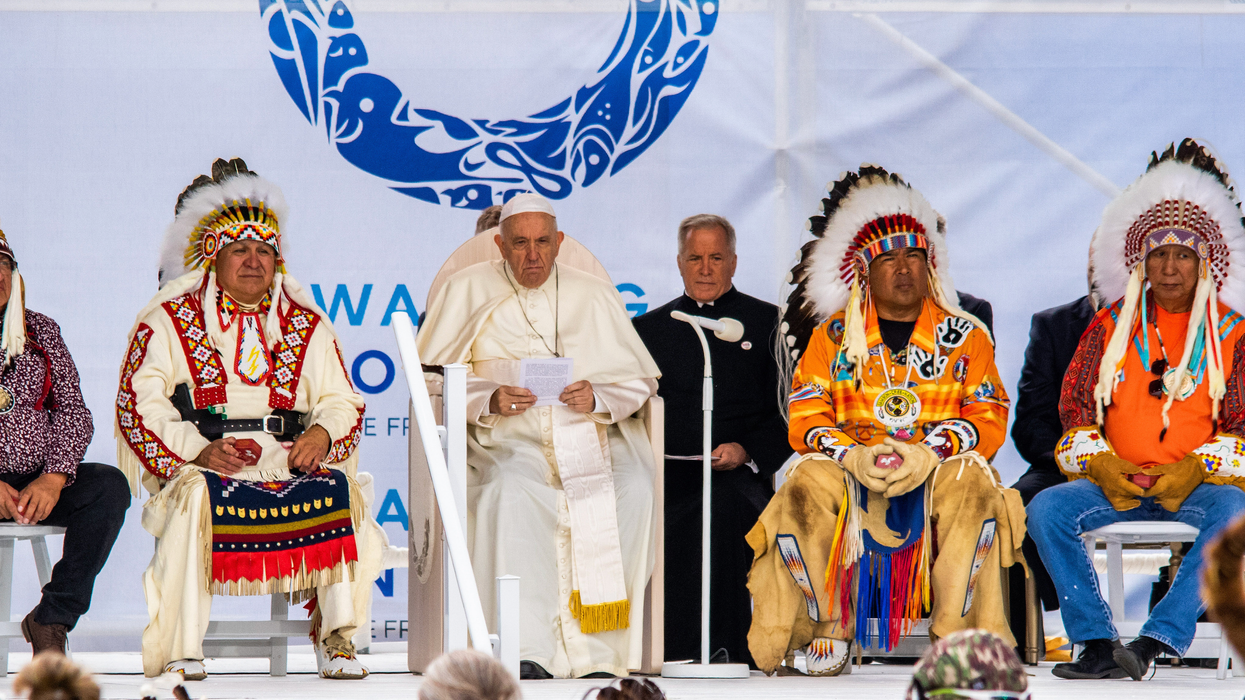
One Native American group hopes the historic move "is more than mere words, but rather is the beginning of a full acknowledgment of the history of oppression and a full accounting of the legacies of colonialism."
In a historic shift long sought by Indigenous-led activists, the Holy See on Thursday formally repudiated the doctrine of discovery, a dubious legal theory born from a series of 15th-century papal decrees used by colonizers including the United States to legally justify the genocidal conquest of non-Christian peoples and their land.
In a joint statement, the Vatican's departments of culture and education declared that "the church acknowledges that these papal bulls did not adequately reflect the equal dignity and rights of Indigenous peoples" and "therefore repudiates those concepts that fail to recognize the inherent human rights of Indigenous peoples, including what has become known as the legal and political 'doctrine of discovery.'"
"The church is also aware that the contents of these documents were manipulated for political purposes by competing colonial powers in order to justify immoral acts against Indigenous peoples that were carried out, at times, without opposition from ecclesiastical authorities," the statement added. "It is only just to recognize these errors, acknowledge the terrible effects of the assimilation policies and the pain experienced by Indigenous peoples, and ask for pardon."
Indigenous leaders—who for decades demanded the Vatican rescind the discovery doctrine—welcomed the move, while expressing hope that it brings real change.
"On the surface it sounds good, it looks good... but there has to be a fundamental change in attitudes, behavior, laws, and policies from that statement," Ernie Daniels, the former chief of Long Plain First Nation in Manitoba, Canada, told CBC Thursday.
"There's still a mentality out there—they want to assimilate, decimate, terminate, eradicate Indigenous people," added Daniels, who was part of a delegation that met with Pope Francis last year in Rome and Canada.
The pontiff—who is currently hospitalized with a respiratory infection—apologized last July in Alberta for the church's human rights crimes against First Nations and asked for forgiveness "for the wrong done by so many Christians to the Indigenous peoples."
Ghislain Picard, an Innu leader and the regional chief of the Assembly of First Nations for Quebec and Labrador, told CBC that the Vatican's move is mostly symbolic.
"The Vatican seems to be washing its hands of its role in the whole colonization of our lands, and to me it would be so simple to just accept the fact that they played a role," he said. "Reconciliation is a buzzword. But how it impacts current policy is really what's at stake here."
Discovery doctrine is rooted in a trio of papal decrees issued in the second half of the 15th century authorizing the Portuguese and Spanish monarchies to conquer land and enslave people in Africa and the Americas if they were non-Christians and dividing the Americas between the two burgeoning empires.
Nullified by the Vatican in the 16th century, the papal decrees nevertheless underpinned centuries of colonial conquest by Europeans and Euro-Americans.
In 1823, United States Supreme Court Chief Justice John Marshall wrote in Johnson v. M'Intosh that Indigenous people could not sell land to whites because Indians' "power to dispose of the soil at their own will to whomsoever they pleased was denied by the original fundamental principle that discovery gave exclusive title to those who made it."
The precedent set by Johnson was cited as recently as 2005, when then-Justice Ruth Bader Ginsburg notoriously cited doctrine of discovery in Sherrill v. Oneida Indian Nation, an opinion decried by many Native Americans.
In a Thursday interview on Indian Country Today's newscast, Arizona State University law professor Robert Miller, who is Eastern Shawnee, said that "what the church did is an important worldwide educational moment, but it doesn't change the law in any country. It doesn't change titles to land anywhere."
"It's gonna take far more than just the pope repudiating these 600-year-old papal bulls to make real changes for Indigenous peoples," he added.
In a lengthy and moving letter to Roman Catholic bishops leaked on Monday, Pope Francis unequivocally asserts that "human activity" is to blame for our planet's destruction, and the only solution is for humanity to change its "lifestyle" and "consumption."
The draft encyclical, published by Italian newspaper L'Espresso on Monday, three days before its intended release, is making waves among the international community as it boldly condemns both climate-deniers and carbon credit speculation, and upholds the growing climate movement and push to divest from fossil fuels.
"Humanity is called to take note of the need for changes in lifestyle and changes in methods of production and consumption to combat this warming, or at least the human causes that produce and accentuate it," he wrote in the draft. "Numerous scientific studies indicate that the greater part of the global warming in recent decades is due to the great concentration of greenhouse gases ... given off above all because of human activity."
The letter was intended for release on Thursday, ahead of the pope's scheduled address to the United Nations in September and less than six months before the upcoming UN climate change summit in Paris. On Monday evening, the Vatican condemned the early release, and reportedly asked journalists not to publish details of the draft, saying it was not the final text.
The draft letter, addressed to bishops but intended as a wider statement on Catholic doctrine, targets those who remain skeptical about the man-made causes of climate change or who believe that geoengineering schemes and other technical advances will permit industrialized nations to continue business as usual.
"The attitudes that stand in the way of a solution, even among believers, range from negation of the problem, to indifference, to convenient resignation or blind faith in technical solutions," reads the text.
Translating the leaked encyclical, the Guardian reports:
At the start of the draft essay, the pope wrote, the Earth "is protesting for the wrong that we are doing to her, because of the irresponsible use and abuse of the goods that God has placed on her. We have grown up thinking that we were her owners and dominators, authorized to loot her. The violence that exists in the human heart, wounded by sin, is also manifest in the symptoms of illness that we see in the Earth, the water, the air and in living things."
He immediately makes clear, moreover, that unlike previous encyclicals, this one is directed to everyone, regardless of religion. "Faced with the global deterioration of the environment, I want to address every person who inhabits this planet," the pope wrote. "In this encyclical, I especially propose to enter into discussion with everyone regarding our common home."
According to the leaked document, the pope will praise the global ecological movement, which has "already travelled a long, rich road and has given rise to numerous groups of ordinary people that have inspired reflection".
In a surprisingly specific and unambiguous passage, the draft rejects outright "carbon credits" as a solution to the problem. It says they "could give rise to a new form of speculation and would not help to reduce the overall emission of polluting gases". On the contrary, the pope wrote, it could help "support the super-consumption of certain countries and sectors".
The encyclical is not Pope Francis's first foray into the climate debate. In a message sent to the UN Climate Convention in Peru last December, he stated that addressing climate change is a "grave ethical and moral responsibility" and warned that "the time to find global solutions is running out."
Though the climate community had expected a call to action from the pope, in addition to statement on the connection between global inequality and climate change, the draft text was seen as a very significant contribution to the climate debate.
Wow: the Pope comes out against carbon credits because they encourage speculation and over-consumption. hard core! https://t.co/YE46weCzfV
-- Naomi Klein (@NaomiAKlein)
June 15, 2015Tariq Aziz, former Deputy Prime Minister of Iraq has passed away. Twelve years of suffering in Iraqi jails have ended and he can finally rest in peace.
Unwell, deprived of adequate medical help and abandoned by the outside world, he was held hostage by Iraqi governments following the illegal invasion of Iraq by the US and the UK governments in 2003. Tariq Aziz was needed by a struggling authority as a symbol of victory after having inherited a destroyed nation following years of sanctions and a failed occupation.
It does not matter to us that our words of sadness and respect for Tariq Aziz - a leader during many dark days of his country - will be used by some to discredit us for alleged support of a dictatorial regime.
Tariq Aziz repeatedly impressed us with his commitment, with which he cooperated with the United Nations when we served at different times as UN humanitarian coordinators in Baghdad. His relentless efforts to prevent the 2003 war will not be forgotten. He was a hard but highly principled task master without whom the inadequate UN Security Council response to human suffering in Iraq would have had an even worse impact.
We have a good idea how the scales of justice would react were it possible to quantify the weight of wrong-doing against the people of Iraq contributed from within Iraq and from the outside.
During the past years, we had hoped that influential leaders would see it as their moral responsibility to see that Tariq Aziz, a sick and elderly statesman, would be allowed to live his last days in the comfort of his family. We were wrong. We had appealed to former US Secretary of State, James Baker, who co-chaired with Tariq Aziz the 1991 Geneva negotiations on Iraq, to support calls for humane treatment of his former counterpart. Baker refused to act as a statesman. We also had hoped to hear the Pope's voice for fellow Christian Tariq Aziz following our contact with the Holy See's foreign minister. The Vatican remained mute. Other leaders in Europe and elsewhere preferred silence to compassion.
Not even our own organization, the United Nations, could muster the courage to demand fair treatment for the man whom the organization had known over decades as a convincing and credible defender of Iraq's rights.
As time passes, we are certain that Tariq Aziz will increasingly be remembered as a strong leader who tried his best to protect the integrity of Iraq against all odds within his country and against outside interference by self-serving political forces.
The Vatican's recent snub of Secretary of State Condoleezza Rice is only the latest salvo in the battle between Pope Benedict XVI and President George W. Bush. This tug of war has profound implications for both U.S. foreign policy and the critical Catholic vote in 2008's presidential race.
Overlapping Agendas
Things haven't always been tense between Bush and Benedict. They share similar views regarding abortion, gay marriage, and other hot-button conservative issues. Cardinal Joseph Ratzinger (as Benedict was known before becoming Pope in April 2005) even helped Bush secure the White House for a second term.
Specifically, after Bush visited the Vatican in June 2004, complaining that "Not all the American bishops are with me," Ratzinger sent a letter to US bishops, ordering them to refuse Communion to "a Catholic politician ... consistently campaigning and voting for permissive abortion and euthanasia laws" - a thinly-veiled reference to John Kerry. Ratzinger added that any person even voting for this Catholic politician "would be guilty of formal cooperation in evil and so unworthy to present himself for Holy Communion." Probably no surprise, then, that Bush increased his margin among Catholics by 6% from 2000 to 2004.
In an interesting twist, Ratzinger also partnered with George W. Bush's brother Neil in a foundation "to promote ecumenical understanding and publish original religious texts" in 1999. Oddly enough, business credit reports listed the foundation as a "management trust for purposes other than education, religion, charity or research," leaving the true nature of the Neil Bush/Cardinal Ratzinger venture unclear.
In 2005, Ratzinger was named as a defendant in a U.S. lawsuit suit accusing him of conspiring to cover up the sexual abuse of minors. At the center of the controversy was a May 2001 confidential letter he had sent Catholic bishops across the world ordering them to keep evidence of the sexual abuse of minors by clergy secret until 10 years after the child had reached adult status.
Soon after becoming Pope, however, Ratzinger was dismissed from the case. A US federal judge decided the lawsuit would be "incompatible with the United States' foreign policy interests."
Disagreements Multiply
On many contentious issues since then, Pope Benedict XVI has disagreed with the Bush administration's policies, but only politely and indirectly. For example, Benedict has spoken in favor of the International Atomic Energy Agency, which is often at loggerheads with Bush administration foreign policy.
Similarly, Benedict's Vatican has taken a firm stance against global warming, even acquiring a carbon offset forest to make the Vatican the "first entirely carbon neutral sovereign state." He has called for greater international co-operation to fight ozone depletion, yet not overtly criticized White House foot-dragging in that area.
The gloves came off, however, regarding the war in Iraq. In a May 2003 interview, Ratzinger said, " There was not sufficient reasons to unleash a war in Iraq. To say nothing of the fact that, given the new weapons that make possible destructions that go beyond the combatant groups, today we should be asking ourselves if it is still licit to admit the very existence of a 'just war.'"
The U.S. invasion of Iraq was similarly contentious for former Pope John Paul II, who sent a special envoy to the White House in March 2003 in an effort to prevent an attack. The papal envoy's pleas fell on deaf ears.
Vatican criticisms of the Bush administration's military intervention in Iraq have continued unabated. French Cardinal Jean-Louis Tauran, head of the Pontifical Council for Interreligious Dialogue, told an Italian magazine in August 2007, "The facts speak for themselves. Alienating the international community (with the U.S. push for war) was a mistake." Tauran, who has referred to the invasion and occupation as a "crime against peace," also said that Christians in Iraq "paradoxically, were more protected under the dictatorship" of Saddam Hussein.
Rice Rebuffed
As such, it is perhaps unsurprising that Benedict failed to honor Secretary of State Condoleezza Rice's urgent request for a private meeting last month. The Italian periodical Corriere della Sera reported that Rice was hoping to capitalize on the Pope's moral authority by having a papal audience focused on the Middle East. Instead, Rice was told that Benedict was on holiday and had to settle for a telephone conversation with a lower Vatican official.
The ongoing tensions between Bush and Benedict over Iraq put America's over 75 million Roman Catholics in a tricky position for 2008. By supporting candidates hawkish on the Bush administration's Iraq policies, are they defying the Pope and the Catholic Church?
For its part, the powerful United States Conference of Catholic Bishops (USCCB) has taken a firm stance against the US presence in Iraq. A July 2007 letter to House Republican Leader John Boehner (R-OH), USCCB noted, "The current situation in Iraq is unacceptable and unsustainable, as is the policy and political stalemate among decision makers in Washington ... our nation must have the moral courage to change course in Iraq."
Dissent is swelling up from the grassroots as well. In August 2007, an alliance of religious groups calling itself Catholics for an End to War collected 10,000 signatures for an online petition "urging leaders to commit to a responsible withdrawal of U.S. troops." Sister Simone Campbell of the national Catholic social justice lobby NETWORK said, "Church leaders and individual Catholics have opposed U.S. policy in Iraq since before the war began," adding that the petition "lets thousands of Catholics unite to speak out even more strongly for an end to the violence and occupation."
In other words, being dovish on Iraq might help the next Democratic presidential contender win Roman Catholic votes. Whether the current front-runners qualify for that distinction, however, is another matter.