

SUBSCRIBE TO OUR FREE NEWSLETTER
Daily news & progressive opinion—funded by the people, not the corporations—delivered straight to your inbox.
5
#000000
#FFFFFF
To donate by check, phone, or other method, see our More Ways to Give page.
Daily news & progressive opinion—funded by the people, not the corporations—delivered straight to your inbox.
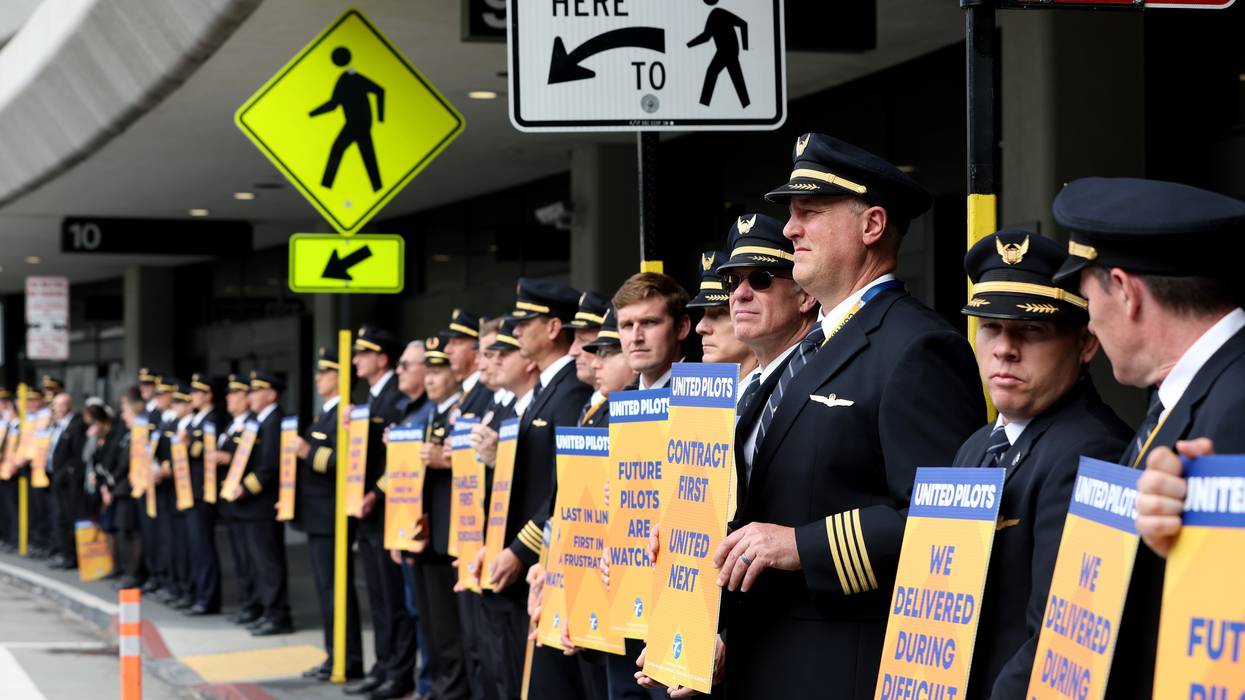
On the heels of strike-authorization votes by American and Southwest pilots, United pilots protested at airports across the U.S. on Friday to tell management that "enough is enough."
Following what the Air Line Pilots Association called "more than four years of empty promises," 3,000 off-duty United Airlines pilots represented by the union protested at major airports across the U.S. on Friday, demanding the finalization of a contract with higher pay and humane scheduling practices.
"Thousands of United pilots are picketing coast-to-coast today to deliver management a message they cannot ignore: Enough is enough," Capt. Garth Thompson, chair of the United ALPA master executive council, said in a statement.
"United management needs to stop slow-rolling negotiations... and do the right thing for their pilots."
"We have been stuck with an antiquated scheduling system and a contract nowhere near industry-leading standards," said Thompson. "We want United to succeed as industry leaders, and every day that passes without an agreement is another day the best and brightest future aviators go elsewhere."
United pilots—joined by ALPA president Capt. Jason Ambrosi, fellow ALPA pilots, and union supporters—demonstrated in front of terminals at airports in 10 cities as well as outside the company's flight training center in Denver.
Association of Flight Attendants-CWA president Sara Nelson was among those who participated in an act of solidarity.
"I am proud to stand here today to send United Airlines management a message that the airline's pilots have the full backing of their international union in their fight for the contract they have earned," said Ambrosi, who leads the 69,000-member union and joined a picket line in Chicago. "United management needs to stop slow-rolling negotiations that have dragged into their fifth year and do the right thing for their pilots."
Management has failed "to recognize the value pilots bring to the overall success of the airline," ALPA said. "United pilots were there for customers during one of the worst times for travel in recent history, and they also helped United Airlines emerge from the pandemic stronger than before."
Thompson, who called Friday's nationwide informational picket a "resounding success," stressed that "United pilots will always be there for our customers."
"Unfortunately," he added, "the same cannot be said about management, who seems to think that a last-minute cancellation of a United pilot's scheduled day off, or abrupt trip reassignments that extend into planned days off, is acceptable for a United pilot's family."
"This old pilot contract impacts our ability to maintain a healthy work-life balance," Thompson continued. "United pilots will deal with this adversity in our usual professional and safe manner. We will continue to work in 2023 despite staffing shortages in Air Traffic Control facilities, aggressive summer schedules, capacity constraints, and weather." However, he noted, "United pilots want the company and the public to know that the bold 'United Next' growth plans cannot work without an updated pilot contract."
"This old pilot contract impacts our ability to maintain a healthy work-life balance."
The action by United pilots comes in the wake of a pair of successful strike-authorization votes by pilots at other airlines.
On May 1, 95% of American Airlines pilots voted to authorize a strike. (Of the airline's 15,000 pilots, 96% participated, with 99% expressing support for a possible strike).
"We will strike if necessary to secure the industry-leading contract that our pilots have earned and deserve—a contract that will position American Airlines for success," said Capt. Ed Sicher, president of the Allied Pilots Association. "Our pilots' resolve is unmistakable. We will not be deterred from our goal of an industry-leading contract."
"The strike-authorization vote is one of several steps APA has taken to prepare for any eventuality and use all legal avenues available to us for contract improvement and resolution," Sicher noted. "The best outcome is for APA and management to agree on an industry-leading contract—achieved through good-faith bargaining—benefiting our pilots, American Airlines, and the passengers we serve."
On Thursday, 97% of Southwest pilots voted to authorize a strike. (Of the airline's 10,000-plus pilots, 98% participated, with 99% expressing support for a possible strike).
"This is a historic day, not only for our pilots but for Southwest Airlines," said Capt. Casey Murray, president of the Southwest Airlines Pilots Association. "The lack of leadership and the unwillingness to address the failures of our organization have led us to this point. Our pilots are tired of apologizing to our passengers."
Murray and other union leaders have attributed Southwest's meltdown last winter to executives' yearslong refusal to invest in much-needed technological upgrades despite benefiting from billions of dollars in federal aid during the first two years of the Covid-19 pandemic.
"We want our passengers to understand that we do not take this path lightly," Murray said Thursday. "We want our customers to be prepared for the path ahead and make arrangements on other carriers so that their plans through the summer and fall are not disrupted."
United's 14,000 pilots could be next in line to vote on strike authorization.
As The Associated Press reported Saturday, "Pilots at all three carriers are looking to match or beat the deal that Delta Air Lines reached with its pilots earlier this year, which raised pay rates by 34% over four years."
"United has proposed to match the Delta increase, but that might not be enough for a deal," AP observed. Citing Thompson, the outlet noted that "discussion about wages has been held up while the two sides negotiate over scheduling, including the union’s wish to limit United's ability to make pilots work on their days off."
The nation's pilots "are unlikely to strike anytime soon, however," AP reported. "Federal law makes it very difficult for unions to conduct strikes in the airline industry, and the last walkout at a U.S. carrier was more than a decade ago."
"Under U.S. law, airline and railroad workers can't legally strike, and companies can't lock them out, until federal mediators determine that further negotiations are pointless," the outlet explained. It continued:
The National Mediation Board rarely declares a dead end to bargaining, and even if it does, there is a no-strikes "cooling-off" period during which the White House and Congress can block a walkout. That's what President Bill Clinton did minutes after pilots began striking against American in 1997. In December, President Joe Biden signed a bill that Congress passed to impose contract terms on freight railroad workers, ending a strike threat.
Regardless of the legal hurdles to a walkout, unions believe that strike votes give them leverage during bargaining, and they have become more common. A shortage of pilots is also putting those unions in particularly strong bargaining position.
Although Congress is highly unlikely to permit an airline strike, disgruntled pilots could still cause disruption through "work to rule," Arthur Wheaton, director of labor studies at Cornell University, told AP.
"They could say, 'We're not working any overtime,'" said Wheaton. "I don't anticipate the pilots trying to screw up travel for everybody intentionally, but bargaining is about leverage and power... having the ability to do that can be a negotiating tactic."
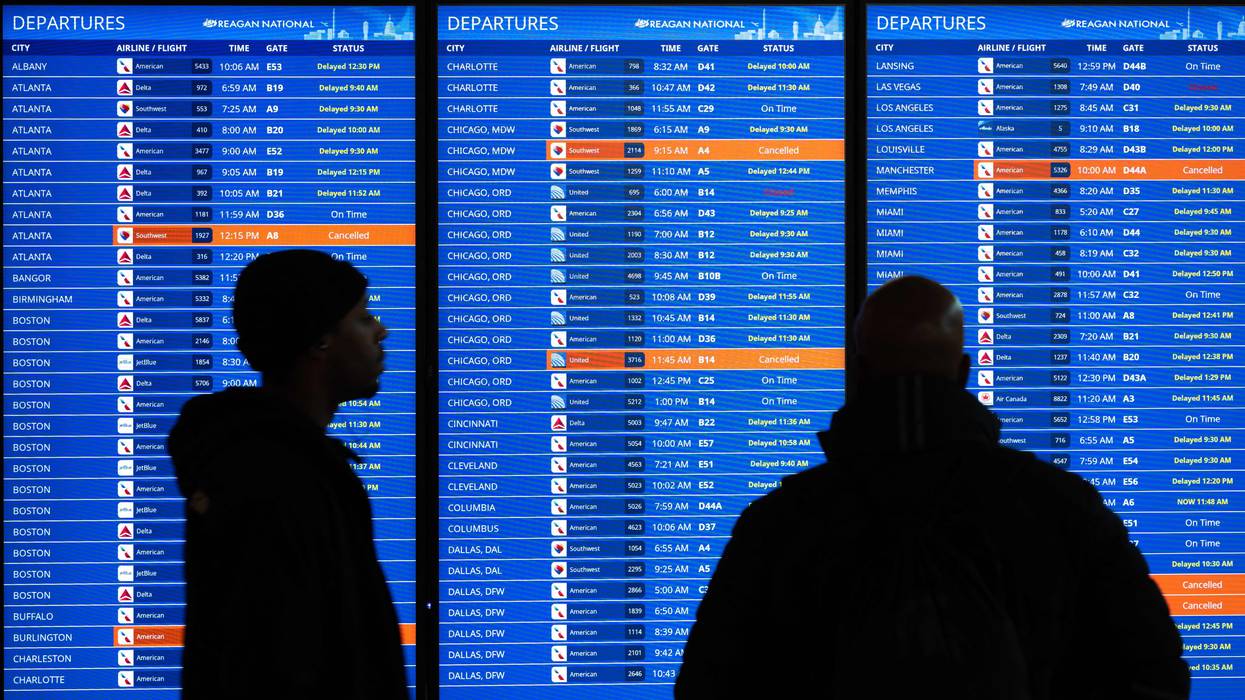
Facing criticism over recent air travel issues, the U.S. Transportation Department is reportedly investigating whether three airlines have scheduled flights they know they can't staff.
Three unidentified U.S. airlines are under federal investigation for potentially scheduling flights the companies know they ultimately will not be able to fly—a revelation The New York Times reported Friday, just two days after United Airlines' CEO suggested competitors are doing just that.
The Times focused largely on how air travel issues—including mass cancellations from a winter storm during the holidays last month and a Federal Aviation Administration (FAA) system outage that grounded air traffic across the country last week—have put Pete Buttigieg, the head of the U.S. Department of Transporation (DOT), "in the hot seat."
"Unfortunately, the Department of Transportation has been hesitant to hold the airlines accountable," John Breyault, the vice president for public policy at the National Consumers League (NCL), told the newspaper. "While Secretary Buttigieg has talked a tough talk, particularly over the past few months, we have yet to see that really translate into action."
"Imagine any other industry taking money for products it can't deliver."
In an interview, Buttigieg defended his record—which has included a proposed rule on refunds, an online dashboard of airlines' commitments, and nearly $16 million in fines—saying that "in terms of what we've done and in terms of what we're doing, I would stack up our work in this area against anybody who’s taken this on at the federal level."
According to the report, "The department is also investigating three U.S. airlines over whether they scheduled flights that they did not have enough staff to support, a spokeswoman for the agency said, though she declined to identify the airlines."
That reporting came after United CEO Scott Kirby said Wednesday during an earnings call with investors that "there are a number of airlines who cannot fly their schedules. The customers are paying the price. They're canceling a lot of flights. But they simply can't fly the schedules today."
"What happened over the holidays wasn't a one-time event caused by the weather, and it wasn't just at one airline. One airline got the bulk of the media coverage, but the weather was the straw that broke the camel's back for several," Kirby said—presumably referring to Southwest Airlines, which faced intense scrutiny for canceling nearly 17,000 flights partly due to issues with its personnel management system that employees and other critics claim could have been avoided with technological upgrades.
United has recognized "the new reality and the new math for all airlines," Kirby asserted, while warning that "our industry has been changed profoundly by the pandemic and you can't run your airline like it's 2019 or you will fail."
"We believe any airline that tries to run at the same staffing levels that it had pre-pandemic is bound to fail and likely to tip over to meltdown anytime there are weather or air traffic control stresses in the system," the CEO said, highlighting the need for investments in not only staff but also technology and infrastructure.
Kirby's comments about competitors' alleged scheduling practices caught the attention of the anti-monopoly think tank American Economic Liberties Project (AELP), which described them as "the airlines' open admission of fraud."
"What an extraordinary admission," William McGee, senior fellow for aviation and travel at AELP and author of the airline industry exposé Attention All Passengers, tweeted Thursday.
For months, the AELP has asked the DOT "to investigate IF airlines were accepting bookings (and $!) for flights they couldn't operate," he said. "Now United's CEO confirmed it. Imagine any other industry taking money for products it can't deliver."
"Ironically, we're learning more about canceled flights from the airlines than we are from the Department of Transportation," McGee told The Lever, while also pointing out that the DOT's "complaint database showed that United was by far the worst offender on unpaid refunds dating back to the earliest days of Covid in 2020."
As The Lever reported Friday:
Complaints against the major U.S. airlines, including United, more than tripled in the first year of the Covid-19 pandemic, as companies routinely sold tickets for flights they could not adequately staff, canceled the flights at the last minute, and slow-walked or withheld refunds while collecting billions in taxpayer bailout dollars.
The behavior prompted 34 attorneys general to write to Buttigieg on December 16 asking his agency to "require airlines to advertise and sell only flights that they have adequate personnel to fly and support, and perform regular audits of airlines to ensure compliance and impose fines on airlines that do not comply."
The letter, submitted as part of the rulemaking process for a still-delayed consumer protection proposal at Buttigieg's agency, also noted that the proposed rule "includes no provision that would correct this practice and that would prevent airlines from advertising and selling tickets for flights that they cannot reasonably provide."
In an opinion piece published by the Times last week in the wake of the FAA outage, the AELP's McGee traced U.S. air travel troubles back much further than the ongoing pandemic, explaining that although "the airlines were initially regulated in the 1930s for many reasons, some of which should be familiar to us in 2023," Congress passed the Airline Deregulation Act (ADA) in 1978.
"One could envision a wholesale return to the pre-1978 era, with route-setting and price-setting brought back into public hands entirely," he wrote, noting that the AELP "has proposed more FAA funding and eliminating federal preemption, which would allow consumers and state officials to sue airlines over consumer and safety rules."
"My colleagues and I are, however, eager to take part in a national conversation about regulating the industry more comprehensively," McGee added. "We haven't had a national discussion for 44 years about the state of air travel. It's time to have that discussion, rather than playing whack-a-mole with each crisis as it arises."
Buttigieg "has taken a tougher line than most of his predecessors" at the DOT, the NCL's Breyault tweeted Friday, while sharing his critical remarks to the Times. "But he is hamstrung by the ADA, which gives airlines far too much power. To truly protect passengers, Congress needs to act."
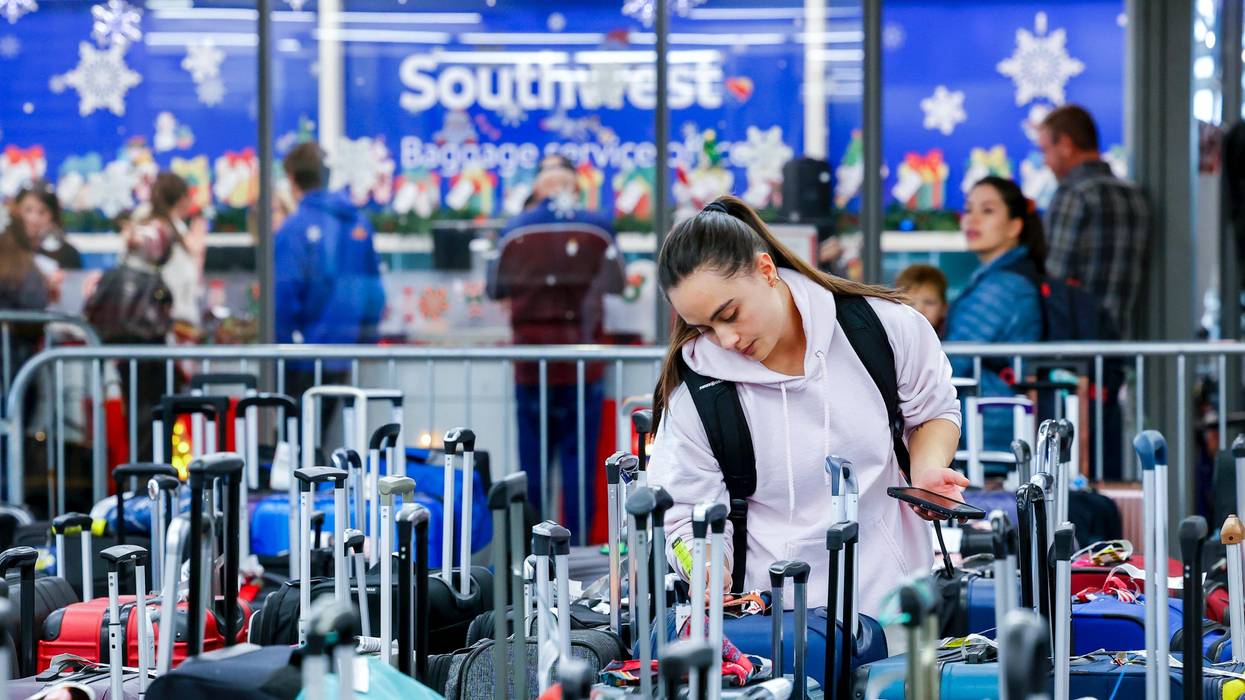
"Southwest must take all necessary steps to ensure that this debacle never happens again," wrote the senators, who inquired about software, staffing, refunds, bags, wheelchairs, and executive and shareholder compensation.
A group of 15 U.S. senators on Thursday demanded answers from Southwest Airlines' CEO regarding the company's management of the disastrous 2022 holiday season, when thousands of travelers were stranded in airports amid nearly 16,000 flight cancelations.
"The mass flight cancellations at Southwest Airlines... during the last week of December ruined the holidays for tens of thousands of travelers, stranding them at gates without their bags and forcing them to miss celebrations with families and friends. Although winter storm Elliott disrupted flights across the country, every other airline operating in the United States managed to return to a regular flight schedule shortly thereafter—except Southwest," the senators wrote in a letter led by Sens. Ed Markey (D-Mass.) and Richard Blumenthal (D-Conn.) to company CEO Robert Jordan. "Southwest must take all necessary steps to ensure that this debacle never happens again."
"In total, Southwest canceled nearly 16,000 flights during this period. As you have rightfully acknowledged, Southwest simply failed its customers," wrote the lawmakers, who include 14 Democrats and Sen. Bernie Sanders (I-Vt.). "For consumers across the country, this failure was more than a headache—it was a nightmare."
The letter continues:
Travelers were stranded across the country for days at a time, forced to spend hours on hold with Southwest customer service representatives or in line at Southwest service desks at the airport. Just as the storm set off a chain reaction of problems for Southwest, these cancellations inevitably led to bad consequences for travelers who could not return to their loved ones over the holidays, lacked access to critical medicine and other personal items in their misplaced bags, or were forced to miss days at work.
Your employees—flight attendants, pilots, ground workers, customer service representatives, dispatchers, ramp workers, and others—were also victims. Some found themselves stranded across the country. Others had to work mandatory overtime in frigid temperatures or spent countless hours seeking impossible-to-find solutions to help furious customers find their way home.
The senators noted that "based on initial comments from Southwest executives and news reports, the main cause of Southwest's meltdown appears to be legacy software that Southwest uses to coordinate its crews and planes."
"Yet, Southwest has long known that its software was outdated and the Southwest Airlines Pilots Association had warned that such a debacle was inevitable unless Southwest invested in new scheduling systems," the lawmakers wrote. "Instead of making those investments, Southwest distributed over $1.8 billion in dividends to its shareholders and bought back over $11 billion in its shares between 2011 and 2020. And just last month, Southwest announced that it would issue a $428 million dividend in the first quarter of this year—the first airline to announce a dividend since the start of the pandemic."
To "better understand the causes of these cancellations and ensure a breakdown of this magnitude never happens again," the senators request answers to questions, including:
"That's the behavior of a company with no intention of changing course from management decisions that seek to enrich shareholders while leaving consumers holding the bag."
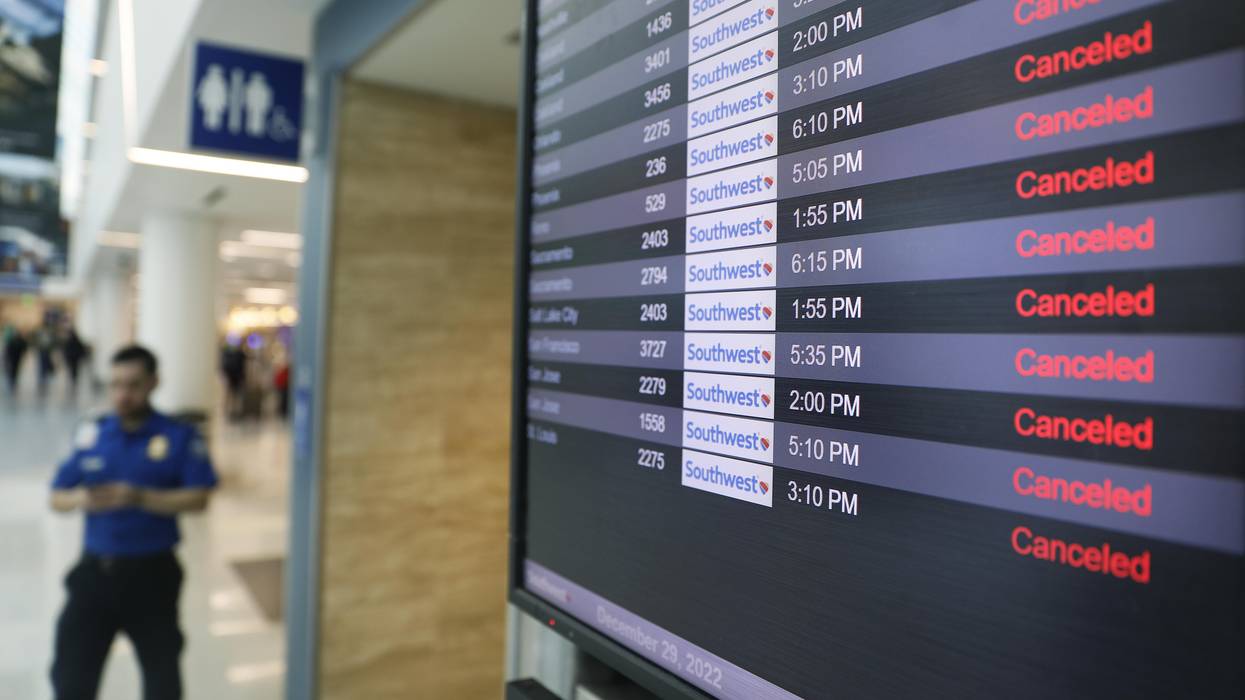
After canceling nearly 17,000 flights around the Christmas holiday—the worst customer service meltdown in the history of the U.S. airline industry—Southwest announced this week that it is promoting several of its executives, a move that watchdogs decried as a slap in the face of the travelers impacted by the company's incompetence and greed.
In a press release, Southwest said it is elevating five executives across different departments at the company, including network operations control and communications. The announcement came just over a week after the Southwest pilots' union published a scathing letter calling the corporation's management a "headquarters-centric cult" that has "eroded our company from within."
While Southwest said the new leadership changes "represent phase two of the organizational structure work that began in September 2022," critics argued the decision to go ahead with the promotions following the holiday debacle shows a total disregard for customers and U.S. regulators, who have been accused of doing far too little to crack down on industry abuses.
"Southwest thought its executives deserved a promotion after leaving thousands of its consumers in the lurch in the middle of peak holiday season travel," Liz Zelnick, director of the Economic Security and Corporate Power program at Accountable.US, said in a statement Tuesday. "That's the behavior of a company with no intention of changing course from management decisions that seek to enrich shareholders while leaving consumers holding the bag. We hope that Congress investigates their failures and holds their executives accountable."
Matt Stoller, director of research at the American Economic Liberties Project, wrote in response to the promotions: "They are just mocking Pete Buttigieg. And why shouldn't they?"
Buttigieg, the head of the U.S. Transportation Department, has faced growing backlash from airline watchdogs and members of his own party in recent days for failing to take decisive action in the lead-up to and in the wake of Southwest's mass cancellations, which pilots and flight attendants say were fueled by the company's refusal to invest in technological upgrades that could have helped the airline giant navigate bad weather and predictable holiday travel chaos.
In recent years, as flight crews pressed for changes to the company's antiquated technology, spent nearly $6 billion buying back its own stock.
"Pete Buttigieg chose to let nearly every domestic airline off scot-free after they were caught completely flat-footed earlier this year," said Jeff Hauser, executive director of the Revolving Door Project, referring to cancellations surrounding the July 4 holiday. "Despite rampant cancellations and widespread violation of federal law by giving travel vouchers instead of cash refunds, the only domestic airline to face any regulatory scrutiny was the small, politically weak Frontier."
"That is despite the fact that Frontier was responsible for far less of the industry-wide meltdown than major players like United or Southwest," Hauser continued. "Every other U.S.-based airline got off with a warning and promised to do better in the future. When you don't actually enforce the law, you lose credibility as a regulator. Our position is simple: when corporations violate federal law, they should be investigated and held accountable."
"When you don't actually enforce the law, you lose credibility as a regulator."
While the Transportation Department has said it is investigating the latest round of mass cancellations and acting on the flurry of refund complaints from Southwest customers whose travel plans were thrown into chaos, lawmakers and advocates argue the agency's actions thus far have fallen far short of what's needed to hold the company accountable and prevent future disasters.
"In light of the sheer magnitude of Southwest Airlines' most recent operational failures and the devastating impact these failures and other airline cancellations continue to have on American consumers, we believe much more needs to be done," 26 Democratic lawmakers wrote in a letter to Buttigieg last week.
"Refunds and other types of compensation policies quickly become meaningless if there's not a clear mechanism or platform for passenger redress. Ensuring passengers and airlines can effectively communicate with one another will allow passengers
to swiftly receive any owed compensation as well as any other helpful information a passenger may need after a canceled or significantly delayed flight," the lawmakers wrote. "Furthermore, the Department should make sure that airlines are able to maintain a reasonable level of operational capabilities in the event of extreme weather or other type of potential disruption. Of course, not all
disruptions can be controlled. But issuing rules and standards that could help limit or prevent future cancellations and delays arising from these initial disruptions will ultimately benefit consumers much more than any reimbursement policy ever could."
William J. McGee, a senior fellow for aviation at American Economic Liberties Project, wrote in an NBC News op-ed earlier this month that "America's commercial aviation system is broken, but so is the only regulatory agency allowed to oversee it."
"Consider what we've seen from the federal government since Covid hit," McGee wrote. "For starters, airlines withheld at least $10 billion in unpaid refunds and unused flight credits after the pandemic forced people not to fly in 2020 and beyond. In November, Secretary Pete Buttigieg finally imposed what he termed 'historic' fines. But only Frontier and five small foreign carriers were penalized."
"Then, the first half of 2022 had an unprecedented number of delayed and canceled flights, more than in all of 2021," he continued. "Despite warnings from lawmakers and groups like my organization, the American Economic Liberties Project, Buttigieg assured passengers in September that the airlines would address their scheduling problems. Unfortunately, he didn't use his authority under the Transportation Department's unfair and deceptive acts rule to investigate why tens of thousands of flights were scheduled and then paid for by consumers, only to be canceled."
"Worse," McGee added, "there have been no reported penalties for the cancellations. This lack of enforcement may have contributed to Southwest's Christmas meltdown, because it's unlikely Southwest and other airlines would have stranded so many passengers if they feared real consequences."

Unless we make drastic changes to how we live, including how we travel, we will all be stranded, not at airports, but on this, our only, rapidly heating planet.
Climate Change, Christmas and Capitalism chaotically converged with an epic operational failure at Southwest Airlines that stranded thousands of holiday travelers and airline staff at airports for days. Winter Storm Elliott slammed the continental United States with snow, pelting winds and freezing cold arctic air in what meteorologists call a "bomb cyclone." Air travel was understandably impacted, but the scale of the disruption at Southwest was many times greater than other airlines, accounting for an estimated 90% of the tens of thousands of canceled flights. Central to this travel catastrophe are the deregulation of the airline industry during the late 1970s, during the Carter administration, and the decision by Southwest executives to prioritize their investors over customers and staff.
In the three years leading up to the pandemic, Southwest reportedly spent $5.6 billion on stock buybacks, and just weeks before the Christmas debacle announced it would be the first U.S. airline since the pandemic began to provide a stock dividend.
"It is unconscionable…we have been sounding the alarm, along with our pilots' union and other unions, that our technology issues are absolutely going to lead us to this place. This is not the first time. It is the first time it's happened over a Christmas that's affected so many," Corliss King, vice president of Transport Workers Union (TWU) Local 556, representing Southwest Airlines flight attendants, said on the Democracy Now! news hour.
Her union has been in contract negotiations with Southwest for four years. Among the workers' demands is that the airline fix "the technology failures that disproportionately impact frontline aviation workers and passengers." Southwest uses software called SkySolver, released in the early 2000s, to correct scheduling interruptions by moving planes and staff around the country as fast and efficiently as possible. The storm overwhelmed Southwest's dated system, as Corliss King explained:
"Crew scheduling, which is our heartbeat of our operation for our crews, is using technology that is not expandable to the airline we are right now…on a normal day, we have 500 people who are out of place, but due to a crisis, we now have a thousand people, 1,500 people out of place. That technology has to be able to expand to meet an unprecedented situation like this. That is not able to happen."
Consequently, thousands of Southwest flight attendants and pilots were stranded, often with no place to stay other than in an airport's crew lounge. Southwest had no way to match available crews with idle planes, lacking basic information about where their workers were. Meanwhile, ground crews were forced to work longer hours in the freezing cold, some suffering frostbite.
Tens of thousands of passengers have spent days stranded in airports, often separated from their luggage – some without medicines. Southwest told most passengers they wouldn't be getting an alternate flight for several days at the earliest, claiming the airline lacked capacity.
"They have no capacity because it's actually more profitable to have bad service than good service," Paul Hudson, president of FlyersRights, an airline passenger rights organization, said on Democracy Now! "Every airline is required to have a plan to deal with bad weather and other disruptions, but there's no enforcement. There are no reserve requirements. There are no customer service standards of any meaningful nature. The whole idea of deregulation was that the airlines would compete to provide better service. But actually what happens today, they compete to provide more profitable but worse service."
For passengers experiencing multi-day flight delays, Paul Hudson warns, "Domestically, you have no rights to delay compensation. If weather is the reason for the cancellation or delay, you don't really have any rights to things like hotel accommodations. It's all up to the airlines. Of course, they'll do anything to avoid those expenses."
While Southwest has underinvested in its IT infrastructure and reserve capacity, it has treated its investors well. In the three years leading up to the pandemic, Southwest reportedly spent $5.6 billion on stock buybacks, and just weeks before the Christmas debacle announced it would be the first U.S. airline since the pandemic began to provide a stock dividend.
U.S. Transportation Secretary Pete Buttigieg tweeted on Wednesday, "Southwest Airlines needs to do everything it takes to get stranded passengers to their destinations–and cover their expenses (like meals, hotel, ground transport) in the meantime. We'll continue to hold them accountable."
This compensation is the least Southwest should do. However, according to the Transportation Department's own website, "There are no federal laws requiring airlines to provide passengers with money or other compensation when their flights are delayed."
Meanwhile, the climate emergency worsens. Air travel is estimated to produce 4% of the global greenhouse gas emissions annually. After a dramatic, pandemic-related drop in 2020, air travel has recovered and is increasing. Unless we make drastic changes to how we live, including how we travel, we will all be stranded, not at airports, but on this, our only, rapidly heating planet.
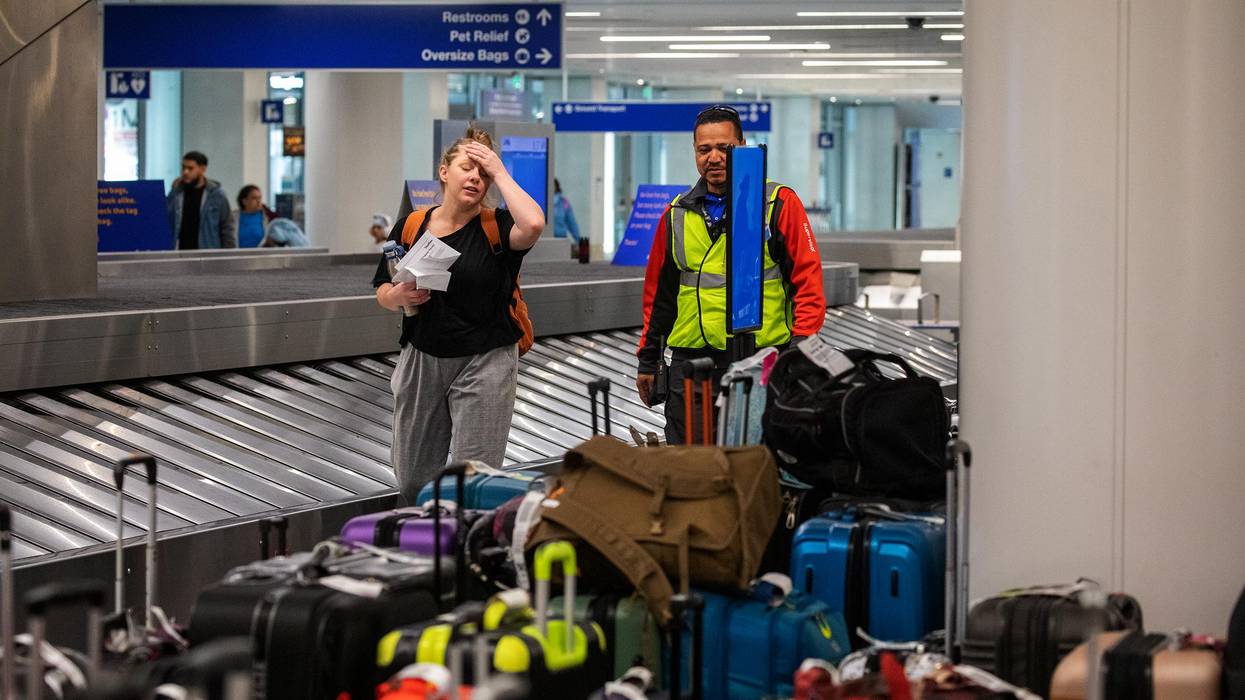
"Southwest Airlines made a risky gamble that mass layoffs and spending billions of dollars on handouts to investors rather than fixing infrastructure would pay off with record profits," said one watchdog. "The airline lost that bet badly."
As travelers and airline workers reel from mass flight cancellations, a corporate watchdog noted Wednesday that Southwest spent nearly $6 billion on stock buybacks in the years ahead of the coronavirus pandemic instead of devoting those resources to technological improvements that unions have been demanding for years.
According to Accountable.US, the crisis Southwest has experienced in recent days amid a massive winter storm is "a problem of its own making." The organization pointed out that the airline opted "to spend $5.6 billion on stock buybacks in the three years leading up to the pandemic rather than making investments in infrastructure to be better prepared for extreme weather events like this week."
The watchdog group added that the company "even reinstated dividends earlier this month, the first major airline to do so after the pandemic."
"Southwest Airlines made a risky gamble that mass layoffs and spending billions of dollars on handouts to investors rather than fixing infrastructure would pay off with record profits," Kyle Herrig, the president of Accountable.US, said in a statement. "The airline lost that bet badly and now it's their customers left paying the price including the thousands stranded in the middle of holiday season travel."
"Southwest's well-compensated executives could have prioritized its workers and customers by preparing for the worst, but greed trumped all as they put a small group of wealthy investors first," Herrig added. "Consumers shouldn't be the ones stuck holding the bag for Southwest's greedy management decisions, but here we are. This is where the Transportation Department should start in any investigation into why this happened."
Southwest has canceled more than 5,000 flights this week—accounting for the bulk of flights canceled in the U.S.—and delayed hundreds more, stranding travelers and flight attendants, throwing holiday plans into chaos, and straining already-exhausted flight crews.
"Southwest's well-compensated executives could have prioritized its workers and customers by preparing for the worst, but greed trumped all."
Unions representing flight attendants and pilots have said that while the winter storm fueled some of the cancellations, deliberate decisions by Southwest management were ultimately responsible for what's been described as the company's "full-blown meltdown."
Specifically, the vice president of the Southwest Airlines Pilots Association told Insider that the company's "outdated" scheduling software has been overwhelmed, wreaking havoc on operations.
"When we get out of position, it's a tough task for our schedulers to put it back together, and right now they're having to do it by hand," said Captain Mike Santoro, explaining that some flights were unnecessarily canceled because the airline's system was unable to adequately keep track of employees.
Lyn Montgomery, president of TWU Local 556, the union that represents flight attendants, told a local news outlet that "this is the worst I've ever seen in my 27 years of working as a flight attendant for Southwest Airlines."
"Obviously, the impact of Winter Storm Elliott created the issues, but the Southwest Airlines systems cannot recover because we have outdated technology," Montgomery said.
The New York Times reported Wednesday that many of the scheduling issues "stem from the carrier's unique 'point-to-point' model, in which planes tend to fly from destination to destination without returning to one or two main hubs."
"Most airlines follow a 'hub-and-spoke' model, in which planes typically return to a hub airport after flying out to other cities," the Times noted. "When bad weather hits, hub-and-spoke airlines can shut down specific routes and have plans in place to restart operations when the skies clear. But bad weather can scramble multiple flights and routes in a point-to-point model, leaving Southwest staff out of position to resume normal operations."
Randy Barnes, president of TWU Local 555, the union that represents Southwest ground workers, said in a statement Wednesday that "if airline managers had planned better, the meltdown we've witnessed in recent days could have been lessened or averted."
"Ground workers need more support," Barnes added. "Many of our people have been forced to work 16- or 18-hour days during this holiday season. Our members work hard, they're dedicated to their jobs, but many are getting sick, and some have experienced frostbite over the past week. In severe weather, it's unreasonable for workers to stay outside for extended periods. People need to be able to cycle in and out of the cold. The airline needs to do more to protect its ground crews."
More than 90% of the 2,760 cancellations in the U.S. thus far on Wednesday have been Southwest flights, according to data compiled by FlightAware.
The company's massive failures have drawn scrutiny from members of Congress and the U.S. Department of Transportation, which has said it is looking into the cancellations.
"This has clearly crossed the line from what’s an uncontrollable weather situation to something that is the airline’s direct responsibility,” Transportation Secretary Pete Buttigieg said late Tuesday in an appearance on "NBC Nightly News."
In a statement, Senate Commerce Committee Chair Maria Cantwell (D-Wash.) similarly argued that "the problems at Southwest Airlines over the last several days go beyond weather."
"The committee will be looking into the causes of these disruptions and its impact to consumers," said Cantwell. "Many airlines fail to adequately communicate with consumers during flight cancellations. Consumers deserve strong protections, including an updated consumer refund rule."

"This impacts lives and threatens safety for all," said the president of Transport Workers Union Local 556.
Southwest Airlines is facing calls for accountability from organized labor and congressional Democrats after canceling thousands of flights over the past week, leaving tens of thousands of workers and customers in limbo during the holiday season.
Every airline has experienced disruptions during Winter Storm Elliott, the dangerous nationwide cold snap that began just days before Christmas. But while other major carriers have largely recovered, Southwest continues to struggle, canceling roughly two-thirds of its flights on Tuesday. United, Delta, American, and JetBlue, by contrast, all reported flight cancellation rates of 2% or less on Tuesday.
While Southwest chief operating officer Andrew Watterson said in a memo sent to employees on Monday night that the company's current systems have been "overmatched" by extreme weather, the union representing Southwest flight attendants attributes ongoing operational failures and maltreatment of workers to the corporation's yearslong refusal to invest in much-needed technological upgrades.
"The way Southwest Airlines has treated its flight crews can only be termed 'despicable.'"
"The way Southwest Airlines has treated its flight crews can only be termed 'despicable,'" Lyn Montgomery, a Dallas-based flight attendant and president of Transport Workers Union (TWU) Local 556, said Monday in a statement.
"We know the demands of holiday travel. We know winter storms. And believe me, we know about stepping up and putting in long work hours when we are called to do so; we are flight attendants," said Montgomery. "But at this point, the many years of failure by management, despite many unions' demands to modernize, has left flight attendants fatigued, stranded, hungry, and cold—on Christmas! This impacts lives and threatens safety for all."
According to TWU Local 556, thousands of Southwest crew members have been "stranded across the country, some forced to sleep on cots in airports, some in hotels without power or water, and far too many working long hours well past acceptable duty days, and more."
"Trying to get home for Christmas seems like a dream to flight attendants who are struggling with the nightmare of simply trying to secure appropriate shelter, food, and rest," the union added.
Other Southwest employees have also been subjected to abuse. According to a leaked memo from last Wednesday, Southwest's vice president for ground operations, Chris Johnson, told ramp agents at Denver International Airport (DIA) that they will be terminated if they refuse to work mandatory overtime or take a sick day without providing a doctor's note immediately upon their return.
Like other corporations, Southwest benefited from billions of dollars in federal aid during the first two years of the Covid-19 pandemic. Although there have been no noticeable improvements in conditions for workers or consumers, chief executive officer Bob Jordan saw his annual compensation package increase to $9.1 million in 2022.
Meanwhile, thousands of Southwest customers have been stranded in airports around the country in recent days, with little knowledge of where their luggage is or when they will be able to reach their destination.
Although the company said Monday in a statement that its agents are trying to re-accommodate as many passengers as possible, it also announced that it will "continue operating a reduced schedule by flying roughly one-third of our schedule for the next several days."
"The plan was to get out of here by now," Amenit Alvarez, who is trying to travel from DIA, told CBS News Colorado on Monday. "I was supposed to be home for Christmas."
According to the outlet: "After two canceled flights since Thursday, Alvarez decided to wait and try rebooking later in the week. While she has friends to stay with, she knows other travelers don't have the same luxury."
In a Tuesday statement, Democratic Sens. Ed Markey (Mass.) and Richard Blumenthal (Conn.) called on Southwest to compensate customers for avoidable holiday flight cancellations.
"Southwest Airlines is failing consumers during the most important travel week of the year," said Markey and Blumenthal. "Instead of a holiday spent celebrating with family and friends, passengers are sleeping in airports or desperately trying to reach customer service agents."
"For those travelers whose holidays have been ruined, there is no real way for Southwest to make this right," the pair continued. "But the company can start by fairly compensating passengers whose flights were canceled, including not only rebooked tickets, ticket refunds, and hotel, meal, and transportation reimbursement, but significant monetary compensation for the disruption to their holiday plans."
"Southwest is planning to issue a $428 million dividend next year," the lawmakers added. "The company can afford to do right by the consumers it has harmed. Southwest should focus first on its customers stranded at airports and stuck on interminable hold."
As Bloomberg reported Tuesday:
The chaos will prove costly to the airline, with Citi analysts estimating it could shave 3% to 5% from Southwest's fourth-quarter earnings. There's a reputational cost as well, with angry travelers stranded over the holiday season and the airline having to apologize, much as it did in a similar collapse after storms in October 2021.
[...]
Dallas-based Southwest's shares declined as much as 6.3% Tuesday and were down 4.8% at 12:53 pm, while United rose and American and Delta declined less than 1%.
The U.S. Department of Transportation (DOT) said late Monday that it "is concerned by Southwest's unacceptable rate of cancellations and delays and reports of lack of prompt customer service." The agency announced that it "will examine whether cancellations were controllable and if Southwest is complying with its customer service plan."
Without naming Southwest, U.S. President Joe Bidenwrote Tuesday on Twitter that "our administration is working to ensure airlines are held accountable" and pointed consumers to a DOT dashboard where they can see if they are entitled to compensation.
U.S. Rep. Jesús "Chuy" García (D-Ill.) welcomed the DOT's probe of Southwest, arguing that what the company's CEO calls a "tough day" is better understood as a manifestation of "corporate greed."
Southwest "hurt itself with an aggressive schedule and by underinvesting in its operations," CNN reported Tuesday. "Stranded customers have been unable to get through to Southwest's customer service lines to rebook flights or find lost baggage. Employees also said they have not been able to communicate with the airline."
Montgomery, the president of TWU Local 556, told the outlet that "the phone system the company uses is just not working."
"They're just not manned with enough manpower in order to give the scheduling changes to flight attendants, and that's created a ripple effect that is creating chaos throughout the nation," she added.
Southwest's current issues have been brewing for a long time, according to captain Casey Murray, president of the Southwest Airlines Pilots Association.
"Southwest is planning to issue a $428 million dividend next year. The company can afford to do right by the consumers it has harmed."
"We've been having these issues for the past 20 months," he told CNN. "We've seen these sorts of meltdowns occur on a much more regular basis and it really just has to do with outdated processes and outdated IT."
"It's phones, it's computers, it's processing power, it's the programs used to connect us to airplanes—that's where the problem lies, and it's systemic throughout the whole airline,” said Murray.
Southwest CEO Jordan, in a memo to employees obtained by CNN, acknowledged many of Murray's concerns and pledged to invest in better systems.
"Part of what we're suffering is a lack of tools," Jordan told employees. "We've talked an awful lot about modernizing the operation, and the need to do that."
Markey and Blumenthal argued that "Southwest cannot avoid compensating passengers by claiming these flight cancellations were caused by recent winter storms."
"As Southwest executives have acknowledged," the airline's recent mass cancellations have been "largely due to the failure of its own internal systems," said the lawmakers. "As such, those cancellations should be categorized as 'controllable,' and Southwest should compensate passengers accordingly."