SUBSCRIBE TO OUR FREE NEWSLETTER
Daily news & progressive opinion—funded by the people, not the corporations—delivered straight to your inbox.
5
#000000
#FFFFFF
To donate by check, phone, or other method, see our More Ways to Give page.
Daily news & progressive opinion—funded by the people, not the corporations—delivered straight to your inbox.
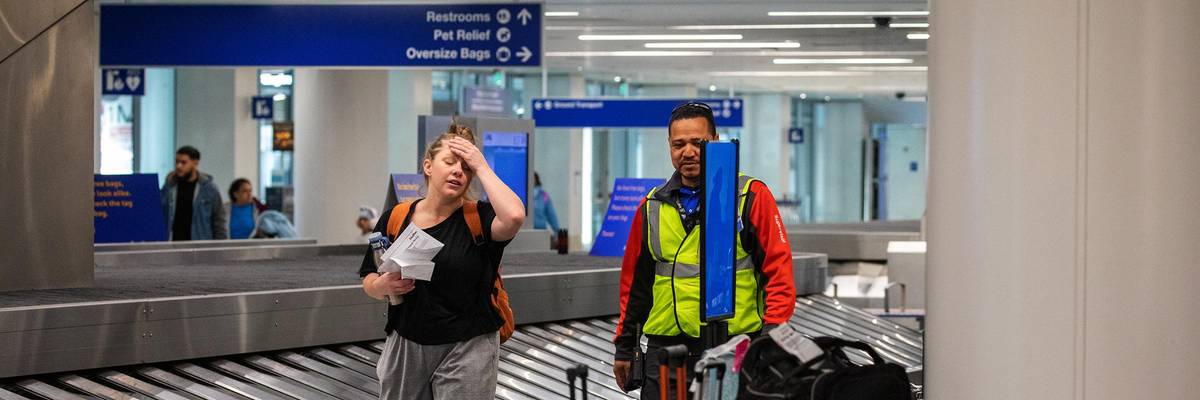
A traveler gets help from Southwest Airlines staff as she tries to find her missing luggage on December 27, 2022 in Los Angeles.
"Southwest Airlines made a risky gamble that mass layoffs and spending billions of dollars on handouts to investors rather than fixing infrastructure would pay off with record profits," said one watchdog. "The airline lost that bet badly."
As travelers and airline workers reel from mass flight cancellations, a corporate watchdog noted Wednesday that Southwest spent nearly $6 billion on stock buybacks in the years ahead of the coronavirus pandemic instead of devoting those resources to technological improvements that unions have been demanding for years.
According to Accountable.US, the crisis Southwest has experienced in recent days amid a massive winter storm is "a problem of its own making." The organization pointed out that the airline opted "to spend $5.6 billion on stock buybacks in the three years leading up to the pandemic rather than making investments in infrastructure to be better prepared for extreme weather events like this week."
The watchdog group added that the company "even reinstated dividends earlier this month, the first major airline to do so after the pandemic."
"Southwest Airlines made a risky gamble that mass layoffs and spending billions of dollars on handouts to investors rather than fixing infrastructure would pay off with record profits," Kyle Herrig, the president of Accountable.US, said in a statement. "The airline lost that bet badly and now it's their customers left paying the price including the thousands stranded in the middle of holiday season travel."
"Southwest's well-compensated executives could have prioritized its workers and customers by preparing for the worst, but greed trumped all as they put a small group of wealthy investors first," Herrig added. "Consumers shouldn't be the ones stuck holding the bag for Southwest's greedy management decisions, but here we are. This is where the Transportation Department should start in any investigation into why this happened."
Southwest has canceled more than 5,000 flights this week—accounting for the bulk of flights canceled in the U.S.—and delayed hundreds more, stranding travelers and flight attendants, throwing holiday plans into chaos, and straining already-exhausted flight crews.
"Southwest's well-compensated executives could have prioritized its workers and customers by preparing for the worst, but greed trumped all."
Unions representing flight attendants and pilots have said that while the winter storm fueled some of the cancellations, deliberate decisions by Southwest management were ultimately responsible for what's been described as the company's "full-blown meltdown."
Specifically, the vice president of the Southwest Airlines Pilots Association told Insider that the company's "outdated" scheduling software has been overwhelmed, wreaking havoc on operations.
"When we get out of position, it's a tough task for our schedulers to put it back together, and right now they're having to do it by hand," said Captain Mike Santoro, explaining that some flights were unnecessarily canceled because the airline's system was unable to adequately keep track of employees.
Lyn Montgomery, president of TWU Local 556, the union that represents flight attendants, told a local news outlet that "this is the worst I've ever seen in my 27 years of working as a flight attendant for Southwest Airlines."
"Obviously, the impact of Winter Storm Elliott created the issues, but the Southwest Airlines systems cannot recover because we have outdated technology," Montgomery said.
The New York Times reported Wednesday that many of the scheduling issues "stem from the carrier's unique 'point-to-point' model, in which planes tend to fly from destination to destination without returning to one or two main hubs."
"Most airlines follow a 'hub-and-spoke' model, in which planes typically return to a hub airport after flying out to other cities," the Times noted. "When bad weather hits, hub-and-spoke airlines can shut down specific routes and have plans in place to restart operations when the skies clear. But bad weather can scramble multiple flights and routes in a point-to-point model, leaving Southwest staff out of position to resume normal operations."
Randy Barnes, president of TWU Local 555, the union that represents Southwest ground workers, said in a statement Wednesday that "if airline managers had planned better, the meltdown we've witnessed in recent days could have been lessened or averted."
"Ground workers need more support," Barnes added. "Many of our people have been forced to work 16- or 18-hour days during this holiday season. Our members work hard, they're dedicated to their jobs, but many are getting sick, and some have experienced frostbite over the past week. In severe weather, it's unreasonable for workers to stay outside for extended periods. People need to be able to cycle in and out of the cold. The airline needs to do more to protect its ground crews."
More than 90% of the 2,760 cancellations in the U.S. thus far on Wednesday have been Southwest flights, according to data compiled by FlightAware.
The company's massive failures have drawn scrutiny from members of Congress and the U.S. Department of Transportation, which has said it is looking into the cancellations.
"This has clearly crossed the line from what’s an uncontrollable weather situation to something that is the airline’s direct responsibility,” Transportation Secretary Pete Buttigieg said late Tuesday in an appearance on "NBC Nightly News."
In a statement, Senate Commerce Committee Chair Maria Cantwell (D-Wash.) similarly argued that "the problems at Southwest Airlines over the last several days go beyond weather."
"The committee will be looking into the causes of these disruptions and its impact to consumers," said Cantwell. "Many airlines fail to adequately communicate with consumers during flight cancellations. Consumers deserve strong protections, including an updated consumer refund rule."
Dear Common Dreams reader, It’s been nearly 30 years since I co-founded Common Dreams with my late wife, Lina Newhouser. We had the radical notion that journalism should serve the public good, not corporate profits. It was clear to us from the outset what it would take to build such a project. No paid advertisements. No corporate sponsors. No millionaire publisher telling us what to think or do. Many people said we wouldn't last a year, but we proved those doubters wrong. Together with a tremendous team of journalists and dedicated staff, we built an independent media outlet free from the constraints of profits and corporate control. Our mission has always been simple: To inform. To inspire. To ignite change for the common good. Building Common Dreams was not easy. Our survival was never guaranteed. When you take on the most powerful forces—Wall Street greed, fossil fuel industry destruction, Big Tech lobbyists, and uber-rich oligarchs who have spent billions upon billions rigging the economy and democracy in their favor—the only bulwark you have is supporters who believe in your work. But here’s the urgent message from me today. It's never been this bad out there. And it's never been this hard to keep us going. At the very moment Common Dreams is most needed, the threats we face are intensifying. We need your support now more than ever. We don't accept corporate advertising and never will. We don't have a paywall because we don't think people should be blocked from critical news based on their ability to pay. Everything we do is funded by the donations of readers like you. When everyone does the little they can afford, we are strong. But if that support retreats or dries up, so do we. Will you donate now to make sure Common Dreams not only survives but thrives? —Craig Brown, Co-founder |
As travelers and airline workers reel from mass flight cancellations, a corporate watchdog noted Wednesday that Southwest spent nearly $6 billion on stock buybacks in the years ahead of the coronavirus pandemic instead of devoting those resources to technological improvements that unions have been demanding for years.
According to Accountable.US, the crisis Southwest has experienced in recent days amid a massive winter storm is "a problem of its own making." The organization pointed out that the airline opted "to spend $5.6 billion on stock buybacks in the three years leading up to the pandemic rather than making investments in infrastructure to be better prepared for extreme weather events like this week."
The watchdog group added that the company "even reinstated dividends earlier this month, the first major airline to do so after the pandemic."
"Southwest Airlines made a risky gamble that mass layoffs and spending billions of dollars on handouts to investors rather than fixing infrastructure would pay off with record profits," Kyle Herrig, the president of Accountable.US, said in a statement. "The airline lost that bet badly and now it's their customers left paying the price including the thousands stranded in the middle of holiday season travel."
"Southwest's well-compensated executives could have prioritized its workers and customers by preparing for the worst, but greed trumped all as they put a small group of wealthy investors first," Herrig added. "Consumers shouldn't be the ones stuck holding the bag for Southwest's greedy management decisions, but here we are. This is where the Transportation Department should start in any investigation into why this happened."
Southwest has canceled more than 5,000 flights this week—accounting for the bulk of flights canceled in the U.S.—and delayed hundreds more, stranding travelers and flight attendants, throwing holiday plans into chaos, and straining already-exhausted flight crews.
"Southwest's well-compensated executives could have prioritized its workers and customers by preparing for the worst, but greed trumped all."
Unions representing flight attendants and pilots have said that while the winter storm fueled some of the cancellations, deliberate decisions by Southwest management were ultimately responsible for what's been described as the company's "full-blown meltdown."
Specifically, the vice president of the Southwest Airlines Pilots Association told Insider that the company's "outdated" scheduling software has been overwhelmed, wreaking havoc on operations.
"When we get out of position, it's a tough task for our schedulers to put it back together, and right now they're having to do it by hand," said Captain Mike Santoro, explaining that some flights were unnecessarily canceled because the airline's system was unable to adequately keep track of employees.
Lyn Montgomery, president of TWU Local 556, the union that represents flight attendants, told a local news outlet that "this is the worst I've ever seen in my 27 years of working as a flight attendant for Southwest Airlines."
"Obviously, the impact of Winter Storm Elliott created the issues, but the Southwest Airlines systems cannot recover because we have outdated technology," Montgomery said.
The New York Times reported Wednesday that many of the scheduling issues "stem from the carrier's unique 'point-to-point' model, in which planes tend to fly from destination to destination without returning to one or two main hubs."
"Most airlines follow a 'hub-and-spoke' model, in which planes typically return to a hub airport after flying out to other cities," the Times noted. "When bad weather hits, hub-and-spoke airlines can shut down specific routes and have plans in place to restart operations when the skies clear. But bad weather can scramble multiple flights and routes in a point-to-point model, leaving Southwest staff out of position to resume normal operations."
Randy Barnes, president of TWU Local 555, the union that represents Southwest ground workers, said in a statement Wednesday that "if airline managers had planned better, the meltdown we've witnessed in recent days could have been lessened or averted."
"Ground workers need more support," Barnes added. "Many of our people have been forced to work 16- or 18-hour days during this holiday season. Our members work hard, they're dedicated to their jobs, but many are getting sick, and some have experienced frostbite over the past week. In severe weather, it's unreasonable for workers to stay outside for extended periods. People need to be able to cycle in and out of the cold. The airline needs to do more to protect its ground crews."
More than 90% of the 2,760 cancellations in the U.S. thus far on Wednesday have been Southwest flights, according to data compiled by FlightAware.
The company's massive failures have drawn scrutiny from members of Congress and the U.S. Department of Transportation, which has said it is looking into the cancellations.
"This has clearly crossed the line from what’s an uncontrollable weather situation to something that is the airline’s direct responsibility,” Transportation Secretary Pete Buttigieg said late Tuesday in an appearance on "NBC Nightly News."
In a statement, Senate Commerce Committee Chair Maria Cantwell (D-Wash.) similarly argued that "the problems at Southwest Airlines over the last several days go beyond weather."
"The committee will be looking into the causes of these disruptions and its impact to consumers," said Cantwell. "Many airlines fail to adequately communicate with consumers during flight cancellations. Consumers deserve strong protections, including an updated consumer refund rule."
As travelers and airline workers reel from mass flight cancellations, a corporate watchdog noted Wednesday that Southwest spent nearly $6 billion on stock buybacks in the years ahead of the coronavirus pandemic instead of devoting those resources to technological improvements that unions have been demanding for years.
According to Accountable.US, the crisis Southwest has experienced in recent days amid a massive winter storm is "a problem of its own making." The organization pointed out that the airline opted "to spend $5.6 billion on stock buybacks in the three years leading up to the pandemic rather than making investments in infrastructure to be better prepared for extreme weather events like this week."
The watchdog group added that the company "even reinstated dividends earlier this month, the first major airline to do so after the pandemic."
"Southwest Airlines made a risky gamble that mass layoffs and spending billions of dollars on handouts to investors rather than fixing infrastructure would pay off with record profits," Kyle Herrig, the president of Accountable.US, said in a statement. "The airline lost that bet badly and now it's their customers left paying the price including the thousands stranded in the middle of holiday season travel."
"Southwest's well-compensated executives could have prioritized its workers and customers by preparing for the worst, but greed trumped all as they put a small group of wealthy investors first," Herrig added. "Consumers shouldn't be the ones stuck holding the bag for Southwest's greedy management decisions, but here we are. This is where the Transportation Department should start in any investigation into why this happened."
Southwest has canceled more than 5,000 flights this week—accounting for the bulk of flights canceled in the U.S.—and delayed hundreds more, stranding travelers and flight attendants, throwing holiday plans into chaos, and straining already-exhausted flight crews.
"Southwest's well-compensated executives could have prioritized its workers and customers by preparing for the worst, but greed trumped all."
Unions representing flight attendants and pilots have said that while the winter storm fueled some of the cancellations, deliberate decisions by Southwest management were ultimately responsible for what's been described as the company's "full-blown meltdown."
Specifically, the vice president of the Southwest Airlines Pilots Association told Insider that the company's "outdated" scheduling software has been overwhelmed, wreaking havoc on operations.
"When we get out of position, it's a tough task for our schedulers to put it back together, and right now they're having to do it by hand," said Captain Mike Santoro, explaining that some flights were unnecessarily canceled because the airline's system was unable to adequately keep track of employees.
Lyn Montgomery, president of TWU Local 556, the union that represents flight attendants, told a local news outlet that "this is the worst I've ever seen in my 27 years of working as a flight attendant for Southwest Airlines."
"Obviously, the impact of Winter Storm Elliott created the issues, but the Southwest Airlines systems cannot recover because we have outdated technology," Montgomery said.
The New York Times reported Wednesday that many of the scheduling issues "stem from the carrier's unique 'point-to-point' model, in which planes tend to fly from destination to destination without returning to one or two main hubs."
"Most airlines follow a 'hub-and-spoke' model, in which planes typically return to a hub airport after flying out to other cities," the Times noted. "When bad weather hits, hub-and-spoke airlines can shut down specific routes and have plans in place to restart operations when the skies clear. But bad weather can scramble multiple flights and routes in a point-to-point model, leaving Southwest staff out of position to resume normal operations."
Randy Barnes, president of TWU Local 555, the union that represents Southwest ground workers, said in a statement Wednesday that "if airline managers had planned better, the meltdown we've witnessed in recent days could have been lessened or averted."
"Ground workers need more support," Barnes added. "Many of our people have been forced to work 16- or 18-hour days during this holiday season. Our members work hard, they're dedicated to their jobs, but many are getting sick, and some have experienced frostbite over the past week. In severe weather, it's unreasonable for workers to stay outside for extended periods. People need to be able to cycle in and out of the cold. The airline needs to do more to protect its ground crews."
More than 90% of the 2,760 cancellations in the U.S. thus far on Wednesday have been Southwest flights, according to data compiled by FlightAware.
The company's massive failures have drawn scrutiny from members of Congress and the U.S. Department of Transportation, which has said it is looking into the cancellations.
"This has clearly crossed the line from what’s an uncontrollable weather situation to something that is the airline’s direct responsibility,” Transportation Secretary Pete Buttigieg said late Tuesday in an appearance on "NBC Nightly News."
In a statement, Senate Commerce Committee Chair Maria Cantwell (D-Wash.) similarly argued that "the problems at Southwest Airlines over the last several days go beyond weather."
"The committee will be looking into the causes of these disruptions and its impact to consumers," said Cantwell. "Many airlines fail to adequately communicate with consumers during flight cancellations. Consumers deserve strong protections, including an updated consumer refund rule."