

SUBSCRIBE TO OUR FREE NEWSLETTER
Daily news & progressive opinion—funded by the people, not the corporations—delivered straight to your inbox.
5
#000000
#FFFFFF
To donate by check, phone, or other method, see our More Ways to Give page.
Daily news & progressive opinion—funded by the people, not the corporations—delivered straight to your inbox.
If the allegations contained in a lawsuit are true, it demonstrates a willful endangerment of citizens and a gross violation of federal laws and policies.
In late 2014 people across West Virginia and southwest Virginia were informed that a collaboration of energy companies had created a limited liability company called Mountain Valley Pipeline LLC. The company was created to develop the Mountain Valley Pipeline, a 303-mile methane-gas pipeline traveling through West Virginia and Virginia mountains, farms, streams, and communities. It is most commonly called the “MVP.” It crossed my organic farm and many places where I travel, work, and play.
From the beginning there were questions about the necessity and the viability of this project. What transpired is a years-long battle to stop the pipeline. By 2022 it was apparent that the MVP was a doomed project, having gone from a price tag of $3.5 billion to over $8 billion and not being able to legally obtain critical permits. It is now projected to eventually cost nearly $10 billion.
The pipeline was rescued in 2023 by then-West Virginia Sen. Joe Manchin when he held the debt ceiling legislation hostage until he got his “Dirty Deal,” inserted into the final Fiscal Responsibility Act of 2023. This then created a situation where degraded and corroded pipe, which had sat in the sun for years beyond the manufacturer’s recommendations, was going to be buried by MVP developers. Despite warnings from citizens, environmental, and safety experts, MVP was allowed to use much of this expired pipe.
Congress, PHMSA, and the Federal Energy Regulatory Commission (FERC) each must conduct investigations to determine if public safety has been compromised and if officials with MVP broke federal law.
In October of 2023 citizens did get the Pipeline and Hazardous Materials Safety Administration (PHMSA) to issue additional safety procedures for any of the pipe remaining to be installed across West Virginia and Virginia. Meanwhile MVP was barreling full steam ahead, installing the pipe in some of the most difficult and environmentally sensitive areas of the route. They worked around the clock in sometimes brutal conditions from early June 2023 through June of 2024, despite the fact that Sen. Manchin and others said it could be completed in as little as four months. More lies and deception from those advocating for the pipeline.
Throughout this time, citizens monitoring the construction would hear rumors of shortcuts and pipeline failures like the one that happened in Bent Mountain, Virginia in May of 2024 just days before the pipeline was given the green light to enter service.
In my community of West Virginia, I heard rumors of pipeline being buried that was not properly approved by inspectors, but I heard nothing more about this after January of 2024 when MVP left my farm. That was until June 4 when I read a story by Mike Tony of the Charleston-Gazette-Mail. The story revealed that a wrongful termination lawsuit had been filed in Monroe County, where I live, in April of 2025. It was recently moved to the federal Court in nearby Bluefield, West Virginia. Subsequent stories by Laurence Hammack of The Roanoke Times and by Carlos Anchondo of E&E News have raised dire concerns among those of us who live in the blast zone of the MVP pipeline in West Virginia and Virginia.
The lawsuit alleged that a pipeline inspector was fired by MVP after refusing to sign off on pipe and/or welds he felt were unsafe. In fact, according to the filing in the Monroe County Court, he was told that if he wanted to keep his job, he was to bury the pipe. He refused, and, according to the complaint, he was transferred and later fired. In my eyes, this man is a public hero. He did his job and was fired for it. I wonder how prevalent this kind of excessive pressure is on those doing this job across the pipeline industry.
If the allegations contained in the lawsuit are true, it demonstrates a willful endangerment of citizens and a gross violation of federal laws and policies. It is imperative that this does not get swept under the rug by Mountain Valley Pipeline with some sort of out of court settlement and a nondisclosure agreement. Congress, PHMSA, and the Federal Energy Regulatory Commission (FERC) each must conduct investigations to determine if public safety has been compromised and if officials with MVP broke federal law.
This is particularly troubling for me as I suspect that some of the pipe and welds in question are near my home or in other places where I frequent often. I also suspect this is not a situation that is isolated to just Monroe County, West Virginia. This week I will be in Washington D.C. seeking answers from FERC, PHMSA, and our elected officials.
"Oil companies know that protest works," said Greenpeace USA's leader.
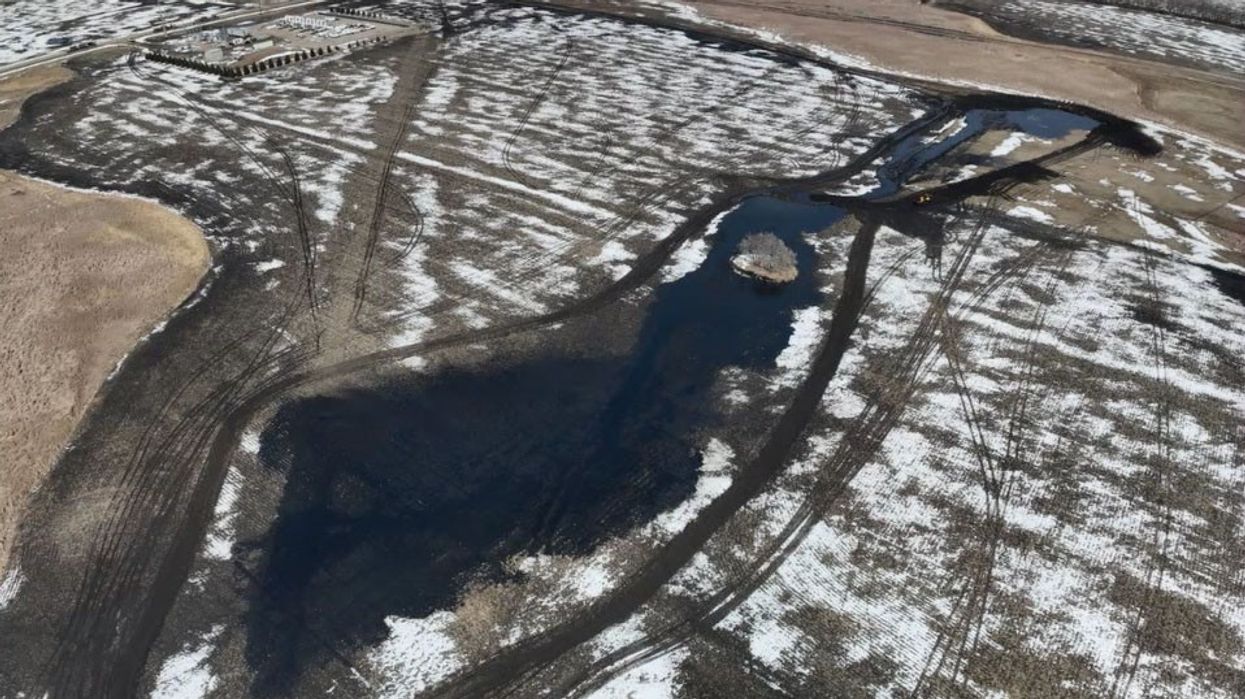
With cleanup efforts still underway in rural North Dakota on Friday after yet another Keystone crude oil pipeline spill, Greenpeace USA interim executive director Sushma Raman said that the incident "shows exactly why we need to protect protest, free speech, and the right to speak up against harm."
Keystone ruptured on Tuesday, spilling an estimated 3,500 barrels of oil into an agricultural field, according to the Pipeline and Hazardous Materials Safety Administration (PHMSA). That came just weeks after a North Dakota jury awarded Energy Transfer and its subsidiary more than $660 million in a case targeting Greenpeace for protests against the Dakota Access oil pipeline.
"We know fossil fuels are unhealthy at every stage of their life cycle. There is no fail-safe way to transport oil and gas, and the risks unfairly fall on the people who live near the route, while the company reaps the benefits," Raman said in a Friday statement. "Everyday people, public watchdogs, and advocacy groups have a right to raise their voices and criticize a corporation when their health and livelihoods are on the line."
"Yet this type of ordinary advocacy is exactly what is under attack in the more than $660 million jury verdict against Greenpeace entities in a lawsuit brought by pipeline company Energy Transfer," added Raman, whose group is appealing the March decision. "Oil companies know that protest works—which is why they're trying to make the stakes so high no one will be willing to take the risk."
"There is no fail-safe way to transport oil and gas, and the risks unfairly fall on the people who live near the route, while the company reaps the benefits."
Environmentalist David Suzuki and co-writer Ian Hanington similarly wrote last week that while Greenpeace argues that it assisted with the protests against Dakota Access "at the request of the Standing Rock Sioux, the environmental group is clearly seen as a threat to oil and gas interests and is a high-profile target for increasingly common efforts to silence opposition."
"From Standing Rock to Wet'suwet'en territory in British Columbia and beyond, militarized law enforcement agencies are relying more often on use of force against land and water defenders, and companies are resorting to tactics such as SLAPPs ("strategic lawsuits against public participation" designed to silence opponents through costly, time-consuming legal processes)," they noted. "Those working to protect land, air, water, plants and animals, and our future face an increasingly uphill battle."
The pair stressed that "the lawsuit against Greenpeace is an attack on the right to protest and speak freely. It won't be the last. We should all stand with Standing Rock, and with organizations such as Greenpeace that are working for people and the planet and holding the line against the destructive fossil fuel industry."
One expert detailed some of the industry's destruction in comments to The Associated Press about the Keystone spill earlier this week:
The spill is not a minor one, said Paul Blackburn, a policy analyst with Bold Alliance, an environmental and landowners group that fought the pipeline's extension, called Keystone XL.
The estimated volume of 3,500 barrels, or 147,000 gallons of crude oil, is equal to 16 tanker trucks of oil, he said. That estimate could increase over time, he added.
Blackburn said the bigger picture is what he called the Keystone pipeline's history of spills at a higher rate than other pipelines. He compared Keystone to the Dakota Access oil pipeline since the latter came online in June 2017. In that period, Keystone's system has spilled nearly 1.2 million gallons (4.5 million liters) of oil, while Dakota Access spilled 1,282 gallons (4,853 liters), Blackburn said.
PHMSA said Thursday that it "has dispatched a total of eight inspectors to investigate the pipeline rupture," and Keystone's operator is "voluntarily committing to full cooperation with our investigation and pledging a series of corrective measures," including "a commitment not to restart the pipeline without prior approval."
The federal agency added Friday that as of 1:00 am local time, "five vacuum trucks have recovered and removed 1,170 barrels of crude oil. Cleanup operations are ongoing. PHMSA will continue to provide updated information as we receive it."
While Republican President Donald Trump aims to revive the Keystone XL project and boost the fossil fuel industry in general, one climate champion on Capitol Hill pointed to the spill as further proof of the need to phase out planet-wrecking oil and gas.
U.S. Sen. Ed Markey (D-Mass.), the chamber's lead sponsor of Green New Deal legislation, said on social media this week: "The Keystone oil pipeline has ruptured and spilled—again. We must continue to fight for strong pipeline safety requirements and get rid of dirty fossil fuels once and for all."
Faced with a troubling report that reveals multiple pipe defects, Mountain Valley Pipeline spins and misrepresents.
Almost four months after high-pressure water testing blew a
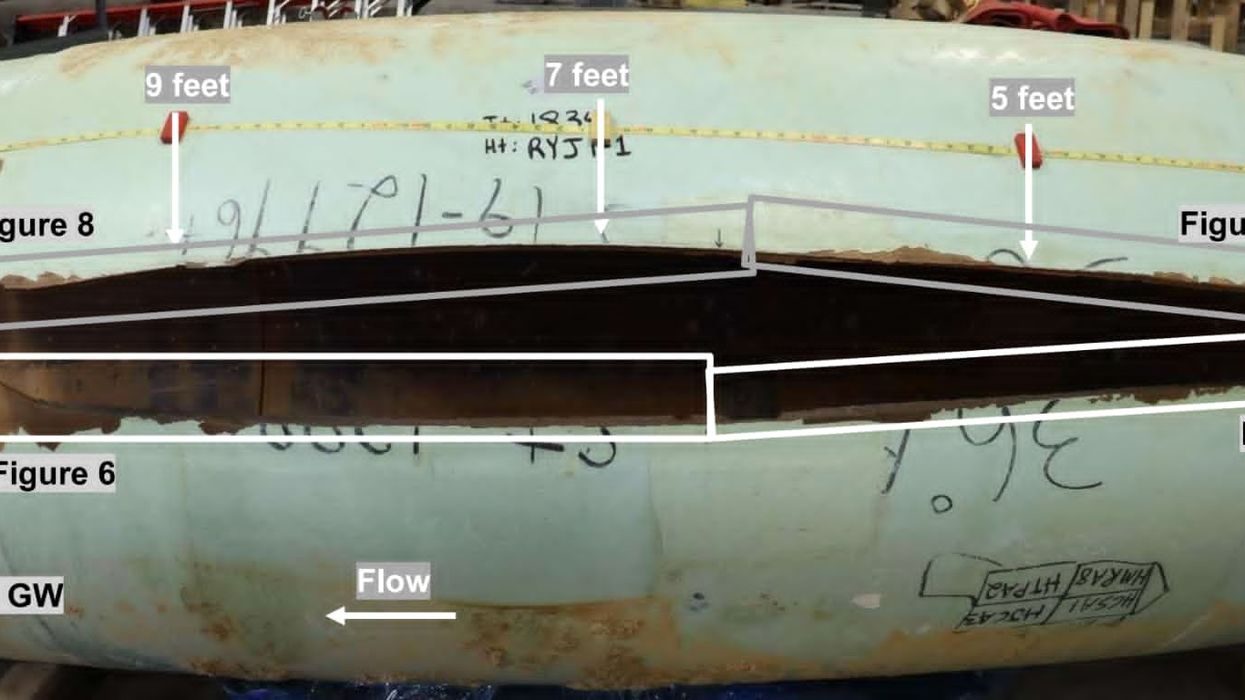
gaping hole in an elbow pipe fitting section of the Mountain Valley Pipeline on Bent Mountain in Virginia, the pipeline operator filed a report with the Federal Energy Regulatory Commission on August 29 addressing the cause of the pipe failure.
The incident, which occurred on May 1, roughly six weeks before MVP went into operation, was first noted by local land owners, who observed sediment in a nearby stream, reported it to the Virginia Department of Environmental Quality (DEQ), and then photographed the burst pipe as it was hauled away a day later.
MVP sent the 43-page report to the Pipeline and Hazardous Materials Safety Administration (PHMSA) on August 28, a day before the report was filed with FERC. In June, PHMSA and MVP entered into a consent agreement to resolve a 2023 notice of proposed safety order, which had alleged that conditions existed along MVP’s route through West Virginia and Virginia that posed “an integrity risk to public safety, property, or the environment.”
This fight will continue until MVP is held accountable and this ruinous disaster is stopped before the unthinkable happens.
MVP’s report—and the company’s reaction to it—leave more questions unanswered than answered.
But one thing is clear: MVP tried to mislead PHMSA and FERC, as well as the press and the public at large, by including with the report filing a two-page cover letter that downplayed the incident and omitted crucial information contained in the report.
Also troubling—and unexplained—the report went through three drafts, dated July 23, August 1, and August 21. It was prepared by risk management firm DNV GL USA, which described MVP as its “customer.”
MVP provided DNV with a 12.5-foot section of pipe that contained the burst elbow fitting as well as two smaller sections (1.5 feet and one foot) from a “sister fitting” from the same test section.
MVP claimed in its cover letter that the sister elbow fitting was the only piece of pipe along the 303-mile long pipeline that had a “matching pedigree.” It gave no supporting evidence, nor did it even describe what it meant by “matching pedigree,” and DNV did not address the claim, much less verify it.
DNV did tensile tests on the blown pipe and “duplicate tensile tests” on the two samples from the sister fitting. The purpose of the analysis was “to determine the metallurgical cause of the failure and identify any contributing factors.”
DNV concluded that “the elbow fitting failed at the longitudinal seam weld as a result of ductile overload.” Ductile overload is “the failure mode that occurs when a material is simply loaded to beyond its ultimate tensile strength.” That seems simple enough. Indeed, it is almost self-evident. Obviously, the pipe burst because pressure was put on it that was beyond its capacity to bear. But that does not tell you why there was ductile overload.
DNV reported that “a majority of the failure was at or near the fusion boundary of the seam weld metal and base metal, indicating a lower tensile strength at or near the fusion boundary compared to the base metal and weld metal.”
That brings us to the second goal of the testing: to determine contributing factors. And that’s where the report gets very interesting—and very scary:
Contributing factors to the lower tensile strength at or near the fusion boundary was (sic) softening of the base metal mid-thickness... and possibly a yield strength lower than the requirement as the base metal yield strength of the sister elbow fitting did not meet the yield strength requirement.
Here, DNV is talking about two different defects in the pipe that burst, and a different defect in the sister pipe.
First, there was inadequate tensile strength , which is the maximum stress that can be applied before an object breaks, in the pipe that burst.
Second, there was possibly also inadequate yield strength, which refers to the maximum stress before an object’s shape permanently changes, in the pipe that burst. The evidence for this is that “the base metal yield strength of the sister elbow fitting”—which MVP admitted had a “matching pedigree”—“did not meet the yield strength requirement.”
Of note, the inadequate yield strength of the sister fitting was not in a welded seam, but rather in the base metal of the pipe itself.
Two pipes tested.
Two pipes defective.
Two different defects.
Taking things further, DNV concluded that “the tensile properties of the sister elbow fitting (base metal) do not meet the tensile requirements for MSS SP75 Grade WPHY70 steel at the time of construction as the yield strength is lower than the required value of 70 ksi; the values are also lower than the MTR value of 70.9 ksi.”
As DNV noted, MSS SP-75 requires a minimum yield strength of 70 kilopounds per square inch (ksi). The two sister elbow samples had a yield strength of 63.5 and 66.8 ksi.
In plain English, the sister elbow would be expected to permanently deform at a level of stress below what was required by industry standards, and the elbow that burst would be expected to break at a level of stress below what is required by industry standards.
Presumably, it is not good for any section of MVP to be either susceptible to permanent alteration or, worse, a straight blow out, when subjected to high pressure. The tested pipes were subject to both. It is terrifying, when one considers that MVP carries explosive methane gas—which is pressurized at up to 1,480 psig—that people live well within the pipeline’s blast zone.
And it gets worse.
DNV reported that there was a separate problem altogether: The sister elbow pipe’s fracture appearance transition temperature (FATT) value, which is the temperature at which the steel’s fracture appearance goes from being mostly flexible to mostly brittle, was “higher (poorer) than typical when compared to 2018 vintage line pipe steel.” Simply put, this means that the sister elbow DNV tested was more susceptible to cracking as compared to other pipe steel made in the same time period.
Mountain Valley Pipeline’s cover letter did not mention any of these problems.
Instead, MVP simply said that its pipeline burst on May 1 “due to a manufacturer’s defective weld,” on one pipe elbow. MVP bragged that a sister fitting “was proactively removed… to provide material for a portion of the mechanical testing aspect of the failure analysis,” but conveniently omitted the fact that the second fitting suffered from multiple manufacturing defects. Incredibly, MVP then misleadingly stated that “a single failure,” when there actually were two defective pipes (out of only two tested), was “a negligible fitting failure rate.”
That’s not even accounting for the fact that this was not the only “failure” that MVP experienced during hydrostatic testing. On June 4, a “jumper pipe” burst, sending a geyser of water hundreds of feet into the nighttime sky and then into a stream that feeds into the Roanoke River. Local residents caught the incident on video. MVP has yet to provide a full explanation of exactly what occurred.
As to the May 1 pipe burst, MVP no doubt was betting that reporters would not dig through 43 pages of highly technical material and instead would rely on MVP’s two-page “summary.” And indeed, with one notable exception, virtually all media outlets did exactly that. Many simply reprinted a story circulated by The Associated Press, which parroted a separate blogpost from MVP that noted that the report found that “there was no evidence of external or internal corrosion.”
By highlighting that DNV found no evidence of corrosion, MVP was cleverly suggesting that widespread concern about corrosion of MVP’s pipes is unfounded. However, concerns about corrosion do not focus on pipes, like the ones at issue here, that were installed and buried in 2018. Rather, the danger of corrosion focuses on the fact that most of the pipeline was installed in 2023 and 2024 using pipes that had been baking in the sun for many years after construction was halted in 2018 and thereafter by federal courts and, in one brief instance, by the Virginia Department of Environmental Quality. In fact, according to federal court testimony from an MVP executive in 2018, the pipe needed to be installed within one year to avoid having the sun degrade its protective coating, which is designed to prevent corrosion.
All of this is very troubling. MVP has a long history of flouting the law, as evidenced by the fact that it has been fined millions of dollars and cited for hundreds of environmental violations as far back as 2018 and as recently as last month.
Now MVP wants those who live along the route and others concerned to accept their claim that the sister elbow fitting it gave to DNV for testing was the only pipe among the 2,500 fittings and thousands of other pipes along the route that had a “matching pedigree” with the pipe that burst, whatever that means, despite the fact that no one—not even DNV—has verified or even evaluated that claim.
MVP likewise does not want anyone to wonder why DNV produced three drafts of the report for its “customer,” MVP. Who knows what MVP asked to be added, deleted, or changed between July 23, when the first draft was completed, and August 21, when the final report was done? Nor is there any explanation as to why MVP waited until August 28 to provide the report to PHMSA.
In short, the people who live next to this polluting and dangerous nightmare, as well as the public at large, are left with many questions and very few answers. And regulatory agencies, whose job it is to protect the public, are simply asleep at the wheel.
As Russell Chisholm, co-director of the Protect Our Water, Heritage, Rights Coalition (POWHR), a local advocacy group, commented:
After four months of waiting, communities near the pipe rupture finally have details from MVP on what caused the pipe explosion during testing. The lab hired by MVP blames the rupture on weak steel and a defective weld. This is a pathetically predictable outcome; we know the MVP has used shoddy materials for their rushed construction job on this massive methane pipeline project. This is yet more evidence of the threat MVP poses to everyone along the route, and why the government never should have greenlit this corrupt project.
MVP continues to assault Appalachia. Week after week after week, MVP files environmental “compliance reports” that instead reveal environmental noncompliance, as sediment is deposited in once pristine and protected streams. This damage would be illegal but for the fact that Congress and the White House exempted this project from environmental laws by legislative fiat in June 2023. And just recently, MVP revealed that it is working to remedy an untold number of “slips,” a euphemism for landslides, that could rupture a pipeline that crosses 75 miles with slopes greater than 30%.
Being treated as a sacrifice zone, the people of Appalachia are left to protect themselves and each other.
It is the latest chapter in a centuries-old story.
But the people of Appalachia are strong—and they are not alone. This fight will continue until MVP is held accountable and this ruinous disaster is stopped before the unthinkable happens.
Because it is not just about tensile strength and hydrostatic testing.
It is about the people who live there. And the land they love.
And in the end, the people will win.
If the 42-inch pipeline ever explodes at 1,480 pounds per square inch of gas pressure, it will be like nothing we have ever seen.
When water pressure blew a gaping hole in the Mountain Valley Pipeline on May 1, folks living near the right of way must have had many mixed reactions—anger, fear, outrage, I told you so, even relief. Relief that it happened now before the pipeline becomes highly pressurized with methane gas.
If the 42-inch pipeline ever explodes at 1,480 pounds per square inch of gas pressure, it will be like nothing we have ever seen. Anyone nearby will likely not survive.
It will probably also mark the end of Secretary of Transportation Pete Buttigieg’s political career because he oversees the Pipeline and Hazardous Materials Safety Administration (PHMSA) whose job it is to make sure MVP gets built safely. Of course, ultimately, it is President Joe Biden who is in charge. His path to reelection, already not easy, will become much harder if MVP ruptures prior to November 5.
It’s 2024, and we know we need to get off fossil fuels ASAP. Why are we building a giant pipeline to suck a climate change accelerant out of America’s biggest deposit of contained methane?
One thing we know for sure is that MVP’s corrosion-proof coating is “no longer fit for purpose.” We don’t know it because we’re experts. We know it because we understand English and we can read. That quote is from a study done by…TC Energy, the company that wanted to build the Keystone XL pipeline (and may still try to if former President Donald Trump wins again).
The picture of the truck hauling away the ruptured section of MVP pipe is alarming, to say the least, but to the untrained eye it offers no clue as to why the steel separated. Hopefully, there will be transparency regarding the investigation and we’ll be able to trust its findings.
Although we know the pipe coating is no good, up until now we’ve had no reason to necessarily question the quality of the pipe itself. But the company that manufactured the pipe, Welspun, has some history that people should be aware of.
In what seems like a weird combination of products lines, besides manufacturing heavy steel pipe, the company also manufactures fine linen. In 2016, Target and Walmart cut ties with Welspun and hundreds of thousands of bed sheets were pulled off store shelves because they were falsely labeled and not as luxurious as advertised.
In 2010, Plains Justice released a report titled Use of Substandard Steel by the U.S. Pipeline Industry 2007 TO 2009. It begins with this: “Between 2007 and 2009 a number of pipe mills produced substandard steel pipe for U.S. pipeline companies. This pipe failed to comply with the American Petroleum Institute Grade 5L X70 standard (API 5L X70 Standard).”
A few paragraphs later: “A number of companies are implicated in producing defective pipe, but it appears that Welspun Corp. Ltd (Welspun), an Indian steel pipe manufacturer, produced most of it. For example, according to released documents, Welspun was responsible for 88% of pipe with expansion anomalies provided to Boardwalk,” which was one of the pipeline building companies.
In 2009, pipeline company Kinder Morgan sued Welspun because pipe that had been purchased was “defective and would not hold up under the required pressure load.”
So has MVP been built with bad pipe? We don’t know, and we need to find out. But regardless, what we do know is MVP’s pipe coating is shot and “no longer fit for purpose.” That alone is more than enough reason to finally throw in the towel and cut our losses on this insane boondoggle.
It’s 2024, and we know we need to get off fossil fuels ASAP. Why are we building a giant pipeline to suck a climate change accelerant out of America’s biggest deposit of contained methane? How much do we want our grandkids to hate us in coming years? How hard do we want to make their lives?
To understand how we know that MVP’s pipe coating is no good, read this. It also tells about three-year-old Delaney Tercero’s death in a hospital burn unit two days after a gas pipeline (which was minuscule compared to MVP) exploded near her home. The cause of the explosion was corrosion due to defective pipe coating. Her parents and younger sister escaped with their lives, but they’ll never get over their loss.
The Mountain Valley Pipeline uses pipe with illegal and unsafe corrosion-proof coating that’s “no longer fit for purpose.”
The builders of the Mountain Valley Pipeline are bringing frivolous multi-million dollar SLAPP suits—or strategic lawsuits against public participation—against pipeline protesters in an attempt to bully them into being quiet.
If only they would slap one here, because this vastly underreported coating issue really needs a lot more publicity. But that’s precisely why I doubt that they will. They don’t want anyone, least of all any real investigative reporters, to focus on their pipes’ serious coating problems.
One thing is clear, MVP has been burying, and continues to bury, illegal, dangerous pipe. A study was done which proves that this is not debatable.
The people who are forced to live within MVP’s blast zone should not have to endure the daily stress of knowing it wasn’t built safely.
Bill McKibben hit the nail on the head when he wrote that the “transition away from fossil fuels” language agreed to at COP28 could be either meaningful or meaningless depending on whether or not it is acted upon. This is similarly true for a rule written into the U.S. Code of Federal Regulations and published in the Federal Register, which is, or at least should be, a million times more legally binding than anything that came out of Dubai. That rule says that pipelines MUST be protected from external corrosion by having a protective coating which, among other things, is “sufficiently ductile to resist cracking.”
The rule exists because long sections of pipe flex a great deal between the time they are manufactured and coated at the plant and when they finally come to rest in a ditch. If the corrosion-proof coating on the pipe is not “sufficiently ductile” (flexible) to also flex when the pipe does, then it will crack. Once a crack in the coating opens up, it creates a pathway for moisture to come in contact with the steel and begin corroding the pipe. Corrosion is a leading cause of pipeline explosions. Controlling corrosion is of particular concern regarding MVP because of its huge size (42-inch diameter) and the extremely high pressure (1,480 pounds per square inch, or psi,) it will be operating under.
In 2018 three-year-old Delaney Tercero was badly burned, as were her parents and younger sister, when a pipeline exploded near their home. Delaney died two days later after what must have been an agonizing ordeal in a hospital burn unit. The pipeline that killed her exploded because of corrosion due to defective pipe coating. It was a 10-inch pipeline. MVP is a 42-inch pipeline. It also has defective pipe coating.
On January 30, 2024 there was a gas pipeline explosion in Oklahoma. It shot flames 500 feet into the air. The fire could be seen from 36 miles away, and it took hours to bring it under control. It started because of corrosion in an 8-inch pipeline and is thought to have migrated to a 24-inch pipeline based on the intensity of the fire. MVP is a 42-inch pipeline.
A 24-inch gas pipeline explosion in Oklahoma in January 2024 sends flames 500 feet into the air. MVP is a 42-inch pipeline.
In July 2023, a gas pipeline exploded near Strasburg, Virginia, next to Interstate 81, shutting down traffic in both directions for hours. It was a 26-inch pipeline operating at 777 psi. MVP is a 42 inch pipeline that will operate at 1,480 psi.
Although language was inserted into last summer’s debt deal that allowed MVP to steamroll the normal permitting process, in no way did any of that language negate the “sufficiently ductile to resist cracking” rule, which has been on the books for over 50 years. Even MVP’s own attorney said that the debt deal dealt specifically and only with permitting issues.
The key to understanding why MVP pipe is illegal lies in a study reported on in the Jan/Feb 2020 issue of Corrosion Management (CM), a publication of the Institute of Corrosion. The article (on p. 16) is not very long nor is it difficult to understand, although there may be a word or two that requires googling. Everyone should read it and print a copy for future reference, before it becomes harder to access. To do so you might have to sign up for a free 30-day subscription to Scribd. The wording in the article and the results of the study make clear that MVP pipe coating has serious, unacceptable flaws.
It should be noted who undertook the study and wrote the article. It wasn’t anti-fossil fuel climate activists. Participants and contributors included TC Energy, the company that wanted to build the Keystone XL (KXL) pipeline, and Welspun, the company that manufactured and coated pipe for both KXL and MVP. One of the authors was James Ferguson, who worked for TC Energy (formerly Trans Canada) for over 18 years and who, at the time of the study, was the director of KXL Technical Services.
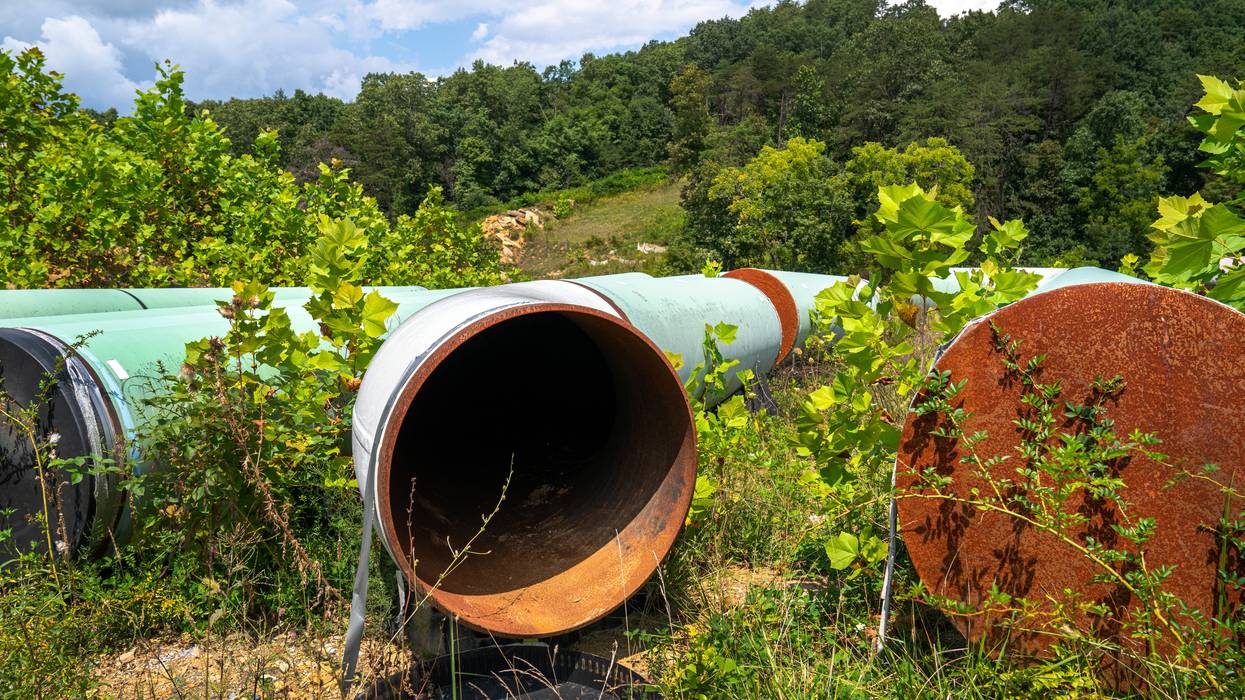
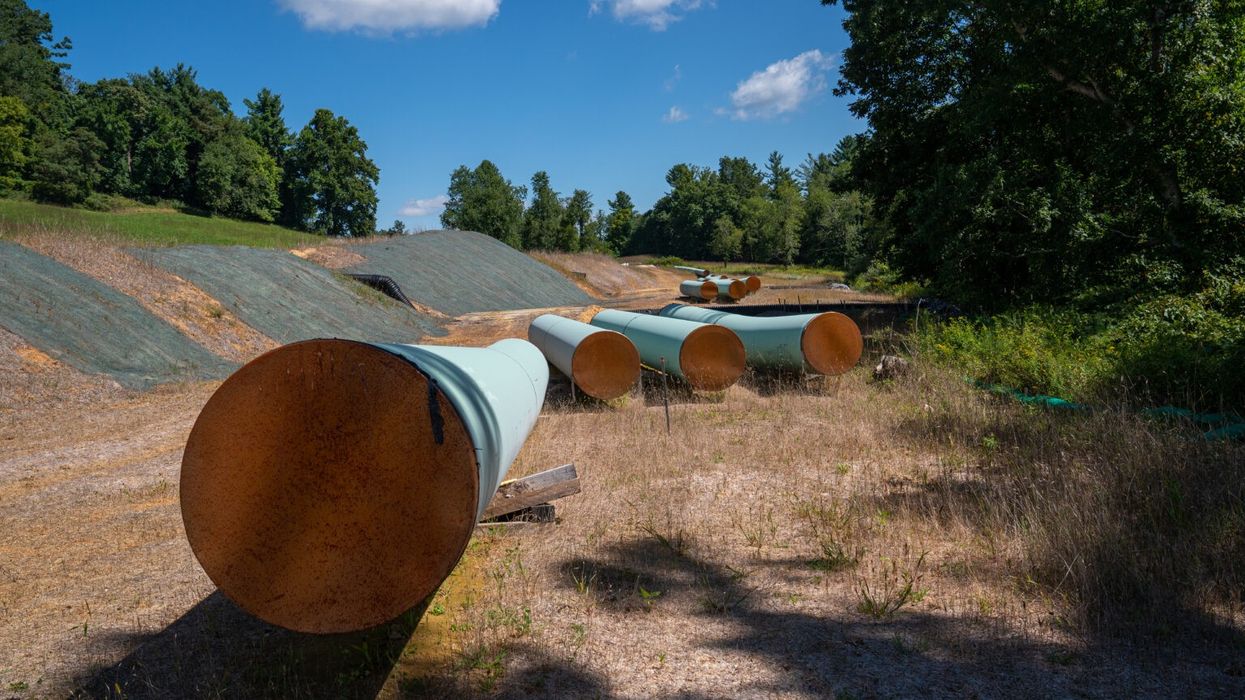
The point of the study was to determine how effective applying whitewash to KXL pipes was in terms of protecting the pipe coating from ultraviolet (UV) exposure, meaning the harmful effects of the sun. Most fossil fuel pipe, including KXL and MVP pipe, is coated with a greenish fusion bonded epoxy (FBE). FBE is, and is meant to be, flexible or ductile after it is applied and dries. However, exposure to the sun will reduce that flexibility over time and the coating can become brittle and crack. The National Association of Pipe Coating Applicators (NAPCA) recommends that FBE not be exposed to the sun for more than six months.
The beginning of the CM article has a paragraph with the heading “Effects of Ultraviolet Exposure on Fusion Bond Epoxy Coatings.” It says that “previous studies of exposed weathering of FBE coating had identified that UV exposure could have a serious deleterious effect on the inherent physical properties of the coating. This phenomenon is common to all FBE coatings that are primarily designed only for below ground service.” Over time, UV exposure will give the glossy green coating applied at the plant more of a chalky green look. Prolonged UV exposure will lead to “a noticeable reduction in the coating thickness” and cause all FBE coatings to “struggle to retain their original flexibility.” The change from glossy to chalky “clearly is accompanied by an embrittlement of the coating” and “reduction of flexibility performance.”
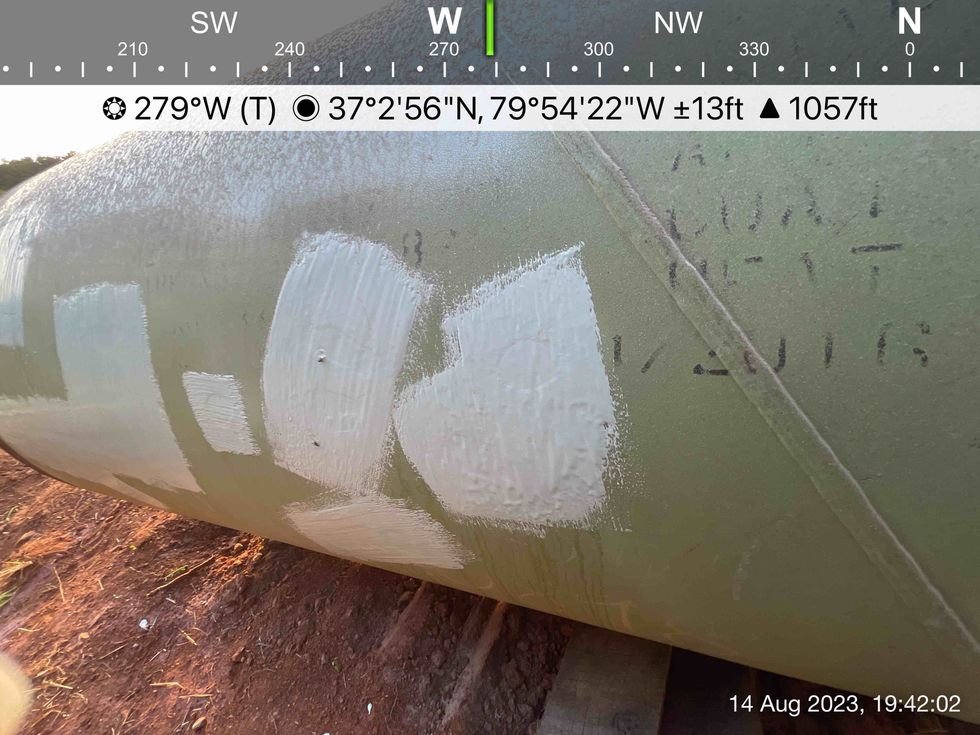
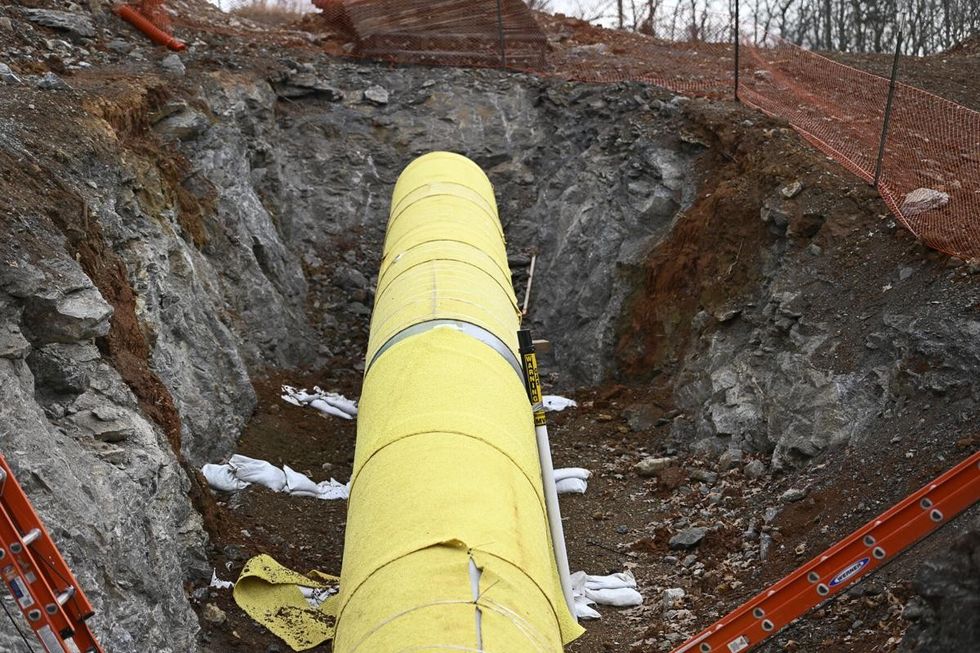
After KXL pipe was manufactured, the pipeline came up against all kinds of opposition for numerous very good reasons. And so it got delayed for years and was ultimately killed near the end of the Obama administration. Because TC Energy was aware of the problems UV creates for FBE coating, twice during that time period the company applied whitewash to the pipe to act as a sort of sunscreen. (It’s important to note here, and then remember, that whitewash was NOT applied to MVP pipe during the six to seven years it has sat in pipe yards and along the pipeline right of way. Dated satellite images can confirm this, as can photographs taken by frontline pipeline opponents.)
Regarding MVP, Buttigieg could rightly point to Sen. Joe Manchin (D-W.V.) as the reason it is being built. But it is on the secretary and a department under his control to make sure MVP is built safely and according to legal rules and regulations.
After former President Donald Trump was elected in 2016, Keystone XL came back to life, which is what prompted the study of its whitewashed pipe. They wanted to show that the whitewash had protected the FBE coating well enough that the pipe was still usable. But that’s not what they found.
The study tested three different groups of KXL pipe, which was generally stacked five layers high. One group included pipe below the top layer. Those pipes weren’t whitewashed, but they also were shaded from the sun by the pipe above them. The coating on those pipes tested OK.
The second group of pipe was from the top layer that had been whitewashed twice, once after 18-24 months of UV exposure and again four to five years later.
The third group involved the last few feet at the ends of top layer pipe. Those last few feet were not whitewashed so as not to cover up stenciling and markings. Those top layer pipe ends received no protection from the sun, and they best represent the coating on MVP pipe.
In eight out of ten tests, the whitewashed pipe failed to attain acceptable adhesion ratings. The non-whitewashed pipe ends “exhibited complete failures” regarding the adhesion test. In addition, the coating thickness on the non-whitewashed pipe ends had been reduced by more than 50%.
Another way to evaluate how well pipe coating will resist corrosion is to perform a catholic disbondment (CD) test. “The CD results of the non-whitewashed pipe ends exposed to UV were deemed total failures,” the study found.
“The flexibility tests were all deemed failures” on both the whitewashed and non-whitewashed pipe. All the flexibility tests “demonstrated similar results of cracking within the coating” even after they reduced the severity of the flexibility test three times from 2.5 degrees to 2.0 degrees to, finally, as little as 1.0 degree.
The first sentence under “Observations” states, “All non-whitewashed pipe that was exposed to continuous UV at the storage site” was “deemed no longer fit for purpose.” Even for whitewashed pipe, the flexibility of the underlying coating was “adversely affected to the point where it was no longer acceptable.”
In 2018 at an oil and gas forum in Canada, a KXL pipeline manager said that defective coating like this is not something that can be remedied in the field but instead it requires shipping the pipe back to the plant for proper stripping, cleaning, and re-coating. This short video shows the elaborate process undertaken to properly apply FBE coating.
The slipshod method that MVP is applying to its degraded pipe coating is wholly inadequate. The “no longer fit for purpose” phrase in the Corrosion Management article basically means that the pipe has a bad case of terminal skin cancer, which is not something MVP is going to remedy with its sporadic paintbrush-applied Band-Aids.
This coating problem is far from unique to MVP. Since 2010 the fossil fuel industry has built 70,000 miles of pipelines, and they have plans to build another 70,000 miles. Most of those pipelines have been and will be fought against, resulting in pipe sitting above ground for extensive periods of time instead of getting quickly buried.
Right now pipeline giant Williams is building the Regional Energy Access Expansion (REAE) project in Pennsylvania. It will lead to a significant increase in fracking in that state, which the majority of Pennsylvanians say they don’t want. Williams is also building the Louisiana Energy Gateway (LEG) project, which will increase gas flow to the LNG export terminals that the people living along the Gulf Coast are trying to shut down. Both REAE and LEG are being built with leftover pipe from the long dead Constitution Pipeline in New York. That pipe was manufactured and coated 10 years ago, and, like MVP pipe, its coating is shot.
But apparently and naturally, after sitting out in the sun for a decade, the pipe was cheap to buy. Cheap enough that it made economic sense for Williams to ship it all the way to Louisiana from New York. In fact, a Williams executive admitted that acquiring the surplus pipe helped keep costs down, making those pipeline projects possible.
Secretary of Transportation Pete Buttigieg was recently in the news during the one-year anniversary of the train derailment in East Palestine, Ohio. He said his department was doing all it could to prevent a similar disaster from happening again. He blamed Congress for not passing helpful legislation.
Regarding MVP, Buttigieg could rightly point to Sen. Joe Manchin (D-W.V.) as the reason it is being built. But it is on the secretary and a department under his control to make sure MVP is built safely and according to legal rules and regulations. That’s the whole reason that PHMSA, the Pipeline and Hazardous Materials Safety Administration, exists. It’s up to Buttigieg and PHMSA to enforce the “sufficiently ductile to resist cracking” rule. It’s up to them to publicly explain why they are disregarding the Corrosion Management study. The fact that now, in his fourth year on the job, Buttigieg still has not even filled the top job at PHMSA makes one ask just how seriously is he regarding pipeline safety.
MVP would never get built near Manchin’s or Buttigieg’s homes. The people who are forced to live within MVP’s blast zone should not have to endure the daily stress of knowing it wasn’t built safely.
MVP and government regulators may argue that there are ways to detect corrosion and other problems before they cause harm. Yet the biggest climate disaster of 2022 was caused by corrosion and created by the same company, Equitrans, that is building MVP. That huge methane leak occurred just 10 days after the site had been inspected and no problem was detected. It took almost two weeks for Equitrans to bring the leak under control.
In 2008 five people were injured and two homes were destroyed when a Williams gas pipeline exploded near Appomattox, Virginia. It was a 30-inch pipeline operating at about half the pressure MVP will operate at. The cause of the explosion was external corrosion due to defective coating that had been compromised by rocks. An inspection undertaken shortly before the pipe exploded did not identify the corroded section of pipe.
The Pennsylvania attorney general has charged Equitrans with crimes regarding a 2018 gas explosion that severely burned a four-year-old boy and his parents, killed their dog, and destroyed their home. The explosion resulted from a leaking Equitrans gas well that the company knew was leaking somewhere, but they never bothered to determine exactly where. Equitrans even had a protocol in place to help prevent corrosion at the well, but they didn’t follow it. One Equitrans employee testified that wells were often not serviced for budgetary reasons. And after the explosion, Equitrans didn’t even conduct the legally required investigation to determine the cause.
If Secretary Buttigieg and PHMSA are going to allow 42-inch MVP to come online with degraded pipe coating, they need to be asked, repeatedly, how they square that decision with the Corrosion Management article and the KXL study. And if someday another person meets Delaney Tercero’s fate because of a MVP explosion, Buttigieg and regulators at PHMSA can blame Equitrans and Manchin… but the fault will be theirs too.
No one should take MVP’s word for it that the pipe is safe and they have the situation under control.
President Joe Biden has been busy lately in Hawaii and Florida dealing with after-the-fact disasters linked to fossil fuels, but there’s a fossil fuel disaster-in-waiting that he also needs to pay attention to and so far he hasn’t. Two thirds of the way through his term, he still has not bothered to nominate an administrator to lead the Pipeline and Hazardous Materials Safety Administration, or PHMSA.
This is a big problem because the builders of the Mountain Valley Pipeline (MVP) are currently burying defective, unsafe, and illegal pipe as fast as they can, which should be of particular interest to the president because when he signed the Dirty Debt Deal, MVP effectively became his pipeline. From a climate perspective MVP is, as Bill McKibben politely called it, dunderheaded. But if it’s going to get built, Biden has a personal responsibility to at least make sure it gets built safely. Right now that is not happening.
In August, PHMSA sent MVP a Notice of Proposed Safety Order (NOPSO) regarding safety problems the agency had identified. The details of the NOPSO are being worked out in consultation with MVP. No doubt pressure is being applied on PHMSA by MVP, the industry in general, and politicians like Joe Manchin to water down any safety measures that might cause a delay in getting MVP built. Whether or not career officials at PHMSA will cave under that pressure we do not yet know. But there is a lot we do know, and our knowledge will make any sort of half-baked safety order unacceptable.
Unless and until MVP can produce some legitimate test results that show otherwise, everyone should assume that MVP’s pipe coating is no different than the KXL pipe coating, meaning that it is “no longer fit for purpose.”
We know that the manufacturer of the corrosion proof epoxy coating on MVP pipes and the National Association of Pipe Coating Applicators say that the coating should not be exposed to the sun for more than six months. Even a senior MVP vice president, testifying in court *68 months ago* during an eminent domain hearing, said that they needed to quickly get the pipe in the ground so that the sun wouldn’t deteriorate the coating.
We know that MVP pipe was coated six to seven years ago and most of it was exposed to the sun for years afterward, including all of the pipe that is currently being buried.
We know that a five-decade old federal law says that all pipelines must have an external coating that protects against corrosion. Even MVP lawyer Donald Verrilli said that the debt deal doesn’t negate the requirement to comply with that law. Federal law also says that the external coating must meet certain standards, including being “sufficiently ductile to resist cracking.” Ductile means flexible.
In the January 2020 issue of Corrosion Management (p. 16) there was an article about a study done on the external coating applied to pipe intended for the Keystone XL (KXL) pipeline, which had sat out in the sun for years just as MVP pipe has. The pipe for both pipelines was manufactured and coated by the same company, Welspun.
In describing the condition of the KXL pipe coating after such prolonged exposure to the sun, the study used phrases such as “no longer acceptable,” “total failures,” “completely failed to retain their original properties and attributes,” and “no longer fit for purpose.”
On page 19 the article stated that KXL pipe coating demonstrated a “serious deterioration in its flexibility performance.” It said the flexibility tests were “deemed failures,” and that the flexibility had deteriorated “to the point where the coating was no longer acceptable.” All the flexibility tests resulted in “cracking within the coating.” Once cracking within the coating occurs, it creates a pathway to the steel pipe that water will surely find, allowing the corrosion process to begin.
Unless and until MVP can produce some legitimate test results that show otherwise, everyone should assume that MVP’s pipe coating is no different than the KXL pipe coating, meaning that it is “no longer fit for purpose.”
We take the sun for granted and often forget how powerful it is. On the plus side it has the potential to save us from runaway climate change if we quickly turn to it as an alternative to burning fossil fuels. On the other hand it can also be extremely destructive. Remember the news story about the trucker who had been on the road for 28 years? The picture of his face said it all. And now we learn that Jimmy Buffett, whose music was often about fun in the sun, has died way too soon from skin cancer.
We need, and Joe Biden needs, to take this pipe coating issue very seriously. This is a massive 42-inch diameter pipeline that will operate at extremely high pressure. Its blast zone includes schools and people’s homes. No one should take MVP’s word for it that the pipe is safe and they have the situation under control. MVP has been fined millions of dollars for hundreds of violations that have occurred so far during construction. The company building MVP was responsible for last year’s biggest climate disaster, a methane leak that they couldn’t stop for 13 days. It was caused by corrosion, and it alone wiped out the climate gains from half of President Biden’s highly touted electric vehicle sales last year.
MVP may pretend it can remedy the coating problem on site, but we’re aware of how coating is properly applied. It’s a fairly elaborate process that can only be done back at the factory (see the two minute video). Even a KXL pipeline manager said fixing defective coating couldn’t be done in the field and that it required shipping the pipe back to the plant for stripping, cleaning, and recoating.
If Donald Trump was still President, PHMSA’s safety order would probably never have even seen the light of day. But if the safety order that gets finalized on Joe Biden’s watch ends up being toothless, then the end result will amount to a distinction without a difference. The ball is in President Biden’s and PHMSA’s court.
While celebrating the forthcoming review, campaigners also argued that "Secretary of Transportation Pete Buttigieg should put a new rule in place that restores the ban on LNG by rail once and for all."
Green groups on Friday applauded as the Biden administration suspended a Trump-era rule allowing liquefied natural gas to be transported by train, delivering another blow to New Fortress Energy's proposal to ship climate-wrecking LNG by rail from Wyalusing, Pennsylvania to Gibbstown, New Jersey.
The Pipeline and Hazardous Materials Safety Administration (PHMSA)—in coordination with the Federal Railroad Administration, another U.S. Department of Transportation (DOT) agency—announced in the Federal Register on Friday that it is amending the Hazardous Materials Regulations (HMR) to suspend authorization of LNG rail transportation.
PHMSA had previously finalized the rule in June 2020, complying with an April 2019 executive order from then-President Donald Trump, who went on a deregulatory spree during his four years in office and is now seeking a second term in 2024.
Rail transportation of LNG has not yet occurred "and there is considerable uncertainty regarding whether any would occur in the time it takes for PHMSA to consider potential modifications to existing, pertinent HMR requirements," the DOT agency noted. The suspension "guarantees no such transportation will occur before its companion rulemaking has concluded or June 30, 2025, whichever is earlier."
Food & Water Watch New Jersey state director Matt Smith said that "suspending the outrageously dangerous Trump bomb train rule is a welcome relief to the communities that would be turned into sacrifice zones for a billionaire hedge fund tycoon to bet big on dirty gas exports. The victory goes to the powerful grassroots movement fighting back against the dangerous New Fortress export scheme and the enormous climate threat associated with the expansion of fracking and LNG."
The suspension follows the DOT in April denying New Fortress' permit request for an export facility on the Delaware River in Gibbstown—a move that Smith had said at the time was "long overdue, and provides some measure of protection for the communities across South Jersey."
Smith stressed Friday that "this victory can, and must, go deeper. The Biden administration should take action to eliminate the threat of fracked gas bomb trains entirely, and it must do more to stop new fossil fuel projects across the country."
The administration of Democratic New Jersey Gov. Phil Murphy "must do more to stop the dirty energy projects that are being proposed across the state," he added. "If our political leaders believe their own rhetoric about the climate crisis, then they must take appropriate action—and that begins by stopping new fossil fuel proposals immediately."
Natural Resources Defense Council senior attorney Kimberly Ong similarly celebrated the development—particularly for frontline communities of the New Fortress project—while also calling for additional action by the Biden administration.
"People of Pennsylvania and New Jersey living near key rail lines would have faced damage to their health, families, and homes in the event of a derailment," Ong said. "After pausing the rule, Secretary of Transportation Pete Buttigieg should put a new rule in place that restores the ban on LNG by rail once and for all. That would finally put an end to the threat to communities around Gibbstown and other communities targeted by similar dangerous projects."
"New Fortress Energy's proposed LNG project endangers nearly 2 million people living near truck and rail transport routes," she pointed out. "LNG is a volatile substance that can lead to fires and even explosions. The rail disaster in East Palestine, Ohio earlier this year underscores how serious a train derailment involving hazardous substances can be."
The February derailment and resulting environmental and public health concerns in Ohio have generated nationwide calls for stricter rail safety policies and inspired the introduction of multiple bills in Congress.