SUBSCRIBE TO OUR FREE NEWSLETTER
Daily news & progressive opinion—funded by the people, not the corporations—delivered straight to your inbox.
5
#000000
#FFFFFF
To donate by check, phone, or other method, see our More Ways to Give page.
Daily news & progressive opinion—funded by the people, not the corporations—delivered straight to your inbox.
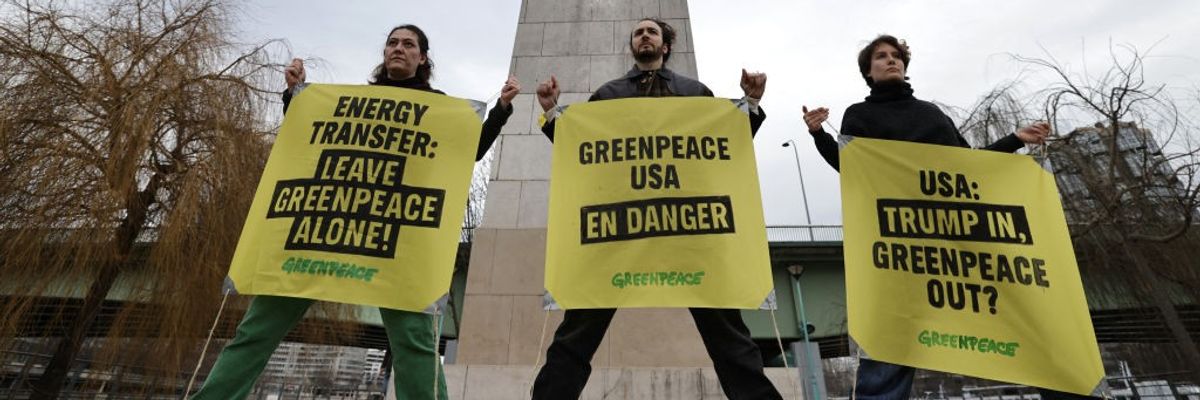
French activists support Greenpeace USA next to the Statue of Liberty at Pont de Grenelle in Paris on February 20, 2025.
"We will not be silenced," the green group said in response to the verdict.
Climate campaigners swiftly sounded the alarm on Wednesday after a North Dakota jury awarded Energy Transfer and its subsidiary more than $660 million in the fossil fuel giant's case targeting Greenpeace for protests against the Dakota Access crude oil pipeline.
While Energy Transfer called the verdict a "win... for the people of Mandan and throughout North Dakota," environmentalist Jon Hinck condemned it as a "travesty of justice."
Hinck and others argue the case against Greenpeace International and two of its entities in the United States is a strategic lawsuit against public participation (SLAPP) intended to intimidate opponents of climate-wrecking fossil fuel projects.
OUTRAGE: A Big Oil-stacked jury just sided with corporate power, slapping Greenpeace with millions in damages for standing with Indigenous water protectors against DAPL. This is a dangerous attack on the right to protest, but the fight is not over. apnews.com/article/gree...
[image or embed]
— Center for Constitutional Rights ( @ccrjustice.org) March 19, 2025 at 6:04 PM
"This case should alarm everyone, no matter their political inclinations," said Sushma Raman, interim executive director of Greenpeace's U.S. entities, in a statement. "It's part of a renewed push by corporations to weaponize our courts to silence dissent. We should all be concerned about the future of the First Amendment, and lawsuits like this aimed at destroying our rights to peaceful protest and free speech. These rights are critical for any work toward ensuring justice—and that's why we will continue fighting back together, in solidarity. While Big Oil bullies can try to stop a single group, they can't stop a movement."
As The New York Times reported Wednesday:
Greenpeace had maintained that it played only a minor part in demonstrations led by the Standing Rock Sioux Tribe. It had portrayed the lawsuit as an attempt to stifle oil industry critics, but a jury apparently disagreed.
The nine-person jury in the Morton County courthouse in Mandan, North Dakota, about 45 minutes north of where the protests took place, returned the verdict after roughly two days of deliberating.
Addressing the legal loss on social media, Greenpeace International vowed that "we will not be silenced."
🚨BREAKING🚨 The trial verdict is in. A jury in the Morton County courthouse found Greenpeace International and two Greenpeace entities in the United States liable for over US$ 660 million combined in Energy Transfer’s meritless SLAPP lawsuit. #WeWillNotBeSilenced
[image or embed]
— Greenpeace International 🌍 ( @greenpeace.org) March 19, 2025 at 5:39 PM
Greenpeace International executive director Mads Christensen echoed that sentiment and pointed to U.S. President Donald Trump's second term as a danger to people and the planet. As the advocacy leader put it: "We are witnessing a disastrous return to the reckless behavior that fueled the climate crisis, deepened environmental racism, and put fossil fuel profits over public health and a livable planet. The previous Trump administration spent four years dismantling protections for clean air, water, and Indigenous sovereignty, and now along with its allies wants to finish the job by silencing protest."
Asked by The Associated Press if Greenpeace plans to appeal just after the verdict, senior legal adviser Deepa Padmanabha said, "We know that this fight is not over."
While the case has sparked fears that a loss in court could end Greenpeace, Padmanabha told AP that the globally known group's work "is never going stop." The adviser added, "That's the really important message today, and we're just walking out and we're going to get together and figure out what our next steps are."
I hate it here. www.nytimes.com/2025/03/19/c...
[image or embed]
— Dr. Genevieve Guenther (she/they) (@doctorvive.bsky.social) March 19, 2025 at 4:19 PM
An independent trial monitoring committee said in a statement that the verdict "reflects a deeply flawed trial with multiple due process violations that denied Greenpeace the ability to present anything close to a full defense."
Marty Garbus, a longtime First Amendment lawyer who is part of the committee, said: "In my six decades of legal practice, I have never witnessed a trial as unfair as the one against Greenpeace that just ended in the courts of North Dakota. This is one of the most important cases in American history."
"The law that can come down in this case can affect any demonstration, religious or political. It's far bigger than the environmental movement. Yet the court in North Dakota abdicated its sacred duty to conduct a fair and public trial and instead let Energy Transfer run roughshod over the rule of law," he added. "Greenpeace has a very strong case on appeal. I believe there is a good chance it ultimately will win both in court and in the court of public opinion."
Greenpeace International general counsel Kristin Casper later said in a statement that "Energy Transfer hasn't heard the last of us in this fight. We're just getting started with our anti-SLAPP lawsuit against Energy Transfer's attacks on free speech and peaceful protest. We will see Energy Transfer in court this July in the Netherlands."
As the
Times detailed, the global group "this year had countersued Energy Transfer in the Netherlands, invoking a new European Union directive against SLAPP suits as well as Dutch law."
Dear Common Dreams reader, It’s been nearly 30 years since I co-founded Common Dreams with my late wife, Lina Newhouser. We had the radical notion that journalism should serve the public good, not corporate profits. It was clear to us from the outset what it would take to build such a project. No paid advertisements. No corporate sponsors. No millionaire publisher telling us what to think or do. Many people said we wouldn't last a year, but we proved those doubters wrong. Together with a tremendous team of journalists and dedicated staff, we built an independent media outlet free from the constraints of profits and corporate control. Our mission has always been simple: To inform. To inspire. To ignite change for the common good. Building Common Dreams was not easy. Our survival was never guaranteed. When you take on the most powerful forces—Wall Street greed, fossil fuel industry destruction, Big Tech lobbyists, and uber-rich oligarchs who have spent billions upon billions rigging the economy and democracy in their favor—the only bulwark you have is supporters who believe in your work. But here’s the urgent message from me today. It's never been this bad out there. And it's never been this hard to keep us going. At the very moment Common Dreams is most needed, the threats we face are intensifying. We need your support now more than ever. We don't accept corporate advertising and never will. We don't have a paywall because we don't think people should be blocked from critical news based on their ability to pay. Everything we do is funded by the donations of readers like you. When everyone does the little they can afford, we are strong. But if that support retreats or dries up, so do we. Will you donate now to make sure Common Dreams not only survives but thrives? —Craig Brown, Co-founder |
Climate campaigners swiftly sounded the alarm on Wednesday after a North Dakota jury awarded Energy Transfer and its subsidiary more than $660 million in the fossil fuel giant's case targeting Greenpeace for protests against the Dakota Access crude oil pipeline.
While Energy Transfer called the verdict a "win... for the people of Mandan and throughout North Dakota," environmentalist Jon Hinck condemned it as a "travesty of justice."
Hinck and others argue the case against Greenpeace International and two of its entities in the United States is a strategic lawsuit against public participation (SLAPP) intended to intimidate opponents of climate-wrecking fossil fuel projects.
OUTRAGE: A Big Oil-stacked jury just sided with corporate power, slapping Greenpeace with millions in damages for standing with Indigenous water protectors against DAPL. This is a dangerous attack on the right to protest, but the fight is not over. apnews.com/article/gree...
[image or embed]
— Center for Constitutional Rights ( @ccrjustice.org) March 19, 2025 at 6:04 PM
"This case should alarm everyone, no matter their political inclinations," said Sushma Raman, interim executive director of Greenpeace's U.S. entities, in a statement. "It's part of a renewed push by corporations to weaponize our courts to silence dissent. We should all be concerned about the future of the First Amendment, and lawsuits like this aimed at destroying our rights to peaceful protest and free speech. These rights are critical for any work toward ensuring justice—and that's why we will continue fighting back together, in solidarity. While Big Oil bullies can try to stop a single group, they can't stop a movement."
As The New York Times reported Wednesday:
Greenpeace had maintained that it played only a minor part in demonstrations led by the Standing Rock Sioux Tribe. It had portrayed the lawsuit as an attempt to stifle oil industry critics, but a jury apparently disagreed.
The nine-person jury in the Morton County courthouse in Mandan, North Dakota, about 45 minutes north of where the protests took place, returned the verdict after roughly two days of deliberating.
Addressing the legal loss on social media, Greenpeace International vowed that "we will not be silenced."
🚨BREAKING🚨 The trial verdict is in. A jury in the Morton County courthouse found Greenpeace International and two Greenpeace entities in the United States liable for over US$ 660 million combined in Energy Transfer’s meritless SLAPP lawsuit. #WeWillNotBeSilenced
[image or embed]
— Greenpeace International 🌍 ( @greenpeace.org) March 19, 2025 at 5:39 PM
Greenpeace International executive director Mads Christensen echoed that sentiment and pointed to U.S. President Donald Trump's second term as a danger to people and the planet. As the advocacy leader put it: "We are witnessing a disastrous return to the reckless behavior that fueled the climate crisis, deepened environmental racism, and put fossil fuel profits over public health and a livable planet. The previous Trump administration spent four years dismantling protections for clean air, water, and Indigenous sovereignty, and now along with its allies wants to finish the job by silencing protest."
Asked by The Associated Press if Greenpeace plans to appeal just after the verdict, senior legal adviser Deepa Padmanabha said, "We know that this fight is not over."
While the case has sparked fears that a loss in court could end Greenpeace, Padmanabha told AP that the globally known group's work "is never going stop." The adviser added, "That's the really important message today, and we're just walking out and we're going to get together and figure out what our next steps are."
I hate it here. www.nytimes.com/2025/03/19/c...
[image or embed]
— Dr. Genevieve Guenther (she/they) (@doctorvive.bsky.social) March 19, 2025 at 4:19 PM
An independent trial monitoring committee said in a statement that the verdict "reflects a deeply flawed trial with multiple due process violations that denied Greenpeace the ability to present anything close to a full defense."
Marty Garbus, a longtime First Amendment lawyer who is part of the committee, said: "In my six decades of legal practice, I have never witnessed a trial as unfair as the one against Greenpeace that just ended in the courts of North Dakota. This is one of the most important cases in American history."
"The law that can come down in this case can affect any demonstration, religious or political. It's far bigger than the environmental movement. Yet the court in North Dakota abdicated its sacred duty to conduct a fair and public trial and instead let Energy Transfer run roughshod over the rule of law," he added. "Greenpeace has a very strong case on appeal. I believe there is a good chance it ultimately will win both in court and in the court of public opinion."
Greenpeace International general counsel Kristin Casper later said in a statement that "Energy Transfer hasn't heard the last of us in this fight. We're just getting started with our anti-SLAPP lawsuit against Energy Transfer's attacks on free speech and peaceful protest. We will see Energy Transfer in court this July in the Netherlands."
As the
Times detailed, the global group "this year had countersued Energy Transfer in the Netherlands, invoking a new European Union directive against SLAPP suits as well as Dutch law."
Climate campaigners swiftly sounded the alarm on Wednesday after a North Dakota jury awarded Energy Transfer and its subsidiary more than $660 million in the fossil fuel giant's case targeting Greenpeace for protests against the Dakota Access crude oil pipeline.
While Energy Transfer called the verdict a "win... for the people of Mandan and throughout North Dakota," environmentalist Jon Hinck condemned it as a "travesty of justice."
Hinck and others argue the case against Greenpeace International and two of its entities in the United States is a strategic lawsuit against public participation (SLAPP) intended to intimidate opponents of climate-wrecking fossil fuel projects.
OUTRAGE: A Big Oil-stacked jury just sided with corporate power, slapping Greenpeace with millions in damages for standing with Indigenous water protectors against DAPL. This is a dangerous attack on the right to protest, but the fight is not over. apnews.com/article/gree...
[image or embed]
— Center for Constitutional Rights ( @ccrjustice.org) March 19, 2025 at 6:04 PM
"This case should alarm everyone, no matter their political inclinations," said Sushma Raman, interim executive director of Greenpeace's U.S. entities, in a statement. "It's part of a renewed push by corporations to weaponize our courts to silence dissent. We should all be concerned about the future of the First Amendment, and lawsuits like this aimed at destroying our rights to peaceful protest and free speech. These rights are critical for any work toward ensuring justice—and that's why we will continue fighting back together, in solidarity. While Big Oil bullies can try to stop a single group, they can't stop a movement."
As The New York Times reported Wednesday:
Greenpeace had maintained that it played only a minor part in demonstrations led by the Standing Rock Sioux Tribe. It had portrayed the lawsuit as an attempt to stifle oil industry critics, but a jury apparently disagreed.
The nine-person jury in the Morton County courthouse in Mandan, North Dakota, about 45 minutes north of where the protests took place, returned the verdict after roughly two days of deliberating.
Addressing the legal loss on social media, Greenpeace International vowed that "we will not be silenced."
🚨BREAKING🚨 The trial verdict is in. A jury in the Morton County courthouse found Greenpeace International and two Greenpeace entities in the United States liable for over US$ 660 million combined in Energy Transfer’s meritless SLAPP lawsuit. #WeWillNotBeSilenced
[image or embed]
— Greenpeace International 🌍 ( @greenpeace.org) March 19, 2025 at 5:39 PM
Greenpeace International executive director Mads Christensen echoed that sentiment and pointed to U.S. President Donald Trump's second term as a danger to people and the planet. As the advocacy leader put it: "We are witnessing a disastrous return to the reckless behavior that fueled the climate crisis, deepened environmental racism, and put fossil fuel profits over public health and a livable planet. The previous Trump administration spent four years dismantling protections for clean air, water, and Indigenous sovereignty, and now along with its allies wants to finish the job by silencing protest."
Asked by The Associated Press if Greenpeace plans to appeal just after the verdict, senior legal adviser Deepa Padmanabha said, "We know that this fight is not over."
While the case has sparked fears that a loss in court could end Greenpeace, Padmanabha told AP that the globally known group's work "is never going stop." The adviser added, "That's the really important message today, and we're just walking out and we're going to get together and figure out what our next steps are."
I hate it here. www.nytimes.com/2025/03/19/c...
[image or embed]
— Dr. Genevieve Guenther (she/they) (@doctorvive.bsky.social) March 19, 2025 at 4:19 PM
An independent trial monitoring committee said in a statement that the verdict "reflects a deeply flawed trial with multiple due process violations that denied Greenpeace the ability to present anything close to a full defense."
Marty Garbus, a longtime First Amendment lawyer who is part of the committee, said: "In my six decades of legal practice, I have never witnessed a trial as unfair as the one against Greenpeace that just ended in the courts of North Dakota. This is one of the most important cases in American history."
"The law that can come down in this case can affect any demonstration, religious or political. It's far bigger than the environmental movement. Yet the court in North Dakota abdicated its sacred duty to conduct a fair and public trial and instead let Energy Transfer run roughshod over the rule of law," he added. "Greenpeace has a very strong case on appeal. I believe there is a good chance it ultimately will win both in court and in the court of public opinion."
Greenpeace International general counsel Kristin Casper later said in a statement that "Energy Transfer hasn't heard the last of us in this fight. We're just getting started with our anti-SLAPP lawsuit against Energy Transfer's attacks on free speech and peaceful protest. We will see Energy Transfer in court this July in the Netherlands."
As the
Times detailed, the global group "this year had countersued Energy Transfer in the Netherlands, invoking a new European Union directive against SLAPP suits as well as Dutch law."