SUBSCRIBE TO OUR FREE NEWSLETTER
Daily news & progressive opinion—funded by the people, not the corporations—delivered straight to your inbox.
5
#000000
#FFFFFF
To donate by check, phone, or other method, see our More Ways to Give page.
Daily news & progressive opinion—funded by the people, not the corporations—delivered straight to your inbox.
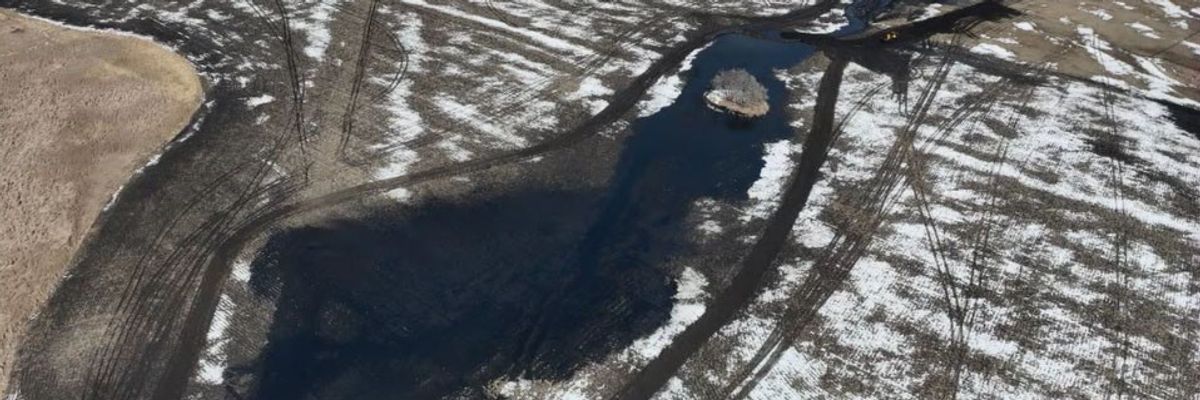
The Keystone pipeline ruptured and spilled oil near Fort Ransom, North Dakota on April 8, 2025.
"Oil companies know that protest works," said Greenpeace USA's leader.
With cleanup efforts still underway in rural North Dakota on Friday after yet another Keystone crude oil pipeline spill, Greenpeace USA interim executive director Sushma Raman said that the incident "shows exactly why we need to protect protest, free speech, and the right to speak up against harm."
Keystone ruptured on Tuesday, spilling an estimated 3,500 barrels of oil into an agricultural field, according to the Pipeline and Hazardous Materials Safety Administration (PHMSA). That came just weeks after a North Dakota jury awarded Energy Transfer and its subsidiary more than $660 million in a case targeting Greenpeace for protests against the Dakota Access oil pipeline.
"We know fossil fuels are unhealthy at every stage of their life cycle. There is no fail-safe way to transport oil and gas, and the risks unfairly fall on the people who live near the route, while the company reaps the benefits," Raman said in a Friday statement. "Everyday people, public watchdogs, and advocacy groups have a right to raise their voices and criticize a corporation when their health and livelihoods are on the line."
"Yet this type of ordinary advocacy is exactly what is under attack in the more than $660 million jury verdict against Greenpeace entities in a lawsuit brought by pipeline company Energy Transfer," added Raman, whose group is appealing the March decision. "Oil companies know that protest works—which is why they're trying to make the stakes so high no one will be willing to take the risk."
"There is no fail-safe way to transport oil and gas, and the risks unfairly fall on the people who live near the route, while the company reaps the benefits."
Environmentalist David Suzuki and co-writer Ian Hanington similarly wrote last week that while Greenpeace argues that it assisted with the protests against Dakota Access "at the request of the Standing Rock Sioux, the environmental group is clearly seen as a threat to oil and gas interests and is a high-profile target for increasingly common efforts to silence opposition."
"From Standing Rock to Wet'suwet'en territory in British Columbia and beyond, militarized law enforcement agencies are relying more often on use of force against land and water defenders, and companies are resorting to tactics such as SLAPPs ("strategic lawsuits against public participation" designed to silence opponents through costly, time-consuming legal processes)," they noted. "Those working to protect land, air, water, plants and animals, and our future face an increasingly uphill battle."
The pair stressed that "the lawsuit against Greenpeace is an attack on the right to protest and speak freely. It won't be the last. We should all stand with Standing Rock, and with organizations such as Greenpeace that are working for people and the planet and holding the line against the destructive fossil fuel industry."
One expert detailed some of the industry's destruction in comments to The Associated Press about the Keystone spill earlier this week:
The spill is not a minor one, said Paul Blackburn, a policy analyst with Bold Alliance, an environmental and landowners group that fought the pipeline's extension, called Keystone XL.
The estimated volume of 3,500 barrels, or 147,000 gallons of crude oil, is equal to 16 tanker trucks of oil, he said. That estimate could increase over time, he added.
Blackburn said the bigger picture is what he called the Keystone pipeline's history of spills at a higher rate than other pipelines. He compared Keystone to the Dakota Access oil pipeline since the latter came online in June 2017. In that period, Keystone's system has spilled nearly 1.2 million gallons (4.5 million liters) of oil, while Dakota Access spilled 1,282 gallons (4,853 liters), Blackburn said.
PHMSA said Thursday that it "has dispatched a total of eight inspectors to investigate the pipeline rupture," and Keystone's operator is "voluntarily committing to full cooperation with our investigation and pledging a series of corrective measures," including "a commitment not to restart the pipeline without prior approval."
The federal agency added Friday that as of 1:00 am local time, "five vacuum trucks have recovered and removed 1,170 barrels of crude oil. Cleanup operations are ongoing. PHMSA will continue to provide updated information as we receive it."
While Republican President Donald Trump aims to revive the Keystone XL project and boost the fossil fuel industry in general, one climate champion on Capitol Hill pointed to the spill as further proof of the need to phase out planet-wrecking oil and gas.
U.S. Sen. Ed Markey (D-Mass.), the chamber's lead sponsor of Green New Deal legislation, said on social media this week: "The Keystone oil pipeline has ruptured and spilled—again. We must continue to fight for strong pipeline safety requirements and get rid of dirty fossil fuels once and for all."
Dear Common Dreams reader, It’s been nearly 30 years since I co-founded Common Dreams with my late wife, Lina Newhouser. We had the radical notion that journalism should serve the public good, not corporate profits. It was clear to us from the outset what it would take to build such a project. No paid advertisements. No corporate sponsors. No millionaire publisher telling us what to think or do. Many people said we wouldn't last a year, but we proved those doubters wrong. Together with a tremendous team of journalists and dedicated staff, we built an independent media outlet free from the constraints of profits and corporate control. Our mission has always been simple: To inform. To inspire. To ignite change for the common good. Building Common Dreams was not easy. Our survival was never guaranteed. When you take on the most powerful forces—Wall Street greed, fossil fuel industry destruction, Big Tech lobbyists, and uber-rich oligarchs who have spent billions upon billions rigging the economy and democracy in their favor—the only bulwark you have is supporters who believe in your work. But here’s the urgent message from me today. It's never been this bad out there. And it's never been this hard to keep us going. At the very moment Common Dreams is most needed, the threats we face are intensifying. We need your support now more than ever. We don't accept corporate advertising and never will. We don't have a paywall because we don't think people should be blocked from critical news based on their ability to pay. Everything we do is funded by the donations of readers like you. When everyone does the little they can afford, we are strong. But if that support retreats or dries up, so do we. Will you donate now to make sure Common Dreams not only survives but thrives? —Craig Brown, Co-founder |
With cleanup efforts still underway in rural North Dakota on Friday after yet another Keystone crude oil pipeline spill, Greenpeace USA interim executive director Sushma Raman said that the incident "shows exactly why we need to protect protest, free speech, and the right to speak up against harm."
Keystone ruptured on Tuesday, spilling an estimated 3,500 barrels of oil into an agricultural field, according to the Pipeline and Hazardous Materials Safety Administration (PHMSA). That came just weeks after a North Dakota jury awarded Energy Transfer and its subsidiary more than $660 million in a case targeting Greenpeace for protests against the Dakota Access oil pipeline.
"We know fossil fuels are unhealthy at every stage of their life cycle. There is no fail-safe way to transport oil and gas, and the risks unfairly fall on the people who live near the route, while the company reaps the benefits," Raman said in a Friday statement. "Everyday people, public watchdogs, and advocacy groups have a right to raise their voices and criticize a corporation when their health and livelihoods are on the line."
"Yet this type of ordinary advocacy is exactly what is under attack in the more than $660 million jury verdict against Greenpeace entities in a lawsuit brought by pipeline company Energy Transfer," added Raman, whose group is appealing the March decision. "Oil companies know that protest works—which is why they're trying to make the stakes so high no one will be willing to take the risk."
"There is no fail-safe way to transport oil and gas, and the risks unfairly fall on the people who live near the route, while the company reaps the benefits."
Environmentalist David Suzuki and co-writer Ian Hanington similarly wrote last week that while Greenpeace argues that it assisted with the protests against Dakota Access "at the request of the Standing Rock Sioux, the environmental group is clearly seen as a threat to oil and gas interests and is a high-profile target for increasingly common efforts to silence opposition."
"From Standing Rock to Wet'suwet'en territory in British Columbia and beyond, militarized law enforcement agencies are relying more often on use of force against land and water defenders, and companies are resorting to tactics such as SLAPPs ("strategic lawsuits against public participation" designed to silence opponents through costly, time-consuming legal processes)," they noted. "Those working to protect land, air, water, plants and animals, and our future face an increasingly uphill battle."
The pair stressed that "the lawsuit against Greenpeace is an attack on the right to protest and speak freely. It won't be the last. We should all stand with Standing Rock, and with organizations such as Greenpeace that are working for people and the planet and holding the line against the destructive fossil fuel industry."
One expert detailed some of the industry's destruction in comments to The Associated Press about the Keystone spill earlier this week:
The spill is not a minor one, said Paul Blackburn, a policy analyst with Bold Alliance, an environmental and landowners group that fought the pipeline's extension, called Keystone XL.
The estimated volume of 3,500 barrels, or 147,000 gallons of crude oil, is equal to 16 tanker trucks of oil, he said. That estimate could increase over time, he added.
Blackburn said the bigger picture is what he called the Keystone pipeline's history of spills at a higher rate than other pipelines. He compared Keystone to the Dakota Access oil pipeline since the latter came online in June 2017. In that period, Keystone's system has spilled nearly 1.2 million gallons (4.5 million liters) of oil, while Dakota Access spilled 1,282 gallons (4,853 liters), Blackburn said.
PHMSA said Thursday that it "has dispatched a total of eight inspectors to investigate the pipeline rupture," and Keystone's operator is "voluntarily committing to full cooperation with our investigation and pledging a series of corrective measures," including "a commitment not to restart the pipeline without prior approval."
The federal agency added Friday that as of 1:00 am local time, "five vacuum trucks have recovered and removed 1,170 barrels of crude oil. Cleanup operations are ongoing. PHMSA will continue to provide updated information as we receive it."
While Republican President Donald Trump aims to revive the Keystone XL project and boost the fossil fuel industry in general, one climate champion on Capitol Hill pointed to the spill as further proof of the need to phase out planet-wrecking oil and gas.
U.S. Sen. Ed Markey (D-Mass.), the chamber's lead sponsor of Green New Deal legislation, said on social media this week: "The Keystone oil pipeline has ruptured and spilled—again. We must continue to fight for strong pipeline safety requirements and get rid of dirty fossil fuels once and for all."
With cleanup efforts still underway in rural North Dakota on Friday after yet another Keystone crude oil pipeline spill, Greenpeace USA interim executive director Sushma Raman said that the incident "shows exactly why we need to protect protest, free speech, and the right to speak up against harm."
Keystone ruptured on Tuesday, spilling an estimated 3,500 barrels of oil into an agricultural field, according to the Pipeline and Hazardous Materials Safety Administration (PHMSA). That came just weeks after a North Dakota jury awarded Energy Transfer and its subsidiary more than $660 million in a case targeting Greenpeace for protests against the Dakota Access oil pipeline.
"We know fossil fuels are unhealthy at every stage of their life cycle. There is no fail-safe way to transport oil and gas, and the risks unfairly fall on the people who live near the route, while the company reaps the benefits," Raman said in a Friday statement. "Everyday people, public watchdogs, and advocacy groups have a right to raise their voices and criticize a corporation when their health and livelihoods are on the line."
"Yet this type of ordinary advocacy is exactly what is under attack in the more than $660 million jury verdict against Greenpeace entities in a lawsuit brought by pipeline company Energy Transfer," added Raman, whose group is appealing the March decision. "Oil companies know that protest works—which is why they're trying to make the stakes so high no one will be willing to take the risk."
"There is no fail-safe way to transport oil and gas, and the risks unfairly fall on the people who live near the route, while the company reaps the benefits."
Environmentalist David Suzuki and co-writer Ian Hanington similarly wrote last week that while Greenpeace argues that it assisted with the protests against Dakota Access "at the request of the Standing Rock Sioux, the environmental group is clearly seen as a threat to oil and gas interests and is a high-profile target for increasingly common efforts to silence opposition."
"From Standing Rock to Wet'suwet'en territory in British Columbia and beyond, militarized law enforcement agencies are relying more often on use of force against land and water defenders, and companies are resorting to tactics such as SLAPPs ("strategic lawsuits against public participation" designed to silence opponents through costly, time-consuming legal processes)," they noted. "Those working to protect land, air, water, plants and animals, and our future face an increasingly uphill battle."
The pair stressed that "the lawsuit against Greenpeace is an attack on the right to protest and speak freely. It won't be the last. We should all stand with Standing Rock, and with organizations such as Greenpeace that are working for people and the planet and holding the line against the destructive fossil fuel industry."
One expert detailed some of the industry's destruction in comments to The Associated Press about the Keystone spill earlier this week:
The spill is not a minor one, said Paul Blackburn, a policy analyst with Bold Alliance, an environmental and landowners group that fought the pipeline's extension, called Keystone XL.
The estimated volume of 3,500 barrels, or 147,000 gallons of crude oil, is equal to 16 tanker trucks of oil, he said. That estimate could increase over time, he added.
Blackburn said the bigger picture is what he called the Keystone pipeline's history of spills at a higher rate than other pipelines. He compared Keystone to the Dakota Access oil pipeline since the latter came online in June 2017. In that period, Keystone's system has spilled nearly 1.2 million gallons (4.5 million liters) of oil, while Dakota Access spilled 1,282 gallons (4,853 liters), Blackburn said.
PHMSA said Thursday that it "has dispatched a total of eight inspectors to investigate the pipeline rupture," and Keystone's operator is "voluntarily committing to full cooperation with our investigation and pledging a series of corrective measures," including "a commitment not to restart the pipeline without prior approval."
The federal agency added Friday that as of 1:00 am local time, "five vacuum trucks have recovered and removed 1,170 barrels of crude oil. Cleanup operations are ongoing. PHMSA will continue to provide updated information as we receive it."
While Republican President Donald Trump aims to revive the Keystone XL project and boost the fossil fuel industry in general, one climate champion on Capitol Hill pointed to the spill as further proof of the need to phase out planet-wrecking oil and gas.
U.S. Sen. Ed Markey (D-Mass.), the chamber's lead sponsor of Green New Deal legislation, said on social media this week: "The Keystone oil pipeline has ruptured and spilled—again. We must continue to fight for strong pipeline safety requirements and get rid of dirty fossil fuels once and for all."