California Voters Prefer 'Progressives' and 'Democratic Socialists' to 'Mainstream Democrats': Poll
Identifying as any sort of Republican, "MAGA" or otherwise, made voters say they were overwhelmingly "less inclined" to give their support.
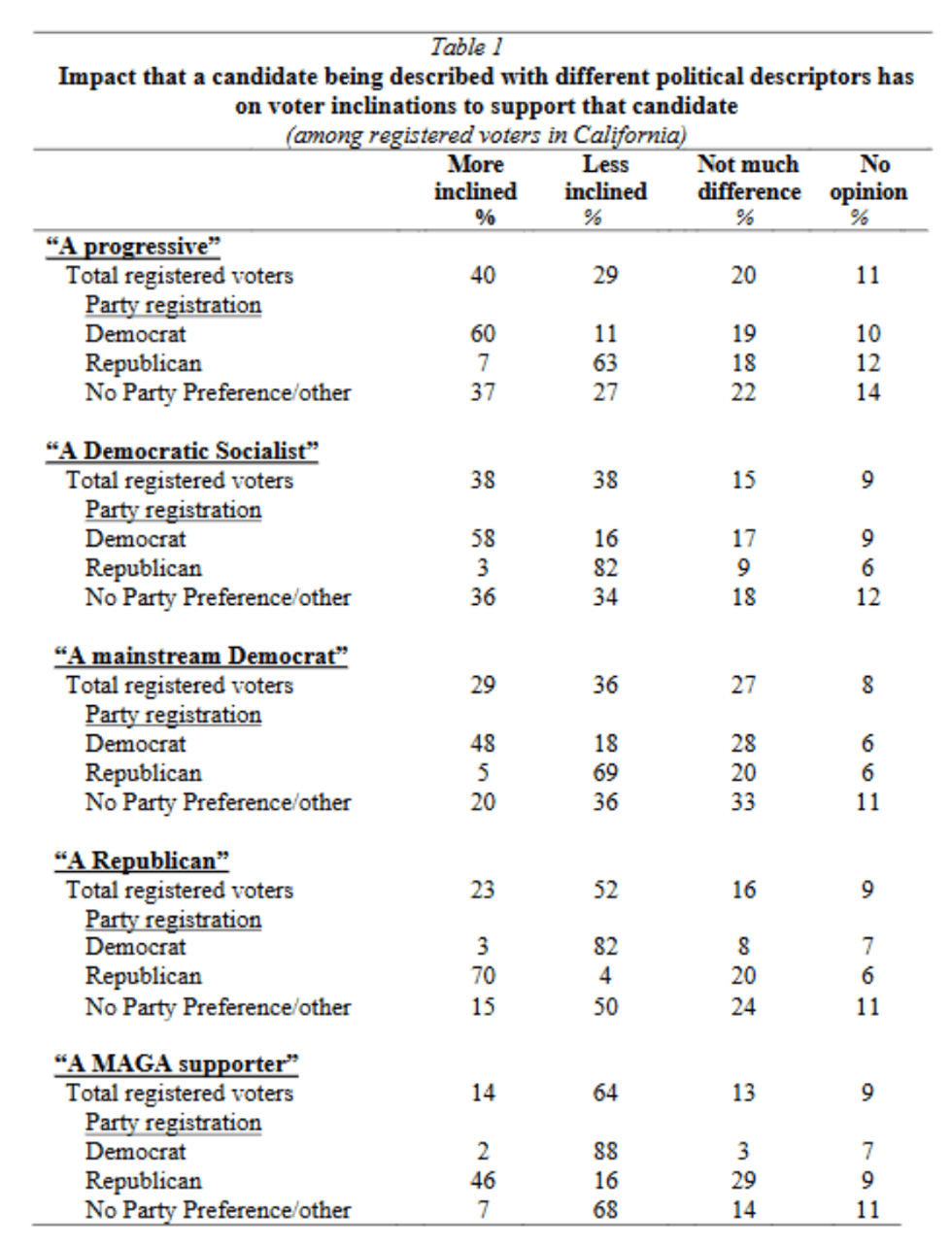 (Poll by the Berkeley Institute of Governmental Studies)
That California voters lean left of the country at large is hardly shocking news, but the poll does provide yet another striking data point in the broader trend of Democratic voters revolting against the establishment of their own party, which has culminated in a surge of left victories nationwide.
Among self-identified Democratic voters in the state, just 48% said they would be "more inclined" to vote for someone who self-identifies with the mainstream of the party, compared with 58% who said they were inclined to vote for a "democratic socialist" and 60% who said they were inclined to vote for a "progressive."
What precisely these terms mean is not defined by the pollster, and in mainstream discourse, "progressives" like Michigan's Democratic Senate nominee Abdul El-Sayed and "democratic socialists" like New York City Mayor Zohran Mamdani are often spoken of in the same breath, largely because their platforms overlap significantly and both defeated better-funded Democratic opponents with greater institutional backing.
Whatever term is used to describe such candidates, pundits in establishment-friendly media have struggled to make sense of their recent wins.
But Sen. Bernie Sanders (I-Vt.)—a long-time critic of corporate influence over the US political system who ran for president in 2016 and 2020 and is arguably more responsible than any other single figure for kicking off this shift in the Democratic electorate—wrote in an op-ed for The Guardian on Wednesday that the reason behind it “is not complicated.”
"We now have more income and wealth inequality than at any time in American history. The top 1% now own more wealth than the bottom 93%, and one man, Elon Musk, owns more wealth than the bottom 50% of US households," he wrote. "Not surprisingly, working families are tired of status quo politics and the same old, same old establishment policies that have failed them for years. They want change, real change—and are supporting progressive candidates who are fighting for that change."
That is why, he argues, candidates who have run on campaign finance reform, establishing a single-payer healthcare system, stronger union protections, higher taxes on the rich, and an end to aggressive foreign interventions in countries like Iran and military support for Israel are seeing success.
In November, progressives like El-Sayed, as well as Minnesota Senate candidate Peggy Flanagan, Florida Senate candidate Angie Nixon, Michigan House candidate William Lawrence, Pennsylvania House candidate Bob Brooks, and others, will try to prove that their politics can win in competitive races against Republicans. So will Randy Villegas, who is aiming to unseat Republican Rep. David Valadao in California's 22nd district.
But California's "jungle primary" system, which lets the top two candidates across all parties face off in the general election, will continue for the next several months to be a front in the Democratic Party's internal war.
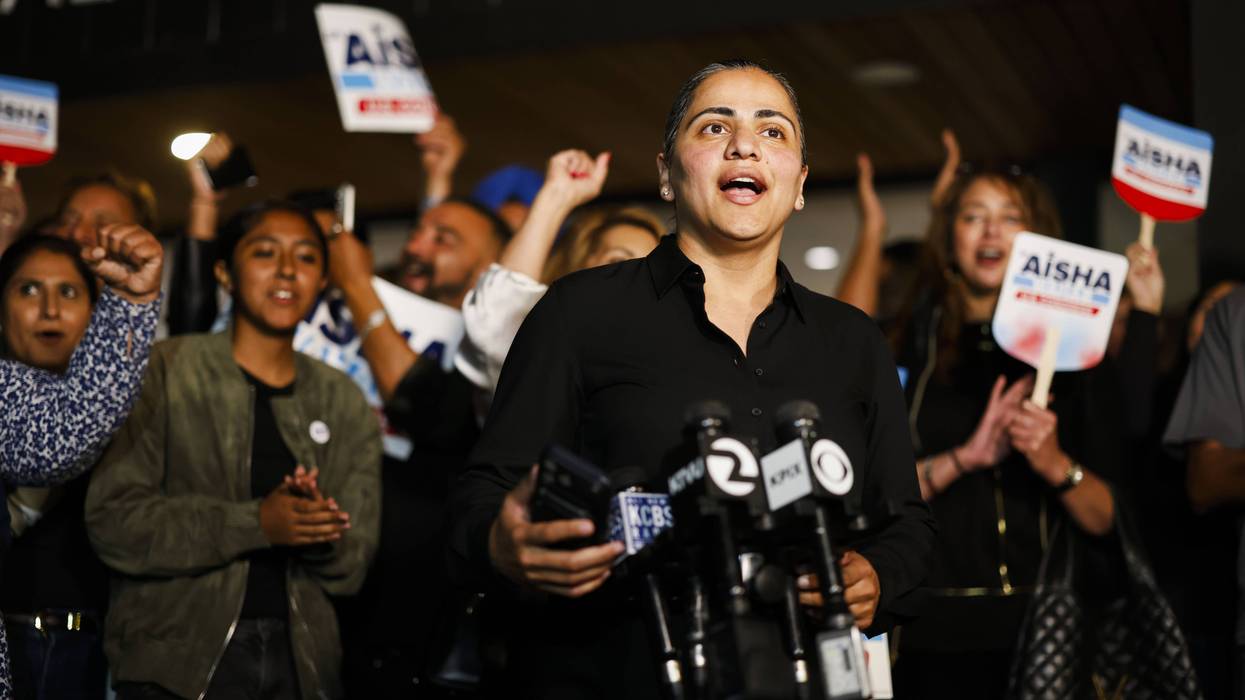
One closely watched race is in California’s 14th District, near Oakland, where a special election for the seat vacated by the disgraced former Democratic Rep. Eric Swalwell has come down to the wire between the progressive state Sen. Aisha Wahab (D-10) and the centrist-leaning transportation official Melissa Hernandez (D).
The two are starkly divided on Israel; while Wahab has called its actions in Gaza" genocide" and called for an end to weapons aid, Hernandez has been noncommittal.
Wahab has also taken stronger stances against corporate abuses and US Immigration and Customs Enforcement (ICE) and called for significant police reforms, while Hernandez has run on public safety and business-friendly policies.
After steamrolling her opponents in the June primary, with a 25-point lead over Hernandez, Wahab was hit with a $6.3 million spending blitz from the American Israel Public Affairs Committee (AIPAC) in the months leading up to this past Tuesday's general election. As of Thursday, the race is too close to call, with Wahab ahead by just over 1,300 votes as 62% of ballots have been counted.
Whoever wins this race will hold the seat for the remainder of Swalwell's term. But the two will face each other again in November with new district lines approved by voters last year as part of a Democratic redistricting effort.
In the 7th district, Sacramento City Council member Mai Vang (D), who was endorsed by the Democratic Socialists of America, unexpectedly finished with more votes in the June primary than 11-term Democratic Rep. Doris Matsui.
The 40-year-old Vang outflanked Matsui, who is more than twice her age, on the left by aggressively championing the abolition of ICE, Medicare for All, and a wealth tax proposal by Rep. Ro Khanna (D-Calif.). The two will face off again one-on-one in November's runoff.
The mayor's race in Los Angeles, between incumbent Karen Bass and democratic socialist City Council member Nithya Raman, will be another test for the left.
Bass, a former member of Congress, has strong institutional support from the Democratic Party, including endorsements from former Vice President Kamala Harris and California Gov. Gavin Newsom.
Raman is challenging her less on ideological grounds and more on the question of competent governance, seeking to overhaul the city's homelessness bureaucracy and construct more affordable housing. She has also pushed back against Bass' call to hire more police officers and advocated instead for investing in more unarmed civilian first responders.