SUBSCRIBE TO OUR FREE NEWSLETTER
Daily news & progressive opinion—funded by the people, not the corporations—delivered straight to your inbox.
5
#000000
#FFFFFF
To donate by check, phone, or other method, see our More Ways to Give page.
Daily news & progressive opinion—funded by the people, not the corporations—delivered straight to your inbox.
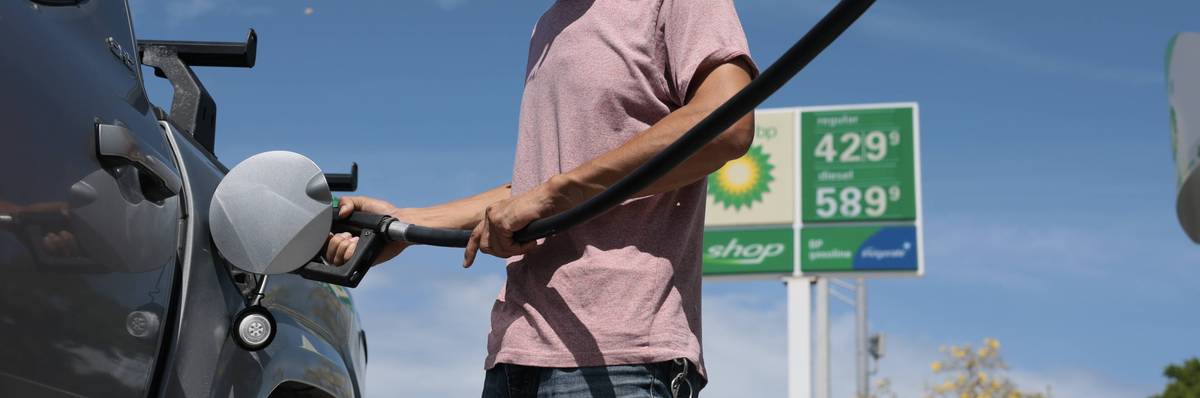
A man puts fuel in his vehicle at a gas station on April 6, 2026 in Miami, Florida.
"Families shouldn’t be paying the price for Trump’s reckless decisions," said US Rep. Zoe Lofgren.
President Donald Trump's decision to restart his illegal war with Iran has sent oil prices back upward, and experts are warning that means more economic pain for working families in the coming months.
The price of Brent crude, which had fallen under $71 per barrel in late June after the US and Iran reached a memorandum of understanding (MOU) to wind down the conflict, has since surged back above $85 per barrel as of Tuesday, days after Trump declared the ceasefire between the two countries to be over.
Rising oil costs mean that the price of gasoline, which has similarly been dropping over the last month, will again start to rise. Petroleum industry analyst Patrick De Haan on Tuesday projected that, based on the current surge in oil prices, the US is "days away" from seeing the average price of gas go back over $4 per gallon.
The renewed hostilities with Iran came amid signs of inflationary pressures in the US easing. Data released by the Bureau of Labor Statistics (BLS) on Tuesday showed consumer prices in June rose by less than expected, with lower energy prices delivering relief.
University of Michigan economist Justin Wolfers argued that while Tuesday's inflation data was positive news, the recent fighting between the US and Iran means it could be short-lived.
"Inflation remains high, is well above the Fed's target, and the ceasefire with Iran is over," Wolfers cautioned, referring to the Federal Reserve.
Alex Jacquez, chief of policy and advocacy at the Groundwork Collaborative, said the resumption of the illegal war would "continue hammering Americans’ budgets at home."
"Gas prices have already started to rise again and last month’s inflation data is stale," said Jacquez. "Trump’s debacle in the Middle East will have lasting, layered effects on our economy for months to come. Working families struggling to make ends meet should lay blame squarely on the president."
Heather Long, chief economist at Navy Federal Credit Union, said the latest consumer price data show "it's still tough for middle-class and moderate-income Americans," as "inflation is wiping out wage gains for many."
More ominously, Long added, "The question is whether this relief is only temporary as the war in Iran restarts."
Project management professional Larry Boorstein warned Trump against spiking the football over the relatively tame inflation data from last month.
"Prices are down because oil prices dropped after the US-Iran MOU," Boorstein wrote. "Prices for food, both at home and away from home, increased, as did prices for shelter. Energy prices fell enough to more than offset increases in food and shelter prices. What's not so good is Trump declared the MOU dead July 8. Oil prices are ticking up again."
Rep. Zoe Lofgren (D-Calif.) put the economic damage caused by the Iran war into perspective by noting that it has cost US consumers over $56 billion so far in the form of higher gas prices, or just under $500 per household.
"Families shouldn’t be paying the price for Trump’s reckless decisions," wrote Lofgren.
Dear Common Dreams reader, It’s been nearly 30 years since I co-founded Common Dreams with my late wife, Lina Newhouser. We had the radical notion that journalism should serve the public good, not corporate profits. It was clear to us from the outset what it would take to build such a project. No paid advertisements. No corporate sponsors. No millionaire publisher telling us what to think or do. Many people said we wouldn't last a year, but we proved those doubters wrong. Together with a tremendous team of journalists and dedicated staff, we built an independent media outlet free from the constraints of profits and corporate control. Our mission has always been simple: To inform. To inspire. To ignite change for the common good. Building Common Dreams was not easy. Our survival was never guaranteed. When you take on the most powerful forces—Wall Street greed, fossil fuel industry destruction, Big Tech lobbyists, and uber-rich oligarchs who have spent billions upon billions rigging the economy and democracy in their favor—the only bulwark you have is supporters who believe in your work. But here’s the urgent message from me today. It's never been this bad out there. And it's never been this hard to keep us going. At the very moment Common Dreams is most needed, the threats we face are intensifying. We need your support now more than ever. We don't accept corporate advertising and never will. We don't have a paywall because we don't think people should be blocked from critical news based on their ability to pay. Everything we do is funded by the donations of readers like you. When everyone does the little they can afford, we are strong. But if that support retreats or dries up, so do we. Will you donate now to make sure Common Dreams not only survives but thrives? —Craig Brown, Co-founder |
President Donald Trump's decision to restart his illegal war with Iran has sent oil prices back upward, and experts are warning that means more economic pain for working families in the coming months.
The price of Brent crude, which had fallen under $71 per barrel in late June after the US and Iran reached a memorandum of understanding (MOU) to wind down the conflict, has since surged back above $85 per barrel as of Tuesday, days after Trump declared the ceasefire between the two countries to be over.
Rising oil costs mean that the price of gasoline, which has similarly been dropping over the last month, will again start to rise. Petroleum industry analyst Patrick De Haan on Tuesday projected that, based on the current surge in oil prices, the US is "days away" from seeing the average price of gas go back over $4 per gallon.
The renewed hostilities with Iran came amid signs of inflationary pressures in the US easing. Data released by the Bureau of Labor Statistics (BLS) on Tuesday showed consumer prices in June rose by less than expected, with lower energy prices delivering relief.
University of Michigan economist Justin Wolfers argued that while Tuesday's inflation data was positive news, the recent fighting between the US and Iran means it could be short-lived.
"Inflation remains high, is well above the Fed's target, and the ceasefire with Iran is over," Wolfers cautioned, referring to the Federal Reserve.
Alex Jacquez, chief of policy and advocacy at the Groundwork Collaborative, said the resumption of the illegal war would "continue hammering Americans’ budgets at home."
"Gas prices have already started to rise again and last month’s inflation data is stale," said Jacquez. "Trump’s debacle in the Middle East will have lasting, layered effects on our economy for months to come. Working families struggling to make ends meet should lay blame squarely on the president."
Heather Long, chief economist at Navy Federal Credit Union, said the latest consumer price data show "it's still tough for middle-class and moderate-income Americans," as "inflation is wiping out wage gains for many."
More ominously, Long added, "The question is whether this relief is only temporary as the war in Iran restarts."
Project management professional Larry Boorstein warned Trump against spiking the football over the relatively tame inflation data from last month.
"Prices are down because oil prices dropped after the US-Iran MOU," Boorstein wrote. "Prices for food, both at home and away from home, increased, as did prices for shelter. Energy prices fell enough to more than offset increases in food and shelter prices. What's not so good is Trump declared the MOU dead July 8. Oil prices are ticking up again."
Rep. Zoe Lofgren (D-Calif.) put the economic damage caused by the Iran war into perspective by noting that it has cost US consumers over $56 billion so far in the form of higher gas prices, or just under $500 per household.
"Families shouldn’t be paying the price for Trump’s reckless decisions," wrote Lofgren.
President Donald Trump's decision to restart his illegal war with Iran has sent oil prices back upward, and experts are warning that means more economic pain for working families in the coming months.
The price of Brent crude, which had fallen under $71 per barrel in late June after the US and Iran reached a memorandum of understanding (MOU) to wind down the conflict, has since surged back above $85 per barrel as of Tuesday, days after Trump declared the ceasefire between the two countries to be over.
Rising oil costs mean that the price of gasoline, which has similarly been dropping over the last month, will again start to rise. Petroleum industry analyst Patrick De Haan on Tuesday projected that, based on the current surge in oil prices, the US is "days away" from seeing the average price of gas go back over $4 per gallon.
The renewed hostilities with Iran came amid signs of inflationary pressures in the US easing. Data released by the Bureau of Labor Statistics (BLS) on Tuesday showed consumer prices in June rose by less than expected, with lower energy prices delivering relief.
University of Michigan economist Justin Wolfers argued that while Tuesday's inflation data was positive news, the recent fighting between the US and Iran means it could be short-lived.
"Inflation remains high, is well above the Fed's target, and the ceasefire with Iran is over," Wolfers cautioned, referring to the Federal Reserve.
Alex Jacquez, chief of policy and advocacy at the Groundwork Collaborative, said the resumption of the illegal war would "continue hammering Americans’ budgets at home."
"Gas prices have already started to rise again and last month’s inflation data is stale," said Jacquez. "Trump’s debacle in the Middle East will have lasting, layered effects on our economy for months to come. Working families struggling to make ends meet should lay blame squarely on the president."
Heather Long, chief economist at Navy Federal Credit Union, said the latest consumer price data show "it's still tough for middle-class and moderate-income Americans," as "inflation is wiping out wage gains for many."
More ominously, Long added, "The question is whether this relief is only temporary as the war in Iran restarts."
Project management professional Larry Boorstein warned Trump against spiking the football over the relatively tame inflation data from last month.
"Prices are down because oil prices dropped after the US-Iran MOU," Boorstein wrote. "Prices for food, both at home and away from home, increased, as did prices for shelter. Energy prices fell enough to more than offset increases in food and shelter prices. What's not so good is Trump declared the MOU dead July 8. Oil prices are ticking up again."
Rep. Zoe Lofgren (D-Calif.) put the economic damage caused by the Iran war into perspective by noting that it has cost US consumers over $56 billion so far in the form of higher gas prices, or just under $500 per household.
"Families shouldn’t be paying the price for Trump’s reckless decisions," wrote Lofgren.