

SUBSCRIBE TO OUR FREE NEWSLETTER
Daily news & progressive opinion—funded by the people, not the corporations—delivered straight to your inbox.
5
#000000
#FFFFFF
To donate by check, phone, or other method, see our More Ways to Give page.
Daily news & progressive opinion—funded by the people, not the corporations—delivered straight to your inbox.
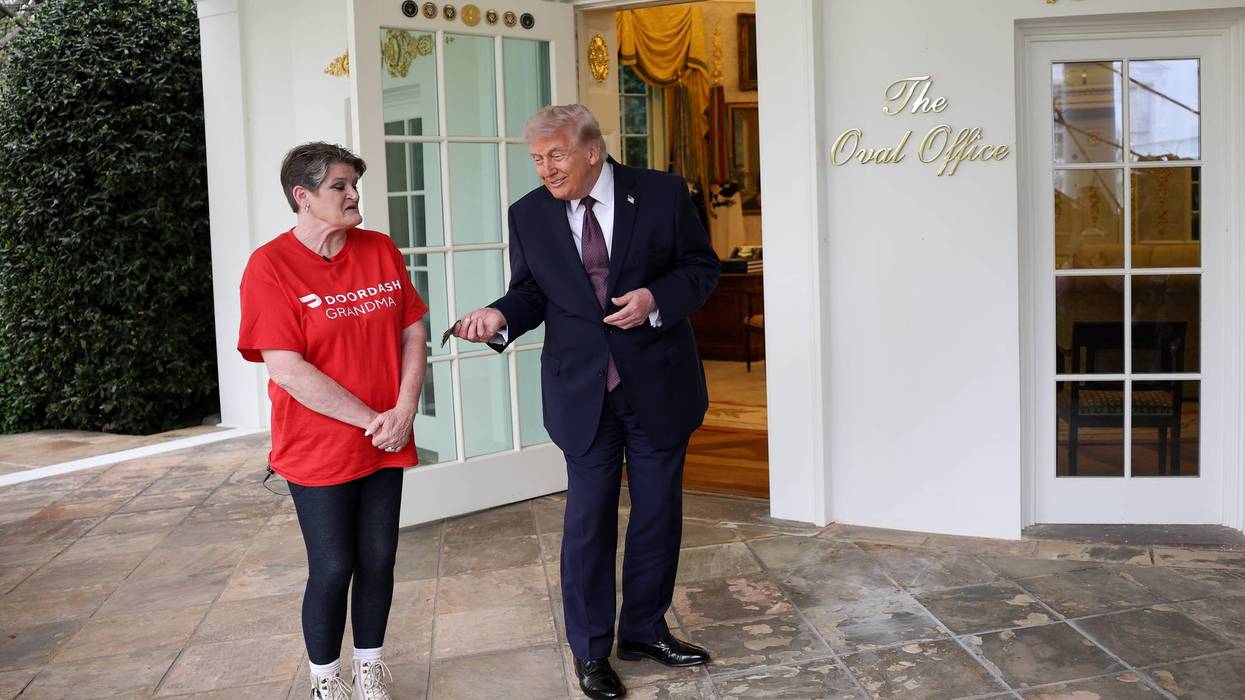
"The fact that a term like 'DoorDash grandma' exists should be a wake-up call," said the head of One Fair Wage. "It should never exist in the first place."
While "DoorDash Grandma" made the company's first food delivery to the White House on Monday to promote President Donald Trump's "no tax on tips" policy, the awkward encounter outside the Oval Office not only highlighted critiques of that provision of the GOP budget package but also sparked calls for a living wage and universal healthcare.
"A perfect image of the Trump era: A grandmother has to work at DoorDash in order to get by, while the president decorates his office in gold accent pieces," said Democratic strategist Max Burns, sharing a photo of the delivery on social media.
Saru Jayaraman, president of worker advocacy group One Fair Wage, told Common Dreams that "it's sad, and it's a sign of a failing society—not something to celebrate or turn into a photo op. We've normalized an economy where older people are pushed into gig work just to survive. The fact that a term like 'DoorDash grandma' exists should be a wake-up call. It should never exist in the first place."
"Corporations are paying poverty wages while policymakers offer Band-Aid solutions like 'no tax on tips' instead of paying a living wage," Jayaraman continued. "At the same time, cuts to Medicaid and food assistance are stripping away the safety net workers rely on to get by. This is all pushing people into greater dependence on tips and unstable income. Workers don't need gimmicks—they need living wages, corporate accountability, and real economic security."
Trump and then-Vice President Kamala Harris latched on to the no tax on tips policy during the 2024 campaign, despite warnings from economists and others that it is a "deceptive ploy," as the Economic Policy Institute's David Cooper and Nina Mast put it last year.
"It does nothing to address the low wages, income instability, wage theft, and abuse tipped workers already face," the pair reiterated in February. "Instead, it may undermine efforts to raise tipped minimum wages, push more workers into tipped jobs, increase workloads, and prompt customers to tip less if they believe tipped workers receive special tax treatment."
After related legislation passed the US Senate last year, Jayaraman said that "for all the bipartisan celebration, this bill is a distraction from the real fight... If Democrats want to offer a true alternative, they need to say it loud and clear: It's time to raise the minimum wage and end the subminimum wage once and for all."
A no tax on tips policy was ultimately included in Republicans' so-called One Big Beautiful Bill Act—which, as a recent Institute on Taxation and Economic Policy analysis details, featured tax breaks that primarily benefited wealthy individuals and corporations while cutting programs that serve working families, such as Medicaid and the Supplemental Nutrition Assistance Program.
Specifically, last year's GOP budget package established a temporary federal income tax deduction for tips, capped at $25,000 per year, through 2028. In a February report, the libertarian Cato Institute estimated that "the roughly 3% of tax returns projected to claim the tips deduction in 2026 will receive an average tax cut of about $1,370," and "as a share of after-tax income, the tips deduction broadly benefits those in the middle of the income distribution."
"These provisions also add to the already large number of tax deductions and credits that shield vastly uneven amounts of income from taxation based on family size and childcare arrangements," the Cato report notes. "In addition to the income limits, the tips deduction is only available to occupations that 'customarily and regularly received tips' before 2025."
Sharon Simmons, who wore a red shirt that read "DoorDash Grandma" while delivering McDonald's bags at the White House on Monday, told Trump that she benefited from the policy. In a statement, the company identified her as an Arkansas-based grandmother of 10 who "started dashing in 2022 to earn income while keeping control of her schedule."
During the delivery, the president asked Simmons whether she voted for him—"uh, maybe," she said—and about banning transgender women from competing in sports in line with their gender identity, on which she said she did not have an opinion.
Labor reporter Michael Sainato pointed out that Simmons previously lived in Nevada and advocated for the no tax on tips policy to the US House Ways and Means Committee last year. He also questioned her comments to Trump about having saved over $11,000 on her most recent tax bill.
The dasher claims "$11,000 in savings by not having to claim." You still have to claim tipsYou can only deduct up to $25k in tips, so $11k in savings off of one year didn't happenThe tax savings are actually minimal taxpolicycenter.org/fiscal-facts...
[image or embed]
— Michael Sainato (@msainato.bsky.social) April 13, 2026 at 3:39 PM
While Trump staff and congressional Republicans shared footage of Simmons' delivery to Trump to promote the budget package provision in the lead-up to tax day, US Rep. Dina Titus (D-Nev.) stressed on social media Monday that the president's "policy is severely limited and sunsets in 2028."
"We must make it permanent and increase the minimum wage to support our nontipped workers like childcare, fast food, and retail. We can do both by passing my LIFT Act," said Titus, whose Labor Income Fairness and Transparency Act is backed by One Fair Wage.
"Cutting taxes on tips might make for a good sound bite, but on its own, it's a hollow fix that ignores the real crisis: Wages so low that two-thirds of restaurant workers don't even earn enough to pay federal income taxes," Jayaraman said last year, when Titus introduced the bill. "In a time of skyrocketing costs, workers are drowning and need more than political gimmicks—they need a raise."
"Tips should be a bonus, not a substitute for a living wage," she argued. "By ending all subminimum wages and requiring that all workers be paid a full livable wage with tips on top, the LIFT Act addresses what working people need most: a fair wage, a level playing field, and the dignity that comes with being able to provide for their families."
Some observers on Monday also noted Simmons' appearance on Fox News, during which she acknowledged the financial burden of her husband's 2025 cancer diagnosis.
"Grandma shouldn't have to rely on DoorDash tips to make up for Republicans doubling the cost of healthcare," declared Democrats on the House Ways and Means Committee, sharing a clip of the interview on social media.
Melanie D'Arrigo, executive director of Campaign for New York Health, which advocates for universal, single-payer healthcare, emphasized that "'no tax on tips' does not make up for the fact that no one can afford healthcare."
Historian Timothy Snyder said, "So let’s have universal healthcare and help people live in dignity."

"We will unveil warfare methods that the enemy will have little ability to counter," said the IRGC spokesperson.
As the US military on Monday began a naval blockade of the Strait of Hormuz after the Trump administration's failed talks with the Iranian government, a spokesperson for Iran's Islamic Revolutionary Guard Corps issued a warning to the United States.
"If the war continues, we will unveil capacities that the enemy has no idea about," said Sardar Mohibi, according to the IRGC-affiliated Tasnim News Agency. "We will unveil warfare methods that the enemy will have little ability to counter."
As Iran's Press TV reported, Iranian Lt. Col. Ebrahim Zolfaqari also commented on the blockade, which began at 10:00 am Eastern time, stressing that "enemy-affiliated vessels do not and will not have the right to pass through the Strait of Hormuz."
"Other vessels will be allowed to transit the strait in compliance with the regulations of the Armed Forces of the Islamic Republic of Iran," Zolfaqari said. "If the security of ports of the Islamic Republic of Iran is threatened, no port in the Persian Gulf or the Sea of Oman will remain safe,
Iran closed the Strait of Hormuz to many ships after the US and Iran launched an illegal war six weeks ago. The waterway between the Persian Gulf and the Gulf of Oman is a crucial trade route, including for fossil fuels from the region, and has become a key negotiating point as the death toll across the Middle East has mounted.
After talks led by Vice President JD Vance broke down, Trump wrote Sunday on his Truth Social platform that "the United States Navy, the Finest in the World, will begin the process of BLOCKADING any and all Ships trying to enter, or leave, the Strait of Hormuz. At some point, we will reach an 'ALL BEING ALLOWED TO GO IN, ALL BEING ALLOWED TO GO OUT' basis, but Iran has not allowed that to happen by merely saying, 'There may be a mine out there somewhere,' that nobody knows about but them."
"THIS IS WORLD EXTORTION, and Leaders of Countries, especially the United States of America, will never be extorted," Trump continued. "I have also instructed our Navy to seek and interdict every vessel in International Waters that has paid a toll to Iran. No one who pays an illegal toll will have safe passage on the high seas. We will also begin destroying the mines the Iranians laid in the Straits. Any Iranian who fires at us, or at peaceful vessels, will be BLOWN TO HELL!"
The president on Monday again threatened any Iranian vessels that "come anywhere close to our BLOCKADE," and also said that "34 Ships went through the Strait of Hormuz yesterday, which is by far the highest number since this foolish closure began."
As North Atlantic Treaty Organization member countries on Monday made clear they did not plan to join Trump's blockade, China's defense minister, Dong Jun, said: "Our ships are moving in and out of the waters of the Strait of Hormuz. We have trade and energy agreements with Iran. We will respect and honor them and expect others not to meddle in our affairs. Iran controls the Strait of Hormuz, and it is open for us."
Summarizing an interview with Salvatore Mercogliano, maritime historian at Campbell University in North Carolina, Al Jazeera reported Monday that "he expected the US Navy to turn around ships that come out of the strait while keeping at a distance from the range of Iran's missiles and drones."
It's possible the US action could result in "two competing blockades," Mercogliano said. "This has the potential to freeze shipping in and out the Strait of Hormuz entirely."
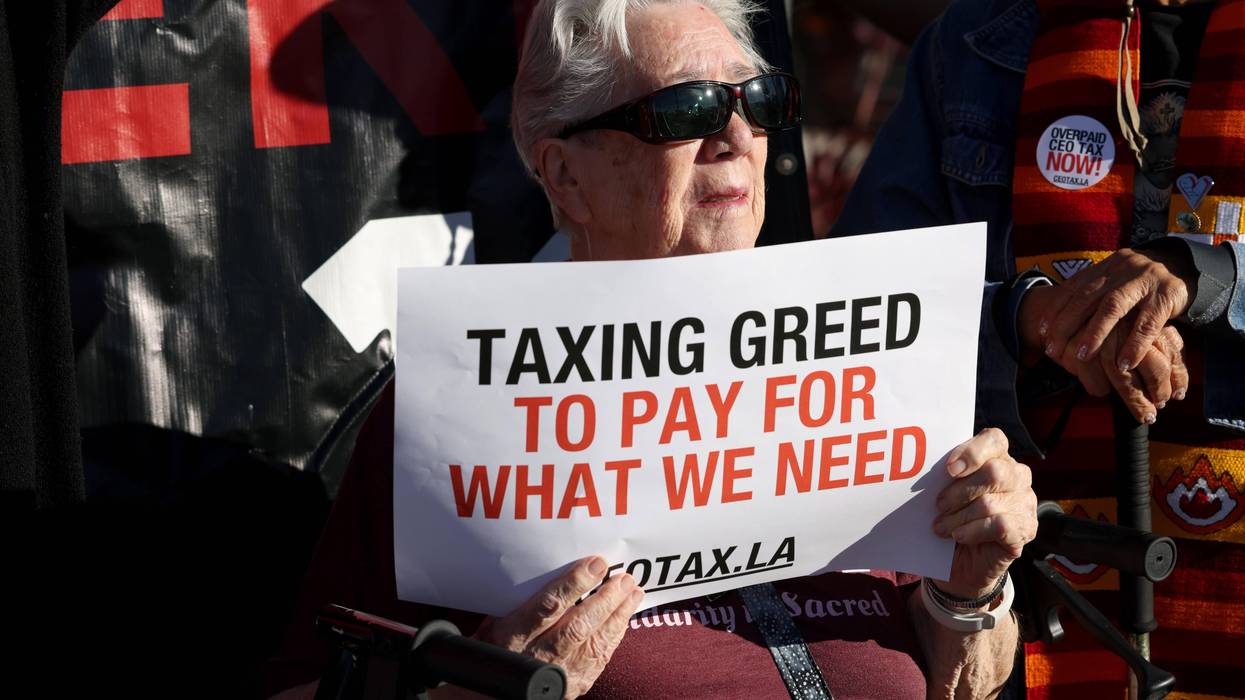
"That the US Congress is not debating or introducing bills to address the issues presented here represents a breakdown of democracy," said an economic justice think tank.
A new report by an economic think tank takes aim at the broadly accepted idea that Americans are divided on the major issues affecting millions of people every day—the question of how to ensure everyone can get the healthcare they need without going bankrupt, how the government can ensure working people make enough money to live, and whether the US should take more aggressive climate action.
As it turns out, the Center for Economic and Policy Research (CEPR) suggested Monday, there's far more agreement on those and more issues across the political spectrum than the corporate media and establishment politicians from both sides of the aisle would have the public believe.
Lawmakers who push for good, fair-paying jobs for all workers; raising the chronically stagnant federal minimum wage; guaranteeing healthcare for all Americans; clean energy investments; and ending the influence of corporations and billionaires on US elections would not be advocating for policies that are just popular on the left, the report says, but would actually be promoting a "Majority Agenda."
"It may feel like Americans agree on nothing right now, but recent polling tells a different story," said CEPR on social media. "From raising the minimum wage and strengthening Social Security to affordable housing and healthcare reform, these progressive policies are broadly popular despite the political establishment continuing to ignore them."
The group pointed to one 2024 poll by the American Communities Project that showed more than 60% of Americans agreed that the economy "is rigged to advantage the rich and the powerful," while 62% disagreed with the idea of cutting social programs to lower taxes.
Another 2024 poll by The Associated Press found that 91% of Americans supported equal protection under the law and 88% supported the right to privacy, while a 2020 poll by the Carr Center for Human Rights at Harvard Kennedy School revealed that 89% of Americans expressed strong support for affordable healthcare, 85% felt people have the right to a job, and 93% thought the right to clean air and water is essential.
Analyzing those surveys and other data, CEPR advised policymakers to consider the Majority Agenda as a "roadmap" to passing policies that large majorities of Americans view as major priorities to improve their quality of life.
The report is divided into three sections: Good Jobs, Strong Infrastructure, and Fair Play.
To push for fair, well-paying employment, said CEPR, lawmakers should support policies including:
The section on strengthening US "infrastructure" looks beyond the traditional definition of the term regarding physical infrastructure projects, pushing for stronger policies that can help working people thrive by ensuring their healthcare, housing, and other basic needs are met.
A stronger infrastructure, said CEPR, would include:
CEPR pointed to three areas in which lawmakers could increase "fair play" for Americans:
"That the US Congress is not debating or introducing bills to address the issues presented here represents a breakdown of democracy, one that comes at a considerable cost to the betterment of life for large swaths of Americans. At the same time, the access to and influence over our democratic processes by the monied class has upended our system of government, and all too often the tyranny of the wealthy minority has reigned," reads the CEPR report.
"We hope this report stands as a reminder that even in a fraught political moment," said CEPR, "there is a range of straightforward, broadly popular policy choices that could improve the lives of millions of people."

"We have trade and energy agreements with Iran. We will respect and honor them and expect others not to meddle in our affairs."
Although President Donald Trump has ordered the US military to enforce a blockade around the Strait of Hormuz, Chinese Defense Minister Dong Jun warned on Monday against any effort to obstruct Chinese vessels.
As reported by Business Today, the Chinese defense minister emphasized that his country and Iran have reached an arrangement allowing the safe transportation of Chinese ships through the strait, and he said the US should not subject them to its blockade.
"Our ships are moving in and out of the waters of the Strait of Hormuz," the defense minister said. "We have trade and energy agreements with Iran. We will respect and honor them and expect others not to meddle in our affairs. Iran controls the Strait of Hormuz, and it is open for us."
Chinese Defense Minister Admiral Dong Jun:
"We have trade and energy agreements with Iran; we expect others not to interfere in our affairs. The Strait of Hormuz is open to us."
China is issuing a warning to the US. pic.twitter.com/oIQK9845Ty
— Daily Iran News (@DailyIranNews) April 13, 2026
Trump announced a blockade on the Strait of Hormuz on Sunday, saying the US would not allow any ships that had cut deals with Iran for safe passage to be let through.
The blockade announcement came after US negotiators, led by Vice President JD Vance, failed to reach a peace agreement with their Iranian counterparts to bring an end to the conflict, which Trump launched illegally without any congressional approval six weeks ago.
The failure to reach a peace deal sent the price of oil upward yet again, as the price of Brent crude oil futures and WTI crude oil futures approached $100 per barrel.