SUBSCRIBE TO OUR FREE NEWSLETTER
Daily news & progressive opinion—funded by the people, not the corporations—delivered straight to your inbox.
5
#000000
#FFFFFF
To donate by check, phone, or other method, see our More Ways to Give page.
Daily news & progressive opinion—funded by the people, not the corporations—delivered straight to your inbox.
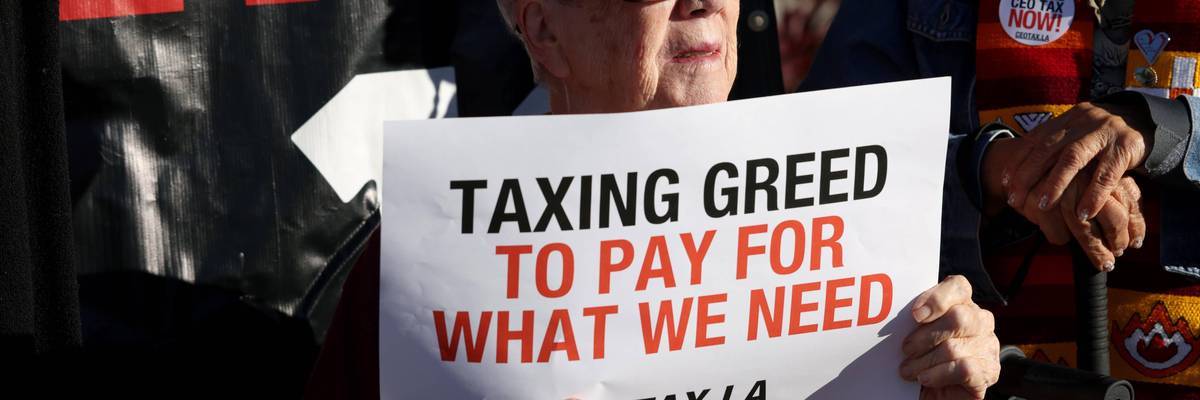
Sister Diane Smith, with CLUE (Clergy and Laity United for Economic Justice), joins The Fair Games Coalition to announce the launch of the Overpaid CEO Tax Initiative in front of the Tesla Diner in Los Angeles on January 14, 2026.
"That the US Congress is not debating or introducing bills to address the issues presented here represents a breakdown of democracy," said an economic justice think tank.
A new report by an economic think tank takes aim at the broadly accepted idea that Americans are divided on the major issues affecting millions of people every day—the question of how to ensure everyone can get the healthcare they need without going bankrupt, how the government can ensure working people make enough money to live, and whether the US should take more aggressive climate action.
As it turns out, the Center for Economic and Policy Research (CEPR) suggested Monday, there's far more agreement on those and more issues across the political spectrum than the corporate media and establishment politicians from both sides of the aisle would have the public believe.
Lawmakers who push for good, fair-paying jobs for all workers; raising the chronically stagnant federal minimum wage; guaranteeing healthcare for all Americans; clean energy investments; and ending the influence of corporations and billionaires on US elections would not be advocating for policies that are just popular on the left, the report says, but would actually be promoting a "Majority Agenda."
"It may feel like Americans agree on nothing right now, but recent polling tells a different story," said CEPR on social media. "From raising the minimum wage and strengthening Social Security to affordable housing and healthcare reform, these progressive policies are broadly popular despite the political establishment continuing to ignore them."
The group pointed to one 2024 poll by the American Communities Project that showed more than 60% of Americans agreed that the economy "is rigged to advantage the rich and the powerful," while 62% disagreed with the idea of cutting social programs to lower taxes.
Another 2024 poll by The Associated Press found that 91% of Americans supported equal protection under the law and 88% supported the right to privacy, while a 2020 poll by the Carr Center for Human Rights at Harvard Kennedy School revealed that 89% of Americans expressed strong support for affordable healthcare, 85% felt people have the right to a job, and 93% thought the right to clean air and water is essential.
Analyzing those surveys and other data, CEPR advised policymakers to consider the Majority Agenda as a "roadmap" to passing policies that large majorities of Americans view as major priorities to improve their quality of life.
The report is divided into three sections: Good Jobs, Strong Infrastructure, and Fair Play.
To push for fair, well-paying employment, said CEPR, lawmakers should support policies including:
The section on strengthening US "infrastructure" looks beyond the traditional definition of the term regarding physical infrastructure projects, pushing for stronger policies that can help working people thrive by ensuring their healthcare, housing, and other basic needs are met.
A stronger infrastructure, said CEPR, would include:
CEPR pointed to three areas in which lawmakers could increase "fair play" for Americans:
"That the US Congress is not debating or introducing bills to address the issues presented here represents a breakdown of democracy, one that comes at a considerable cost to the betterment of life for large swaths of Americans. At the same time, the access to and influence over our democratic processes by the monied class has upended our system of government, and all too often the tyranny of the wealthy minority has reigned," reads the CEPR report.
"We hope this report stands as a reminder that even in a fraught political moment," said CEPR, "there is a range of straightforward, broadly popular policy choices that could improve the lives of millions of people."
Dear Common Dreams reader, It’s been nearly 30 years since I co-founded Common Dreams with my late wife, Lina Newhouser. We had the radical notion that journalism should serve the public good, not corporate profits. It was clear to us from the outset what it would take to build such a project. No paid advertisements. No corporate sponsors. No millionaire publisher telling us what to think or do. Many people said we wouldn't last a year, but we proved those doubters wrong. Together with a tremendous team of journalists and dedicated staff, we built an independent media outlet free from the constraints of profits and corporate control. Our mission has always been simple: To inform. To inspire. To ignite change for the common good. Building Common Dreams was not easy. Our survival was never guaranteed. When you take on the most powerful forces—Wall Street greed, fossil fuel industry destruction, Big Tech lobbyists, and uber-rich oligarchs who have spent billions upon billions rigging the economy and democracy in their favor—the only bulwark you have is supporters who believe in your work. But here’s the urgent message from me today. It's never been this bad out there. And it's never been this hard to keep us going. At the very moment Common Dreams is most needed, the threats we face are intensifying. We need your support now more than ever. We don't accept corporate advertising and never will. We don't have a paywall because we don't think people should be blocked from critical news based on their ability to pay. Everything we do is funded by the donations of readers like you. When everyone does the little they can afford, we are strong. But if that support retreats or dries up, so do we. Will you donate now to make sure Common Dreams not only survives but thrives? —Craig Brown, Co-founder |
A new report by an economic think tank takes aim at the broadly accepted idea that Americans are divided on the major issues affecting millions of people every day—the question of how to ensure everyone can get the healthcare they need without going bankrupt, how the government can ensure working people make enough money to live, and whether the US should take more aggressive climate action.
As it turns out, the Center for Economic and Policy Research (CEPR) suggested Monday, there's far more agreement on those and more issues across the political spectrum than the corporate media and establishment politicians from both sides of the aisle would have the public believe.
Lawmakers who push for good, fair-paying jobs for all workers; raising the chronically stagnant federal minimum wage; guaranteeing healthcare for all Americans; clean energy investments; and ending the influence of corporations and billionaires on US elections would not be advocating for policies that are just popular on the left, the report says, but would actually be promoting a "Majority Agenda."
"It may feel like Americans agree on nothing right now, but recent polling tells a different story," said CEPR on social media. "From raising the minimum wage and strengthening Social Security to affordable housing and healthcare reform, these progressive policies are broadly popular despite the political establishment continuing to ignore them."
The group pointed to one 2024 poll by the American Communities Project that showed more than 60% of Americans agreed that the economy "is rigged to advantage the rich and the powerful," while 62% disagreed with the idea of cutting social programs to lower taxes.
Another 2024 poll by The Associated Press found that 91% of Americans supported equal protection under the law and 88% supported the right to privacy, while a 2020 poll by the Carr Center for Human Rights at Harvard Kennedy School revealed that 89% of Americans expressed strong support for affordable healthcare, 85% felt people have the right to a job, and 93% thought the right to clean air and water is essential.
Analyzing those surveys and other data, CEPR advised policymakers to consider the Majority Agenda as a "roadmap" to passing policies that large majorities of Americans view as major priorities to improve their quality of life.
The report is divided into three sections: Good Jobs, Strong Infrastructure, and Fair Play.
To push for fair, well-paying employment, said CEPR, lawmakers should support policies including:
The section on strengthening US "infrastructure" looks beyond the traditional definition of the term regarding physical infrastructure projects, pushing for stronger policies that can help working people thrive by ensuring their healthcare, housing, and other basic needs are met.
A stronger infrastructure, said CEPR, would include:
CEPR pointed to three areas in which lawmakers could increase "fair play" for Americans:
"That the US Congress is not debating or introducing bills to address the issues presented here represents a breakdown of democracy, one that comes at a considerable cost to the betterment of life for large swaths of Americans. At the same time, the access to and influence over our democratic processes by the monied class has upended our system of government, and all too often the tyranny of the wealthy minority has reigned," reads the CEPR report.
"We hope this report stands as a reminder that even in a fraught political moment," said CEPR, "there is a range of straightforward, broadly popular policy choices that could improve the lives of millions of people."
A new report by an economic think tank takes aim at the broadly accepted idea that Americans are divided on the major issues affecting millions of people every day—the question of how to ensure everyone can get the healthcare they need without going bankrupt, how the government can ensure working people make enough money to live, and whether the US should take more aggressive climate action.
As it turns out, the Center for Economic and Policy Research (CEPR) suggested Monday, there's far more agreement on those and more issues across the political spectrum than the corporate media and establishment politicians from both sides of the aisle would have the public believe.
Lawmakers who push for good, fair-paying jobs for all workers; raising the chronically stagnant federal minimum wage; guaranteeing healthcare for all Americans; clean energy investments; and ending the influence of corporations and billionaires on US elections would not be advocating for policies that are just popular on the left, the report says, but would actually be promoting a "Majority Agenda."
"It may feel like Americans agree on nothing right now, but recent polling tells a different story," said CEPR on social media. "From raising the minimum wage and strengthening Social Security to affordable housing and healthcare reform, these progressive policies are broadly popular despite the political establishment continuing to ignore them."
The group pointed to one 2024 poll by the American Communities Project that showed more than 60% of Americans agreed that the economy "is rigged to advantage the rich and the powerful," while 62% disagreed with the idea of cutting social programs to lower taxes.
Another 2024 poll by The Associated Press found that 91% of Americans supported equal protection under the law and 88% supported the right to privacy, while a 2020 poll by the Carr Center for Human Rights at Harvard Kennedy School revealed that 89% of Americans expressed strong support for affordable healthcare, 85% felt people have the right to a job, and 93% thought the right to clean air and water is essential.
Analyzing those surveys and other data, CEPR advised policymakers to consider the Majority Agenda as a "roadmap" to passing policies that large majorities of Americans view as major priorities to improve their quality of life.
The report is divided into three sections: Good Jobs, Strong Infrastructure, and Fair Play.
To push for fair, well-paying employment, said CEPR, lawmakers should support policies including:
The section on strengthening US "infrastructure" looks beyond the traditional definition of the term regarding physical infrastructure projects, pushing for stronger policies that can help working people thrive by ensuring their healthcare, housing, and other basic needs are met.
A stronger infrastructure, said CEPR, would include:
CEPR pointed to three areas in which lawmakers could increase "fair play" for Americans:
"That the US Congress is not debating or introducing bills to address the issues presented here represents a breakdown of democracy, one that comes at a considerable cost to the betterment of life for large swaths of Americans. At the same time, the access to and influence over our democratic processes by the monied class has upended our system of government, and all too often the tyranny of the wealthy minority has reigned," reads the CEPR report.
"We hope this report stands as a reminder that even in a fraught political moment," said CEPR, "there is a range of straightforward, broadly popular policy choices that could improve the lives of millions of people."