SUBSCRIBE TO OUR FREE NEWSLETTER
Daily news & progressive opinion—funded by the people, not the corporations—delivered straight to your inbox.
5
#000000
#FFFFFF
To donate by check, phone, or other method, see our More Ways to Give page.
Daily news & progressive opinion—funded by the people, not the corporations—delivered straight to your inbox.
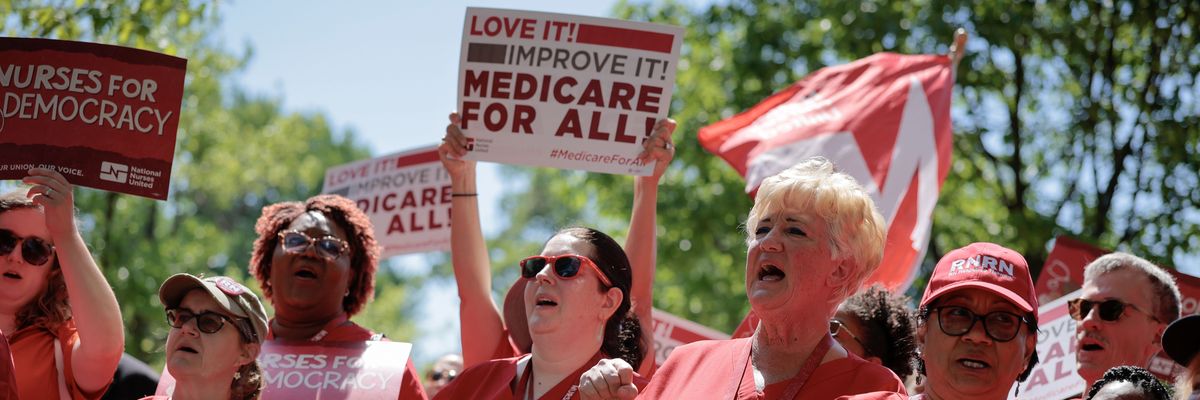
Nurses rally with lawmakers to show their support for Medicare for All on April 29, 2025 in Washington, DC.
The Washington Post editorial predictably ignores research showing that a single-payer system would save hundreds of billions of dollars—and tens of thousands of lives—each year.
An editorial published on Christmas by the Jeff Bezos-owned Washington Post inveighed against supporters of Medicare for All in the United States, pointing to the struggles of Britain's chronically underfunded National Health Service as a "cautionary tale" while ignoring research showing that a single-payer system would save the US hundreds of billions of dollars and tens of thousands of lives each year.
The editorial, headlined "Socialized medicine can’t survive the winter," laments the "religious-like devotion to the NHS" in the United Kingdom even as "hospital corridors overflow and routine procedures get canceled due to a catastrophic event commonly known as 'winter.'"
The Post editorial board, led by opinion editor Adam O'Neal, waves away expert analyses showing that the UK government is underinvesting in its healthcare system relative to other countries in Europe, resulting in the kinds of problems the Thursday editorial attributed to the supposedly inherent flaws of single-payer systems.
"This is the dark reality of single-payer and a cautionary tale for the third of Americans who mistakenly believe Medicare for All is a good idea," the editorial declared ominously.
The editorial understates Medicare for All's popularity among US voters. A recent Data for Progress survey found that even after hearing common opposing arguments, 58% of voters strongly or somewhat support improving Medicare and expanding it to cover everyone in the US.
A separate poll conducted by GQR Research found that 54% of voters nationally, and 56% in battleground districts, support Medicare for All. US Rep. Pramila Jayapal (D-Wash.), the co-leader of the Medicare for All Act in the House, is reportedly planning to present those findings to colleagues next month as she pushes Democrats to rally behind her legislation ahead of the critical midterm elections.
Welcome to the newest co-sponsors of my Medicare for All bill in the House!
Medicare for All is not only good policy — as premiums skyrocket for millions of Americans — it is incredibly popular. Let’s keep building momentum for universal health care and get this passed! pic.twitter.com/k5sg7hEkYR
— Rep. Pramila Jayapal (@RepJayapal) December 25, 2025
The renewed push for Medicare for All comes as the corporate-dominated healthcare status quo hits Americans with massive premium hikes stemming from congressional Republicans' refusal to extend Affordable Care Act tax credits.
Predictably, the Post's editorial board—which Bezos has instructed to write "every day in support and defense of two pillars: personal liberties and free markets"—neglected to mention the myriad horrors of the United States' for-profit system in its diatribe against Medicare for All.
The editorial also ignores research showing potentially massive benefits from a transition to Medicare for All, which would virtually eliminate private insurance while providing comprehensive coverage to everyone in the US for free at the point of service.
One study published in The Lancet estimated that a Medicare for All system would save more than 68,000 lives and over $450 billion in healthcare expenditures annually.
An analysis by Yale researchers calculated that "if the US had had a single-payer universal healthcare system in 2020"—which marked the onset of the Covid-19 pandemic—"nearly 212,000 American lives would have been saved that year" and "the country would have saved $105 billion in Covid-19 hospitalization expenses alone."
Dear Common Dreams reader, It’s been nearly 30 years since I co-founded Common Dreams with my late wife, Lina Newhouser. We had the radical notion that journalism should serve the public good, not corporate profits. It was clear to us from the outset what it would take to build such a project. No paid advertisements. No corporate sponsors. No millionaire publisher telling us what to think or do. Many people said we wouldn't last a year, but we proved those doubters wrong. Together with a tremendous team of journalists and dedicated staff, we built an independent media outlet free from the constraints of profits and corporate control. Our mission has always been simple: To inform. To inspire. To ignite change for the common good. Building Common Dreams was not easy. Our survival was never guaranteed. When you take on the most powerful forces—Wall Street greed, fossil fuel industry destruction, Big Tech lobbyists, and uber-rich oligarchs who have spent billions upon billions rigging the economy and democracy in their favor—the only bulwark you have is supporters who believe in your work. But here’s the urgent message from me today. It's never been this bad out there. And it's never been this hard to keep us going. At the very moment Common Dreams is most needed, the threats we face are intensifying. We need your support now more than ever. We don't accept corporate advertising and never will. We don't have a paywall because we don't think people should be blocked from critical news based on their ability to pay. Everything we do is funded by the donations of readers like you. When everyone does the little they can afford, we are strong. But if that support retreats or dries up, so do we. Will you donate now to make sure Common Dreams not only survives but thrives? —Craig Brown, Co-founder |
An editorial published on Christmas by the Jeff Bezos-owned Washington Post inveighed against supporters of Medicare for All in the United States, pointing to the struggles of Britain's chronically underfunded National Health Service as a "cautionary tale" while ignoring research showing that a single-payer system would save the US hundreds of billions of dollars and tens of thousands of lives each year.
The editorial, headlined "Socialized medicine can’t survive the winter," laments the "religious-like devotion to the NHS" in the United Kingdom even as "hospital corridors overflow and routine procedures get canceled due to a catastrophic event commonly known as 'winter.'"
The Post editorial board, led by opinion editor Adam O'Neal, waves away expert analyses showing that the UK government is underinvesting in its healthcare system relative to other countries in Europe, resulting in the kinds of problems the Thursday editorial attributed to the supposedly inherent flaws of single-payer systems.
"This is the dark reality of single-payer and a cautionary tale for the third of Americans who mistakenly believe Medicare for All is a good idea," the editorial declared ominously.
The editorial understates Medicare for All's popularity among US voters. A recent Data for Progress survey found that even after hearing common opposing arguments, 58% of voters strongly or somewhat support improving Medicare and expanding it to cover everyone in the US.
A separate poll conducted by GQR Research found that 54% of voters nationally, and 56% in battleground districts, support Medicare for All. US Rep. Pramila Jayapal (D-Wash.), the co-leader of the Medicare for All Act in the House, is reportedly planning to present those findings to colleagues next month as she pushes Democrats to rally behind her legislation ahead of the critical midterm elections.
Welcome to the newest co-sponsors of my Medicare for All bill in the House!
Medicare for All is not only good policy — as premiums skyrocket for millions of Americans — it is incredibly popular. Let’s keep building momentum for universal health care and get this passed! pic.twitter.com/k5sg7hEkYR
— Rep. Pramila Jayapal (@RepJayapal) December 25, 2025
The renewed push for Medicare for All comes as the corporate-dominated healthcare status quo hits Americans with massive premium hikes stemming from congressional Republicans' refusal to extend Affordable Care Act tax credits.
Predictably, the Post's editorial board—which Bezos has instructed to write "every day in support and defense of two pillars: personal liberties and free markets"—neglected to mention the myriad horrors of the United States' for-profit system in its diatribe against Medicare for All.
The editorial also ignores research showing potentially massive benefits from a transition to Medicare for All, which would virtually eliminate private insurance while providing comprehensive coverage to everyone in the US for free at the point of service.
One study published in The Lancet estimated that a Medicare for All system would save more than 68,000 lives and over $450 billion in healthcare expenditures annually.
An analysis by Yale researchers calculated that "if the US had had a single-payer universal healthcare system in 2020"—which marked the onset of the Covid-19 pandemic—"nearly 212,000 American lives would have been saved that year" and "the country would have saved $105 billion in Covid-19 hospitalization expenses alone."
An editorial published on Christmas by the Jeff Bezos-owned Washington Post inveighed against supporters of Medicare for All in the United States, pointing to the struggles of Britain's chronically underfunded National Health Service as a "cautionary tale" while ignoring research showing that a single-payer system would save the US hundreds of billions of dollars and tens of thousands of lives each year.
The editorial, headlined "Socialized medicine can’t survive the winter," laments the "religious-like devotion to the NHS" in the United Kingdom even as "hospital corridors overflow and routine procedures get canceled due to a catastrophic event commonly known as 'winter.'"
The Post editorial board, led by opinion editor Adam O'Neal, waves away expert analyses showing that the UK government is underinvesting in its healthcare system relative to other countries in Europe, resulting in the kinds of problems the Thursday editorial attributed to the supposedly inherent flaws of single-payer systems.
"This is the dark reality of single-payer and a cautionary tale for the third of Americans who mistakenly believe Medicare for All is a good idea," the editorial declared ominously.
The editorial understates Medicare for All's popularity among US voters. A recent Data for Progress survey found that even after hearing common opposing arguments, 58% of voters strongly or somewhat support improving Medicare and expanding it to cover everyone in the US.
A separate poll conducted by GQR Research found that 54% of voters nationally, and 56% in battleground districts, support Medicare for All. US Rep. Pramila Jayapal (D-Wash.), the co-leader of the Medicare for All Act in the House, is reportedly planning to present those findings to colleagues next month as she pushes Democrats to rally behind her legislation ahead of the critical midterm elections.
Welcome to the newest co-sponsors of my Medicare for All bill in the House!
Medicare for All is not only good policy — as premiums skyrocket for millions of Americans — it is incredibly popular. Let’s keep building momentum for universal health care and get this passed! pic.twitter.com/k5sg7hEkYR
— Rep. Pramila Jayapal (@RepJayapal) December 25, 2025
The renewed push for Medicare for All comes as the corporate-dominated healthcare status quo hits Americans with massive premium hikes stemming from congressional Republicans' refusal to extend Affordable Care Act tax credits.
Predictably, the Post's editorial board—which Bezos has instructed to write "every day in support and defense of two pillars: personal liberties and free markets"—neglected to mention the myriad horrors of the United States' for-profit system in its diatribe against Medicare for All.
The editorial also ignores research showing potentially massive benefits from a transition to Medicare for All, which would virtually eliminate private insurance while providing comprehensive coverage to everyone in the US for free at the point of service.
One study published in The Lancet estimated that a Medicare for All system would save more than 68,000 lives and over $450 billion in healthcare expenditures annually.
An analysis by Yale researchers calculated that "if the US had had a single-payer universal healthcare system in 2020"—which marked the onset of the Covid-19 pandemic—"nearly 212,000 American lives would have been saved that year" and "the country would have saved $105 billion in Covid-19 hospitalization expenses alone."