SUBSCRIBE TO OUR FREE NEWSLETTER
Daily news & progressive opinion—funded by the people, not the corporations—delivered straight to your inbox.
5
#000000
#FFFFFF
To donate by check, phone, or other method, see our More Ways to Give page.
Daily news & progressive opinion—funded by the people, not the corporations—delivered straight to your inbox.

U.S. Rep. Ro Khanna (D-CA) speaks during a news conference outside the US Capitol on November 18, 2025 in Washington, DC.
"We cannot have a nation with extreme concentration of wealth in a few places, but where... healthcare, childcare, housing, education is unaffordable," the San Francisco lawmaker said.
US Rep. Ro Khanna defended California's proposed tax on extreme wealth Saturday after a pair of prominent Silicon Valley venture capitalists threatened to launch a primary bid for his California House seat.
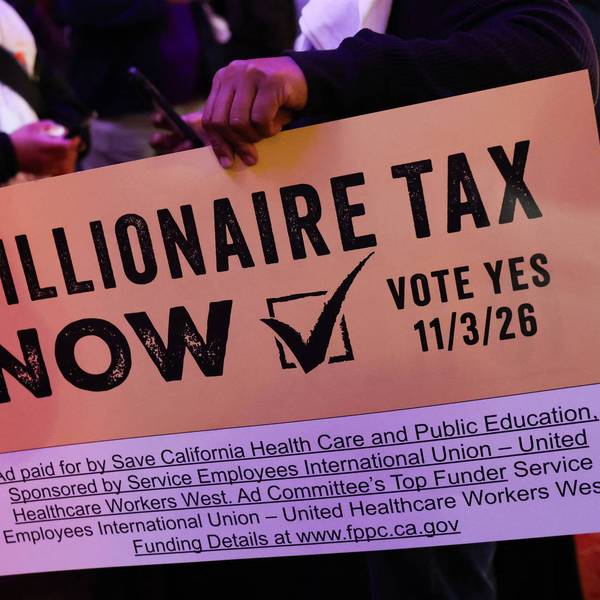
The proposal, which advocates are gathering signatures to place on the ballot in 2026, would impose a one-time 5% tax on those with net worths over $1 billion to recoup about $90 billion in Medicaid funds stripped from the state by this year’s Republican budget law. The roughly 200 billionaires affected would have five years to pay the tax.
While higher taxes on the superrich are overwhelmingly popular with Americans, the proposal has rankled many of California’s wealthiest residents, as well as California’s Democratic Gov. Gavin Newsom, who said earlier this month that he’s “adamantly” against the measure.
On Friday, the New York Times reported that two of the valley's biggest powerbrokers—venture capitalist and top Trump administration ally Peter Thiel and Google co-founder Larry Page—were threatening to reduce their ties to California in response to the tax proposal.
This has been a common refrain from elites faced with proposed tax increases, though data suggests they rarely follow through on their threats to bail on cities and states, even when those hikes are implemented. Meanwhile, the American Prospect has pointed out that the one-time tax would still apply to those who moved out of the Golden State.
Khanna (D-Calif.), who is both a member of the House's progressive faction and a longtime darling of the tech sector, has increasingly sparred with industry leaders in recent years over their reactionary stances on labor rights, regulation, and taxation.
In a post on X, the congressman reacted with derision at the threats of billionaire flight: "Peter Thiel is leaving California if we pass a 1% tax on billionaires for five years to pay for healthcare for the working class facing steep Medicaid cuts. I echo what [former President Franklin D. Roosevelt] said with sarcasm of economic royalists when they threatened to leave, 'I will miss them very much.'"
Casado, who donated to Khanna’s 2024 reelection campaign according to OpenSecrets, complained that “Ro has done a speed run, alienating every moderate I know who has supported him, including myself.”
"Beyond being totally out of touch with [the moderate] faction of his base, he’s devolved into an obnoxious jerk," Casado continued. "At least that makes voting him the fuck out all the more gratifying."
Casado's post received a reply from another former Khanna donor, Garry Tan, the CEO of the tech startup accelerator Y Combinator.
"Time to primary him," Tan said of Khanna.
Tan, a self-described centrist Democrat, has never run for office before. But he is notorious for his social media tirades against local progressives in San Francisco and was one of the top financial backers of the corporate-led push to oust the city's liberal former district attorney, Chesa Boudin, in 2022.
Casado replied: "Count me in. Happy to be involved at any level."
Progressive commentator Krystal Ball marveled that “Tech oligarchs are now openly conspiring against Ro Khanna because he dared to back a modest wealth tax.”
So far, neither Casado nor Tan has hinted at any concrete plans to challenge Khanna in 2026. If they did, defeating him would likely be a tall order—since his sophomore election in 2018, a primary challenger has never come within 30 points of unseating him.
But Khanna still felt the need to respond to the brooding tech royals. He noted that he has "supported a modest wealth tax since the day I ran in 2016," which prompted another angry retort from Casado, who accused the congressman of "antagonizing the people who made your district the amazing place it is" with a tax on billionaires.
Khanna hit back at his critics with a lengthy defense of not just the wealth tax, but his conception of what he calls "pro-innovation progressivism."
"My district is $18 trillion, nearly one-third of the US stock market in a 50-mile radius. We have five companies with a market cap over $1 trillion," Khanna said. "If I can stand up for a billionaire tax, this is not a hard position for 434 other [House] members or 100 senators."
"The seminal innovation in tech is done by thousands, often with public funds," Khanna continued. "Yes, we need entrepreneurs to commercialize disruptive innovation... But the idea that they would not start companies to make billions, or take advantage of an innovation cluster, if there is a 1-2% tax on their staggering wealth defies common sense and economic theory."
"We cannot have a nation with extreme concentration of wealth in a few places, but where 70% of Americans believe the American dream is dead and healthcare, childcare, housing, education is unaffordable," he concluded. "What will stifle American innovation, what will make us fall behind China, is if we see further political dysfunction and social unrest, if we fail to cultivate the talent in every American and in every city and town... So, yes, a billionaire tax is good for American innovation, which depends on a strong and thriving American democracy."
Dear Common Dreams reader, It’s been nearly 30 years since I co-founded Common Dreams with my late wife, Lina Newhouser. We had the radical notion that journalism should serve the public good, not corporate profits. It was clear to us from the outset what it would take to build such a project. No paid advertisements. No corporate sponsors. No millionaire publisher telling us what to think or do. Many people said we wouldn't last a year, but we proved those doubters wrong. Together with a tremendous team of journalists and dedicated staff, we built an independent media outlet free from the constraints of profits and corporate control. Our mission has always been simple: To inform. To inspire. To ignite change for the common good. Building Common Dreams was not easy. Our survival was never guaranteed. When you take on the most powerful forces—Wall Street greed, fossil fuel industry destruction, Big Tech lobbyists, and uber-rich oligarchs who have spent billions upon billions rigging the economy and democracy in their favor—the only bulwark you have is supporters who believe in your work. But here’s the urgent message from me today. It's never been this bad out there. And it's never been this hard to keep us going. At the very moment Common Dreams is most needed, the threats we face are intensifying. We need your support now more than ever. We don't accept corporate advertising and never will. We don't have a paywall because we don't think people should be blocked from critical news based on their ability to pay. Everything we do is funded by the donations of readers like you. When everyone does the little they can afford, we are strong. But if that support retreats or dries up, so do we. Will you donate now to make sure Common Dreams not only survives but thrives? —Craig Brown, Co-founder |
US Rep. Ro Khanna defended California's proposed tax on extreme wealth Saturday after a pair of prominent Silicon Valley venture capitalists threatened to launch a primary bid for his California House seat.
The proposal, which advocates are gathering signatures to place on the ballot in 2026, would impose a one-time 5% tax on those with net worths over $1 billion to recoup about $90 billion in Medicaid funds stripped from the state by this year’s Republican budget law. The roughly 200 billionaires affected would have five years to pay the tax.
While higher taxes on the superrich are overwhelmingly popular with Americans, the proposal has rankled many of California’s wealthiest residents, as well as California’s Democratic Gov. Gavin Newsom, who said earlier this month that he’s “adamantly” against the measure.
On Friday, the New York Times reported that two of the valley's biggest powerbrokers—venture capitalist and top Trump administration ally Peter Thiel and Google co-founder Larry Page—were threatening to reduce their ties to California in response to the tax proposal.
This has been a common refrain from elites faced with proposed tax increases, though data suggests they rarely follow through on their threats to bail on cities and states, even when those hikes are implemented. Meanwhile, the American Prospect has pointed out that the one-time tax would still apply to those who moved out of the Golden State.
Khanna (D-Calif.), who is both a member of the House's progressive faction and a longtime darling of the tech sector, has increasingly sparred with industry leaders in recent years over their reactionary stances on labor rights, regulation, and taxation.
In a post on X, the congressman reacted with derision at the threats of billionaire flight: "Peter Thiel is leaving California if we pass a 1% tax on billionaires for five years to pay for healthcare for the working class facing steep Medicaid cuts. I echo what [former President Franklin D. Roosevelt] said with sarcasm of economic royalists when they threatened to leave, 'I will miss them very much.'"
Casado, who donated to Khanna’s 2024 reelection campaign according to OpenSecrets, complained that “Ro has done a speed run, alienating every moderate I know who has supported him, including myself.”
"Beyond being totally out of touch with [the moderate] faction of his base, he’s devolved into an obnoxious jerk," Casado continued. "At least that makes voting him the fuck out all the more gratifying."
Casado's post received a reply from another former Khanna donor, Garry Tan, the CEO of the tech startup accelerator Y Combinator.
"Time to primary him," Tan said of Khanna.
Tan, a self-described centrist Democrat, has never run for office before. But he is notorious for his social media tirades against local progressives in San Francisco and was one of the top financial backers of the corporate-led push to oust the city's liberal former district attorney, Chesa Boudin, in 2022.
Casado replied: "Count me in. Happy to be involved at any level."
Progressive commentator Krystal Ball marveled that “Tech oligarchs are now openly conspiring against Ro Khanna because he dared to back a modest wealth tax.”
So far, neither Casado nor Tan has hinted at any concrete plans to challenge Khanna in 2026. If they did, defeating him would likely be a tall order—since his sophomore election in 2018, a primary challenger has never come within 30 points of unseating him.
But Khanna still felt the need to respond to the brooding tech royals. He noted that he has "supported a modest wealth tax since the day I ran in 2016," which prompted another angry retort from Casado, who accused the congressman of "antagonizing the people who made your district the amazing place it is" with a tax on billionaires.
Khanna hit back at his critics with a lengthy defense of not just the wealth tax, but his conception of what he calls "pro-innovation progressivism."
"My district is $18 trillion, nearly one-third of the US stock market in a 50-mile radius. We have five companies with a market cap over $1 trillion," Khanna said. "If I can stand up for a billionaire tax, this is not a hard position for 434 other [House] members or 100 senators."
"The seminal innovation in tech is done by thousands, often with public funds," Khanna continued. "Yes, we need entrepreneurs to commercialize disruptive innovation... But the idea that they would not start companies to make billions, or take advantage of an innovation cluster, if there is a 1-2% tax on their staggering wealth defies common sense and economic theory."
"We cannot have a nation with extreme concentration of wealth in a few places, but where 70% of Americans believe the American dream is dead and healthcare, childcare, housing, education is unaffordable," he concluded. "What will stifle American innovation, what will make us fall behind China, is if we see further political dysfunction and social unrest, if we fail to cultivate the talent in every American and in every city and town... So, yes, a billionaire tax is good for American innovation, which depends on a strong and thriving American democracy."
US Rep. Ro Khanna defended California's proposed tax on extreme wealth Saturday after a pair of prominent Silicon Valley venture capitalists threatened to launch a primary bid for his California House seat.
The proposal, which advocates are gathering signatures to place on the ballot in 2026, would impose a one-time 5% tax on those with net worths over $1 billion to recoup about $90 billion in Medicaid funds stripped from the state by this year’s Republican budget law. The roughly 200 billionaires affected would have five years to pay the tax.
While higher taxes on the superrich are overwhelmingly popular with Americans, the proposal has rankled many of California’s wealthiest residents, as well as California’s Democratic Gov. Gavin Newsom, who said earlier this month that he’s “adamantly” against the measure.
On Friday, the New York Times reported that two of the valley's biggest powerbrokers—venture capitalist and top Trump administration ally Peter Thiel and Google co-founder Larry Page—were threatening to reduce their ties to California in response to the tax proposal.
This has been a common refrain from elites faced with proposed tax increases, though data suggests they rarely follow through on their threats to bail on cities and states, even when those hikes are implemented. Meanwhile, the American Prospect has pointed out that the one-time tax would still apply to those who moved out of the Golden State.
Khanna (D-Calif.), who is both a member of the House's progressive faction and a longtime darling of the tech sector, has increasingly sparred with industry leaders in recent years over their reactionary stances on labor rights, regulation, and taxation.
In a post on X, the congressman reacted with derision at the threats of billionaire flight: "Peter Thiel is leaving California if we pass a 1% tax on billionaires for five years to pay for healthcare for the working class facing steep Medicaid cuts. I echo what [former President Franklin D. Roosevelt] said with sarcasm of economic royalists when they threatened to leave, 'I will miss them very much.'"
Casado, who donated to Khanna’s 2024 reelection campaign according to OpenSecrets, complained that “Ro has done a speed run, alienating every moderate I know who has supported him, including myself.”
"Beyond being totally out of touch with [the moderate] faction of his base, he’s devolved into an obnoxious jerk," Casado continued. "At least that makes voting him the fuck out all the more gratifying."
Casado's post received a reply from another former Khanna donor, Garry Tan, the CEO of the tech startup accelerator Y Combinator.
"Time to primary him," Tan said of Khanna.
Tan, a self-described centrist Democrat, has never run for office before. But he is notorious for his social media tirades against local progressives in San Francisco and was one of the top financial backers of the corporate-led push to oust the city's liberal former district attorney, Chesa Boudin, in 2022.
Casado replied: "Count me in. Happy to be involved at any level."
Progressive commentator Krystal Ball marveled that “Tech oligarchs are now openly conspiring against Ro Khanna because he dared to back a modest wealth tax.”
So far, neither Casado nor Tan has hinted at any concrete plans to challenge Khanna in 2026. If they did, defeating him would likely be a tall order—since his sophomore election in 2018, a primary challenger has never come within 30 points of unseating him.
But Khanna still felt the need to respond to the brooding tech royals. He noted that he has "supported a modest wealth tax since the day I ran in 2016," which prompted another angry retort from Casado, who accused the congressman of "antagonizing the people who made your district the amazing place it is" with a tax on billionaires.
Khanna hit back at his critics with a lengthy defense of not just the wealth tax, but his conception of what he calls "pro-innovation progressivism."
"My district is $18 trillion, nearly one-third of the US stock market in a 50-mile radius. We have five companies with a market cap over $1 trillion," Khanna said. "If I can stand up for a billionaire tax, this is not a hard position for 434 other [House] members or 100 senators."
"The seminal innovation in tech is done by thousands, often with public funds," Khanna continued. "Yes, we need entrepreneurs to commercialize disruptive innovation... But the idea that they would not start companies to make billions, or take advantage of an innovation cluster, if there is a 1-2% tax on their staggering wealth defies common sense and economic theory."
"We cannot have a nation with extreme concentration of wealth in a few places, but where 70% of Americans believe the American dream is dead and healthcare, childcare, housing, education is unaffordable," he concluded. "What will stifle American innovation, what will make us fall behind China, is if we see further political dysfunction and social unrest, if we fail to cultivate the talent in every American and in every city and town... So, yes, a billionaire tax is good for American innovation, which depends on a strong and thriving American democracy."