SUBSCRIBE TO OUR FREE NEWSLETTER
Daily news & progressive opinion—funded by the people, not the corporations—delivered straight to your inbox.
5
#000000
#FFFFFF
To donate by check, phone, or other method, see our More Ways to Give page.
Daily news & progressive opinion—funded by the people, not the corporations—delivered straight to your inbox.
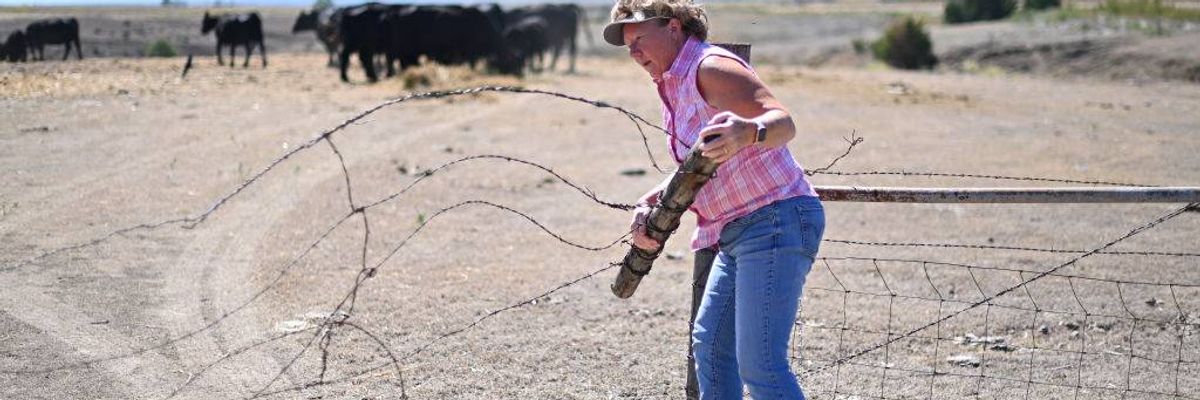
Cattle rancher Denise McConville puts a gate back up after feeding alfalfa to her black angus cattle on September 12, 2022 in McCook, NE.
"The marketplace is fundamentally broken," one rancher explained.
Even as US beef prices have continued to surge, American cattle ranchers have come under increased financial pressure—and a new report from More Perfect Union claims that this is due in part to industry consolidation in the meat-packing industry.
Bill Bullard, the CEO of the trade association R-CALF USA, explained to More Perfect Union that cattle ranchers are essentially at the bottom of the pyramid in the beef-producing process, while the top is occupied by "four meat packers controlling 80% of the market."
"It's there that the meat packers are able to exert their market power in order to leverage down the price that the cattle feeder receives for the animals," Bullard said.
To illustrate the impact this has had on farmers, Bullard pointed out that cattle producers in 1980 received 63 cents for every dollar paid by consumers for beef, whereas four decades later they were receiving just 37 cents for every dollar.
"That allocation has flipped on its head because the marketplace is fundamentally broken," Bullard told More Perfect Union.
Angela Huffman, president of Farm Action, recently highlighted the role played by the four big meatpacking companies—Tyson, Cargill, National Beef, and JBS—in hurting US ranchers.
Writing on her Substack page earlier this month, Huffman zeroed in on Tyson's recent decision to close one of its meatpacking plants in Lexington, Nebraska to demonstrate the outsize power that big corporations have over the US food supply.
The Lexington plant employs more than 3,000 people and is capable of processing 5,000 head of cattle a day, and its closure is expected to both devastate the local economy and have a major impact on US ranchers throughout the region.
Huffman noted a report from the Associated Press estimating that the Lexington plant's closure, combined with projected job cuts at a Tyson plant in Amarillo, Texas, could cut national beef processing capacity by up to 9%.
"Ranchers were already dealing with high costs, drought, and years of uneven prices," Huffman wrote. "Now they face even less competition for their cattle. When there are fewer packers active in the market, ranchers have less bargaining power, and cattle prices fall even as beef prices in grocery stores stay near record highs."
Dan Osborn, an independent US Senate candidate running in Nebraska, has made the dangers of corporate consolidation a central theme of his campaign, and on Monday he released a video explaining why he spends so much time talking about monopolies, particularly in the agricultural industry.
"If you're a farmer, your inputs, your seed, your chemicals, you have to buy from monopolies," he said. "Sygenta, Chinese-owned company you've got to buy your seed from, they control and manipulate that market. And then when your production's over and you're selling it, you're selling it to monopolies as well."
Want to know why I talk about MONOPOLIES all the time? This is why. 👇 pic.twitter.com/MuYh0gZRVr
— Dan Osborn (@osbornforne) December 22, 2025
Osborn said that the trend of industry consolidation wasn't just limited to agriculture, but is now moving forward with major railroad and media mergers.
"We need to create an economic environment in this country that favors competition," he said. "That's what a free market is. A free market isn't three or four big people or big corporations controlling everything."
Dear Common Dreams reader, It’s been nearly 30 years since I co-founded Common Dreams with my late wife, Lina Newhouser. We had the radical notion that journalism should serve the public good, not corporate profits. It was clear to us from the outset what it would take to build such a project. No paid advertisements. No corporate sponsors. No millionaire publisher telling us what to think or do. Many people said we wouldn't last a year, but we proved those doubters wrong. Together with a tremendous team of journalists and dedicated staff, we built an independent media outlet free from the constraints of profits and corporate control. Our mission has always been simple: To inform. To inspire. To ignite change for the common good. Building Common Dreams was not easy. Our survival was never guaranteed. When you take on the most powerful forces—Wall Street greed, fossil fuel industry destruction, Big Tech lobbyists, and uber-rich oligarchs who have spent billions upon billions rigging the economy and democracy in their favor—the only bulwark you have is supporters who believe in your work. But here’s the urgent message from me today. It's never been this bad out there. And it's never been this hard to keep us going. At the very moment Common Dreams is most needed, the threats we face are intensifying. We need your support now more than ever. We don't accept corporate advertising and never will. We don't have a paywall because we don't think people should be blocked from critical news based on their ability to pay. Everything we do is funded by the donations of readers like you. When everyone does the little they can afford, we are strong. But if that support retreats or dries up, so do we. Will you donate now to make sure Common Dreams not only survives but thrives? —Craig Brown, Co-founder |
Even as US beef prices have continued to surge, American cattle ranchers have come under increased financial pressure—and a new report from More Perfect Union claims that this is due in part to industry consolidation in the meat-packing industry.
Bill Bullard, the CEO of the trade association R-CALF USA, explained to More Perfect Union that cattle ranchers are essentially at the bottom of the pyramid in the beef-producing process, while the top is occupied by "four meat packers controlling 80% of the market."
"It's there that the meat packers are able to exert their market power in order to leverage down the price that the cattle feeder receives for the animals," Bullard said.
To illustrate the impact this has had on farmers, Bullard pointed out that cattle producers in 1980 received 63 cents for every dollar paid by consumers for beef, whereas four decades later they were receiving just 37 cents for every dollar.
"That allocation has flipped on its head because the marketplace is fundamentally broken," Bullard told More Perfect Union.
Angela Huffman, president of Farm Action, recently highlighted the role played by the four big meatpacking companies—Tyson, Cargill, National Beef, and JBS—in hurting US ranchers.
Writing on her Substack page earlier this month, Huffman zeroed in on Tyson's recent decision to close one of its meatpacking plants in Lexington, Nebraska to demonstrate the outsize power that big corporations have over the US food supply.
The Lexington plant employs more than 3,000 people and is capable of processing 5,000 head of cattle a day, and its closure is expected to both devastate the local economy and have a major impact on US ranchers throughout the region.
Huffman noted a report from the Associated Press estimating that the Lexington plant's closure, combined with projected job cuts at a Tyson plant in Amarillo, Texas, could cut national beef processing capacity by up to 9%.
"Ranchers were already dealing with high costs, drought, and years of uneven prices," Huffman wrote. "Now they face even less competition for their cattle. When there are fewer packers active in the market, ranchers have less bargaining power, and cattle prices fall even as beef prices in grocery stores stay near record highs."
Dan Osborn, an independent US Senate candidate running in Nebraska, has made the dangers of corporate consolidation a central theme of his campaign, and on Monday he released a video explaining why he spends so much time talking about monopolies, particularly in the agricultural industry.
"If you're a farmer, your inputs, your seed, your chemicals, you have to buy from monopolies," he said. "Sygenta, Chinese-owned company you've got to buy your seed from, they control and manipulate that market. And then when your production's over and you're selling it, you're selling it to monopolies as well."
Want to know why I talk about MONOPOLIES all the time? This is why. 👇 pic.twitter.com/MuYh0gZRVr
— Dan Osborn (@osbornforne) December 22, 2025
Osborn said that the trend of industry consolidation wasn't just limited to agriculture, but is now moving forward with major railroad and media mergers.
"We need to create an economic environment in this country that favors competition," he said. "That's what a free market is. A free market isn't three or four big people or big corporations controlling everything."
Even as US beef prices have continued to surge, American cattle ranchers have come under increased financial pressure—and a new report from More Perfect Union claims that this is due in part to industry consolidation in the meat-packing industry.
Bill Bullard, the CEO of the trade association R-CALF USA, explained to More Perfect Union that cattle ranchers are essentially at the bottom of the pyramid in the beef-producing process, while the top is occupied by "four meat packers controlling 80% of the market."
"It's there that the meat packers are able to exert their market power in order to leverage down the price that the cattle feeder receives for the animals," Bullard said.
To illustrate the impact this has had on farmers, Bullard pointed out that cattle producers in 1980 received 63 cents for every dollar paid by consumers for beef, whereas four decades later they were receiving just 37 cents for every dollar.
"That allocation has flipped on its head because the marketplace is fundamentally broken," Bullard told More Perfect Union.
Angela Huffman, president of Farm Action, recently highlighted the role played by the four big meatpacking companies—Tyson, Cargill, National Beef, and JBS—in hurting US ranchers.
Writing on her Substack page earlier this month, Huffman zeroed in on Tyson's recent decision to close one of its meatpacking plants in Lexington, Nebraska to demonstrate the outsize power that big corporations have over the US food supply.
The Lexington plant employs more than 3,000 people and is capable of processing 5,000 head of cattle a day, and its closure is expected to both devastate the local economy and have a major impact on US ranchers throughout the region.
Huffman noted a report from the Associated Press estimating that the Lexington plant's closure, combined with projected job cuts at a Tyson plant in Amarillo, Texas, could cut national beef processing capacity by up to 9%.
"Ranchers were already dealing with high costs, drought, and years of uneven prices," Huffman wrote. "Now they face even less competition for their cattle. When there are fewer packers active in the market, ranchers have less bargaining power, and cattle prices fall even as beef prices in grocery stores stay near record highs."
Dan Osborn, an independent US Senate candidate running in Nebraska, has made the dangers of corporate consolidation a central theme of his campaign, and on Monday he released a video explaining why he spends so much time talking about monopolies, particularly in the agricultural industry.
"If you're a farmer, your inputs, your seed, your chemicals, you have to buy from monopolies," he said. "Sygenta, Chinese-owned company you've got to buy your seed from, they control and manipulate that market. And then when your production's over and you're selling it, you're selling it to monopolies as well."
Want to know why I talk about MONOPOLIES all the time? This is why. 👇 pic.twitter.com/MuYh0gZRVr
— Dan Osborn (@osbornforne) December 22, 2025
Osborn said that the trend of industry consolidation wasn't just limited to agriculture, but is now moving forward with major railroad and media mergers.
"We need to create an economic environment in this country that favors competition," he said. "That's what a free market is. A free market isn't three or four big people or big corporations controlling everything."