SUBSCRIBE TO OUR FREE NEWSLETTER
Daily news & progressive opinion—funded by the people, not the corporations—delivered straight to your inbox.
5
#000000
#FFFFFF
To donate by check, phone, or other method, see our More Ways to Give page.
Daily news & progressive opinion—funded by the people, not the corporations—delivered straight to your inbox.
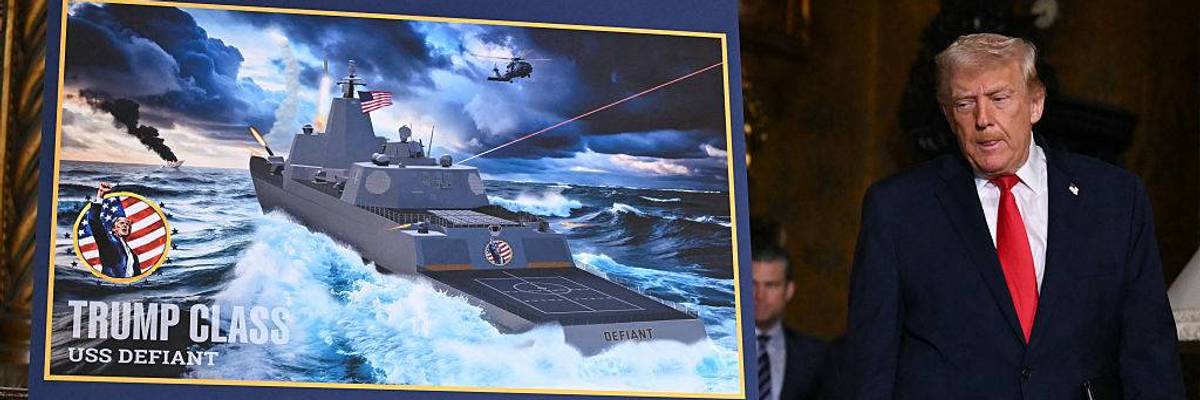
US President Donald Trump arrives to announce the US Navy's new Golden Fleet initiative, unveiling a new class of warships, at Mar-a-Lago in Palm Beach, Florida, on December 22, 2025.
"A future administration will cancel the program before the first ship hits the water," said one critic.
President Donald Trump on Monday announced that the US Navy is building a new class of warship that will be named after him—but naval warfare experts are warning the project looks like a wasteful boondoggle.
Mark Cancian, a senior adviser at the Center for Strategic and International Studies, wrote an analysis of the Trump-branded ships the day after their announcement in which he bluntly predicted that they "will never sail."
Among other things, Cancian argued that the ship being commissioned by the president "will take years to design, cost $9 billion each to build, and contravene the Navy’s new concept of operations, which envisions distributed firepower."
As if that weren't enough, Cancian projected that "a future administration will cancel the program before the first ship hits the water."
Dan Grazier, a senior fellow and program director at the Stimson Center, also predicted doom for Trump's prized ships, which he said would be too overloaded with the latest cutting-edge technology to be effective at naval combat.
"Every gadget you add to one of these systems is one more thing that can break," Grazier wrote in an analysis published by the Quincy Institute for Responsible Statecraft. "When designers lack discipline, as they obviously did while sketching out this latest future boondoggle, a simple mathematical truth asserts itself."
In fact, Grazier felt so confident in his gloomy prognostication for Trump's warships that he told readers they could "take it to the bank."
"The Navy will spend tens of billions of dollars over the course of the next decade on the Trump-class program," he wrote. "At best, the Navy will receive three troublesome ships that will cost more than $10 billion each before then entire scheme is abandoned."
William Hartung, a senior research fellow at the Quincy Institute for Responsible Statecraft, flagged a particularly troubling detail of Trump's warship plan in a lengthy analysis published by Forbes on Thursday.
"The most troubling aspect of the proposed Trump-class ships is that they are supposed to carry sea-launched nuclear armed cruise missiles," Hartung explained. "The last thing the US military needs is yet another way to deliver nuclear weapons. And because nuclear-armed cruise missiles are difficult to tell from cruise missiles armed with nonnuclear bombs, there is a danger that and adversary could mistake an attack with a nonnuclear armed missile with a nuclear attack, with devastating consequences."
Hartung also pointed out that the ships, which are projected to cost billions each, are not the only pricey weapons system that Trump is planning to build, as earlier this year he vowed to build a "Golden Dome" missile defense system that is projected to cost anywhere from $292 billion and $3.6 trillion.
"It’s time for Congress to do its oversight job and slow down these 'golden' programs until the administration can make a plausible case that they can be both affordable and effective," Hartung concluded. "The odds are against them."
Bernard Loo, senior fellow at Singapore’s S. Rajaratnam School of International Studies, said in an interview with CNBC that Trump's proposed ships appear to be "a prestige project more than anything else."
Loo argued that the proposed ships' massive size, with each projected to displace more than 35,000 tons while measuring more than 840 feet, would make each vessel a "bomb magnet" for adversaries.
"The size and the prestige value of it all make it an even more tempting target," Loo added.
Dear Common Dreams reader, It’s been nearly 30 years since I co-founded Common Dreams with my late wife, Lina Newhouser. We had the radical notion that journalism should serve the public good, not corporate profits. It was clear to us from the outset what it would take to build such a project. No paid advertisements. No corporate sponsors. No millionaire publisher telling us what to think or do. Many people said we wouldn't last a year, but we proved those doubters wrong. Together with a tremendous team of journalists and dedicated staff, we built an independent media outlet free from the constraints of profits and corporate control. Our mission has always been simple: To inform. To inspire. To ignite change for the common good. Building Common Dreams was not easy. Our survival was never guaranteed. When you take on the most powerful forces—Wall Street greed, fossil fuel industry destruction, Big Tech lobbyists, and uber-rich oligarchs who have spent billions upon billions rigging the economy and democracy in their favor—the only bulwark you have is supporters who believe in your work. But here’s the urgent message from me today. It's never been this bad out there. And it's never been this hard to keep us going. At the very moment Common Dreams is most needed, the threats we face are intensifying. We need your support now more than ever. We don't accept corporate advertising and never will. We don't have a paywall because we don't think people should be blocked from critical news based on their ability to pay. Everything we do is funded by the donations of readers like you. When everyone does the little they can afford, we are strong. But if that support retreats or dries up, so do we. Will you donate now to make sure Common Dreams not only survives but thrives? —Craig Brown, Co-founder |
President Donald Trump on Monday announced that the US Navy is building a new class of warship that will be named after him—but naval warfare experts are warning the project looks like a wasteful boondoggle.
Mark Cancian, a senior adviser at the Center for Strategic and International Studies, wrote an analysis of the Trump-branded ships the day after their announcement in which he bluntly predicted that they "will never sail."
Among other things, Cancian argued that the ship being commissioned by the president "will take years to design, cost $9 billion each to build, and contravene the Navy’s new concept of operations, which envisions distributed firepower."
As if that weren't enough, Cancian projected that "a future administration will cancel the program before the first ship hits the water."
Dan Grazier, a senior fellow and program director at the Stimson Center, also predicted doom for Trump's prized ships, which he said would be too overloaded with the latest cutting-edge technology to be effective at naval combat.
"Every gadget you add to one of these systems is one more thing that can break," Grazier wrote in an analysis published by the Quincy Institute for Responsible Statecraft. "When designers lack discipline, as they obviously did while sketching out this latest future boondoggle, a simple mathematical truth asserts itself."
In fact, Grazier felt so confident in his gloomy prognostication for Trump's warships that he told readers they could "take it to the bank."
"The Navy will spend tens of billions of dollars over the course of the next decade on the Trump-class program," he wrote. "At best, the Navy will receive three troublesome ships that will cost more than $10 billion each before then entire scheme is abandoned."
William Hartung, a senior research fellow at the Quincy Institute for Responsible Statecraft, flagged a particularly troubling detail of Trump's warship plan in a lengthy analysis published by Forbes on Thursday.
"The most troubling aspect of the proposed Trump-class ships is that they are supposed to carry sea-launched nuclear armed cruise missiles," Hartung explained. "The last thing the US military needs is yet another way to deliver nuclear weapons. And because nuclear-armed cruise missiles are difficult to tell from cruise missiles armed with nonnuclear bombs, there is a danger that and adversary could mistake an attack with a nonnuclear armed missile with a nuclear attack, with devastating consequences."
Hartung also pointed out that the ships, which are projected to cost billions each, are not the only pricey weapons system that Trump is planning to build, as earlier this year he vowed to build a "Golden Dome" missile defense system that is projected to cost anywhere from $292 billion and $3.6 trillion.
"It’s time for Congress to do its oversight job and slow down these 'golden' programs until the administration can make a plausible case that they can be both affordable and effective," Hartung concluded. "The odds are against them."
Bernard Loo, senior fellow at Singapore’s S. Rajaratnam School of International Studies, said in an interview with CNBC that Trump's proposed ships appear to be "a prestige project more than anything else."
Loo argued that the proposed ships' massive size, with each projected to displace more than 35,000 tons while measuring more than 840 feet, would make each vessel a "bomb magnet" for adversaries.
"The size and the prestige value of it all make it an even more tempting target," Loo added.
President Donald Trump on Monday announced that the US Navy is building a new class of warship that will be named after him—but naval warfare experts are warning the project looks like a wasteful boondoggle.
Mark Cancian, a senior adviser at the Center for Strategic and International Studies, wrote an analysis of the Trump-branded ships the day after their announcement in which he bluntly predicted that they "will never sail."
Among other things, Cancian argued that the ship being commissioned by the president "will take years to design, cost $9 billion each to build, and contravene the Navy’s new concept of operations, which envisions distributed firepower."
As if that weren't enough, Cancian projected that "a future administration will cancel the program before the first ship hits the water."
Dan Grazier, a senior fellow and program director at the Stimson Center, also predicted doom for Trump's prized ships, which he said would be too overloaded with the latest cutting-edge technology to be effective at naval combat.
"Every gadget you add to one of these systems is one more thing that can break," Grazier wrote in an analysis published by the Quincy Institute for Responsible Statecraft. "When designers lack discipline, as they obviously did while sketching out this latest future boondoggle, a simple mathematical truth asserts itself."
In fact, Grazier felt so confident in his gloomy prognostication for Trump's warships that he told readers they could "take it to the bank."
"The Navy will spend tens of billions of dollars over the course of the next decade on the Trump-class program," he wrote. "At best, the Navy will receive three troublesome ships that will cost more than $10 billion each before then entire scheme is abandoned."
William Hartung, a senior research fellow at the Quincy Institute for Responsible Statecraft, flagged a particularly troubling detail of Trump's warship plan in a lengthy analysis published by Forbes on Thursday.
"The most troubling aspect of the proposed Trump-class ships is that they are supposed to carry sea-launched nuclear armed cruise missiles," Hartung explained. "The last thing the US military needs is yet another way to deliver nuclear weapons. And because nuclear-armed cruise missiles are difficult to tell from cruise missiles armed with nonnuclear bombs, there is a danger that and adversary could mistake an attack with a nonnuclear armed missile with a nuclear attack, with devastating consequences."
Hartung also pointed out that the ships, which are projected to cost billions each, are not the only pricey weapons system that Trump is planning to build, as earlier this year he vowed to build a "Golden Dome" missile defense system that is projected to cost anywhere from $292 billion and $3.6 trillion.
"It’s time for Congress to do its oversight job and slow down these 'golden' programs until the administration can make a plausible case that they can be both affordable and effective," Hartung concluded. "The odds are against them."
Bernard Loo, senior fellow at Singapore’s S. Rajaratnam School of International Studies, said in an interview with CNBC that Trump's proposed ships appear to be "a prestige project more than anything else."
Loo argued that the proposed ships' massive size, with each projected to displace more than 35,000 tons while measuring more than 840 feet, would make each vessel a "bomb magnet" for adversaries.
"The size and the prestige value of it all make it an even more tempting target," Loo added.