

SUBSCRIBE TO OUR FREE NEWSLETTER
Daily news & progressive opinion—funded by the people, not the corporations—delivered straight to your inbox.
5
#000000
#FFFFFF
To donate by check, phone, or other method, see our More Ways to Give page.
Daily news & progressive opinion—funded by the people, not the corporations—delivered straight to your inbox.
"He's helping fund Russia's war machine, while our allies pay the price," said one congressional Democrat.
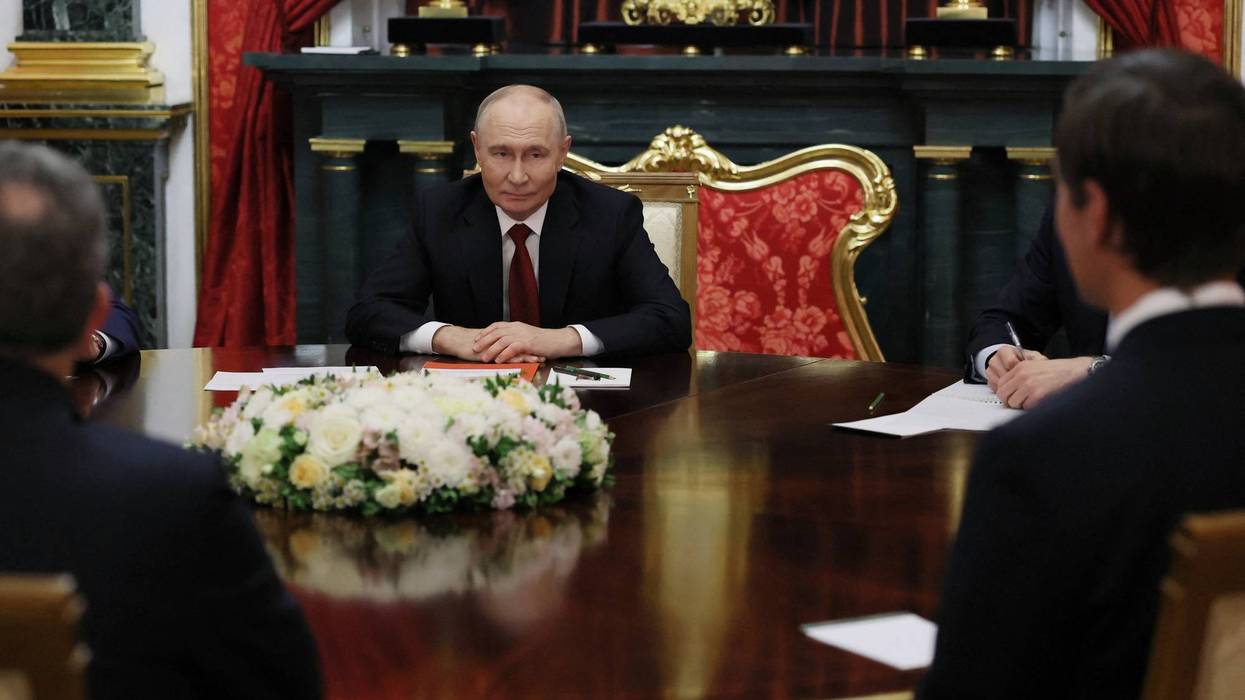
Democrats in Congress and Ukrainian President Volodymyr Zelenskyy on Friday swiftly condemned US President Donald Trump's plan to secure diesel from Russia in hopes of combating fuel prices that have skyrocketed due to his illegal war on Iran.
"I have just concluded a highly successful discussion with President Vladimir Putin, of Russia, wherein it was agreed that Russia will immediately supply over 300,000 Tons of Diesel Fuel to the American and Global Marketplace, another 500,000 Tons during the month of November, and 1,000,000 Tons immediately thereafter," Trump wrote on his Truth Social platform, with the US midterm elections just weeks away, and voters frustrated by the country's affordability crisis.
"Additionally, based on the condition of their Diesel Refineries, Russia will then deliver, within a short period of time, 3,000,000 Tons of Diesel Fuel," Trump said. "Between our TOTAL CONTROL of the Strait of Hormuz, and this great announcement on Russian Energy, Diesel Prices for Americans and, indeed, the World, will be COMING DOWN, IN RECORD NUMBERS, AND FAST! Lower prices for Americans, especially our Great Farmers, Ranchers, and Truckers, is my Greatest Priority. This is a very big and important announcement. Additionally, it must be understood, that Iran will not have a Nuclear Weapon!"
After Trump's post, the Department of the Treasury's Office of Foreign Assets Control issued a general license "authorizing transactions related to the sale, delivery, offloading, and importation of diesel" from Russia—which launched a full-scale invasion of neighboring Ukraine in 2022. In response, Congress has appropriated over $170 billion to help Ukraine.
The Associated Press pointed out that Trump announced the deal with Putin after "he signed a sweeping Russia sanctions law last month that aimed at clamping down on Russia's energy revenues," and as "his envoy Steve Witkoff and son-in-law Jared Kushner were meeting with Ukrainian officials in Miami to discuss a proposal to try to end the Russia-Ukraine war."
In a lengthy statement, the Ukrainian president warned Friday that "any easing of sanctions against Russia without a clear and lasting de-escalation agreement with Russia is an obvious weakness. It plays into Russia's hands—allowing it to kill more, wage war for longer, have even less respect for America, and inflict even greater losses and damage on the world."
US Senate Minority Leader Chuck Schumer (D-NY) declared that "Trump is doing a deal with the devil to try to help his flailing political fortunes from the shockingly high diesel prices caused by his own reckless, illegal war in the Middle East. This filthy deal will only aid and abet the same Putin who is helping the Iranians to target and try to kill American troops in the Middle East and who illegally and viciously invaded our ally Ukraine."
According to an online tracker launched by Brown University's Costs of War Project, since Trump started bombing Iran without congressional authorization in February, Americans have paid over $130 billion more for fuel—$71.74 billion for gasoline and $58.56 billion for diesel—or nearly $1,000 per household.
Several other Democratic lawmakers from both chambers of Congress—which Democrats hope to reclaim from Trump's Republican Party in November—were also critical, including Sen. Richard Blumenthal (D-Conn.), who said that striking a deal "with a murdering dictator" to lift sanctions "is an embarrassment and makes us complicit in Putin's war against Ukraine."
"This poorly concealed attempt to mitigate the havoc caused by Trump's illegal war in Iran will only benefit the Chinese and Russian economies, and lead to the slaughter of more innocents in Ukraine," he argued. "The president should rescind this agreement immediately. To the American companies considering taking Putin's blood money: Congress is watching."
Denouncing Trump's announcement as "a disgrace," Sen. Elizabeth Warren (D-Mass.) said: "You know how Trump could bring down gas and diesel prices? By ending his illegal war with Iran. Instead, he's going to help fund Putin's war machine."
Sen. Andy Kim (D-NJ) described Trump's approach as "desperate and shortsighted," adding: "Trump ran on America First but has no idea how to actually deliver for the American people. We wouldn't be in this mess without his wasteful war with Iran. We need to build opportunity for Americans with our foreign policy, not Putin. End this war and not a single dime to Russia."
House Foreign Affairs Committee Ranking Member Gregory Meeks (D-NY) also slammed the president's reversal on sanctions against Russia, stressing that "instead of putting economic pressure on Putin for his invasion of Ukraine, Trump continues to appease him. His disastrous Iran War has sent gas and diesel costs soaring, and Americans are paying the price."
Congresswoman Madeleine Dean (D-Pa.) similarly said: "Desperate to escape the consequences of his failed Iran war, Trump is preparing to stab Ukraine in the back and buy diesel from Putin. He's helping fund Russia's war machine, while our allies pay the price."
"The proposed diesel export ban is a short-sighted 'America First' response to a global crisis his reckless war helped create."
In an effort to blunt price hikes from his war with Iran, President Donald Trump is reportedly preparing a 90-day ban on diesel exports from the United States.
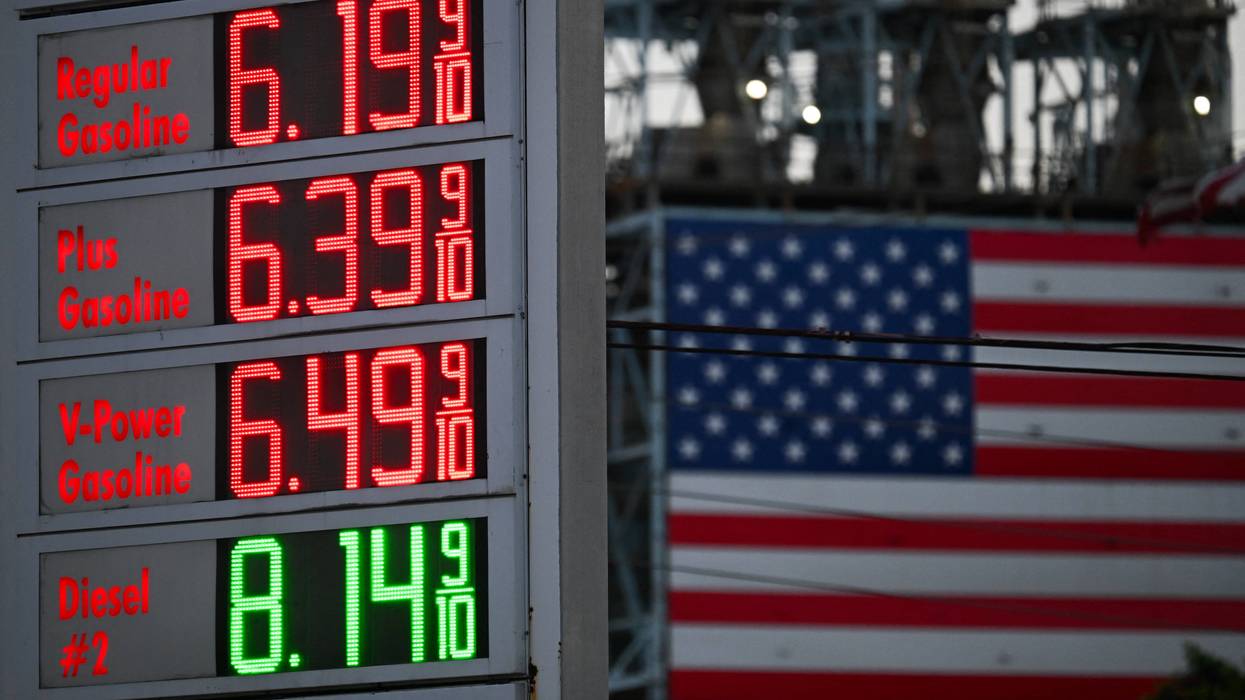
The cost of diesel—which is used to power semitrucks, trains, construction and farm equipment, and other large machines—has soared since Trump launched the war at the end of February, prompting Iran to restrict oil shipments through the critical Strait of Hormuz.
As of Wednesday, according to the American Automobile Association, average US diesel prices have jumped to $6.52 per gallon, a 77% increase from last year. Over the past month, as Trump has ramped up hostilities with Iran, prices have risen by 91 cents a gallon, a 16.2% increase.
Heightened diesel prices increase the cost of everything else—including food, transportation, and other energy sources. And while Trump claimed earlier this month to be bringing prices "way down, way, way down,” the latest federal data show consumer prices rising 0.4% in August—four times July’s monthly increase—and 3.4% over the past year.
With the midterms less than two months away and many voters blaming Trump for the strain on their pocketbooks, several GOP members of Congress, including some facing tough Senate races, such as Sen. Dan Sullivan (Alaska) and Rep. Ashley Hinson (Iowa), have cheered the idea.
During a press conference on Tuesday, Trump told reporters: "I’ve said let’s not send out the diesel. We make a lot of diesel. It could have a little bit of an effect on regular automobile gasoline because when you do that, you know, it’s a sort of a flow. It’s a balance. But no, I’ve called for it. I’ve called for it within my people. I’ve been talking about it.”
But while the plan may help to keep diesel prices down for long enough to help Republicans stop the bleeding before November, some economists are warning that it could make things much worse in the long term.
“The US Gulf Coast would get a temporary pump price dip, at the cost of likely higher coastal prices [elsewhere] and eventually, higher prices for everyone as investment gets scared away," explained Bob McNally, president of Rapidan Energy Group and a former White House energy adviser under the administration of former President George W. Bush.
"You would get a short-term, abrupt collapse in pump prices” in some regions, McNally said, but “the US would shatter its reputation as a safe place to invest for a generation.”
Energy economist Philip Verleger said that a ban, even if temporary, "would have the same long-term effect as President [Richard] Nixon’s soybean embargo: the world would no longer view the United States as a dependable source.”
Speaking to Reuters, Verleger warned that in an already undersupplied market, removing US barrels could potentially double global prices.
But the short term seems to be all Trump and those around him pushing the ban are considering. An oil industry executive who discussed the proposed ban with White House officials told Politico that Trump viewed any fallout as “a December problem.”
He said that "cooler heads" in the White House have been "overpowered" by the "political camp" that has a "sky-is-falling, we-have-to-do-something concern about prices at the pump."
Lorne Stockman, research director at Oil Change International, argued that there was a much simpler solution: ending the war that has caused oil prices to spike in the first place.
"The proposed diesel export ban is a short-sighted 'America First' response to a global crisis his reckless war helped create," Stockman said. "The US exports about 5% of global diesel, and a ban risks turning a severe shortage into a global economic disaster."
"It could send international prices soaring, drive up the cost of food, fertilizer, and essential goods, deepen hunger, and push already-struggling economies toward recession," he continued. "At the same time, it would likely do nothing for people in the US, as refineries would cut production and gasoline prices would rise even further."
He said, "Congress should use its constitutional powers to stop Trump’s war, tax the oil industry’s soaring windfall profits, and support farmers and other hard-hit sectors, and accelerate renewable energy and electrification, not hoard fuel and force the rest of the world to pay the price.”
"Diesel touches almost everything Americans buy," said one expert.
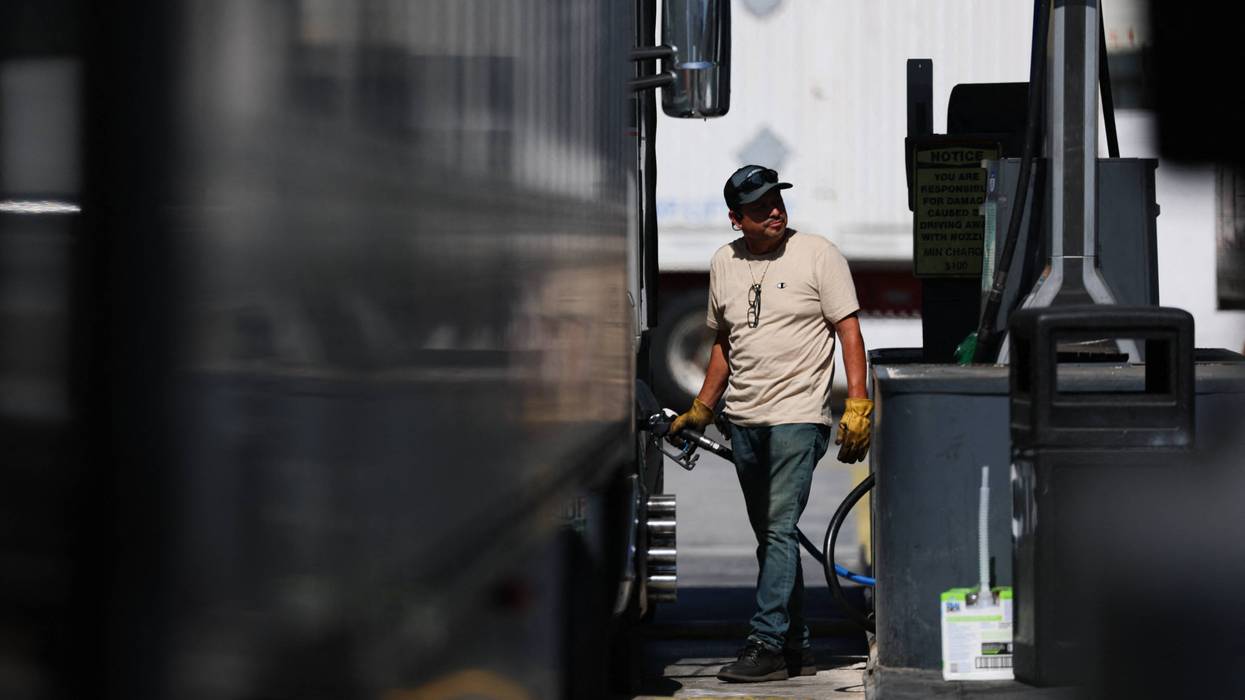
The price of diesel fuel hit another record high on Friday, thanks in large part to President Donald Trump's illegal war with Iran.
New data released by the American Automobile Association showed the average price of diesel in the US increasing to $6.06, a 14% increase over the average price one month ago and a 64% increase from the average price one year ago.
In a Friday social media post, petroleum industry analyst Patrick De Haan reported that the price of diesel "is not slowing down," hitting an average of $6.07 as of 10:34 am ET.
De Haan also projected that Americans will collectively spend $711 million more on gasoline and diesel on Friday than they did a year ago, and warned "this number will continue to grow and could soon be $1 billion per day."
Rising diesel prices often portend higher inflation because it is the fuel used by trucks to ship goods across the country.
In an interview with The Associated Press published Friday, David Ortega, professor of food economics and policy at Michigan State University, warned that US consumers are likely in for another painful round of cost increases if the price of diesel stays at record highs.
“Early on, much of the cost increase gets absorbed along the supply chain through existing freight contracts and retailer margins,” said Ortega. “But as contracts reprice and fuel surcharges take hold, more of that cost makes its way to the grocery store.”
Ortega's analysis was echoed by Mark Tepper, CEO of Strategic Wealth Partners, who wrote in a social media post that "inflation could be about to get a lot more painful" if the price of diesel doesn't come down soon.
"Diesel touches almost everything Americans buy," Tepper explained. "Coming out of the pandemic, rising diesel prices were a leading indicator for the inflation that followed."
Diane Swonk, chief economist at audit services firm KPMG, said rising diesel costs, combined with the latest Consumer Price Index report from the Bureau of Labor Statistics showing continued elevated inflation, made it likely that the US Federal Reserve will hike interest rates.
"The Fed will begin hiking in September, removing what it gave us in rate cuts in late 2025," Swonk predicted. "We now expect three rate hikes by early 2026. The probability that the vote will be unanimous just rose."
The record diesel prices, and their subsequent impact on inflation, come less than two months before the midterm elections.
The social media account for Democrats in the US House of Representatives pounced on news of higher diesel prices, which they said would mean "higher delivery prices, more expensive groceries, and surging electric bills."
"Trump's war with Iran did this," the House Democrats added.
Alex Jacquez, senior vice president of policy, advocacy, and research at Groundwork Collaborative, also took a shot at the president's policies, noting that in recent weeks he has "imposed further tariffs on one of our closest trading partners and continues escalation in Iran."
"Trump promised to lower costs and improve daily life for Americans," Jacquez added. "He’s not only failed to deliver on that promise, he’s driven our economy over a cliff."
Willamette University historian Seth Cotlar argued that the spike in diesel fuel could have significant impact on the US Senate race in Maine, where Republican incumbent Sen. Susan Collins is vying for a sixth term in office.
"Home heating oil season is about to start up," Cotlar observed. "In Maine, about 50% of homes use heating oil which is almost identical to diesel. How’s that GOP affordability agenda coming Senator Collins?"