SUBSCRIBE TO OUR FREE NEWSLETTER
Daily news & progressive opinion—funded by the people, not the corporations—delivered straight to your inbox.
5
#000000
#FFFFFF
To donate by check, phone, or other method, see our More Ways to Give page.
Daily news & progressive opinion—funded by the people, not the corporations—delivered straight to your inbox.
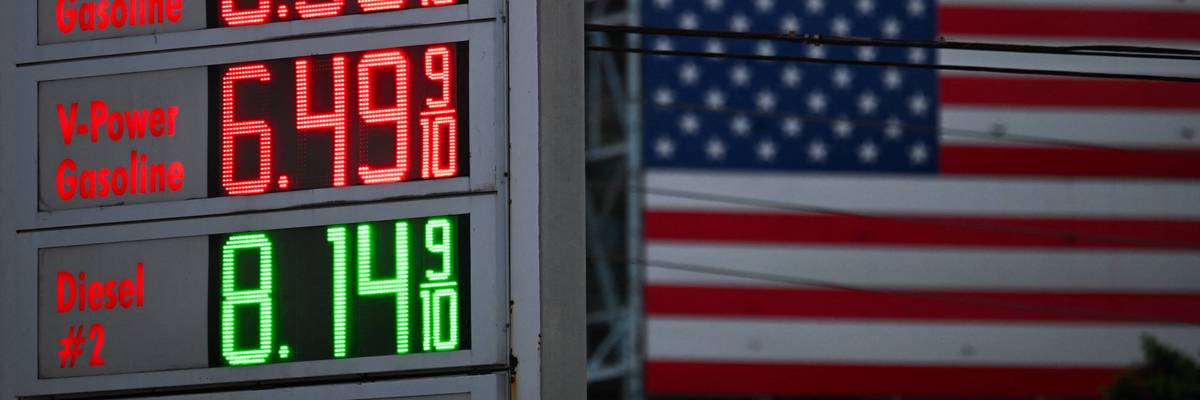
Gas prices at a Shell gas station above $6 a gallon for regular gasoline and $8 a gallon for diesel are displayed across from a US flag outside of the Marathon Petroleum Corp. Los Angeles Refinery in Carson, California on September 22, 2026.
"The proposed diesel export ban is a short-sighted 'America First' response to a global crisis his reckless war helped create."
In an effort to blunt price hikes from his war with Iran, President Donald Trump is reportedly preparing a 90-day ban on diesel exports from the United States.
The cost of diesel—which is used to power semitrucks, trains, construction and farm equipment, and other large machines—has soared since Trump launched the war at the end of February, prompting Iran to restrict oil shipments through the critical Strait of Hormuz.
As of Wednesday, according to the American Automobile Association, average US diesel prices have jumped to $6.52 per gallon, a 77% increase from last year. Over the past month, as Trump has ramped up hostilities with Iran, prices have risen by 91 cents a gallon, a 16.2% increase.
Heightened diesel prices increase the cost of everything else—including food, transportation, and other energy sources. And while Trump claimed earlier this month to be bringing prices "way down, way, way down,” the latest federal data show consumer prices rising 0.4% in August—four times July’s monthly increase—and 3.4% over the past year.
With the midterms less than two months away and many voters blaming Trump for the strain on their pocketbooks, several GOP members of Congress, including some facing tough Senate races, such as Sen. Dan Sullivan (Alaska) and Rep. Ashley Hinson (Iowa), have cheered the idea.
During a press conference on Tuesday, Trump told reporters: "I’ve said let’s not send out the diesel. We make a lot of diesel. It could have a little bit of an effect on regular automobile gasoline because when you do that, you know, it’s a sort of a flow. It’s a balance. But no, I’ve called for it. I’ve called for it within my people. I’ve been talking about it.”
But while the plan may help to keep diesel prices down for long enough to help Republicans stop the bleeding before November, some economists are warning that it could make things much worse in the long term.
“The US Gulf Coast would get a temporary pump price dip, at the cost of likely higher coastal prices [elsewhere] and eventually, higher prices for everyone as investment gets scared away," explained Bob McNally, president of Rapidan Energy Group and a former White House energy adviser under the administration of former President George W. Bush.
"You would get a short-term, abrupt collapse in pump prices” in some regions, McNally said, but “the US would shatter its reputation as a safe place to invest for a generation.”
Energy economist Philip Verleger said that a ban, even if temporary, "would have the same long-term effect as President [Richard] Nixon’s soybean embargo: the world would no longer view the United States as a dependable source.”
Speaking to Reuters, Verleger warned that in an already undersupplied market, removing US barrels could potentially double global prices.
But the short term seems to be all Trump and those around him pushing the ban are considering. An oil industry executive who discussed the proposed ban with White House officials told Politico that Trump viewed any fallout as “a December problem.”
He said that "cooler heads" in the White House have been "overpowered" by the "political camp" that has a "sky-is-falling, we-have-to-do-something concern about prices at the pump."
Lorne Stockman, research director at Oil Change International, argued that there was a much simpler solution: ending the war that has caused oil prices to spike in the first place.
"The proposed diesel export ban is a short-sighted 'America First' response to a global crisis his reckless war helped create," Stockman said. "The US exports about 5% of global diesel, and a ban risks turning a severe shortage into a global economic disaster."
"It could send international prices soaring, drive up the cost of food, fertilizer, and essential goods, deepen hunger, and push already-struggling economies toward recession," he continued. "At the same time, it would likely do nothing for people in the US, as refineries would cut production and gasoline prices would rise even further."
He said, "Congress should use its constitutional powers to stop Trump’s war, tax the oil industry’s soaring windfall profits, and support farmers and other hard-hit sectors, and accelerate renewable energy and electrification, not hoard fuel and force the rest of the world to pay the price.”
Dear Common Dreams reader, It’s been nearly 30 years since I co-founded Common Dreams with my late wife, Lina Newhouser. We had the radical notion that journalism should serve the public good, not corporate profits. It was clear to us from the outset what it would take to build such a project. No paid advertisements. No corporate sponsors. No millionaire publisher telling us what to think or do. Many people said we wouldn't last a year, but we proved those doubters wrong. Together with a tremendous team of journalists and dedicated staff, we built an independent media outlet free from the constraints of profits and corporate control. Our mission has always been simple: To inform. To inspire. To ignite change for the common good. Building Common Dreams was not easy. Our survival was never guaranteed. When you take on the most powerful forces—Wall Street greed, fossil fuel industry destruction, Big Tech lobbyists, and uber-rich oligarchs who have spent billions upon billions rigging the economy and democracy in their favor—the only bulwark you have is supporters who believe in your work. But here’s the urgent message from me today. It's never been this bad out there. And it's never been this hard to keep us going. At the very moment Common Dreams is most needed, the threats we face are intensifying. We need your support now more than ever. We don't accept corporate advertising and never will. We don't have a paywall because we don't think people should be blocked from critical news based on their ability to pay. Everything we do is funded by the donations of readers like you. When everyone does the little they can afford, we are strong. But if that support retreats or dries up, so do we. Will you donate now to make sure Common Dreams not only survives but thrives? —Craig Brown, Co-founder |
In an effort to blunt price hikes from his war with Iran, President Donald Trump is reportedly preparing a 90-day ban on diesel exports from the United States.
The cost of diesel—which is used to power semitrucks, trains, construction and farm equipment, and other large machines—has soared since Trump launched the war at the end of February, prompting Iran to restrict oil shipments through the critical Strait of Hormuz.
As of Wednesday, according to the American Automobile Association, average US diesel prices have jumped to $6.52 per gallon, a 77% increase from last year. Over the past month, as Trump has ramped up hostilities with Iran, prices have risen by 91 cents a gallon, a 16.2% increase.
Heightened diesel prices increase the cost of everything else—including food, transportation, and other energy sources. And while Trump claimed earlier this month to be bringing prices "way down, way, way down,” the latest federal data show consumer prices rising 0.4% in August—four times July’s monthly increase—and 3.4% over the past year.
With the midterms less than two months away and many voters blaming Trump for the strain on their pocketbooks, several GOP members of Congress, including some facing tough Senate races, such as Sen. Dan Sullivan (Alaska) and Rep. Ashley Hinson (Iowa), have cheered the idea.
During a press conference on Tuesday, Trump told reporters: "I’ve said let’s not send out the diesel. We make a lot of diesel. It could have a little bit of an effect on regular automobile gasoline because when you do that, you know, it’s a sort of a flow. It’s a balance. But no, I’ve called for it. I’ve called for it within my people. I’ve been talking about it.”
But while the plan may help to keep diesel prices down for long enough to help Republicans stop the bleeding before November, some economists are warning that it could make things much worse in the long term.
“The US Gulf Coast would get a temporary pump price dip, at the cost of likely higher coastal prices [elsewhere] and eventually, higher prices for everyone as investment gets scared away," explained Bob McNally, president of Rapidan Energy Group and a former White House energy adviser under the administration of former President George W. Bush.
"You would get a short-term, abrupt collapse in pump prices” in some regions, McNally said, but “the US would shatter its reputation as a safe place to invest for a generation.”
Energy economist Philip Verleger said that a ban, even if temporary, "would have the same long-term effect as President [Richard] Nixon’s soybean embargo: the world would no longer view the United States as a dependable source.”
Speaking to Reuters, Verleger warned that in an already undersupplied market, removing US barrels could potentially double global prices.
But the short term seems to be all Trump and those around him pushing the ban are considering. An oil industry executive who discussed the proposed ban with White House officials told Politico that Trump viewed any fallout as “a December problem.”
He said that "cooler heads" in the White House have been "overpowered" by the "political camp" that has a "sky-is-falling, we-have-to-do-something concern about prices at the pump."
Lorne Stockman, research director at Oil Change International, argued that there was a much simpler solution: ending the war that has caused oil prices to spike in the first place.
"The proposed diesel export ban is a short-sighted 'America First' response to a global crisis his reckless war helped create," Stockman said. "The US exports about 5% of global diesel, and a ban risks turning a severe shortage into a global economic disaster."
"It could send international prices soaring, drive up the cost of food, fertilizer, and essential goods, deepen hunger, and push already-struggling economies toward recession," he continued. "At the same time, it would likely do nothing for people in the US, as refineries would cut production and gasoline prices would rise even further."
He said, "Congress should use its constitutional powers to stop Trump’s war, tax the oil industry’s soaring windfall profits, and support farmers and other hard-hit sectors, and accelerate renewable energy and electrification, not hoard fuel and force the rest of the world to pay the price.”
In an effort to blunt price hikes from his war with Iran, President Donald Trump is reportedly preparing a 90-day ban on diesel exports from the United States.
The cost of diesel—which is used to power semitrucks, trains, construction and farm equipment, and other large machines—has soared since Trump launched the war at the end of February, prompting Iran to restrict oil shipments through the critical Strait of Hormuz.
As of Wednesday, according to the American Automobile Association, average US diesel prices have jumped to $6.52 per gallon, a 77% increase from last year. Over the past month, as Trump has ramped up hostilities with Iran, prices have risen by 91 cents a gallon, a 16.2% increase.
Heightened diesel prices increase the cost of everything else—including food, transportation, and other energy sources. And while Trump claimed earlier this month to be bringing prices "way down, way, way down,” the latest federal data show consumer prices rising 0.4% in August—four times July’s monthly increase—and 3.4% over the past year.
With the midterms less than two months away and many voters blaming Trump for the strain on their pocketbooks, several GOP members of Congress, including some facing tough Senate races, such as Sen. Dan Sullivan (Alaska) and Rep. Ashley Hinson (Iowa), have cheered the idea.
During a press conference on Tuesday, Trump told reporters: "I’ve said let’s not send out the diesel. We make a lot of diesel. It could have a little bit of an effect on regular automobile gasoline because when you do that, you know, it’s a sort of a flow. It’s a balance. But no, I’ve called for it. I’ve called for it within my people. I’ve been talking about it.”
But while the plan may help to keep diesel prices down for long enough to help Republicans stop the bleeding before November, some economists are warning that it could make things much worse in the long term.
“The US Gulf Coast would get a temporary pump price dip, at the cost of likely higher coastal prices [elsewhere] and eventually, higher prices for everyone as investment gets scared away," explained Bob McNally, president of Rapidan Energy Group and a former White House energy adviser under the administration of former President George W. Bush.
"You would get a short-term, abrupt collapse in pump prices” in some regions, McNally said, but “the US would shatter its reputation as a safe place to invest for a generation.”
Energy economist Philip Verleger said that a ban, even if temporary, "would have the same long-term effect as President [Richard] Nixon’s soybean embargo: the world would no longer view the United States as a dependable source.”
Speaking to Reuters, Verleger warned that in an already undersupplied market, removing US barrels could potentially double global prices.
But the short term seems to be all Trump and those around him pushing the ban are considering. An oil industry executive who discussed the proposed ban with White House officials told Politico that Trump viewed any fallout as “a December problem.”
He said that "cooler heads" in the White House have been "overpowered" by the "political camp" that has a "sky-is-falling, we-have-to-do-something concern about prices at the pump."
Lorne Stockman, research director at Oil Change International, argued that there was a much simpler solution: ending the war that has caused oil prices to spike in the first place.
"The proposed diesel export ban is a short-sighted 'America First' response to a global crisis his reckless war helped create," Stockman said. "The US exports about 5% of global diesel, and a ban risks turning a severe shortage into a global economic disaster."
"It could send international prices soaring, drive up the cost of food, fertilizer, and essential goods, deepen hunger, and push already-struggling economies toward recession," he continued. "At the same time, it would likely do nothing for people in the US, as refineries would cut production and gasoline prices would rise even further."
He said, "Congress should use its constitutional powers to stop Trump’s war, tax the oil industry’s soaring windfall profits, and support farmers and other hard-hit sectors, and accelerate renewable energy and electrification, not hoard fuel and force the rest of the world to pay the price.”