
SUBSCRIBE TO OUR FREE NEWSLETTER
Daily news & progressive opinion—funded by the people, not the corporations—delivered straight to your inbox.
5
#000000
#FFFFFF
To donate by check, phone, or other method, see our More Ways to Give page.


Daily news & progressive opinion—funded by the people, not the corporations—delivered straight to your inbox.
"With the Supreme Court decision to criminalize people who are unhoused, we need you to stand up and create more humane housing policies today."
In the wake of a U.S. Supreme Court ruling that is devastating for homeless people, over 50 organizations on Tuesday urged President Joe Biden to take immediate action to address the nation's housing emergency before his first term ends next January.
"We appreciate the steps your administration has taken to address America's affordable housing crisis," the coalition wrote, applauding his proposed 5% cap on rent hikes for tenants of corporate landlords and "regulatory actions to use public land for affordable housing, provide grants for deeply affordable homes, and require 30-day notice for rent increases and lease expirations."
Noting that Biden is not seeking a second term—Democratic Vice President Kamala Harris is set to face former Republican President Donald Trump in the November election—and the urgency of the housing crisis, the groups argued that "taking stronger action will resonate deeply with working and low-income people and people of color nationwide."
"Now is a critical moment for aggressive action to help end the worst housing and homelessness crisis our country has ever seen, help renters and houseless folks struggling with the cost of rent now, and set the country on a long-term path of providing safe, stable, and permanently affordable rental housing for decades to come," the letter states. "We, the undersigned, are calling on you to show leadership by using your executive authority immediately, to effect change now—during the worst housing and homelessness crisis of a generation."
"We must urgently create a more just and sustainable housing system."
Specifically, the coalition is calling for Biden to issue one executive order to establish an Office of Social Housing at the U.S. Department of Housing and Urban Development, and another for rent regulations and good cause eviction protections in federally insured properties.
Additionally, the groups want Biden to demand federal legislation supporting the right of all renters to organize and bargain collectively as tenant unions with landlords over rents and living conditions, along with appropriating $1 trillion over a decade to create 12 million permanently affordable homes, as well as $230 billion to fully repair and green existing public housing.
The letter—part of the House Every One! campaign—is led by the Center for Popular Democracy (CPD) Action and backed by groups including Stand Up Alaska, Make the Road Connecticut, Delaware Alliance for Community Advancement, Florida Rising, New Georgia Project, Step Up Louisiana, Maryland Communities United, Maine People's Alliance, Detroit Action, TakeAction Minnesota, New York Communities for Change, One Pennsylvania, Texas Organizing Project, and Our Future West Virginia.
As part of the campaign, "during the month of August, thousands of renters and community groups across the country will host local town hall meetings to call on their local and national representatives to crack down on corporate landlords, cap rents, and invest in tenant-owned, permanently affordable green social housing," CPD said in an email Monday.
The coalition wrote to Biden Tuesday that "we must protect families from the looming threat of unprecedented homelessness and displacement; halt Wall Street speculation and corporate landlords' growing influence over the housing market; create truly affordable green social housing; and redress our federal government's history of institutionalized bias, putting us on a path towards greater racial, economic, and gender equity."
"We all deserve a safe, stable, and affordable place to call home," the letter says. "We must urgently create a more just and sustainable housing system."
The letter also stresses that "with the Supreme Court decision to criminalize people who are unhoused, we need you to stand up and create more humane housing policies today, nodding to the City of Grants Pass, Oregon v. Johnson ruling. The right-wing justices ruled that local governments can enforce bans on sleeping outdoors, regardless of whether they are able to offer shelter space.
Some Democrats are under fire for welcoming the June ruling—including California Gov. Gavin Newsom, who is widely believed to have presidential ambitions. Since the decision, Newsom has issued an executive order directing officials to clear out homeless encampments, participated in clearing of a Los Angeles encampment, and threatened to withhold funding from counties that don't crack down on unhoused people.
"Gavin Newsom using a Republican Supreme Court's cruel decision in order to pivot to anti-homeless demagogue is shameful and sleazy," said one critic.
After personally participating in the forced displacement of homeless people in a Los Angeles encampment, Democratic California Gov. Gavin Newsom on Thursday threatened to withhold funding from counties that don't sufficiently crack down on the unhoused.
Buoyed by the right-wing U.S. Supreme Court's recent City of Grants Pass, Oregon v. Johnson ruling—which was welcomed by Newsom and other Democratic leaders like San Francisco Mayor London Breed who filed amicus briefs in the case—the governor issued an executive order last month directing officials to clear out homeless encampments, which have proliferated amid rampant economic inequality and stratospheric housing prices in the nation's most populous state.
After taking part in a Thursday sweep of an encampment in Mission Hills in L.A.'s San Fernando Valley, Newsom declared: "I want to see results... If we don't see demonstrable results, I'll start to redirect money."
Newsom praised leaders like Breed and Democratic Los Angeles Mayor Karen Bass for reducing the number of people sleeping on their cities' streets and directed his ire mostly toward county governments.
"This is a sincerely held belief that we need local government to step up," the governor added. "This is a crisis. Act like it."
Newsom has made—and followed through on—similar promises in the past. Last month, his office redirected a $10 million grant for San Diego County to buy so-called "tiny homes" for the unhoused because officials there "could not move with the urgency the housing and homelessness crisis demands."
University of California, Los Angeles sociology professor and homelessness expert Chris Herring told The Guardian following Newsom's executive order that the directive is "giving a green light to a harsher approach" to tackling California's unhoused crisis, which critics say criminalizes people for being poor.
"It sends a clear message to municipalities that even if you do not have shelter available, you can go through with this," Herring said. "The law now allows cities and counties to cite and incarcerate individuals for sleeping outside."
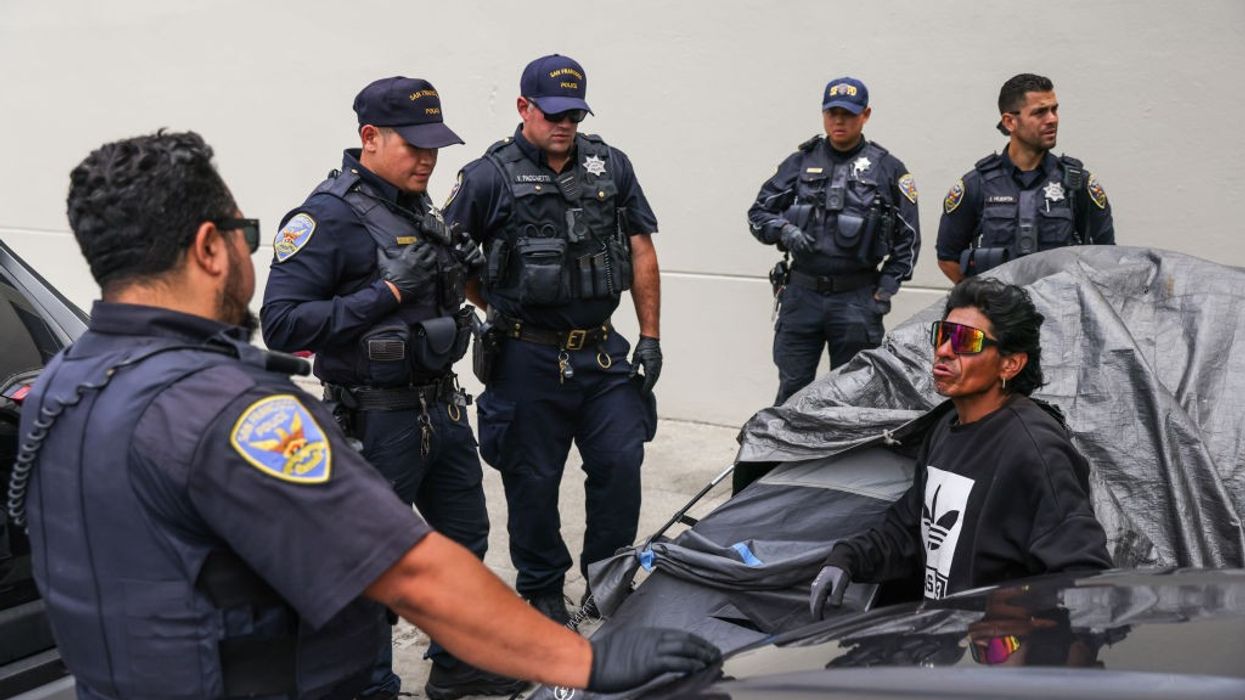
In San Francisco—where Breed, a moderate Democrat, is up for reelection in November—police have begun aggressively sweeping homeless encampments. Unhoused residents are given a choice between capacity-challenged shelters, where they're often separated from family and pets and subjected to dangerous conditions, or jail.
This, in a city that's
short several thousand shelter beds.
Some San Franciscans who initially supported police sweeps have recoiled when faced with what one small business owner called the "inhumane" reality of the policy.
As The San Francisco Standard's Christin Evans reported this week:
One woman described to me having her wallet—containing her ID, debit, and EBT cards—pulled from her hand as a police officer proceeded to "taunt" her with possible arrest. Why? Because she declined to accept a bed at a crowded shelter where she would be separated from her husband. A day later, police officers arrived at the site where the couple had relocated a few blocks away and issued a citation for illegal lodging. Now, the couple have a court date to address a "crime" that is punishable by a $1,000 fine and up to a year in jail.
Experts from across the political spectrum have asserted that homeless sweeps don't work. A study of Los Angeles' homeless population published in July by the Rand Corporation, a Santa Monica-based think tank, found that cleared encampments generally return after a month or two.
"We found continuing evidence that local encampment cleanup activities don't appear to lead to a persistent reduction in the number of unsheltered residents in the area," study co-author Jason Ward said during a video conference, according to an article published last week by The American Prospect. "They just tend to move them around and the numbers tend to return in our relatively small area to previous trends pretty quickly."
"Homelessness is dangerous, humiliating, and traumatic. Nobody needs to be reminded of these truths," article author Nicholas Slayton wrote. "If Gavin Newson wants to fix the problem, he could work to get more housing built, especially affordable units—by, for instance, signing rather than vetoing a social housing bill."
"But if he wants to sweep the problem under the rug so as to pretend like he's doing something useful while actually making the problem worse, he could continue on his present course," he added.
"The only way to end homeless encampments in California is to end the need for homeless encampments," an expert said.
Civil rights advocates and progressive commentators on Thursday condemned California Gov. Gavin Newsom after the Democrat issued an executive order to shut down homeless encampments on state property and to incentivize local authorities to do the same.
The order marks the first notable state policy shift to result from a momentous U.S. Supreme Court ruling on June 28, decided 6-3 on ideological lines, that the liberal dissenting justices argued criminalized homelessness.
Eric Tars, a policy director at the National Homelessness Law Center, told The New York Times that the executive order effectively blamed the victims of a systemic problem.
"The only way to end homeless encampments in California is to end the need for homeless encampments," he said. "California has an affordable housing crisis, and unless Newsom's executive order is coming with sufficient resources to address that, this new push isn't going to work."
In a direct response to Newsom on social media, Diane Yentel, president of the National Low Income Housing Coalition, said that the governor hadn't provided the fundamental ingredient needed to solve the homelessness problem.
"You didn't provide the needed affordable housing," she wrote. "You're choosing political expediency over real solutions. That's not leadership, it's cowardice. This will only worsen homelessness."
Echoing the need for more housing, Nina Turner, a senior fellow at the Institute on Race, Power and Political Economy, called the Newsom decision "shameful," while Jordan Chariton, a journalist at Status Coup, a progressive media outlet, called it "disgusting," saying Newsom's solution was to "sweep them all up like it's taking out the trash."
Mel Buer, a reporter for The Real News Network, indicated on social media that the decision was in keeping with the political approach of the governor, who is widely believed to have presidential ambitions.
"Saw this one coming from a mile off," Buer wrote of Thursday's executive order. "Newsom's a fucking heartless dipshit who would rather court billionaire donors to his 2028 presidential run than be a real human being."
You didn’t provide the needed affordable housing.
You’re choosing political expediency over real solutions. That’s not leadership, it’s cowardice.
This will only worsen homelessness. https://t.co/2tHk5awTo8
— Diane Yentel (@dianeyentel) July 25, 2024
Critics of last month's Supreme Court ruling in City of Grants Pass, Oregon v. Johnson argued that it would lead to a crackdown on homelessness throughout the country. The conservative justices ruled that the Oregon city could ban sleeping in public places—sidewalks, streets, parks—overturning a 9th U.S. Circuit Court of Appeals decision that the local law was unconstitutional.
The San Francisco-based 9th Circuit is one of the most liberal courts in the country and had issued a number of rulings in favor of the rights of homeless people in recent years, frustrating Republicans and some Democrats including Newsom.
California is home to roughly one-third of the nation's homeless population and the reasons for the problem are the subject of fierce ideological debate, as are the solutions. This was evident in the response to the Supreme Court ruling, which led one Republican mayor in California to declare that he was "warming up the bulldozer."
Newsom welcomed the ruling but other Democrats, such as Los Angeles Mayor Karen Bass, expressed dismay and concern.
"This ruling must not be used as an excuse for cities across the country to attempt to arrest their way out of this problem or hide the homelessness crisis in neighboring cities or in jail," Bass said a statement at the time.
Newsom doesn't have the power to force local authorities such as Bass to remove homeless encampments but could wield influence at the municipal level because of his control over billions in funding to address homelessness, The New York Times reported.
Newsom's administration has spent $24 billion in responding to the homelessness crisis since he took office in 2019, including $1 billion to help municipalities remove encampments and $3.3 billion to expand housing for homeless people, the executive order says.
Homeless people still have civil rights, advocacy groups say, warning that they will sue local governments that mistreat the unsheltered. They also point to research showing that sweeping encampments is ineffective, as it doesn't address the root problems of homelessness. A Rand Corporation survey last year showed that sweeps affect homeless populations in an area only temporarily.
New laws criminalizing the state of being homeless will not pass, and existing laws will not be retained, if we the people reject them.
Yesterday’s Supreme Court decision in City of Grants Pass, Oregon v. Johnson was an abomination. Justice Sonia Sotomayor had it right when she said that criminally punishing people for sleeping outside when there is no shelter available to them is “unconscionable and unconstitutional.”
Alas, six of her fellow justices disagreed, ruling that fining and imprisoning people just because they are homeless does not violate the Eighth Amendment prohibition against cruel and unusual punishment. So these vile, counterproductive responses to our housing crisis have been held to be constitutional.
But the second half of Justice Sotomayor’s verdict is alive and well: Punishing people because they are unhoused is unconscionable. The Supreme Court failed to stop this hateful practice, but we can.
Laws that imprison people for being unhoused are just as unconscionable today as they were before the Supreme Court ruling.
In my work teaching a law school clinic where we defend people facing eviction, and in research and writing as part of a book project, I have spent the last few years researching and writing about inspiring housing rights campaigns across the country.
Tenant unions, religious groups, civic organizations, labor unions, and others have come together to lobby local officials in Louisville, confront corporate landlords in North Carolina, run candidates for office in Kansas City, commit civil disobedience in Connecticut, convene phone banks in Tacoma, and fight like hell in dozens of other communities, too. They have won victories like bans on cold-weather and school-year evictions, referendums creating huge boosts in affordable housing funds, ceilings on rent increases, and protections against unlawful evictions.
This growing movement demands the fulfillment of the human right to housing. The people in this movement, not a half-dozen unelected, lifetime-appointed elites in black robes, will have the last word on how we treat our unhoused sisters and brothers.
That was always going to be the case, no matter how the court decided Grants Pass. As a practical matter, the Supreme Court majority only ruled that anti-homeless legislation is allowable—not that it is advisable, much less required. New laws criminalizing the state of being homeless will not pass, and existing laws will not be retained, if we the people reject them.
More broadly, transformative justice always comes from the bottom up, not from court decisions handed down from on high. Compare the anti-abolition movement to the Dred Scott decision sanctioning slavery, the civil rights movement to the Plessy v. Ferguson decision that enshrined “separate but equal,” the labor movement to multiple anti-worker decisions like the Hammer v. Dagenhart ruling that struck down laws prohibiting child labor.
During one of my visits to the amazing advocates of the Louisville Tenant Union, I heard one of the tenants tell her story. She and her children had not only been unlawfully evicted, she was wrongly arrested and imprisoned in the process. Judges did not save her, and law enforcement certainly didn’t. Instead, she found support and justice when she joined together with her fellow tenants.
“The powers that be told me I was crazy, but that’s harder to say when I am standing next to 100 other people who have gone through the same thing,” she said. “We are the ones to keep us safe.”
She is right. Laws that imprison people for being unhoused are just as unconscionable today as they were before the Supreme Court ruling. Together, we can stop them. Together, we can keep all of us safe.
"Maybe the right-wing justices could empathize with the most vulnerable Americans if they spent less time jet-setting on luxury vacations on their wealthy benefactors' dime," said one critic.
"SCOTUS just criminalized homelessness."
So said numerous legal experts and advocates for the unhoused Friday after the U.S. Supreme Court's right-wing supermajority ruled that local governments can enforce bans on sleeping outdoors, regardless of whether municipalities are able to offer them shelter space.
In a 6-3 decision along ideological lines, the justices ruled in City of Grants Pass, Oregon v. Johnson that officials can criminalize sleeping and camping on public property including parks, even when housing options are unavailable or unaffordable.
"We are disappointed that a majority of the court has decided that our Constitution allows a city to punish its homeless residents simply for sleeping outside with a blanket to survive the cold when there is nowhere else for them to go," said Ed Johnson, director of litigation at the Oregon Law Center, which represented unhoused Grants Pass residents in the case.
The decision overturned a ruling by the San Francisco-based 9th U.S. Circuit Court of Appeals that found bans on outdoor sleeping violated the 8th Amendment's proscription of cruel and unusual punishment.
"Homelessness is complex. Its causes are many. So may be the public policy responses required to address it," Justice Neil Gorsuch wrote for the majority. "A handful of federal judges cannot begin to 'match' the collective wisdom the American people possess in deciding 'how best to handle' a pressing social question like homelessness."
Gorsuch suggested that unhoused people could invoke "necessity... insanity, diminished-capacity, and duress defenses" when they are prosecuted for poverty-related offenses.
In a dissent calling the criminalization of unhoused people "unconscionable and unconstitutional," Justice Sonia Sotomayor wrote that "sleep is a biological necessity, not a crime."
"For some people, sleeping outside is their only option," she noted.
Sotomayor continued:
Homelessness is a reality for too many Americans. On any given night, over half a million people across the country lack a fixed, regular, and adequate nighttime residence. Many do not have access to shelters and are left to sleep in cars, sidewalks, parks, and other public places. They experience homelessness due to complex and interconnected issues, including crippling debt and stagnant wages; domestic and sexual abuse; physical and psychiatric disabilities; and rising housing costs coupled with declining affordable housing options.
"It is possible to acknowledge and balance the issues facing local governments, the humanity and dignity of homeless people, and our constitutional principles," Sotomayor asserted. "Instead, the majority focuses almost exclusively on the needs of local governments and leaves the most vulnerable in our society with an impossible choice: Either stay awake or be arrested."
"The Constitution provides a baseline of rights for all Americans rich and poor, housed and unhoused," Sotomayor added. "This court must safeguard those rights even when, and perhaps especially when, doing so is uncomfortable or unpopular."
Attorney Theane Evangelis, who represented Grants Pass in the case, cheered the decision, arguing that the 9th Circuit ruling had "tied the hands of local governments."
Some leaders in places where the homelessness crisis is most acute welcomed Friday's ruling, including Democratic California Gov. Gavin Newsom, who filed an amicus brief in the case, and London Breed, the Democratic mayor of San Francisco, which also filed an amicus brief.
"Gorsuch extensively cites San Francisco's amicus in the decision,"
noted Raya Steier, a San Francisco-based attorney who led the successful campaign to pass a local ballot measure taxing the wealthy to generate hundreds of millions of dollars in revenue for Covid rent relief and affordable housing. "Congratulations London Breed and David Chiu, this is now your legacy."
Economic justice advocates said rising inequality and housing costs have played a key role in driving the U.S. unhoused population to a record 650,000. If all the unhoused people in the country came together to form a city, it would be the nation's 23rd-largest—ahead of Las Vegas, Boston, Detroit, and Portland, Oregon—based on 2020 Census figures.
"We are in the midst of a crisis where housing is unaffordable for millions of Americans. Millions of us are just one paycheck away from losing our homes," New York-based Center for Popular Democracy Action said in a statement. "Today, the Supreme Court has made the morally bankrupt decision to allow people experiencing homelessness to be persecuted and punished just for existing, while denying them shelter and safety as a human right."
"For those who are unhoused, this will mean fines, tickets, and even incarceration for a vulnerable community already abandoned by city and state authorities," the group added.
Referring to the high court's 2010 Citizens United v. Federal Election Commission ruling, many social media users said that "corporations are people" but "the homeless are not."
Others pointed to the millions of dollars worth of gifts and other perks—many of them undisclosed—lavished upon Supreme Court members, especially far-right Justices Clarence Thomas and Samuel Alito, by right-wing billionaires, some with business before the court.
"Today's decision shows how little the MAGA supermajority cares about struggling Americans," said Tracy Adair, communications manager at Stand Up America, a New York-based pro-democracy group. "It is unfathomably cruel to punish unhoused individuals for existing on public property when they have nowhere else to go."
"Maybe the right-wing justices could empathize with the most vulnerable Americans if they spent less time jet-setting on luxury vacations on their wealthy benefactors' dime," Adair added.
Advocates for the unhoused stressed that the solution to homelessness is housing, not criminalization.
"Cities should not punish people for being poor," said Jennifer Friedenbach, executive director of the Coalition on Homelessness, a housing justice and human rights group serving San Francisco. "The solution is, and has always been, safe and affordable housing."
In response to the ruling, the National Homelessness Law Center is calling on the Biden administration to invest at least $356 billion next year to fund universal rental assistance, upgraded public housing, a national housing trust fund, eviction and homelessness prevention programs, and voluntary supportive and emergency services.