

SUBSCRIBE TO OUR FREE NEWSLETTER
Daily news & progressive opinion—funded by the people, not the corporations—delivered straight to your inbox.
5
#000000
#FFFFFF
To donate by check, phone, or other method, see our More Ways to Give page.
Daily news & progressive opinion—funded by the people, not the corporations—delivered straight to your inbox.
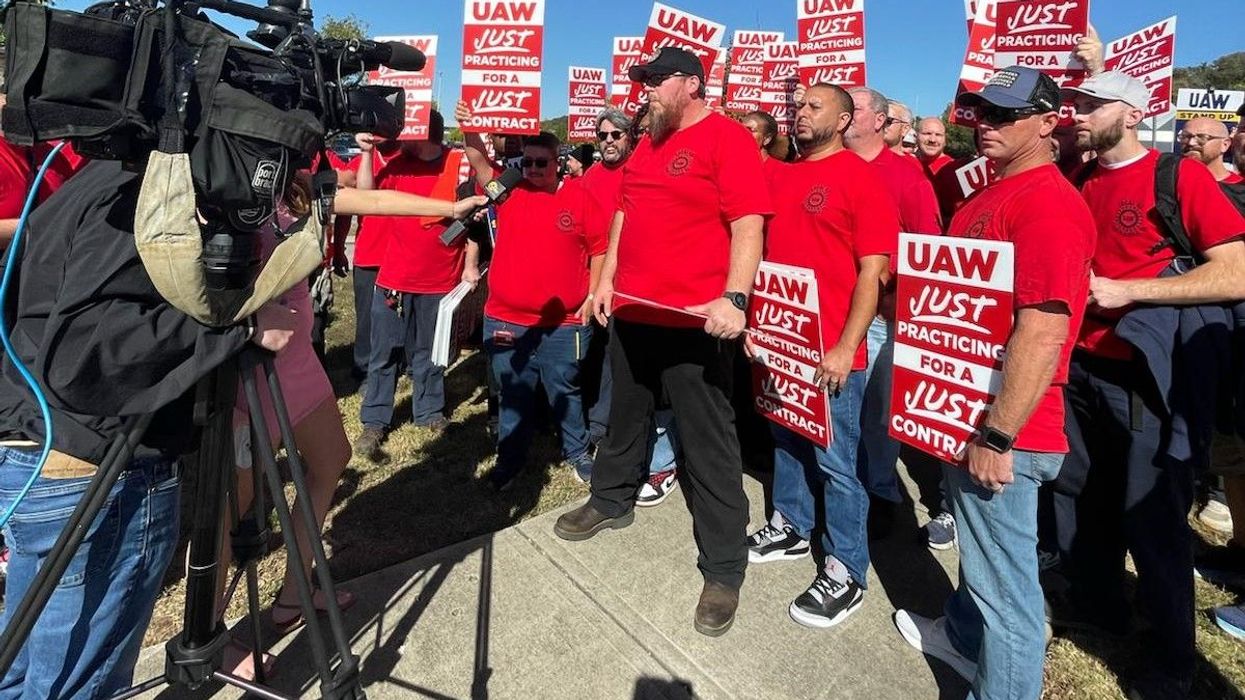
"I'm voting yes to get Volkswagen to come back to the table," said one employee at the plant. "The majority of the people I know don't want VW's 'final offer.'"
Volkswagen workers in Chattanooga, Tennessee, who unionized with the United Auto Workers last year, announced Thursday that they will vote next week to authorize a strike after over 13 months of fruitless contract negotiations with the auto giant.
The strike authorization vote planned for October 28-29 "comes after months of unfair labor practices committed by the company, including bad faith negotiations, unlawful intimidation, and the unilateral cutting of jobs at Volkswagen’s only US assembly plant," UAW said in a statement. The union also highlighted Volkswagen's $20.6 billion in profits last year.
Company spokesperson Michael Lowder said Monday that "Volkswagen made it clear to the union that our last, best, and final offer is indeed final. We cannot in good faith prolong negotiations by continuing to bargain when we have already put our best offer on the table. It is time for the UAW to give VW employees a voice and let them decide for themselves by voting on our final offer."
However, multiple employees said Thursday that they are not happy with the company's latest offer and plan to vote for a strike.
"I'm voting yes because this is the time to show Volkswagen we are serious about receiving industry-standard treatment. Job security's essential. They could pay us $100 an hour, but it means nothing if they close the plant two weeks into the agreement," said James Robinson. "I'm hoping this process shows the company we are serious about getting a fair contract. We will show them their offer wasn't enough, show them we're willing to stand up to get what we deserve."
"I'm hoping this process shows the company we are serious about getting a fair contract."
Employee Taylor Fugate said that "I'm voting yes to get Volkswagen to come back to the table. The majority of the people I know don't want VW's 'final offer.' They want to keep negotiating, and we are willing to do what it takes to make that happen."
"We need affordable healthcare and a strong job security statement that leaves no gray area," Fugate added. "We also deserve equal standards—Southern autoworkers shouldn't be treated differently!"
One elected Republican held a press conference on Wednesday in a bid to bully the union into holding a vote on the company's latest offer. Local 3 News reported that Hamilton County Commissioner Jeff Eversole said: "Volkswagen put forward a final union contract offer over a month ago that offers significant gains for Chattanooga workers, including a 20% wage increase, a cost-of-living allowance, a $4,000 ratification bonus, lower healthcare costs, and much more. Many employees have been reaching out to the UAW to vote, and the UAW has refused."
Payday Report's Mike Elk pointed out Thursday that "the tactics used by the GOP in Chattanooga are similar to the tactics that they have used for more than a decade to sometimes successfully dissuade union votes by implying that the plant may close if the union gets 'too greedy' (their words, not my mine, as the son of a Volkswagen auto assembly line worker)."
Local 3 News noted that "during the press conference, dozens of members from both the UAW and the Chattanooga Area Central Labor Council, or CLC, began picketing outside of the VW plant."
The outlet also spoke with some employees. One of them, Dakotah Bailey, explained that "originally, it was going to be a 25% increase in wages. They didn't want to take that, and now they dropped it down to 20%. I wanted to try and get my money now. Especially right before the holidays. It would be great to have an extra $5,500 sitting in my bank account."
According to a "Volkswagen Stories" video series published by the UAW on YouTube, wages are a primary concern for workers. Other top priorities include health and safety conditions at the plant, healthcare, paid time off, and retirement benefits.
"I don't want to strike, but if it comes to it, I will," Volkswagen worker Mitchell Harris said Thursday. "Because I feel that all my brothers and sisters of UAW Local 42 deserve respect, to provide a better life for their families, and have job security for us and generations to come."
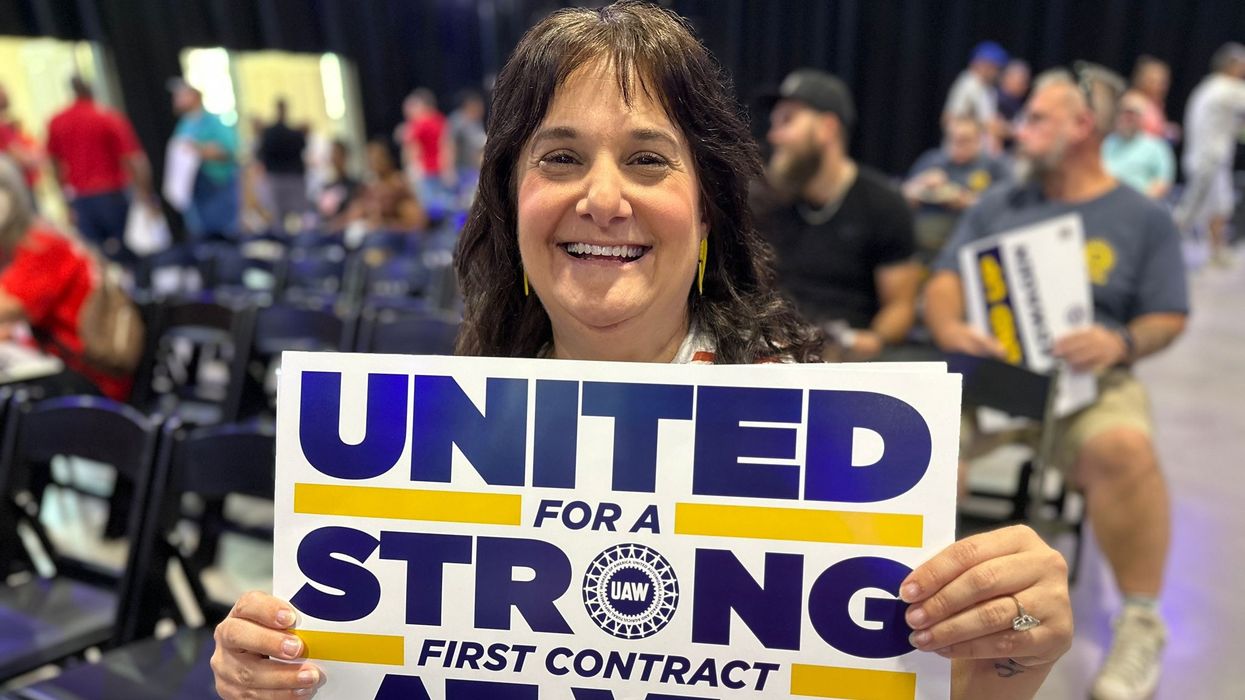
"You're the backbone of this plant, you're the backbone of this company, and you deserve your fair share of the wealth that you create," UAW President Shawn Fain told workers.
Following their historic vote to join the United Auto Workers in April, workers at a Volkswagen plant in Chattanooga, Tennessee held a rally on Sunday as they prepare to head into their first round of negotiations with the company next week.
With their vote, the Chattanooga workers became the first Southern automakers not affiliated with one of the Big Three auto companies to win a union.
"Just a few months ago, you voted 3-1 to join the UAW," the union's president Shawn Fain told the assembled workers, adding, "You had faith, and you moved mountains, you overcame opposition, and you won your union."
"With the kinds of profits you're generating, Volkswagen could double your wages, not raise prices, and still make billions of dollars. It's a choice."
At a rally that began at 1:30 pm Eastern Time on Sunday, Fain told gathered workers that they were now ready for the "next step."
"We tell Volkswagen, get out your pens, because it's time to put it down in writing," Fain said.
Heading into negotiations, the UAW is set to make several demands of Volkswagen, among them improved health and safety; competitive wages including cost of living allowances, profit sharing, and no tiers; improved paid-time-off policies; more retirement security; affordable healthcare; and union protections such as due process, union representation, paid time for union work, job training, and fair promotion policies.
Fain warned the workers that the company and the corporate media would try to fearmonger about the union's demands.
"They're going to say that our righteous fight for a high quality of life for the working class will wreck the economy or derail the transition to EV," Fain said, adding, "The only economy that's going to get wrecked in this is their economy that only works for the rich and the corporate class."
Fain shared figures showing that Volkswagen had increased its profits since 2021 by 49% compared with the previous three years, securing $24 billion in profits in 2023 alone. But instead of sharing that windfall equitably with the workforce and the local economy, it paid CEO Oliver Blume $10.5 million and wealthy shareholders $12.7 billion. Shareholders have seen their dividends jump by 288% in two years.
"That's billions of dollars that have been robbed from the workers who generated those profits," Fain said. "It's billions of dollars that weren't spent on the EV transition. It's billions of dollars being spent on mansions in faraway countries and yachts in private marinas, and not being spent in the local businesses right here in Tennessee."
At the same time, workers at the Chattanooga plant had produced more than 1.5 million vehicles for over $50 billion in sales since 2011.
"You're the backbone of this plant, you're the backbone of this company, and you deserve your fair share of the wealth that you create," Fain said, adding, "With the kinds of profits you're generating, Volkswagen could double your wages, not raise prices, and still make billions of dollars. It's a choice."
Ultimately, Fain said the figures he cited had one cause: "corporate greed."
Fain noted that the Chattanooga workers were entering negotiations for their first union contract roughly one year after UAW workers at the Big Three car makers launched their historic "stand up strike, ultimately winning record-breaking contracts from General Motors, Ford, and Stellantis.
"Since that moment, workers everywhere including here at Volkswagen are standing up to fight corporate greed and demand your fair share in the economy," Fain said.
He told the Chattanooga workers, "Now is your time to win a record contract and make history again."
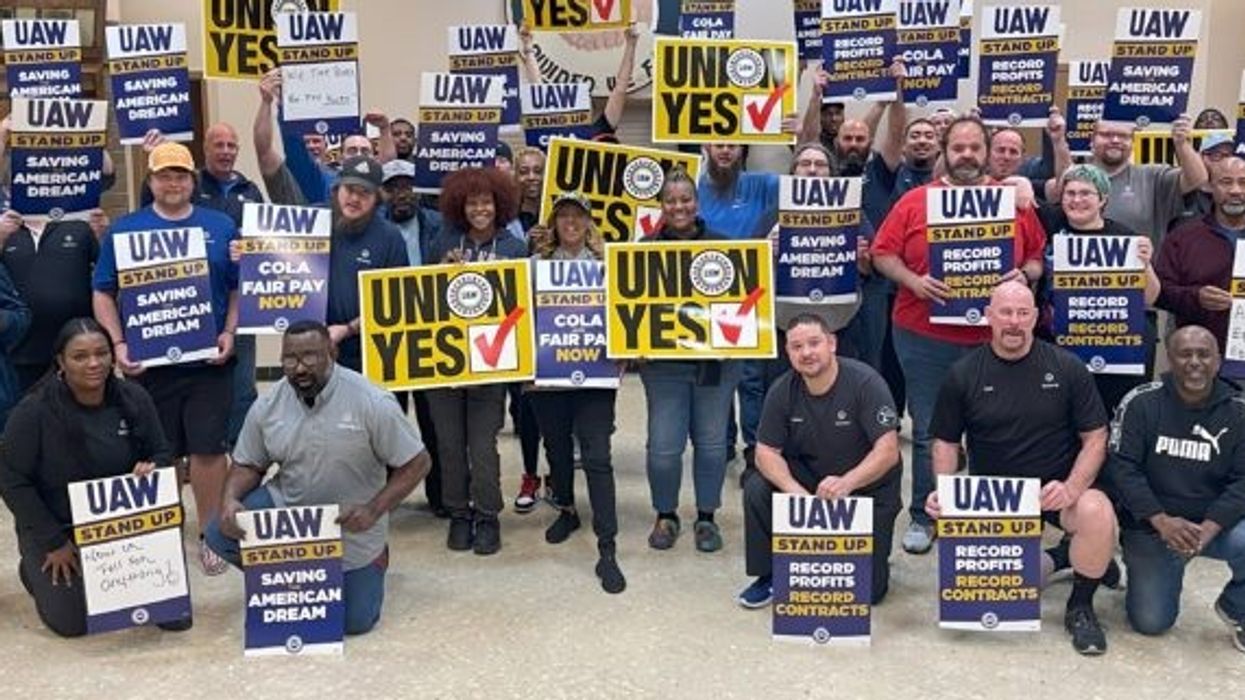
If roughly 5,000 Alabama Mercedes workers vote to unionize in the coming weeks, the ripple effects could empower workers nationwide.
The United Auto Workers recently scored the largest union victory in decades in the South. Their success at a Tennessee Volkswagen plant could be a turning point for labor in a region long known for governmental hostility to unions.
The next test will be a UAW election scheduled for the week of May 13 at a Mercedes-Benz factory in Alabama, a state that has attracted so much auto investment it has earned the nickname “the Detroit of the South.”
If the roughly 5,000 Mercedes workers vote to unionize, the ripple effects could empower workers nationwide.
We need a New South economic structure based on fairness and equity.
For decades, Southern states have pursued “low-road” development strategies, luring investors with massive public subsidies and repressive labor policies. This has pitted workers across the country against each other, undercutting everyone’s ability to secure fair compensation.
Alabama has spent $1.6 billion to woo Mercedes, along with Toyota, Hyundai, and Honda. All these foreign companies’ operations in the South are non-union, in contrast to the unionized Big Three of Ford, GM, and Stellantis.
This foreign investment has created thousands of Alabama jobs—but with weak worker protections, the state remains one of the nation’s poorest. And while these companies have enjoyed rising corporate profits, they have left workers behind.
An in-depth report by the nonprofit group Alabama Arise found that inflation-adjusted average pay for the state’s autoworkers has dropped by 11% over the past 20 years to $64,682. Meanwhile, CEO pay stands at $13.9 million at Mercedes and $6.9 million at Toyota.
The foreign-owned firms’ payrolls also reflect Alabama’s long history of racial discrimination, with Black and Latino workers earning substantially less than their white counterparts. By contrast, the Economic Policy Institute has found that union workers make 10.1% more on average than non-union workers.
The benefits are even greater for workers of color. Unionized Black workers make 13.1% more than non-union Black workers in comparable jobs—and Latino union members make 18.8% more than non-union Latino workers.
Equitable pay practices boost local economies by putting more money in workers’ pockets for groceries, housing, and other goods and services from local businesses. And that’s good for families of every color.
But Alabama Governor Kay Ivey doesn’t see things that way. Before the UAW vote in Tennessee, she joined GOP governors from Georgia, Mississippi, South Carolina, Tennessee, and Texas to discourage VW workers from voting yes with unfounded threats of mass layoffs.
When 73% of those autoworkers voted for the UAW, it was a strong rebuke of the region’s low-road, anti-worker model. So corporate lobbyists in the region have enlisted state legislators and cabinet officials in a sustained campaign to blunt organizing momentum.
How will the election turn out in Alabama?
A new poll indicates that 52% of residents in this deep-red state support the autoworkers’ union drive, while just 21% are opposed. This echoes a 2022 poll commissioned by the Institute for Policy Studies in Jefferson County, Alabama, where workers were attempting to unionize an Amazon warehouse in Bessemer. That survey showed nearly two-thirds support.
While the Alabama Amazon campaign fell short in the face of aggressive anti-union tactics, increased public approval of unions is a testament to many years of community and labor organizing.
The fact that a large majority of workers at the Mercedes-Benz plant signed petitions earlier this year in support of the election is encouraging. We need a New South economic structure based on fairness and equity. Organized labor is an essential partner in that mission.

"We're poised to be the first domino of many to fall," one worker at the Chattanooga plant said.
Workers at a Volkswagen plant in Chattanooga, Tennessee, became the first Southern autoworkers not employed by one of the Big Three car manufacturers to win a union Friday night when they voted to join the United Auto Workers by a "landslide" majority.
This is the first major victory for the UAW after it launched the biggest organizing drive in modern U.S. history on the heels of its "stand up strike" that secured historic contracts with the Big Three in fall 2023.
"Many of the talking heads and the pundits have said to me repeatedly before we announced this campaign, 'You can't win in the South,'" UAW president Shawn Fain told the victorious workers in a video shared by UAW. "They said Southern workers aren't ready for it. They said non-union autoworkers didn't have it in them. But you all said, 'Watch this!' And you all moved a mountain."
"This incredible victory for labor will transform Tennessee and the South!"
According to the UAW's real-time results, the vote tally now stands at 2,628—or 73%—yes to 985—or 27%—no. Voting at the around 4,300-worker plant began Wednesday.
The Chattanooga workers announced their current union drive in December 2023. Friday's victory follows two failed unionization attempts at the plant in 2014 and 2019.
"We saw the big contract that UAW workers won at the Big Three and that got everybody talking," Zachary Costello, a trainer in VW's proficiency room, said in a statement. "You see the pay, the benefits, the rights UAW members have on the job, and you see how that would change your life. That's why we voted overwhelmingly for the union. Once people see the difference a union makes, there's no way to stop them."
The union's win comes despite the opposition of Republican Tennessee Gov. Bill Lee.
"Today, I joined fellow governors in opposing the UAW's unionization campaign," Lee said on social media Tuesday. "We want to keep good-paying jobs and continue to grow the American auto manufacturing sector. A successful unionization drive will stop this growth in its tracks, to the detriment of American workers."
However, Tennessee State Rep. Justin Jones (D-52) celebrated the win.
"Watching history tonight in Chattanooga, as Volkswagen workers voted in a landslide to join the UAW," he wrote on social media Friday night. "Despite pressure from Gov. Lee, this is the first auto plant in the South to unionize since the 1940s. This incredible victory for labor will transform Tennessee and the South!"
Other national labor leaders and progressive politicians also congratulated the Chattanooga workers.
Lee Saunders, president of the American Federation of State, County, and Municipal Employees, said the win "shows what we already know—workers in every part of this country want the freedom to join a union, and when we stand together, we have tremendous power. Even though the deck is stacked against us, momentum is on our side, and we're winning."
Sen. Bernie Sanders (I-Vt.) said: "This is a huge victory not only for UAW workers at Volkswagen, but for every worker in America. The tide is turning. Workers all across the country, even in our most conservative states, are sick and tired of corporate greed and are demanding economic justice."
"I think it's a great push for the entire South, and people will follow suit."
Rep. Alexandria Ocasio-Cortez (D-N.Y.) called the results "an utterly historic victory for the working class."
"Tennessee is shining bright tonight," she wrote on social media Friday. "We are in a new era. Congratulations to the courageous workers in Chattanooga and the entire UAW. Absolutely heroic. Solidarity IS the strategy—across the South, and all over the country."
More Perfect Union said the victory would "change the auto industry, and the future of American labor," and the campaign organizers themselves are aware of the importance of what they've accomplished.
"We understand that the world's watching us," worker Isaac Meadows, who has been at the plant for one year, told More Perfect Union. "You know there's a labor movement in this country, you know, we're poised to be the first domino of many to fall."
Worker Kelcey Smith, who has also been at the plant for one year, added, "I think it's a great push for the entire South, and people will follow suit."
The next domino to fall could be the Mercedes-Benz plant in Vance, Alabama, where a UAW election is scheduled from May 13-17. All told, more than 10,000 non-union car makers have signed union cards since the UAW launched its historic organizing drive.
For the Chattanooga workers, meanwhile, their next big fight will be to secure their first union-negotiated contract.
"The real fight begins now," Fain told cheering workers. "The real fight is getting your fair share. The real fight is the fight to get more time with your families. The real fight is the fight for our union contract."
"And I can guarantee you one thing," Fain continued, "this international unionist leadership, this membership all over this nation has your back in this fight."

"Looking back, you could see this being the first domino in something that changes the entire South," said one labor journalist.
Volkswagen workers in Chattanooga, Tennessee began voting Wednesday on whether to join the United Auto Workers, a closely watched election seen as a critical test for the emboldened union's ability to organize in the U.S. South.
The election kicked off a month after workers at the Chattanooga plant filed a petition with the National Labor Relations Board (NLRB) formally requesting an election to join the UAW, which secured record-breaking contracts at the Big Three U.S. automakers last year after a historic six-week strike.
Following the hard-fought contract victories, the UAW launched what's been described as the largest union organizing drive in modern U.S. history, targeting nonunion car manufacturers such as Tesla, Toyota, and Volkswagen.
The Chattanooga election marks the third time in a decade that the UAW has tried to organize the Volkswagen plant, which currently has around 4,300 workers. Voting concludes on Friday.
"This election is a big, big deal—probably the most important union election that this country has seen in years," labor journalist Hamilton Nolan said in a Democracy Now! appearance on Wednesday. "Looking back, you could see this being the first domino in something that changes the entire South."
About 4,000 Volkswagen workers in Tennessee are voting on whether to unionize with the United Auto Workers. Labor journalist @hamiltonnolan says it's the most important union vote in years and could be the "first domino" in a wider push to organize the auto industry in the South. pic.twitter.com/RWFnO5KznI
— Democracy Now! (@democracynow) April 17, 2024
Chattanooga workers voiced confidence that this election will be different than 2014 and 2019, when Volkswagen employees voted against joining the UAW by narrow margins.
"We're going to win," Lisa Elliott, a quality control worker at Volkswagen, told The Guardian's Steven Greenhouse. "We have the momentum. I know this will be a historic event."
In addition to the Chattanooga effort, the UAW is trying to organize Mercedes-Benz workers in Vance, Alabama. Earlier this month, a supermajority of Mercedes workers in Vance submitted a petition to the NLRB requesting an election to join the UAW.
UAW's organizing efforts have drawn national attention—and ire from anti-union politicians, including the Republican governors of Tennessee, Alabama, Mississippi, and other states in the U.S. South.
Joseph McCartin, a labor historian at Georgetown University, told Greenhouse that "a victory at Volkswagen would make a victory at Mercedes much more likely."
"Victories at both Volkswagen and Mercedes would be nothing less than an earthquake," McCartin added. "This would be the biggest breakthrough in private-sector organizing in decades. It would mean that the anti-union citadel [in the South] that has repulsed effort after organizing effort has been breached."
University of California, Berkeley professor Harley Shaiken echoed that assessment in an interview with The New York Times.
"It would be a revolution for the UAW and for the auto industry," Shaiken said of a UAW win. "It would break the glass ceiling for unions in the South, and would mean more purchasing power for working-class people in that region."

“Momentum this time is way better than the first two times we’ve tried to unionize," said one worker in Tennessee pushing for the UAW campaign.
On a cold, drizzly Valentine’s Day in 2014, I spent the night at a UAW party at the old wood-paneled IBEW hall next to Chattanooga’s brand-new Volkswagen plant as workers eagerly awaited union election results.
One Volkswagen worker passed around a moonshine bottle as nearly 200 people crammed the union hall. The energy was lit as people seemed optimistic that the union would win.
“I am excited,” Volkswagen worker Justin King told me as he was putting on his cowboy boots to get ready for the party.
Earlier in the evening, at his house in Orchard Knob, labor, and community organizer Michael Gilliland was nervous. Something seemed off; Chattanooga had been blanketed with unprecedented anti-union TV ads, and support for the union had dissipated quickly in the final days.
The party at the IBEW hall quickly died when the vote was announced as 626 for the union and 712 against.
Instead of drinking that moonshine and celebrating a historic union victory in the South that Valentine’s Day, I sat in a freezing car in Volkswagen’s parking lot with veteran New York Times labor reporter Steven Greenhouse, trying to make sense of what went wrong.
In 2019, I again traveled to Chattanooga, hoping the UAW could win there. They had been fighting for five years as a minority union and organizing shop-floor actions, winning some changes for workers. I hoped that maybe this time, I would get to attend a raucous victory party of UAW workers.
However, Michael Gilliland was pessimistic. The corruption scandal around the UAW was growing, and the anti-union forces in town once again blanketed the city with hundreds of thousands of dollars in anti-union ads.
Sadly, once again, he was right, as the union lost by a margin of 776-833.
Now, for the first time in decades, I have seen Gilliland, who heads the community labor organization CALEB (Chattanooga in Action for Love, Equality, and Benevolence), optimistic about the chances of the UAW winning at Volkswagen.
After the pandemic and the ensuing strike wave, which saw more than 3,000 strikes since 2020, and the success of the Stand Up Strike, Gilliland feels that the atmosphere has completely changed in the community.
“I think that there’s an energy that most likely comes from the momentum that was created last year, with the Big Three win being so recently victorious, and to be able to show those comparisons of bargaining with the Big Three,” says Gilliand. “lt creates a lot of opportunity to think about what those changes might look like in concrete terms for workers on the line.”
In 2014, when the UAW first tried for an election, anti-union forces put recent concessions by the UAW as evidence that Volkswagen had little to unionize for.
As part of the auto bailout in 2009, new hires under UAW contracts at GM made $16.50 an hour. During the 2014 UAW election, new non-union assembly line workers at Volkswagen started at $14.50 an hour, which, with cost-of-living differences between Tennessee and the Midwest factored in, is arguably slightly higher.
“What the UAW is offering, we can already do without them,” anti-union Volkswagen worker Mike Burton, who created the website for the “No 2 UAW” campaign, told me in 2014.
The union ultimately lost that vote in 2014 by a narrow margin of only 626 for the union to 712 against. As I wrote for the New York Times at the time, “Many Chattanooga workers had trouble seeing the upside of joining the U.A.W.”
(Read my full 4,000-word long form on that defeat, “The Battle for Chattanooga: Southern Masculinity & The Anti-Union Campaign at Volkswagen.”)
Federal Government Intervention & Rank-and-File Revolt Depose UAW Leadership
In 2019, when the UAW tried for a union election again, the UAW felt much more optimistic. However, at the time, the UAW was accused in the press of corruption charges as several senior UAW officials had already pled guilty to accepting bribes from their employers.
Hammered with captive audience anti-union meetings and hundreds of thousands of dollars in TV ads highlighting the union’s corruption, the union once again lost by a margin of 776 for the union to 833 against.
“There was actually a corruption scandal with UAW, “says 34-year-old Volkswagen worker Zach Costello. “All you would hear about is corruption, corruption, corruption.”
A few months after the election, several of its top leaders, including UAW President Gary Jones, were arrested for accepting bribes from employers, validating the distrust many Volkswagen workers had of the UAW.
The federal government would eventually intervene and force the UAW to accept a consent decree that opened space for union reformers.
As part of the consent decree, the UAW was forced to hold a referendum on whether rank-and-file members should be allowed to vote directly for the UAW’s president or elect a president through a complex and opaque system of delegates, which the UAW had used for 80 years.
UAW members voted overwhelmingly to have their president directly elected by referendum. In 2023, reformer Shawn Fain was elected president, defeating incumbent Ray Curry, the first time an incumbent president had been defeated in the history of the UAW.
Fain immediately moved to take the union on a more militant footing. In September of 2023, Fain led his union in a series of escalating strikes against factories owned by all of the Big Three, the first time in the history of the UAW that the union had struck at all three automakers simultaneously.
The union won impressive wage gains of at least 25% at all three big employers. The union then decided to use that momentum to launch an ambitious $40 million organizing effort at non-union auto manufacturers in the U.S. South.
Non-union employers responded frantically, with Volkswagen offering workers an 11% wage increase this year in the hopes of fighting off a union drive there. It wasn’t enough to dissuade workers.
A National Campaign Instead of Isolated Battles
The UAW launched a nationwide organizing effort. In addition to filing for a union election at Volkswagen, the UAW has announced that a majority of workers at Mercedes in Alabama have signed up to join the union. Public union campaigns have also been launched at Hyundai in Montgomery, Alabama, and Toyota in Troy, Missouri.
If workers win in Chattanooga, it will likely give momentum to those other union campaigns, creating unprecedented momentum for union organizing in the anti-union South.
Unlike previous union campaigns, where Volkswagen union organizers felt isolated, now they feel like they are part of a nationwide campaign.
“It’s happening all along the country, and especially here in the South that the fact that that investment, time organizing energy is being immediately translated towards major organizing efforts all across the South, I think gives an opportunity for organizing committees to build off of each other,” says Michael Gilliland.
Volkswagen’s union effort is happening after the pandemic. According to Gallup, in 2014, only 53% of Americans said they had positive views of unions.
During the pandemic, the popularity of unions skyrocketed, as workers went on more than 3,000 strikes since the beginning of the pandemic, according to Payday Report’s Strike Tracker.
Following the pandemic, union popularity is at a near-record high, with 67% of Americans approving of unions, according to Gallup.
“You have strike after strike happening around the country. You had the writers, the actors, and then UAW followed up,” says Volkswagen worker Zach Costello speaking of the “Summer of Strikes” last year. “And then you had the big contract they got. That, like, sparked an insane amount of discussion around unions all around the plant.”
Volkswagen workers, who went through three different union attempts at the plant, say they see a very different mentality this time, particularly among young people, who were less enthusiastic about unions in previous elections.
“There are a lot of young workers in the plant now and this generation wants respect,” says veteran Volkswagen worker Steve Cochran. “They’re not okay with mistreatment by management. They see what’s happening at Starbucks and Amazon”.
Workers of color at the plant also say that they feel more empowered than in previous union campaigns at the plant.
“Momentum this time is way better than the first two times we’ve tried to unionize,” Volkswagen worker Yolanda Peoples told NPR. “Among African American women, there has been a boost as far as getting it organized this time. I see a big change.”
Peoples credited the UAW putting forward African-American women as spokespeople during the “Stand Up Strike” in playing a role in this.
“I believe that watching the Big Three is one of the things that changed their minds,” Peoples told NPR. “And actually seeing more African American women standing up with the UAW too has been a changing factor.”
Biden’s EPA Rules Help Union Drive
In past anti-union campaigns, union busters warned that the plant could close if people voted for the union. However, Volkswagen’s Chattanooga plant expanded in July of 2022, adding a brand new assembly line for the production of the Volkswagen ID.4.
“We are growing, and a lot more people can smell the BS now when they say that,” says Volkswagen worker Zach Costello.
Indeed, Dave Dayen at The American Prospect has argued that Biden’s new EPA emission rules force employers to produce more electric cars, making it extremely unlikely that Volkswagen would close the plant.
“There’s no way they can shut that factory down,” Corey Cantor, Senior Associate for electric vehicles at BloombergNEF, told Dayen.
The tide has changed for the UAW at Volkswagen at Chattanooga, and Michael Gilliland, for the first time in a decade, seems optimistic.
“I think there are plenty of people that see what’s happening, as you know, carrying our hopes for the city in their hands that every worker at Volkswagen can create a new standard of living wages,” says Gilliland. “So, I think we really recognize how important it is not just as a regional fight, not just as a national fight, or a fight for a union. But like what this might mean for workers and working-class people in the local economy”.
Hopefully, this year I’ll get to cover a victory party at the old union hall in Chattanooga after a decade of waiting and hoping for a union breakthrough in the South.

"A reckoning is coming," said a strategist for UAW president Shawn Fain. "Workers are standing up—and they are going to win."
Volkswagen workers in Chattanooga, Tennessee filed a petition Monday with National Labor Relations Board formally requesting an election to join the United Auto Workers, which is campaigning aggressively to organize nonunion plants in the U.S. South and across the country.
The UAW tried and narrowly failed to organize Volkswagen's Chattanooga plant in 2014 and 2019, but the union's historic strike and contract victories at the Big Three automakers last year emboldened its unionization efforts.
"We want to be heard," Crystal Jenkins, a logistics worker at the Chattanooga plant, says in a video released by the UAW on Monday. "The reason I'm voting yes for the union is to have a voice."
Volkswagen is one of more than a dozen nonunion automakers that the UAW is targeting as part of what's been described as "the largest organizing drive in modern American history."
"A reckoning is coming," Chris Brooks, a strategist for UAW president Shawn Fain, wrote on social media. "Workers are standing up—and they are going to win.
The UAW said Monday that "a supermajority" of the more than 1,000 workers at the Chattanooga plant—Volkswagen's only assembly facility in the U.S.—signed union cards in just 100 days, a sign of broad support for the organizing effort.
"I come from a UAW family, so I've seen how having our union enables us to make life better on the job and off," said Yolanda Peoples, a production team member in assembly. "We are a positive force in the plant. When we win our union, we'll be able to bargain for a safer workplace, so people can stay on the job and the company can benefit from our experience. When my father retired as a UAW member, he had something to fall back on. VW workers deserve the same."

"People are standing up like never before," said one organizer. "They know that standing up to join the union is how you win fair treatment, fair pay, and a better life."
Workers at Volkswagen's only U.S. plant in Chattanooga, Tennessee announced Thursday that they're launching a public organizing committee with the goal of joining the United Auto Workers, which is aiming to expand its membership to include employees at more than a dozen nonunion car companies after winning historic contracts at the Big Three.
In less than a week, more than 1,000 workers at the Volkswagen plant signed union authorization cards, giving the nascent union drive more than 30% support so far at the Chattanooga location.
The UAWnarrowly failed to organize the plant in 2014 and 2019. But leaders of the new unionization push expressed confidence that the outcome would be different this time around as the newly emboldened UAW puts special emphasis on the South, where the unionization rate is significantly lower than in the rest of the country.
"People are standing up like never before," said Steve Cochran, a lead organizer of the Chattanooga union drive. "There are a lot of young workers in the plant now and this generation wants respect. They're not okay with mistreatment by management. They see what's happening at Starbucks and Amazon. They know that standing up to join the union is how you win fair treatment, fair pay, and a better life."
Organizers pointed to the $184 billion in profits that Volkswagen Group has brought in over the past decade while workers' wages have stagnated or declined.
"In the last three years, we've seen VW make nearly a trillion dollars in revenue and $78 billion in profit, but we haven't seen our fair share in Chattanooga," reads the union campaign's website. "Now we're ready to fight for a better job, a better life, and a better future."
Josh Epperson, a member of the organizing committee who has worked at the Chattanooga plant for more than a decade, said the facility has high turnover because newer employees aren't given "the tools and support they need to thrive."
"With the union, we can improve working conditions," said Epperson. "If there's an issue in our work area, we'll have a way to address it. We'll find common ground so we can make it a good job and people will want to stay."
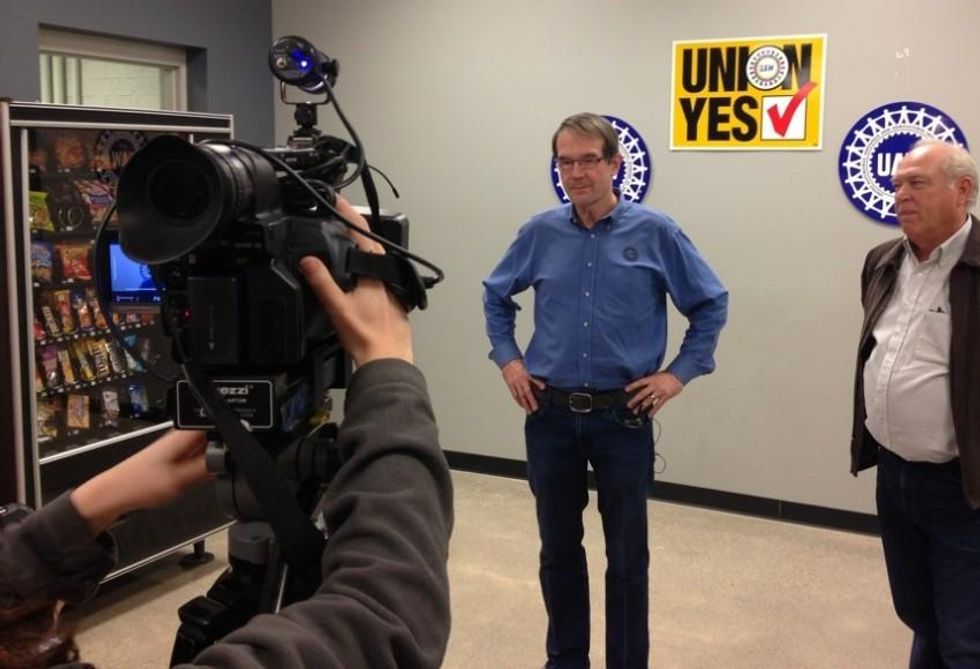
The key to organizing workers in areas like the South, where unions hold little sway, is building trust. From conversations at Volkswagen's Chattanooga plant, I learned that the U.A.W. lost because workers were suspicious of it. Meddling by antiunion politicians was a factor in U.A.W.'s defeat, but that's not the whole story. Many workers who voted against the U.A.W. said they weren't opposed to unions, but they just didn't trust the U.A.W.
Many Chattanooga workers thought the U.A.W. deal ensuring VW's neutrality in the election limited their ability to have a meaningful voice in future contracts. While it's easy to understand why the U.A.W. sought the agreement, given the viciousness with which companies often fight organizing drives, antiunion workers successfully portrayed such a pact as a "backroom deal."
"If unions are to succeed in the South, they need to build trust among workers, not make them feel that deals are being cut behind their backs."
Several unions have agreed to "sweetheart deals" with employers to win neutrality, and in exchange, "pre-agree" to employer sought contract concessions that cap wages before even organizing a single member. A 2008 Wall Street Journal report uncovered how Unite Here and the Service Employees International Union clandestinely negotiated contracts with Sodexo and Aramark without any traditional labor organizing. Under this arrangement, members were unaware that labor contracts were negotiated prior to joining the union. In Chattanooga, antiunion workers successfully persuaded Volkswagen workers, who had previously signed union cards indicating support for the U.A.W., that such a deal undercutting them was already in the works.
Anti-U.A.W. workers distributed flyers attacking U.A.W.'s pact in which it had agreed to "maintain or enhance the cost advantage and other competitive advantages" Volkswagen already enjoys. They claimed the union had already negotiated a contract that would put them in line with U.A.W. new hire rates at the Big Three -- Chrysler, Ford and General Motors -- resulting in wage cuts. There was some truth to this claim. U.A.W.-negotiated Big Three contracts pay new hires significantly less than senior workers with starting salaries less than $16 an hour, slightly more than Chattanooga's starting rate.
Many Chattanooga workers had trouble seeing the upside of joining the U.A.W. Local politicians and outside interest groups, while providing no supporting evidence, claimed that VW would discontinue investing there if U.A.W. won. Scared by such job security threats and unimpressed by U.A.W.'s failure to concretely establish the "upside" of its union, the majority chose the status quo.
By their nature, unions are big, often bureaucratic institutions with sometimes billions of dollars in assets. A lot of workers unfamiliar with unions or already ideologically opposed look at them and say, "I don't know these people. How do I know they won't sell me out?" If unions are going to organize the South, they have to build democratic organizations in which workers make decisions about their workplace - not by signing onto to "sweetheart deals."