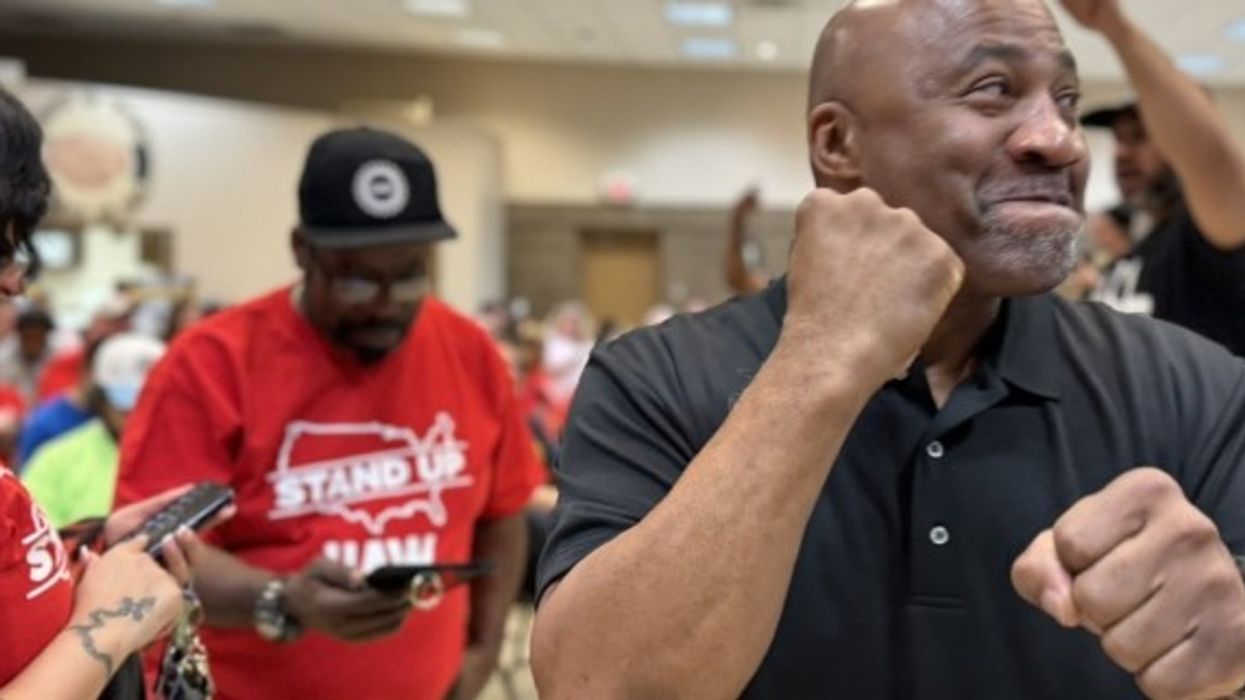
“I am excited,” Volkswagen worker Justin King told me as he was putting on his cowboy boots to get ready for the party.
Earlier in the evening, at his house in Orchard Knob, labor, and community organizer Michael Gilliland was nervous. Something seemed off; Chattanooga had been blanketed with unprecedented anti-union TV ads, and support for the union had dissipated quickly in the final days.
The party at the IBEW hall quickly died when the vote was announced as 626 for the union and 712 against.
Instead of drinking that moonshine and celebrating a historic union victory in the South that Valentine’s Day, I sat in a freezing car in Volkswagen’s parking lot with veteran New York Times labor reporter Steven Greenhouse, trying to make sense of what went wrong.
In 2019, I again traveled to Chattanooga, hoping the UAW could win there. They had been fighting for five years as a minority union and organizing shop-floor actions, winning some changes for workers. I hoped that maybe this time, I would get to attend a raucous victory party of UAW workers.
However, Michael Gilliland was pessimistic. The corruption scandal around the UAW was growing, and the anti-union forces in town once again blanketed the city with hundreds of thousands of dollars in anti-union ads.
Sadly, once again, he was right, as the union lost by a margin of 776-833.
Now, for the first time in decades, I have seen Gilliland, who heads the community labor organization CALEB (Chattanooga in Action for Love, Equality, and Benevolence), optimistic about the chances of the UAW winning at Volkswagen.
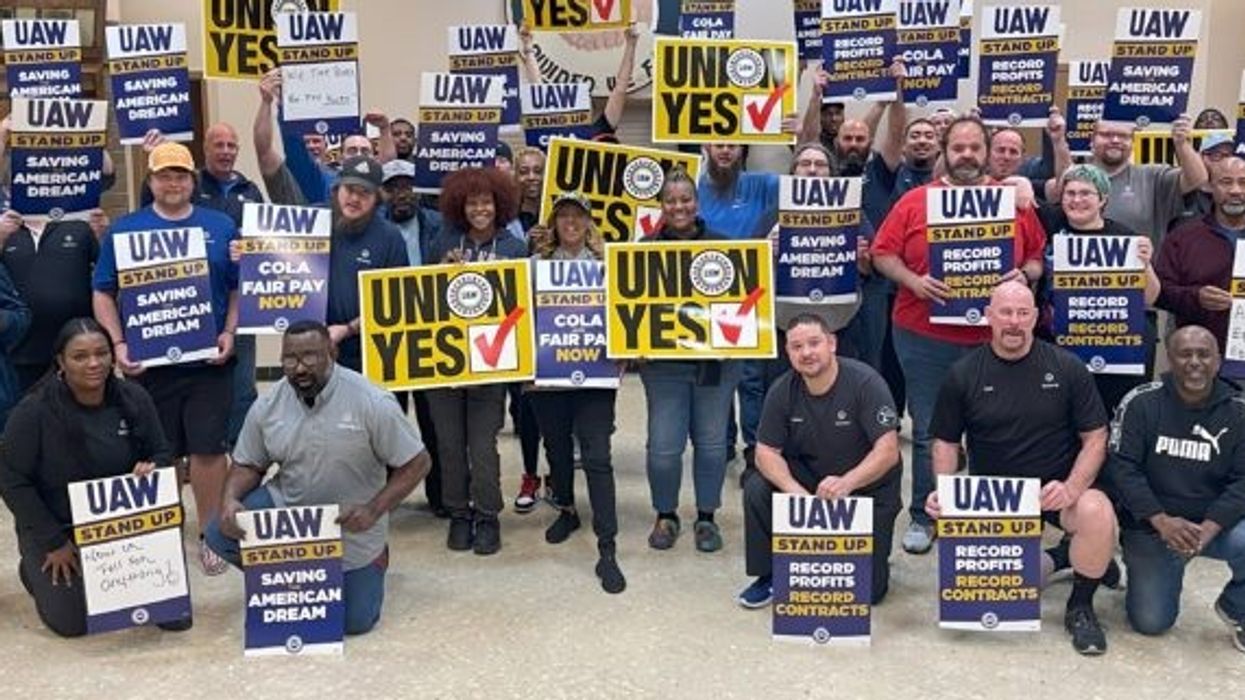
After the pandemic and the ensuing strike wave, which saw more than 3,000 strikes since 2020, and the success of the Stand Up Strike, Gilliland feels that the atmosphere has completely changed in the community.
“I think that there’s an energy that most likely comes from the momentum that was created last year, with the Big Three win being so recently victorious, and to be able to show those comparisons of bargaining with the Big Three,” says Gilliand. “lt creates a lot of opportunity to think about what those changes might look like in concrete terms for workers on the line.”
In 2014, when the UAW first tried for an election, anti-union forces put recent concessions by the UAW as evidence that Volkswagen had little to unionize for.
As part of the auto bailout in 2009, new hires under UAW contracts at GM made $16.50 an hour. During the 2014 UAW election, new non-union assembly line workers at Volkswagen started at $14.50 an hour, which, with cost-of-living differences between Tennessee and the Midwest factored in, is arguably slightly higher.
“What the UAW is offering, we can already do without them,” anti-union Volkswagen worker Mike Burton, who created the website for the “No 2 UAW” campaign, told me in 2014.
The union ultimately lost that vote in 2014 by a narrow margin of only 626 for the union to 712 against. As I wrote for the New York Times at the time, “Many Chattanooga workers had trouble seeing the upside of joining the U.A.W.”
(Read my full 4,000-word long form on that defeat, “The Battle for Chattanooga: Southern Masculinity & The Anti-Union Campaign at Volkswagen.”)
Federal Government Intervention & Rank-and-File Revolt Depose UAW Leadership
In 2019, when the UAW tried for a union election again, the UAW felt much more optimistic. However, at the time, the UAW was accused in the press of corruption charges as several senior UAW officials had already pled guilty to accepting bribes from their employers.
Hammered with captive audience anti-union meetings and hundreds of thousands of dollars in TV ads highlighting the union’s corruption, the union once again lost by a margin of 776 for the union to 833 against.
“There was actually a corruption scandal with UAW, “says 34-year-old Volkswagen worker Zach Costello. “All you would hear about is corruption, corruption, corruption.”
A few months after the election, several of its top leaders, including UAW President Gary Jones, were arrested for accepting bribes from employers, validating the distrust many Volkswagen workers had of the UAW.
The federal government would eventually intervene and force the UAW to accept a consent decree that opened space for union reformers.
As part of the consent decree, the UAW was forced to hold a referendum on whether rank-and-file members should be allowed to vote directly for the UAW’s president or elect a president through a complex and opaque system of delegates, which the UAW had used for 80 years.
UAW members voted overwhelmingly to have their president directly elected by referendum. In 2023, reformer Shawn Fain was elected president, defeating incumbent Ray Curry, the first time an incumbent president had been defeated in the history of the UAW.
Fain immediately moved to take the union on a more militant footing. In September of 2023, Fain led his union in a series of escalating strikes against factories owned by all of the Big Three, the first time in the history of the UAW that the union had struck at all three automakers simultaneously.
The union won impressive wage gains of at least 25% at all three big employers. The union then decided to use that momentum to launch an ambitious $40 million organizing effort at non-union auto manufacturers in the U.S. South.
Non-union employers responded frantically, with Volkswagen offering workers an 11% wage increase this year in the hopes of fighting off a union drive there. It wasn’t enough to dissuade workers.
A National Campaign Instead of Isolated Battles
The UAW launched a nationwide organizing effort. In addition to filing for a union election at Volkswagen, the UAW has announced that a majority of workers at Mercedes in Alabama have signed up to join the union. Public union campaigns have also been launched at Hyundai in Montgomery, Alabama, and Toyota in Troy, Missouri.
If workers win in Chattanooga, it will likely give momentum to those other union campaigns, creating unprecedented momentum for union organizing in the anti-union South.
Unlike previous union campaigns, where Volkswagen union organizers felt isolated, now they feel like they are part of a nationwide campaign.
“It’s happening all along the country, and especially here in the South that the fact that that investment, time organizing energy is being immediately translated towards major organizing efforts all across the South, I think gives an opportunity for organizing committees to build off of each other,” says Michael Gilliland.
Volkswagen’s union effort is happening after the pandemic. According to Gallup, in 2014, only 53% of Americans said they had positive views of unions.
During the pandemic, the popularity of unions skyrocketed, as workers went on more than 3,000 strikes since the beginning of the pandemic, according to Payday Report’s Strike Tracker.
Following the pandemic, union popularity is at a near-record high, with 67% of Americans approving of unions, according to Gallup.
“You have strike after strike happening around the country. You had the writers, the actors, and then UAW followed up,” says Volkswagen worker Zach Costello speaking of the “Summer of Strikes” last year. “And then you had the big contract they got. That, like, sparked an insane amount of discussion around unions all around the plant.”
Volkswagen workers, who went through three different union attempts at the plant, say they see a very different mentality this time, particularly among young people, who were less enthusiastic about unions in previous elections.
“There are a lot of young workers in the plant now and this generation wants respect,” says veteran Volkswagen worker Steve Cochran. “They’re not okay with mistreatment by management. They see what’s happening at Starbucks and Amazon”.
Workers of color at the plant also say that they feel more empowered than in previous union campaigns at the plant.
“Momentum this time is way better than the first two times we’ve tried to unionize,” Volkswagen worker Yolanda Peoples told NPR. “Among African American women, there has been a boost as far as getting it organized this time. I see a big change.”
Peoples credited the UAW putting forward African-American women as spokespeople during the “Stand Up Strike” in playing a role in this.
“I believe that watching the Big Three is one of the things that changed their minds,” Peoples told NPR. “And actually seeing more African American women standing up with the UAW too has been a changing factor.”
Biden’s EPA Rules Help Union Drive
In past anti-union campaigns, union busters warned that the plant could close if people voted for the union. However, Volkswagen’s Chattanooga plant expanded in July of 2022, adding a brand new assembly line for the production of the Volkswagen ID.4.
“We are growing, and a lot more people can smell the BS now when they say that,” says Volkswagen worker Zach Costello.
Indeed, Dave Dayen at The American Prospect has argued that Biden’s new EPA emission rules force employers to produce more electric cars, making it extremely unlikely that Volkswagen would close the plant.
“There’s no way they can shut that factory down,” Corey Cantor, Senior Associate for electric vehicles at BloombergNEF, told Dayen.
The tide has changed for the UAW at Volkswagen at Chattanooga, and Michael Gilliland, for the first time in a decade, seems optimistic.
“I think there are plenty of people that see what’s happening, as you know, carrying our hopes for the city in their hands that every worker at Volkswagen can create a new standard of living wages,” says Gilliland. “So, I think we really recognize how important it is not just as a regional fight, not just as a national fight, or a fight for a union. But like what this might mean for workers and working-class people in the local economy”.
Hopefully, this year I’ll get to cover a victory party at the old union hall in Chattanooga after a decade of waiting and hoping for a union breakthrough in the South.