SUBSCRIBE TO OUR FREE NEWSLETTER
Daily news & progressive opinion—funded by the people, not the corporations—delivered straight to your inbox.
5
#000000
#FFFFFF
To donate by check, phone, or other method, see our More Ways to Give page.
Daily news & progressive opinion—funded by the people, not the corporations—delivered straight to your inbox.
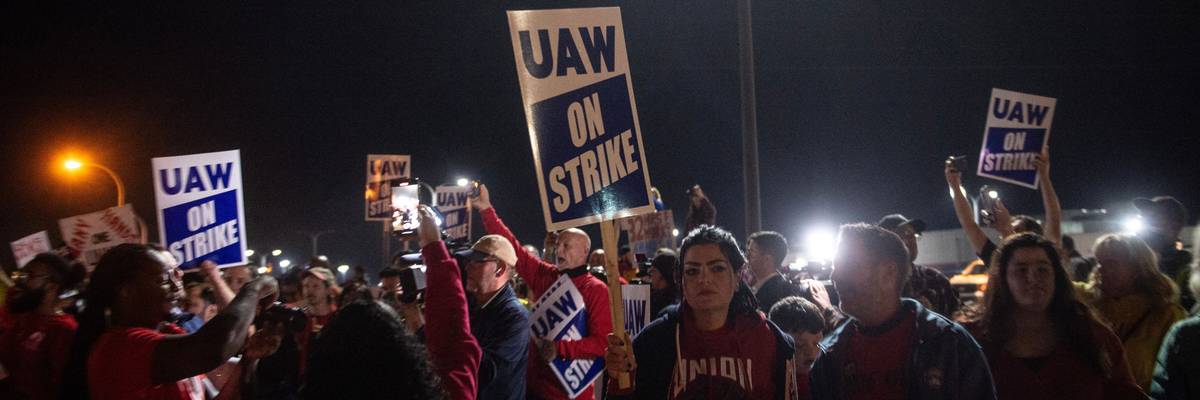
United Auto Workers members picket and hold signs outside of the UAW Local 900 headquarters across the street from the Ford Assembly Plant in Wayne, Michigan on September 15, 2023.
"The money is there, the cause is righteous, the world is watching, and the UAW is ready to stand up," said Shawn Fain, the union's president.
The United Auto Workers union kicked off historic strikes against the Big Three U.S. car manufacturers early Friday morning after the companies failed to meet workers' demands for adequate pay increases and benefit improvements.
The initial wave of strikes hit select Ford, General Motors, and Stellantis facilities, with the union deploying a tactic it has described as a " stand-up strike."
UAW members at General Motors' Wentzville Assembly in Missouri, Ford's Michigan Assembly, and Stellantis' Toledo Assembly in Ohio were the first to walk off the job on Friday, and additional locals will be called on to strike in the coming days as negotiations continue.
Those who remain on the job will be working under an expired collective bargaining agreement, though they still have status quo protections.
The labor actions mark the first time the UAW has ever gone on strike against all three major automakers simultaneously.
"We've been working hard, trying to reach a deal for economic and social justice for our members," UAW president Shawn Fain said in a speech late Thursday, just ahead of the midnight strike deadline. "We have been firm. We are committed to winning an agreement with the Big Three that reflects the incredible sacrifice and contributions UAW members have made to these companies."
"The money is there, the cause is righteous, the world is watching, and the UAW is ready to stand up," Fain added. "This is our defining moment."
The companies' latest publicized offers to the UAW included raises of up to 20% over the course of a four-year contract, but the proposals thus far have fallen well short of the union's demands on wages, cost-of-living adjustments, retiree benefits, and other key issues.
Ford CEO Jim Farley, who brought in nearly $21 million in total compensation last year, told CNN that the UAW's push for a near-40% wage increase would "put us out of business," a claim that Fain dismissed as a "joke."
"The cost of labor for a vehicle is 5% of the vehicle," Fain said from the picket line outside Ford's Michigan Assembly plant. "They could double our wages and not raise the prices of vehicles, and they would still make billions of dollars. It's a lie like everything else that comes out of their mouths."
Between 2013 and 2022, according to an Economic Policy Institute analysis released this week, the Big Three automakers saw roughly $250 billion in total profits—an increase of 92%—and the companies' CEOs received a 40% pay increase. The automakers also rewarded shareholders with $66 billion in dividend payouts and stock buybacks.
U.S. autoworkers' wages, meanwhile, have declined by over 19% since the car industry's 2008 crisis, during which workers gave up cost-of-living adjustments and other benefits to help keep the major automakers afloat.
"As a single parent, I'm working paycheck to paycheck," Adelisa LeBron, a striking Ford worker, told The Washington Post. "I love the way Shawn is fighting for us, how he's not going to settle."
In his address late Thursday, Fain urged locals that are not currently on strike to "keep organizing" to "show the companies you are ready to join the stand-up strike at a moment's notice."
"This strategy will keep the companies guessing," he said. "It will give our national negotiators maximum leverage and flexibility in bargaining. And if we need to go all out, we will. Everything is on the table."
On Friday evening, the UAW is planning to hold what Fain dubbed a "mass rally" outside of a Ford building in downtown Detroit, where U.S. Sen. Bernie Sanders (I-Vt.) is expected to appear.
"We must show the world that our fight is a righteous fight," said Fain.
Dear Common Dreams reader, It’s been nearly 30 years since I co-founded Common Dreams with my late wife, Lina Newhouser. We had the radical notion that journalism should serve the public good, not corporate profits. It was clear to us from the outset what it would take to build such a project. No paid advertisements. No corporate sponsors. No millionaire publisher telling us what to think or do. Many people said we wouldn't last a year, but we proved those doubters wrong. Together with a tremendous team of journalists and dedicated staff, we built an independent media outlet free from the constraints of profits and corporate control. Our mission has always been simple: To inform. To inspire. To ignite change for the common good. Building Common Dreams was not easy. Our survival was never guaranteed. When you take on the most powerful forces—Wall Street greed, fossil fuel industry destruction, Big Tech lobbyists, and uber-rich oligarchs who have spent billions upon billions rigging the economy and democracy in their favor—the only bulwark you have is supporters who believe in your work. But here’s the urgent message from me today. It's never been this bad out there. And it's never been this hard to keep us going. At the very moment Common Dreams is most needed, the threats we face are intensifying. We need your support now more than ever. We don't accept corporate advertising and never will. We don't have a paywall because we don't think people should be blocked from critical news based on their ability to pay. Everything we do is funded by the donations of readers like you. When everyone does the little they can afford, we are strong. But if that support retreats or dries up, so do we. Will you donate now to make sure Common Dreams not only survives but thrives? —Craig Brown, Co-founder |
The United Auto Workers union kicked off historic strikes against the Big Three U.S. car manufacturers early Friday morning after the companies failed to meet workers' demands for adequate pay increases and benefit improvements.
The initial wave of strikes hit select Ford, General Motors, and Stellantis facilities, with the union deploying a tactic it has described as a " stand-up strike."
UAW members at General Motors' Wentzville Assembly in Missouri, Ford's Michigan Assembly, and Stellantis' Toledo Assembly in Ohio were the first to walk off the job on Friday, and additional locals will be called on to strike in the coming days as negotiations continue.
Those who remain on the job will be working under an expired collective bargaining agreement, though they still have status quo protections.
The labor actions mark the first time the UAW has ever gone on strike against all three major automakers simultaneously.
"We've been working hard, trying to reach a deal for economic and social justice for our members," UAW president Shawn Fain said in a speech late Thursday, just ahead of the midnight strike deadline. "We have been firm. We are committed to winning an agreement with the Big Three that reflects the incredible sacrifice and contributions UAW members have made to these companies."
"The money is there, the cause is righteous, the world is watching, and the UAW is ready to stand up," Fain added. "This is our defining moment."
The companies' latest publicized offers to the UAW included raises of up to 20% over the course of a four-year contract, but the proposals thus far have fallen well short of the union's demands on wages, cost-of-living adjustments, retiree benefits, and other key issues.
Ford CEO Jim Farley, who brought in nearly $21 million in total compensation last year, told CNN that the UAW's push for a near-40% wage increase would "put us out of business," a claim that Fain dismissed as a "joke."
"The cost of labor for a vehicle is 5% of the vehicle," Fain said from the picket line outside Ford's Michigan Assembly plant. "They could double our wages and not raise the prices of vehicles, and they would still make billions of dollars. It's a lie like everything else that comes out of their mouths."
Between 2013 and 2022, according to an Economic Policy Institute analysis released this week, the Big Three automakers saw roughly $250 billion in total profits—an increase of 92%—and the companies' CEOs received a 40% pay increase. The automakers also rewarded shareholders with $66 billion in dividend payouts and stock buybacks.
U.S. autoworkers' wages, meanwhile, have declined by over 19% since the car industry's 2008 crisis, during which workers gave up cost-of-living adjustments and other benefits to help keep the major automakers afloat.
"As a single parent, I'm working paycheck to paycheck," Adelisa LeBron, a striking Ford worker, told The Washington Post. "I love the way Shawn is fighting for us, how he's not going to settle."
In his address late Thursday, Fain urged locals that are not currently on strike to "keep organizing" to "show the companies you are ready to join the stand-up strike at a moment's notice."
"This strategy will keep the companies guessing," he said. "It will give our national negotiators maximum leverage and flexibility in bargaining. And if we need to go all out, we will. Everything is on the table."
On Friday evening, the UAW is planning to hold what Fain dubbed a "mass rally" outside of a Ford building in downtown Detroit, where U.S. Sen. Bernie Sanders (I-Vt.) is expected to appear.
"We must show the world that our fight is a righteous fight," said Fain.
The United Auto Workers union kicked off historic strikes against the Big Three U.S. car manufacturers early Friday morning after the companies failed to meet workers' demands for adequate pay increases and benefit improvements.
The initial wave of strikes hit select Ford, General Motors, and Stellantis facilities, with the union deploying a tactic it has described as a " stand-up strike."
UAW members at General Motors' Wentzville Assembly in Missouri, Ford's Michigan Assembly, and Stellantis' Toledo Assembly in Ohio were the first to walk off the job on Friday, and additional locals will be called on to strike in the coming days as negotiations continue.
Those who remain on the job will be working under an expired collective bargaining agreement, though they still have status quo protections.
The labor actions mark the first time the UAW has ever gone on strike against all three major automakers simultaneously.
"We've been working hard, trying to reach a deal for economic and social justice for our members," UAW president Shawn Fain said in a speech late Thursday, just ahead of the midnight strike deadline. "We have been firm. We are committed to winning an agreement with the Big Three that reflects the incredible sacrifice and contributions UAW members have made to these companies."
"The money is there, the cause is righteous, the world is watching, and the UAW is ready to stand up," Fain added. "This is our defining moment."
The companies' latest publicized offers to the UAW included raises of up to 20% over the course of a four-year contract, but the proposals thus far have fallen well short of the union's demands on wages, cost-of-living adjustments, retiree benefits, and other key issues.
Ford CEO Jim Farley, who brought in nearly $21 million in total compensation last year, told CNN that the UAW's push for a near-40% wage increase would "put us out of business," a claim that Fain dismissed as a "joke."
"The cost of labor for a vehicle is 5% of the vehicle," Fain said from the picket line outside Ford's Michigan Assembly plant. "They could double our wages and not raise the prices of vehicles, and they would still make billions of dollars. It's a lie like everything else that comes out of their mouths."
Between 2013 and 2022, according to an Economic Policy Institute analysis released this week, the Big Three automakers saw roughly $250 billion in total profits—an increase of 92%—and the companies' CEOs received a 40% pay increase. The automakers also rewarded shareholders with $66 billion in dividend payouts and stock buybacks.
U.S. autoworkers' wages, meanwhile, have declined by over 19% since the car industry's 2008 crisis, during which workers gave up cost-of-living adjustments and other benefits to help keep the major automakers afloat.
"As a single parent, I'm working paycheck to paycheck," Adelisa LeBron, a striking Ford worker, told The Washington Post. "I love the way Shawn is fighting for us, how he's not going to settle."
In his address late Thursday, Fain urged locals that are not currently on strike to "keep organizing" to "show the companies you are ready to join the stand-up strike at a moment's notice."
"This strategy will keep the companies guessing," he said. "It will give our national negotiators maximum leverage and flexibility in bargaining. And if we need to go all out, we will. Everything is on the table."
On Friday evening, the UAW is planning to hold what Fain dubbed a "mass rally" outside of a Ford building in downtown Detroit, where U.S. Sen. Bernie Sanders (I-Vt.) is expected to appear.
"We must show the world that our fight is a righteous fight," said Fain.