

SUBSCRIBE TO OUR FREE NEWSLETTER
Daily news & progressive opinion—funded by the people, not the corporations—delivered straight to your inbox.
5
#000000
#FFFFFF
To donate by check, phone, or other method, see our More Ways to Give page.
Daily news & progressive opinion—funded by the people, not the corporations—delivered straight to your inbox.
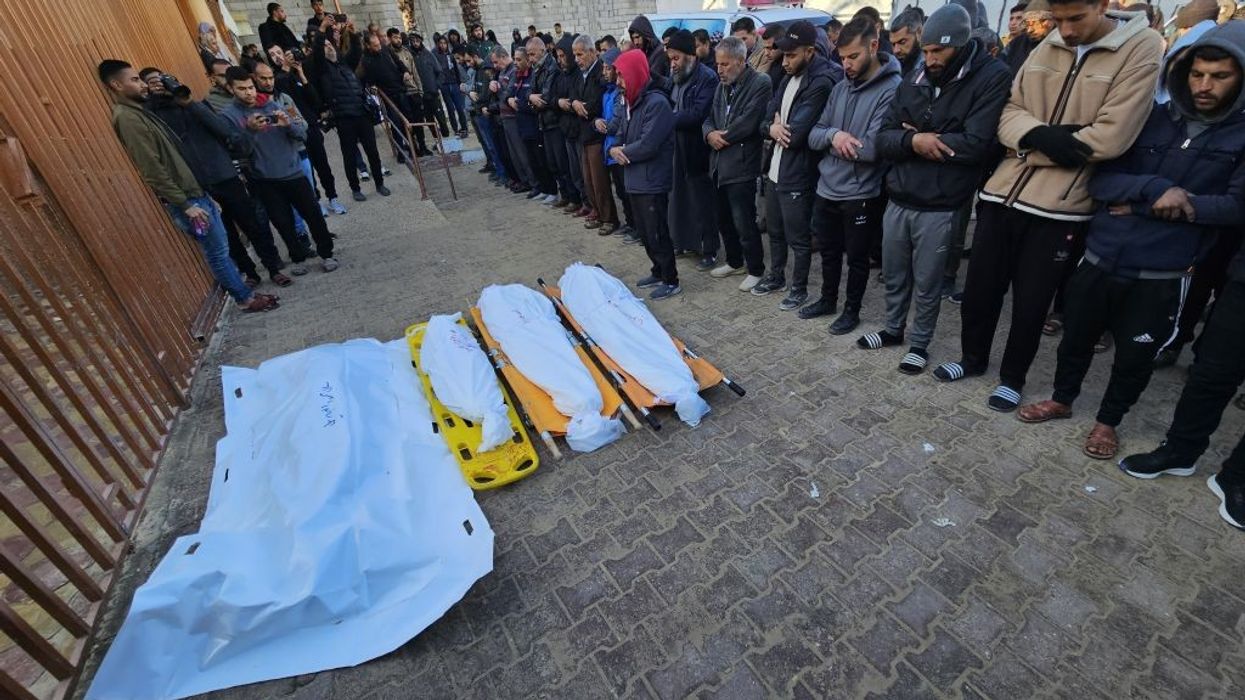
The analysis was published a day before Israeli forces bombed yet another "safe zone," killing at least 12 Palestinians, including children.
A report published on Wednesday details how Israel forcibly expels Palestinians in the Gaza Strip in order to facilitate—and hide—genocidal attacks in evacuated areas, while forcing refugees into alleged humanitarian "safe zones" that are "intentionally designed to ensure the destruction of all life sheltering there."
The Palestinian human rights group Al-Haq published the report, titled How to Hide a Genocide, which examines "the role of evacuation orders and safe zones in Israel's genocidal campaign in Gaza."
According to the report:
Since the very first week of its genocide, Israel has methodically cleared vast stretches of the Gaza Strip of its inhabitants through its unlawful issuance of evacuation orders. Israel presents these evacuation orders to the public as proof of its efforts to minimize civilian casualties and to support its alleged compliance with fundamental principles of international humanitarian law. However, they achieve the direct opposite. Over 90% of Gaza's population... has been forcibly displaced from their homes and temporary shelters, the majority of them multiple times, to alleged safe zones.
Contrary to their label, these zones are anything but safe. With insufficient space, shelter, sanitation facilities, food, or water sources, and medical care, these safe zones are intentionally designed to ensure the destruction of all life sheltering there. What's more, the safe zones—despite their unilateral establishment by Israel—are routinely targeted by Israeli occupying forces (IOF) by air, land, and sea. Crowded together with nowhere to flee, Palestinians in Gaza are either killed by Israeli strikes, severely physically and mentally injured by the IOF's physical and psychological warfare, or subject to a slow death as a result of starvation, dehydration, a complete lack of crucial medical care, or the rampant spread of infectious diseases in the densely populated, unsanitary zones.
Al-Haq said: "As shown throughout the report, by applying humanitarian terms to its practice of forcibly transferring Palestinians, without any legal basis and in a manner that breaches international law, and labeling areas as safe zones despite being constantly attacked and lacking in all essentials for survival, Israel argues that it is acting in accordance with its legal obligations when in fact it is providing further evidence of its genocidal intent as it uses these measures to commit and contribute to the genocidal acts of killing, causing serious bodily and mental harm, and creation of conditions calculated to destroy Palestinians in Gaza."
The Al-Haq report was published shortly after Sila Mahmoud Al-Faseeh, a 3-week-old baby girl,
died from hypothermia in the al-Mawasi safe zone in southern Gaza. She is one of at least eight people—seven of them infants or children—who have reportedly frozen to death in Gaza in recent weeks.
The report was also published a day before Israeli forces bombed a tent encampment in al-Mawasi, killing at least 12 Palestinians including three children and wounding at least 15 others.
It was one of numerous Israeli strikes on the al-Mawasi safe zone, which have killed or wounded at least hundreds of Palestinians. In the deadliest of these, at least 90 Palestinians including many women and children were killed—some of them burned alive in their tents—and hundreds of others were injured when eight 2,000-pound bombs, at least one of which was supplied by the United States, were dropped on the humanitarian zone on July 13, 2024 in order to assassinate Hamas leader Mohammed Deif. Israeli forces then attacked and killed rescue workers arriving at the site of the strike.
U.S. Secretary of State Antony Blinkencalled the death toll from the strike "unacceptably high." However, just weeks later, the Biden administration approved approximately $20 billion worth of new U.S. weapons for Israel.
The International Court of Justice in The Hague, Netherlands is currently weighing whether Israel is committing genocide in Gaza.
"Israel continues to bomb Gaza and restrict essential supplies from entering the strip," said the emergency coordinator of Doctors Without Borders.
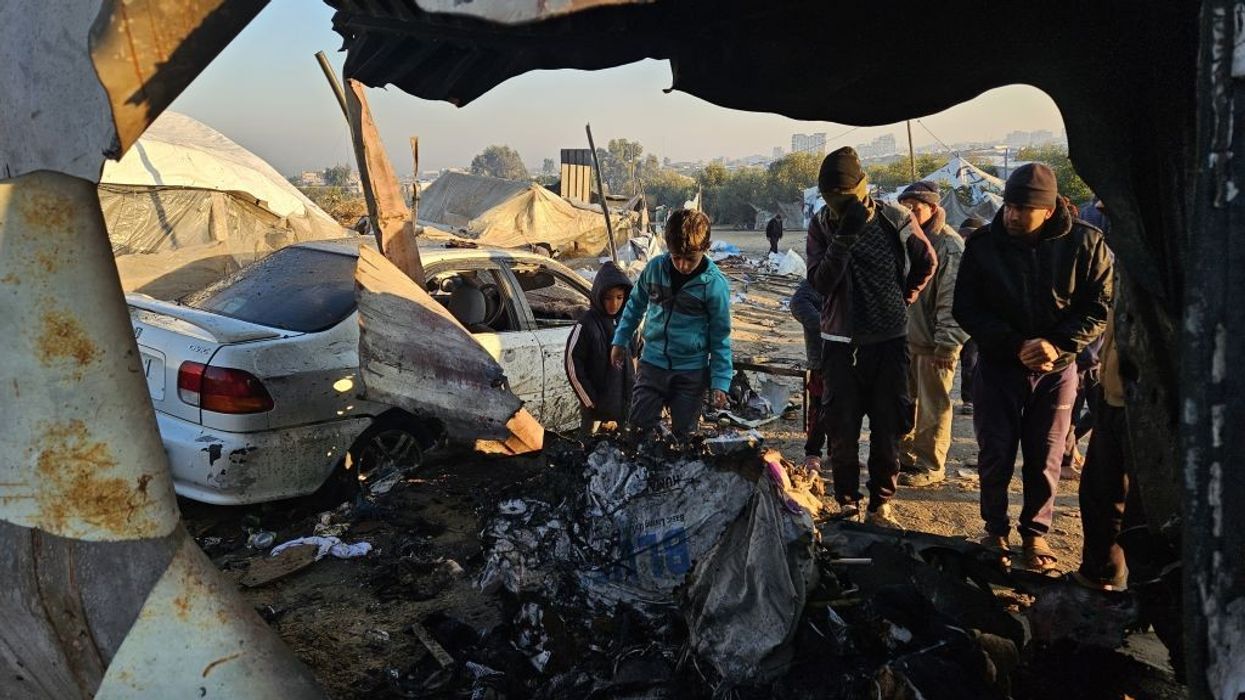
Israeli forces early Thursday carried out another attack on a so-called humanitarian "safe zone" in southern Gaza, killing at least 11 people—including three children—as the assault on the Palestinian enclave raged with no end in sight.
Reuters reported that at least 15 people were also wounded in the attack on Al-Mawasi, an overcrowded tent city on Gaza's southern coast that Israel has repeatedly bombed. In one case late last year, the Israeli military used 2,000-pound bombs supplied by the United States to attack the camp filled with displaced families.
The Israel Defense Forces (IDF) confirmed in a social media post that it carried out the strike on the designated humanitarian zone, claiming it targeted Hassam Shahwan, whom the IDF described as the head of Hamas Internal Security Forces in southern Gaza.
Video footage shows people attempting to put out fires at the scene with buckets of water:
Un ataque del ejército israelí mata al menos a 11 personas y provoca 15 heridos en #Gaza.
El ataque se produjo de madrugada en la en la zona humanitaria de Al Mawasi. Entre los fallecidos hay 4 menores y dos mujeres.#DWNoticias / ajr pic.twitter.com/LCKci8IZsg
— DW Español (@dw_espanol) January 2, 2025
Thursday's attack underscored humanitarian aid groups' warning that nowhere is truly safe for Gazans as Israeli forces carry out deadly airstrikes across the besieged enclave. Al Jazeera reported early Thursday that in addition to the IDF's attack on Al-Mawasi, "there has been a significant escalation of strikes in central Gaza."
"Palestinians are mourning those killed in an Israeli strike on civilians in the suburb of central Deir el-Balah city," the outlet reported. "The bodies—shredded into pieces—have been brought to Al-Aqsa Hospital."
"In northern Gaza," Al Jazeera added, "seven civilians were killed in Jabalia following an Israeli attack. In the Shati refugee camp, reports are emerging of three people killed in an attack at the central market."
Israel's incessant bombing is fueling a devastating humanitarian crisis worsened by falling temperatures. At least six Palestinian children—including several who were living in makeshift shelters in Al-Mawasi—have died of hypothermia in recent days.
"Last winter—although people were already displaced and the conditions were harsh—there were still some buildings to take shelter in," Pascale Coissard, emergency coordinator at Doctors Without Borders, said Thursday. "Today, after 14 months of war and destruction of infrastructure, most of the people in Gaza are living in tents that barely isolate the cold wind and rain. Just in the past 12 hours, the rain hasn't stopped."
"Even before their lives have started outside the womb, babies are at risk of disease and death," Coissard added. "Once born, babies face immediate and extreme challenges: displaced in the cold of winter, without adequate access to warmth, shelter, or healthcare, as Israel continues to bomb Gaza and restrict essential supplies from entering the strip, while looting of aid trucks within the enclave is making it difficult for that small amount of aid allowed by Israeli authorities to reach those in need."
CNN noted earlier this week that "the cold weather has not only claimed the lives of children."
"On Friday, the health ministry said a nurse was found dead in his tent in Al-Mawasi on Friday due to severe cold," the outlet reported.
"The far-right genocidal Israeli government continues to use its one-ton Biden bombs to massacre Palestinians as if they were sheep for the slaughter," said one advocacy group.
The Israeli military bombed Gaza's overcrowded tent city of al-Mawasi early Tuesday morning in its latest attack on a supposed "safe zone," killing dozens of people and intensifying anger at the countries enabling the assault—principally the United States.
Video footage from the scene shows rescue workers transporting wounded people to barely functioning nearby hospitals as others desperately searched for bodies buried under sand.
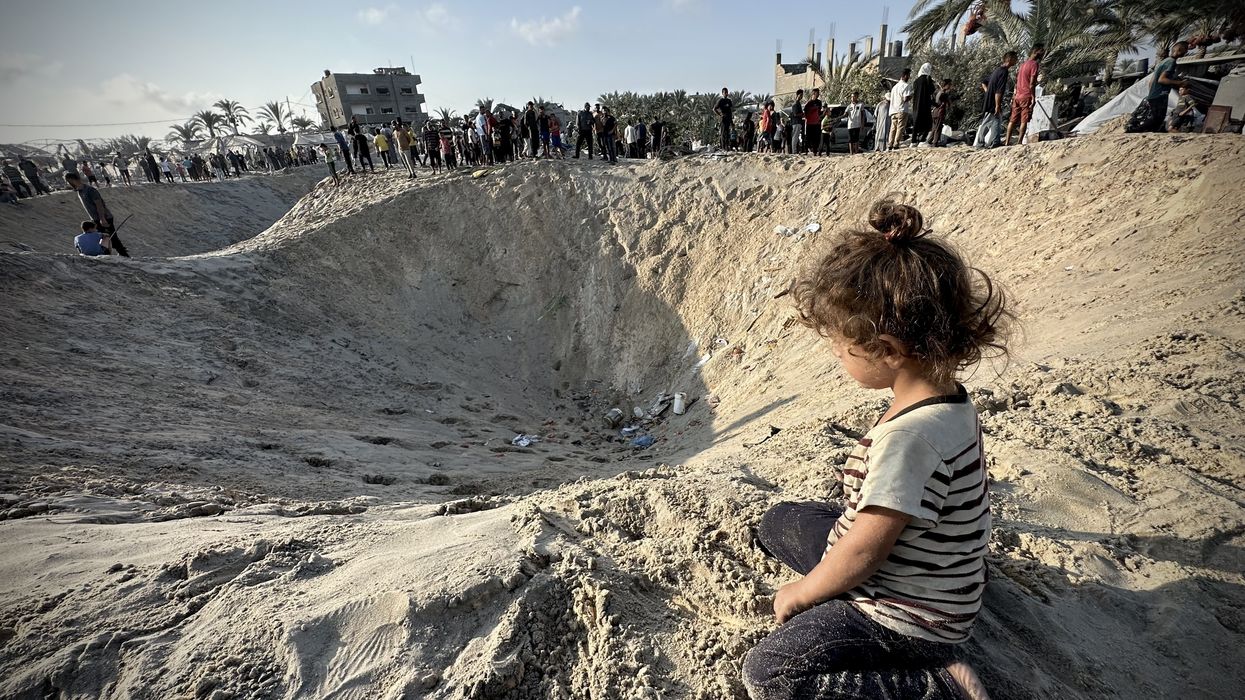
The Israeli military claimed it was targeting Hamas militants and used "precise munitions" in an effort to mitigate civilian harm, but observers said the massive craters left by the attack were consistent with 2,000-pound MK-84 bombs supplied in large numbers by the United States. The Biden administration has transported thousands of the bombs to Israel since the October 7 Hamas-led attack.
Maha Hussaini, strategy director at the Euro-Mediterranean Human Rights Monitor, said in the wake of Tuesday's attack that "in an overcrowded camp where hundreds of thousands of displaced Palestinians are scattered in makeshift tents, even the smallest bomb can cause immense damage and numerous casualties."
"Now, imagine the devastation when the Israeli occupation army uses three U.S.-made MK-84 bombs on them," Hussaini added.
Horrifying scenes from the israeli massacre of displaced Palestinian families in Mawasi, west Khan Younis: who in God’s name bombs tents pic.twitter.com/1sBEG7vUb9
— Sarah Wilkinson (@swilkinsonbc) September 10, 2024
A spokesperson for Gaza's civil defense said the Israeli attack destroyed dozens of tents, killed at least 40 people, and wounded over 60 more.
"Entire families disappeared... under the sand, in deep holes," the official said. Reuters noted that "tents in the surrounding area had been completely incinerated, leaving only their metal frames dusted with ghostly ash in a wasteland littered with debris."
The Israel Defense Forces said its target was a "command center" that Hamas purportedly established in the designated humanitarian zone, which Israeli forces have repeatedly attacked. Hamas denied its fighters were in the area and said the Israeli bombing killed mostly women and children.
The Associated Press reported that one of its camera operators "saw three large craters at the scene, where first responders and displaced people were sifting through the sand and rubble with garden tools and their bare hands by the light of mobile phones."
"They pulled body parts from the sand, including what appeared to be a human leg," the outlet reported. "Nasser Hospital in Khan Younis, one of three hospitals to receive casualties, said around two dozen bodies were brought in from the strike. An Associated Press cameraman saw 10 bodies in the hospital's morgue, including two children and three women."
U.S.-based advocacy groups said the attack was the latest example of the Biden administration's complicity in Israel's assault on the Gaza Strip, which has killed more than 41,000 people and sparked mass starvation.
"The U.S. continues sending the Israeli government the bombs and warplanes it uses to slaughter Palestinians," said Jewish Voice for Peace Action. "Now, another unbearable and horrific massacre of forcibly displaced Palestinians who were sheltering in a tent encampment. STOP ARMING ISRAEL."
Nihad Awad, national executive director of the Council on American-Islamic Relations (CAIR), said in a statement that "the far-right genocidal Israeli government continues to use its one-ton Biden bombs to massacre Palestinians as if they were sheep for the slaughter, not human beings deserving life and freedom."
"The continued military and financial support for Israel's genocide by President Biden will live in the memories of the survivors of these massacres and in the hearts of their loved ones for generations to come," said Awad. "If the Biden administration does not radically change course now by forcing a cease-fire on Netanyahu, it will be clear that it does not seem to have a shred of humanity left and that no crime will stop it from enabling the Gaza genocide."
"We live in an area that is considered humanitarian and is supposed to be safe, but it is not," one woman said. "There is no safe place for us or our children."
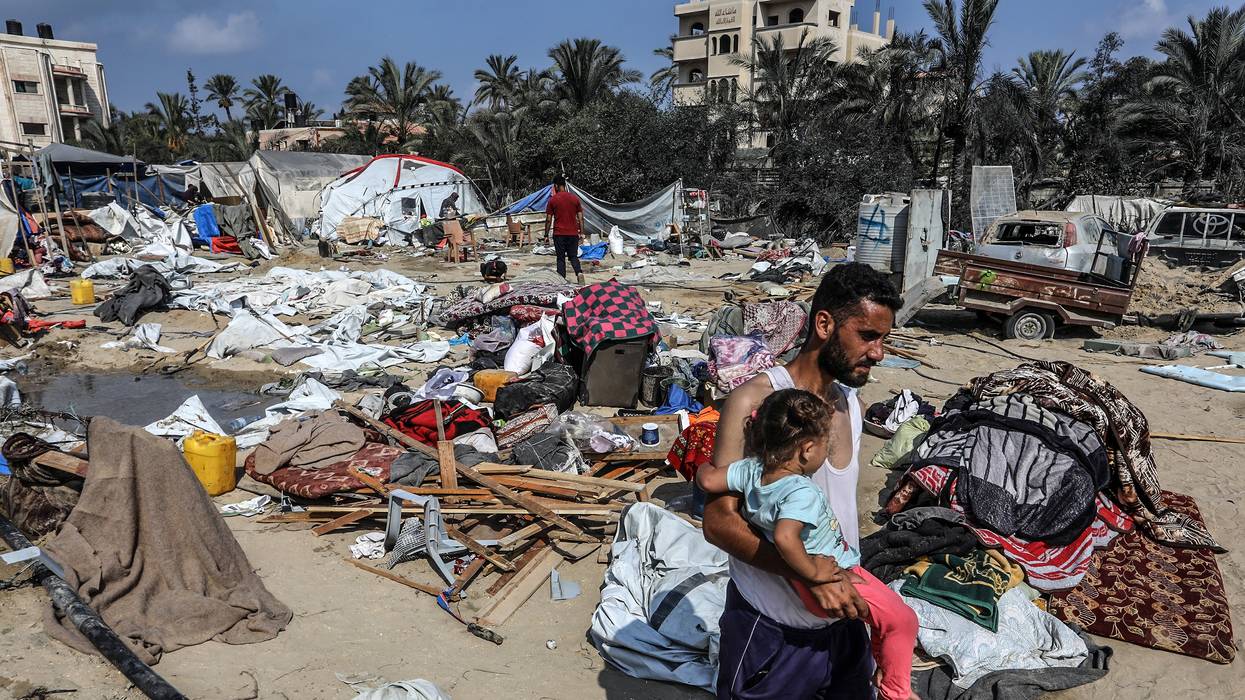
Palestinians living in the so-called "humanitarian zone" designated by Israel described extreme and worsening overcrowding on Tuesday, saying that as the Israel Defense Forces has repeatedly struck the area in recent months, displaced people living there have been left feeling they "could die any minute."
A 37-year-old mother of four, Nisreen Joudeh, told The New York Times that al-Mawasi, a stretch of coastal land to which hundreds of thousands of people from other parts of Gaza have evacuated under Israeli orders, "is no longer a safe area."
With materials for tents now costing hundreds of dollars instead of an average of $50 as they did before Israel began bombarding Gaza and blocking humanitarian aid last October, families now commonly share the tents that have been erected along the sandy shore area.
"A tent that used to accommodate four to seven people now houses 15 to 17 people from two or more families," a man named Karel Mohammed told the Times, and overcrowding has intensified in recent weeks as Israel forcibly displaced tens of thousands more Palestinians and ordered them to al-Mawasi.
People face "scorching heat" with very few trees to provide shade, and have access to only "primitive bathrooms," according to Mohammed.
With Israel continuing to block large amounts of humanitarian aid—actions that United Nations experts last month said have pushed Gaza into famine—Mohammed said there is "no drinkable water, no healthy food" in al-Mawasi.
"The truth is that this area is anything but humanitarian," said Mohammed. "Our life in these camps is like hell."
The Times' dispatch from al-Mawasi came a day after the United Nations Children's Fund (UNICEF) reported that the "lack of clean water" and the destruction of Gaza's sanitation and sewage treatment systems" have caused a surge in diseases including diarrhea and skin disorders across Gaza.
Mona al-Farra, another Palestinian who is sheltering in al-Mawasi in a tent crowded with nine other family members, said skin rashes among children have particularly become rampant due to a lack of clean water and medicine.
"We live in an area that is considered humanitarian and is supposed to be safe, but it is not," she told the Times, adding that her family frequently hears airstrikes nearby. "There is no safe place for us or our children."
Last month, at least 90 Palestinians were killed in a bombing within al-Mawasi, which the IDF said had targeted Hamas commander Muhammed Deif.
The so-called humanitarian zone covers 18 square miles, according to the U.N., or nearly 13% of the Gaza Strip. The IDF adjusted the area's borders last month, shrinking it by about one-fifth.
Doctors Without Borders, also known as Medecins Sans Frontieres (MSF), shared on social media on Monday drawings that had been made by children in a mental health clinic in al-Mawasi, with the artwork exemplifying the "complete psychological destruction" among Gaza's youngest residents that a report warned of earlier this year.
"Even though the wounds are invisible, the drawings provide a glimpse into what these children have witnessed. It is beyond words," said Samuel Johann, an emergency coordinator for MSF. "I cannot express what I feel, seeing what these children have experienced, through their eyes and the reality they are facing."
"Today," he said, "I heard a Palestinian colleague describe the human suffering of the war as such: 'Only the dead have been spared this suffering.'"

"Israel's far-right government carries out this mass slaughter of Palestinians secure in the knowledge that it will be supported and excused by the Biden administration," said one rights advocate.
The United Nations' top expert on human rights in Palestine condemned the Israeli military as it resorted to a familiar excuse for the killing of nearly 100 Palestinians on Saturday in an area that had been designated as a "humanitarian zone"—just the latest massacre of dozens of people whom the Israel Defense Forces dismissed as collateral damage in attacks they claimed were targeting Hamas.
"The justification is always the same: 'targeting Palestinian militants,'" said Francesca Albanese, U.N special rapporteur on the Occupied Palestinian Territories. "When is the world going to stop this death machine?"
Albanese was referring this time to the bombardment of al-Mawasi, a coastal area west of Khan Younis where hundreds of thousands of Gaza residents have been sheltering after fleeing cities including Rafah.
Al Jazeera reporter Tareq Abu Azzoum described the attack as "a new massacre committed by the Israeli military," with "five bombs and five missiles" hitting the area where Palestinians have been sheltering in makeshift tents for months.
Gaza's Ministry of Health reported that at least 90 people had been killed in the attack, which the IDF claimed was based on "precise intelligence" and targeted Hamas commanders Mohammed Deif and Rafa Salama.
"We have seen time and time again attacks on areas where there are displaced Palestinians in the tens of thousands," reported Al Jazeera's Hamdah Salhut. "This is a tactic that is commonly used by Israeli forces, saying civilians are being used as 'human shields' for Hamas figures, using that as justification for killing dozens of civilians."
The Washington Post reported that it was "unclear" whether Deif, who has survived multiple assassination attempts by Israel, was killed in the attack.
Paramedics and children were reportedly among nearly 300 people who were wounded, and an official at Nasser Hospital told Al Jazeera that the facility had no more capacity to treat wounded patients.
The British charity Medical Aid for Palestine reported that it was "forced to temporarily evacuate one of our medical points near the area, which is intended to provide primary healthcare services, due to the insecurity."
"MAP’s Mohammed Al Khatib in Khan Younis reports: 'Al-Mawasi is heavily crowded and has a big market where people move around to try and secure their basic needs,'" said the group. "We have been warning for months that there is no safe place for anyone in Gaza amid Israel's military bombardment."
"A number of victims are still under the rubble and on the roads, and ambulance and civil defense crews are unable to reach them," the Health Ministry told the Associated Press.
The AP assessed footage that showed a "huge crater" in the area where thousands of people had been ordered to evacuate to when the IDF began its full-scale assault on Rafah in May. Burnt-out cars, household belongings, and charred tents—like those seen in previous attacks on so-called "humanitarian zones" in al-Mawasi and Rafah—were left after the bombings.
Academic and writer Ori Goldberg said it was "impossible to exaggerate the level of criminality, immorality, and crass, murderous stupidity that come together in the massacre Israel carried out in al-Mawasi this morning."
"Israel used wildly disproportionate force [to] assassinate two people," said Goldberg. "Israel pushed the displaced Palestinians to Mawasi, defining it a 'safe zone.' Then, assuming it had a chance to assassinate Muhammad Deif, one of the most senior Hamas leaders supposedly hiding there, Israel bombed the 'safe zone.' Dozens were killed. The death of a single person does not legitimize the slaughter of dozens."
Goldberg noted that the massacre came shortly after U.S. President Joe Biden announced Hamas and Israel were inching closer to a truce, with both sides agreeing to a "framework" for a cease-fire.
"There is a hostage deal on the table. Deif's death will not bring about the collapse of Hamas; it will only make Hamas less willing to compromise," said Goldberg. "Israel forces 'evacuation,' Israel bombs, Israel knows, Israel attacks and kills, Israel sets conditions, Israel balks. Israel has run out of options. It knows only death."
The Council on American-Islamic Relations (CAIR) said that as with previous attacks on designated safe zones, the IDF's massacre was made possible partially by the political and material support of the United States and other Western countries.
"Israel's far-right government carries out this mass slaughter of Palestinians secure in the knowledge that it will be supported and excused by the Biden administration and that American bombs and taxpayer funds will continue to flow," said Nihad Awad, national director of CAIR. "President Biden's continuing support for and silence about the genocide gives a green light for more Israeli abuses and war crimes. President Biden must stop enabling these daily massacres and end our nation's complicity in genocide."

"How much more can the Palestinians survive this?" asked one researcher. "Safe zones targeted, refugees killed with merciless brutality."
As humanitarians and world leaders condemn an Israel Defense Forces bombing and resulting fire in a Rafah "safe zone" that killed 45 people and wounded hundreds more, the Israeli military on Tuesday killed at least 21 more at another refugee camp in the southern Gaza Strip.
"Four tank shells hit a cluster of tents in Al-Mawasi, a coastal area that Israel had advised civilians in Rafah to move to for safety," Reuters reported, citing health officials in the Hamas-governed Palestinian enclave. "At least 12 of the dead were women."
Gaza-based journalist Hind Khoudary said on social media Tuesday: "I have a live hit on Al Jazeera in a bit and all I'm thinking about is how I will report on this massacre again. My heart is pounding so fast. My [fingers] are shaking. I want to cry."
Journalist Hind Khoudary says Israel's latest attack on a tent encampment, which has killed nearly 22 Palestinians, was in an area that Israel had declared a 'safe zone' and ordered people to move to. pic.twitter.com/rlcLKr8fW1
— Quds News Network (@QudsNen) May 28, 2024
According to Agence France-Presse, IDF spokesperson Rear Adm. Daniel Hagari told reporters on Tuesday that "I don't know about this incident. We are putting this incident under investigation, and we will update you in advance."
Hagari also addressed a probe into the Rafah attack—which Prime Minister Benjamin Netanyahu called a "tragic mistake"—during a Tuesday press briefing, saying that "on Sunday night, we eliminated senior Hamas terrorists in a targeted strike on a compound used by Hamas" and "due to unforeseen circumstances, a fire ignited tragically taking the lives of Gazan civilians nearby."
"Contrary to reports, we conducted the strike outside the area that we designated as a humanitarian area and called civilians to evacuate to. Our strike was over a kilometer-and-a-half away from the Al-Mawasi humanitarian area. What we call the safer zone," Hagari said. "Our munition alone could not have ignited a fire of this size... We are looking into all possibilities including the option that weapons stored in a compound next to our target, which we did not know of, may have ignited as a result of the strike."
The IDF's claims about the Sunday massacre have not quelled outrage around the world—including from U.S. lawmakers urging President Joe Biden to suspend weapons and diplomatic support for Israel's war, which has killed over 36,000 Palestinians, injured another 81,000, and left thousands more missing and believed dead beneath the rubble, according to Gaza health officials.
Palestinians who have so far survived the Israeli assault on Gaza for more than seven months are struggling to find food, water, shelter, and medical care. The IDF has destroyed civilian infrastructure—including homes, hospitals, schools, and mosques—across the enclave and severely restricted the delivery of humanitarian aid.
"Day after day, massacre after massacre, and the Biden administration continues to ship the bombs to the far-right, openly genocidal Israeli government that it uses to slaughter Palestinian children, women, medical personnel, journalists, international aid workers, and the sick and elderly, and continues to shield Israel from international accountability," Council on American-Islamic Relations national executive director Nihad Awad said Tuesday.
"This genocidal brutality, which is being exposed daily by piles of charred and dismembered Palestinian civilians, must stop," Awad added. "Sadly, because of President Biden's insistence on sending more bombs to enable Netanyahu's war crimes in Rafah, this is now as much an American genocide as it is an Israeli genocide."
Both deadly IDF attacks on displaced Palestinians in and near Rafah came in the wake of the International Court of Justice last week directing Israel to "immediately halt its military offensive or any other action in the Rafah governorate," which followed the ICJ's January order that the country "take all measures within its power" to uphold its obligations under the Genocide Convention.
Middle East Eye reported Tuesday that Nabil Abu Rudeineh, a Palestinian presidential spokesperson, "called the new attack a massacre, and called for the implementation of the International Court of Justice decision last week for Israel to halt its offensive on Rafah," which began earlier this month.
Responding to the Tuesday attack on social media, London-based researcher Naks Bilal said that "without humanitarian intervention it is impossible to see how this does not stop."
"How much more can the Palestinians survive this? Safe zones targeted, refugees killed with merciless brutality," Bilal added. "Focus energy on calling for intervention, or there will be no Palestinians."
This post has been updated with comment from the Council on American-Islamic Relations.

"It is a narrow strip of beach on the coast that lacks the basic infrastructure—like toilets and running water—needed to sustain the population," said the agency chief.
As Israel's tanks and warplanes continued attacking eastern Rafah on Thursday amid fears of a full-scale invasion, United Nations leaders warned that the area to which Israeli forces are directing Palestinians in the southern Gaza Strip city is unsafe.
The Israel Defense Forces this week has
circulated a map and claimed that "the IDF has expanded the humanitarian area in Al-Mawasi to accommodate the increased levels of aid flowing into Gaza. This expanded humanitarian area includes field hospitals, tents, and increased amounts of food, water, medication, and additional supplies."
However, in an interview published Wednesday, Tess Ingram of the United Nations Children's Fund (UNICEF)
said that "the area that they're being directed to evacuate to is not safe. It's not safe because there aren't the services there to meet their basic needs, water, toilets, shelter."
"But it's also not safe because we know that that area has been subject to strikes despite being a so-called safe zone. So we're really concerned about that impact of a ground offensive on one of the most densely populated areas in the world," she told The Intercept's Jeremy Scahill.
"Israel's latest evacuation orders and their ground operations will bring more death and displacement."
Rafah was home to about a quarter-million people before October 7, but since Israel launched what the International Court of Justice has
called a "plausibly" genocidal assault on Gaza—killing at least 34,904 Palestinians and wounding another 78,514 as of Thursday—the city's population has swelled to over 1.4 million.
UNICEF Executive Director Catherine Russell
said last week that a major military operation against the crowded city "would bring catastrophe on top of catastrophe" for the young people there, explaining that "nearly all of the some 600,000 children now crammed into Rafah are either injured, sick, malnourished, traumatized, or living with disabilities."
Noting that "many of them have been displaced multiple times already," Ingram, who recently returned from Gaza, similarly told Scahill that "they're exhausted, traumatized, sick, hungry, and their ability to safely evacuate is limited."
Despite warnings from humanitarian leaders and the U.S. government—which has continued to arm the IDF throughout the war—Israeli forces attacked Rafah this week and seized control of the border crossing with Egypt, further restricting aid delivery.
U.S. President Joe Biden previously called attacking Rafah a "red line." While criticizing the IDF assault on the city Wednesday, the American leader was accused of "moving the goal post" because he merely threatened to cut off arms if Israel pursued a major invasion, rather than stopping the flow of arms immediately.
Israeli Prime Minister Benjamin Netanyahu made clear on Thursday that he has no intention of backing down, saying in a video message in Hebrew that "if we are forced to stand alone, we will stand alone."
Russell said in a statement Thursday that "the intensification of military operations in the Rafah area and the closure of key border crossings into southern Gaza have severed our access to fuel, threatening to grind humanitarian operations to a halt."
According to the UNICEF chief:
If the Kerem Shalom and Rafah crossings are not reopened to fuel and humanitarian supplies, the consequences will be felt almost immediately: Life support services for premature babies will lose power; children and families will become dehydrated or consume dangerous water; sewage will overflow and spread disease further. Simply put, lost time will soon become lost lives.
I strongly urge the relevant authorities to provide humanitarian actors with actionable measures and concrete assurances to facilitate safe and secure movement of humanitarian cargo, via all routes, into and within the Gaza Strip.
"I am also deeply concerned about the movement of civilians in Gaza to unsafe areas," Russell continued. "In response to evacuation orders in eastern Rafah, at least 80,000 people have reportedly fled the area, with many seeking shelter in Al-Mawasi and among the ruins of Khan Younis. We have been warning for months that Al-Mawasi is not a safe option. It is a narrow strip of beach on the coast that lacks the basic infrastructure—like toilets and running water—needed to sustain the population."
Plus, as Scott Anderson, deputy director of the U.N. Relief and Works Agency for Palestine Refugees in the Near East, told Politico on Wednesday, "there's already 450,000 people in that general area. It is crowded."
Anderson also warned about dwindling supplies, saying that "we're down to no fuel. We're basically out. We've kept enough to meet the minimum security standards we have to meet for the U.N. so we can continue to stay here. But we're down to that level. Some hospitals will start shutting down their generators in three days if we don't get fuel in."
Martin Griffiths, the U.N. under-secretary-general for humanitarian affairs and emergency relief coordinator, stressed in a Thursday statement that "civilians must be protected and have their basic needs met, whether they move or stay."
While warning that "Israel's latest evacuation orders and their ground operations will bring more death and displacement," Griffiths also said that "we remain committed to providing aid to people, regardless of where they are."
"The decisions that are made today and their consequences in human suffering will be remembered by the generation that follows us," he concluded. "Let us be ready for their reproaches."