

SUBSCRIBE TO OUR FREE NEWSLETTER
Daily news & progressive opinion—funded by the people, not the corporations—delivered straight to your inbox.
5
#000000
#FFFFFF
To donate by check, phone, or other method, see our More Ways to Give page.
Daily news & progressive opinion—funded by the people, not the corporations—delivered straight to your inbox.
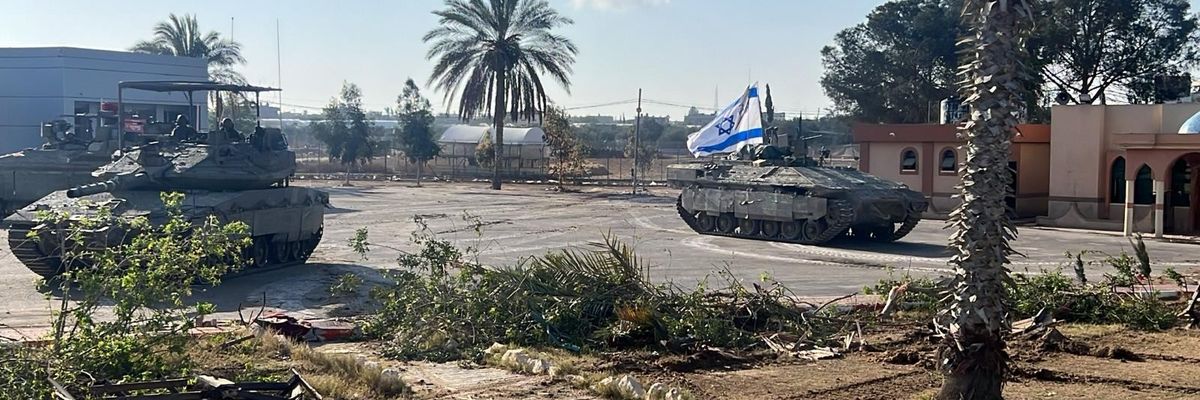
Israeli tanks are seen at Rafah's border crossing with Egypt on May 6, 2024.
"This has devastating impacts for the people of Gaza who are already on the verge of famine," said the UNRWA's director of planning.
With tanks and ground forces, the Israeli military seized control of the Gaza side of Rafah's border crossing with Egypt on Tuesday, cutting off a critical humanitarian aid route as much of the enclave's population faces imminent famine.
Israel's takeover of the Rafah crossing came hours after the country's military ordered more than 100,000 people in the southern Gaza city to evacuate ahead of a ground assault, which is moving forward after the right-wing Israeli government rejected a cease-fire proposal accepted by Hamas. Cease-fire negotiations mediated by Egypt and Qatar are expected to continue in the coming days.
Video footage posted to social media shows an Israeli tank running over a Gaza sign as Israeli forces took control of the Rafah crossing on Tuesday.
Israeli tank bulldozers Gaza sign as Israeli army captures Rafah crossing this morning.
pic.twitter.com/JNnAXKeW9h
— Ragıp Soylu (@ragipsoylu) May 7, 2024
Reporting from Rafah, Al Jazeera's Hani Mahmoud said the Israeli military is "cutting off the only lifeline right now to the people in Gaza, particularly for the 1.5 million displaced Palestinians here in Rafah."
The Rafah crossing is closed, cutting off the life line for 1.5m people crammed into this tiny piece of land right at the southern end of the Gaza strip.
Hani Mahmoud reporting from Rafah. pic.twitter.com/kPeImrntDj
— Saul Staniforth (@SaulStaniforth) May 7, 2024
Two key humanitarian aid routes—the Rafah and Kerem Shalom crossings—have been shut down for days as the Israeli military plows ahead with its Rafah assault in the face of international outrage. More than 600,000 children are currently living in Rafah, and aid organizations say Israel has no credible plan to protect them.
Overnight, Israel launched deadly airstrikes in Rafah, describing its military operation in the overcrowded city as "very precise." One resident
told Reuters that the Israeli strikes killed his wife and children.
Jens Laerke, a spokesperson for the United Nations Office for the Coordination of Humanitarian Affairs, told The Associated Press that Israeli authorities have denied the agency access to the Rafah crossing.
A lasting shutdown of the route, Laerke warned, "will plunge this crisis into unprecedented levels of need, including the very real possibility of a famine." He added that Israel's military is "ignoring all warnings about what this could mean for civilians and for the humanitarian operation across the Gaza Strip."
Speaking to Al Jazeera on Tuesday, the director of planning at the U.N. Relief and Works Agency for Palestine Refugees in the Near East (UNRWA)—the most important aid organization operating in Gaza—said the closure of the Rafah crossing is having "catastrophic impacts on everyone in Gaza."
"Since October, this has been the main entry point of goods coming into Gaza," said Sam Rose. "There has only been a trickle of goods coming in, and since Sunday the crossing has been closed completely. And this has devastating impacts for the people of Gaza who are already on the verge of famine."
"No aid coming in means no aid distributed after a couple of days," Rose continued. "And equally importantly, Rafah and Kerem Shalom are the only entry points for fuel in Gaza, so without the fuel there's no ability for trucks to move around, there's no ability for desalination plants to operate and provide safe water, there's no electricity. It cuts off everything. Rafah and Kerem Shalom—they're the lifeblood for the small amount of goods that have been coming into Gaza since October, so absolutely devastating."
"Absolutely devastating"
This morning the IDF have seized the Palestinian side of the Rafah crossing, and Sam Rose from UNRWA explains what it means now that the crossing is closed. pic.twitter.com/iC1w8AWnt5
— Saul Staniforth (@SaulStaniforth) May 7, 2024
Laerke of the U.N. humanitarian affairs office said that cutting off the supply of fuel to Gaza for an extended period of time "would be a very effective way of putting the humanitarian operation in its grave."
Volker Türk, the U.N. high commissioner for human rights, said in a statement that "more attacks on what is now the primary humanitarian hub in the Gaza strip are not the answer."
"First and foremost, there must be a cease-fire. Humanitarian aid must be allowed to flow freely and at scale. And the hostages and those arbitrarily detained must be released at once," said Türk. "Those that elect to flout international humanitarian law and international human rights law must be held to account."
Dear Common Dreams reader, It’s been nearly 30 years since I co-founded Common Dreams with my late wife, Lina Newhouser. We had the radical notion that journalism should serve the public good, not corporate profits. It was clear to us from the outset what it would take to build such a project. No paid advertisements. No corporate sponsors. No millionaire publisher telling us what to think or do. Many people said we wouldn't last a year, but we proved those doubters wrong. Together with a tremendous team of journalists and dedicated staff, we built an independent media outlet free from the constraints of profits and corporate control. Our mission has always been simple: To inform. To inspire. To ignite change for the common good. Building Common Dreams was not easy. Our survival was never guaranteed. When you take on the most powerful forces—Wall Street greed, fossil fuel industry destruction, Big Tech lobbyists, and uber-rich oligarchs who have spent billions upon billions rigging the economy and democracy in their favor—the only bulwark you have is supporters who believe in your work. But here’s the urgent message from me today. It's never been this bad out there. And it's never been this hard to keep us going. At the very moment Common Dreams is most needed, the threats we face are intensifying. We need your support now more than ever. We don't accept corporate advertising and never will. We don't have a paywall because we don't think people should be blocked from critical news based on their ability to pay. Everything we do is funded by the donations of readers like you. When everyone does the little they can afford, we are strong. But if that support retreats or dries up, so do we. Will you donate now to make sure Common Dreams not only survives but thrives? —Craig Brown, Co-founder |
With tanks and ground forces, the Israeli military seized control of the Gaza side of Rafah's border crossing with Egypt on Tuesday, cutting off a critical humanitarian aid route as much of the enclave's population faces imminent famine.
Israel's takeover of the Rafah crossing came hours after the country's military ordered more than 100,000 people in the southern Gaza city to evacuate ahead of a ground assault, which is moving forward after the right-wing Israeli government rejected a cease-fire proposal accepted by Hamas. Cease-fire negotiations mediated by Egypt and Qatar are expected to continue in the coming days.
Video footage posted to social media shows an Israeli tank running over a Gaza sign as Israeli forces took control of the Rafah crossing on Tuesday.
Israeli tank bulldozers Gaza sign as Israeli army captures Rafah crossing this morning.
pic.twitter.com/JNnAXKeW9h
— Ragıp Soylu (@ragipsoylu) May 7, 2024
Reporting from Rafah, Al Jazeera's Hani Mahmoud said the Israeli military is "cutting off the only lifeline right now to the people in Gaza, particularly for the 1.5 million displaced Palestinians here in Rafah."
The Rafah crossing is closed, cutting off the life line for 1.5m people crammed into this tiny piece of land right at the southern end of the Gaza strip.
Hani Mahmoud reporting from Rafah. pic.twitter.com/kPeImrntDj
— Saul Staniforth (@SaulStaniforth) May 7, 2024
Two key humanitarian aid routes—the Rafah and Kerem Shalom crossings—have been shut down for days as the Israeli military plows ahead with its Rafah assault in the face of international outrage. More than 600,000 children are currently living in Rafah, and aid organizations say Israel has no credible plan to protect them.
Overnight, Israel launched deadly airstrikes in Rafah, describing its military operation in the overcrowded city as "very precise." One resident
told Reuters that the Israeli strikes killed his wife and children.
Jens Laerke, a spokesperson for the United Nations Office for the Coordination of Humanitarian Affairs, told The Associated Press that Israeli authorities have denied the agency access to the Rafah crossing.
A lasting shutdown of the route, Laerke warned, "will plunge this crisis into unprecedented levels of need, including the very real possibility of a famine." He added that Israel's military is "ignoring all warnings about what this could mean for civilians and for the humanitarian operation across the Gaza Strip."
Speaking to Al Jazeera on Tuesday, the director of planning at the U.N. Relief and Works Agency for Palestine Refugees in the Near East (UNRWA)—the most important aid organization operating in Gaza—said the closure of the Rafah crossing is having "catastrophic impacts on everyone in Gaza."
"Since October, this has been the main entry point of goods coming into Gaza," said Sam Rose. "There has only been a trickle of goods coming in, and since Sunday the crossing has been closed completely. And this has devastating impacts for the people of Gaza who are already on the verge of famine."
"No aid coming in means no aid distributed after a couple of days," Rose continued. "And equally importantly, Rafah and Kerem Shalom are the only entry points for fuel in Gaza, so without the fuel there's no ability for trucks to move around, there's no ability for desalination plants to operate and provide safe water, there's no electricity. It cuts off everything. Rafah and Kerem Shalom—they're the lifeblood for the small amount of goods that have been coming into Gaza since October, so absolutely devastating."
"Absolutely devastating"
This morning the IDF have seized the Palestinian side of the Rafah crossing, and Sam Rose from UNRWA explains what it means now that the crossing is closed. pic.twitter.com/iC1w8AWnt5
— Saul Staniforth (@SaulStaniforth) May 7, 2024
Laerke of the U.N. humanitarian affairs office said that cutting off the supply of fuel to Gaza for an extended period of time "would be a very effective way of putting the humanitarian operation in its grave."
Volker Türk, the U.N. high commissioner for human rights, said in a statement that "more attacks on what is now the primary humanitarian hub in the Gaza strip are not the answer."
"First and foremost, there must be a cease-fire. Humanitarian aid must be allowed to flow freely and at scale. And the hostages and those arbitrarily detained must be released at once," said Türk. "Those that elect to flout international humanitarian law and international human rights law must be held to account."
With tanks and ground forces, the Israeli military seized control of the Gaza side of Rafah's border crossing with Egypt on Tuesday, cutting off a critical humanitarian aid route as much of the enclave's population faces imminent famine.
Israel's takeover of the Rafah crossing came hours after the country's military ordered more than 100,000 people in the southern Gaza city to evacuate ahead of a ground assault, which is moving forward after the right-wing Israeli government rejected a cease-fire proposal accepted by Hamas. Cease-fire negotiations mediated by Egypt and Qatar are expected to continue in the coming days.
Video footage posted to social media shows an Israeli tank running over a Gaza sign as Israeli forces took control of the Rafah crossing on Tuesday.
Israeli tank bulldozers Gaza sign as Israeli army captures Rafah crossing this morning.
pic.twitter.com/JNnAXKeW9h
— Ragıp Soylu (@ragipsoylu) May 7, 2024
Reporting from Rafah, Al Jazeera's Hani Mahmoud said the Israeli military is "cutting off the only lifeline right now to the people in Gaza, particularly for the 1.5 million displaced Palestinians here in Rafah."
The Rafah crossing is closed, cutting off the life line for 1.5m people crammed into this tiny piece of land right at the southern end of the Gaza strip.
Hani Mahmoud reporting from Rafah. pic.twitter.com/kPeImrntDj
— Saul Staniforth (@SaulStaniforth) May 7, 2024
Two key humanitarian aid routes—the Rafah and Kerem Shalom crossings—have been shut down for days as the Israeli military plows ahead with its Rafah assault in the face of international outrage. More than 600,000 children are currently living in Rafah, and aid organizations say Israel has no credible plan to protect them.
Overnight, Israel launched deadly airstrikes in Rafah, describing its military operation in the overcrowded city as "very precise." One resident
told Reuters that the Israeli strikes killed his wife and children.
Jens Laerke, a spokesperson for the United Nations Office for the Coordination of Humanitarian Affairs, told The Associated Press that Israeli authorities have denied the agency access to the Rafah crossing.
A lasting shutdown of the route, Laerke warned, "will plunge this crisis into unprecedented levels of need, including the very real possibility of a famine." He added that Israel's military is "ignoring all warnings about what this could mean for civilians and for the humanitarian operation across the Gaza Strip."
Speaking to Al Jazeera on Tuesday, the director of planning at the U.N. Relief and Works Agency for Palestine Refugees in the Near East (UNRWA)—the most important aid organization operating in Gaza—said the closure of the Rafah crossing is having "catastrophic impacts on everyone in Gaza."
"Since October, this has been the main entry point of goods coming into Gaza," said Sam Rose. "There has only been a trickle of goods coming in, and since Sunday the crossing has been closed completely. And this has devastating impacts for the people of Gaza who are already on the verge of famine."
"No aid coming in means no aid distributed after a couple of days," Rose continued. "And equally importantly, Rafah and Kerem Shalom are the only entry points for fuel in Gaza, so without the fuel there's no ability for trucks to move around, there's no ability for desalination plants to operate and provide safe water, there's no electricity. It cuts off everything. Rafah and Kerem Shalom—they're the lifeblood for the small amount of goods that have been coming into Gaza since October, so absolutely devastating."
"Absolutely devastating"
This morning the IDF have seized the Palestinian side of the Rafah crossing, and Sam Rose from UNRWA explains what it means now that the crossing is closed. pic.twitter.com/iC1w8AWnt5
— Saul Staniforth (@SaulStaniforth) May 7, 2024
Laerke of the U.N. humanitarian affairs office said that cutting off the supply of fuel to Gaza for an extended period of time "would be a very effective way of putting the humanitarian operation in its grave."
Volker Türk, the U.N. high commissioner for human rights, said in a statement that "more attacks on what is now the primary humanitarian hub in the Gaza strip are not the answer."
"First and foremost, there must be a cease-fire. Humanitarian aid must be allowed to flow freely and at scale. And the hostages and those arbitrarily detained must be released at once," said Türk. "Those that elect to flout international humanitarian law and international human rights law must be held to account."

