SUBSCRIBE TO OUR FREE NEWSLETTER
Daily news & progressive opinion—funded by the people, not the corporations—delivered straight to your inbox.
5
#000000
#FFFFFF
To donate by check, phone, or other method, see our More Ways to Give page.
Daily news & progressive opinion—funded by the people, not the corporations—delivered straight to your inbox.
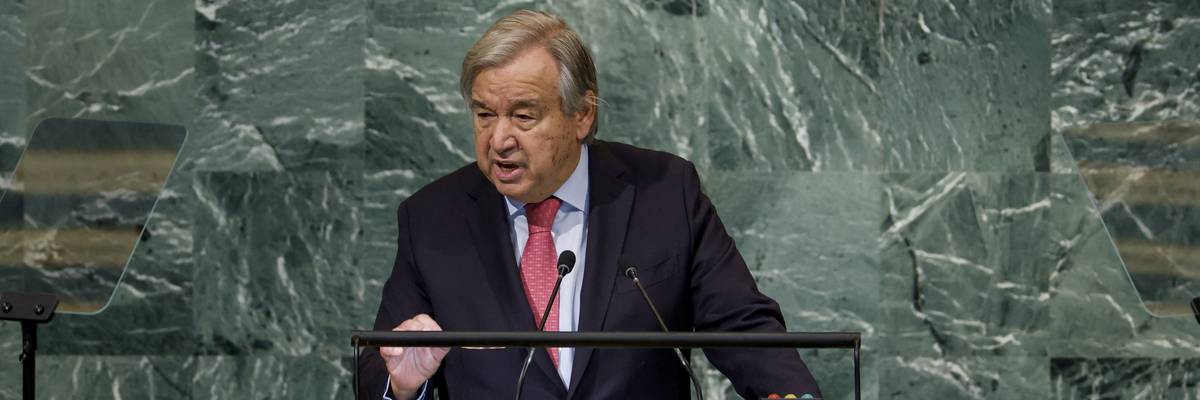
United Nations Secretary General António Guterres speaks during the 77th session of the United Nations General Assembly (UNGA) at the UN headquarters on September 20, 2022 in New York City.
Could the irrationality, lack of knowledge, and limited vision of world leaders destroy the hopes that the world’s people have invested in the UN?
Currently we live in a world bristling with nuclear and conventional weapons—with a potential destructiveness unprecedented in history. A nuclear war, for example, would largely be over in one hour, with each second equivalent in destruction to World War II.
Meanwhile, our security is increasingly threatened by skyrocketing global military expenditure at the same time as the United Nation’s capacity to maintain peace is being undermined by member states starving the organization of funds.
In the aftermath of two world wars, there was considerable hope that humanity would learn its lesson and that each would be “the war to end all wars.” Indeed, the United Nations was created for just this purpose, as stated in the Preamble to its Charter: “We the peoples of the United Nations determined to save succeeding generations from the scourge of war, which twice in our lifetime has brought untold sorrow to mankind…” But hope was not enough.
The Charter’s prescription for preventing violent conflict was a solid one. The states that joined the organization agreed, as an obligation of membership, to resolve their disputes peacefully and to refrain from the threat or use of force against one another.
The UN of today is staggering under the unparalleled expectation that it should be able to deal effectively with a multiplicity of extremely complex problems and that it should somehow be able to do so with resources that are woefully inadequate.
The prescription went beyond the peaceful settlement of disputes to address the root causes of conflict and create conditions for sustainable peace, pledging “to reaffirm our faith in fundamental human rights, in the dignity and worth of the human person, in the equal rights of men and women and of nations large and small, and to establish conditions under which justice and respect for the obligations arising from treaties and other sources of international law can be maintained, and to promote social progress and better standards of life in larger freedom…”
But before this hopeful blueprint could get off the drawing board, a new danger to global peace and security arose:
As the Charter was being negotiated and signed in San Francisco, the atomic bomb was being developed in Los Alamos, New Mexico, a thousand miles away… The first atomic bomb was exploded over Hiroshima on 6 August 1945, just forty-one days after the Charter was signed. By the time the United Nations was established on 24 October 1945, the world that it was to serve had changed in fundamental ways.
Indeed, for the next 45 years, the nuclear threat and the Cold War hung like a pall over the UN, greatly distorting the hopes invested in it by the world’s peoples.
When the Cold War suddenly ended, its legacy of abuse and neglect was not easily swept away. One superpower had bankrupted itself in the headlong race toward military superiority, and the other had spent vast resources developing expensive nuclear weapons.
Meanwhile, large segments of the world’s population lived in extreme poverty and were malnourished, unhealthy, and undereducated. The neglect of demographic and environmental problems led to a whole host of security threats, as underdevelopment, economic stagnation, and rising expectations generated conditions for protest, violence, and intrastate war. There were also new threats, as global warming; deforestation; desertification; degradation of air, soil and water; and loss of biodiversity endangered the health of the planet itself.
In the power vacuum following the Cold War, the UN was no longer sidelined but, instead, required to take center stage. In a short space of time, the expectations, demands, and responsibilities placed on the organization increased dramatically. An organization whose peacekeeping budget was no greater than the budgets of the New York City police and fire departments was asked to become the world’s police and fire department. At the same time, some who clamored for it to play this enhanced role continued to be late in payment of their dues or to withhold them altogether.
The UN of today is staggering under the unparalleled expectation that it should be able to deal effectively with a multiplicity of extremely complex problems and that it should somehow be able to do so with resources that are woefully inadequate.
Even so, over its 81 years, the UN has had many successes, exemplified by the 12 Nobel Peace Prizes awarded to various parts of the organization. Although detailing its work is well beyond the scope of this article, mentioning just a few achievements can provide some context.
At the time of the UN’s creation, almost one-third of the world’s population (750 million people) were under the yoke of colonial rule. Due to UN decolonization efforts, they are now citizens of 80 independent states and UN membership has grown from 51 to 193.
The UN operates at two levels. At the inter-governmental level, it offers venues (through the General Assembly and its committees, the Economic and Social Council and the Security Council) for member states to discuss international problems and take action, when possible. In a world dominated by Westphalian states, whose interests are not always aligned, multilateral decision-making is necessarily slow and cumbersome. But there are many instances where agreements have had far-reaching consequences. An example is the Universal Declaration of Human Rights and its covenants, as well as the many subsequent human rights instruments, including the establishment of mechanisms to monitor and assist their implementation.
Another example is the 2015 Sustainable Development goals and targets, including, “no poverty;” “zero hunger;” “good health and well-being;” “quality education;” “gender equality;” “clean water and sanitation;” “climate action;” “peace, justice, and strong institutions;” and nine others.
UN thematic conferences offer another opportunity for inter-governmental dialogue, with potentially constructive outcomes on issues such as climate change, HIV/AIDs, population and development, women and gender equality, racism, and others.
In a parallel process, the secretary-general, the Secretariat and its departments, as well as UN funds, programmes, and specialized agencies (i.e., the World Food Programme, the Office of the United Nations High Commissioner for Refugees, the United Nations Children’s Fund, the World Health Organization, and many others) fulfill their mandates and implement resolutions of the General Assembly or Security Council around the world.
Throughout the UN’s existence, efforts in preventive diplomacy, peacemaking, peacekeeping, post-conflict peacebuilding, and peace enforcement have prevented and resolved many crises and conflicts. Local UN disarmament initiatives have ensured that conflicts don’t reoccur and international efforts have contributed to nuclear non-proliferation, and to outlawing and monitoring of biological and chemical weapons. Humanitarian efforts have prevented or contained famines, refugee flows, and pandemics. Smallpox has been eradicated, and the end of polio is near. The number of people living in extreme poverty has been halved, access to schooling has massively increased, and maternal mortality slashed. The UN has also played a major role in advancing gender equality.
The International Court of Justice (also part of the UN) has helped create and strengthen international law by providing legally-binding judgments in a host of cases. Treaties, negotiated via the UN, have established new international law, such as the UN Convention on the Law of the Sea, which provides a legal framework for marine and maritime activities.
The UN is also involved in many less recognized efforts, including improving agricultural productivity; codifying principles and techniques of international air navigation; labor issues; standardizing and regulating international telecommunications; protecting intellectual property; offering assistance on migration; promoting peaceful nuclear energy and inhibiting its military use; verifying adherence to the Chemical Weapons Convention; and many others.
But the UN’s most important achievement, as Secretary-General António Guterres has argued, is: “Eight decades later, one can draw a direct line between the creation of the United Nations and the prevention of a third world war.”
Even after the Cold War, states continue to pursue the flawed policy of deterrence and to equate military might with security, in spite of research that arms races increase the likelihood of war and evidence that military spending does not decrease conflict—as the most recent data from the world’s leading source of information on organized violence show.
In 2025, violent conflicts increased to 65, the highest since data collection began in 1946. While most were intrastate conflict, there is also a sharp increase in interstate conflict: “The first decade of the 2000s saw 8 interstate conflicts, while the 2010s saw 12. The 2020s have thus far seen 22.”
Fatalities also increased sharply in 2025 to the second highest since the Rwandan genocide in 1994. The war between Russia and Ukraine was the deadliest in the world for the third consecutive year.
The world’s global military expenditure also increased in 2025 for the 11th consecutive year—to an astonishing 2.9 trillion dollars. If similar increases continue, and NATO countries enlarge their expenditure to 5% as pledged, global military spending could reach 6.6 trillion by 2035—five times the level at the end of the Cold War.
Do we really want or need more weapons and more wars? Shouldn’t we, instead, choose cooperative security, collective security, and human security, as represented by the United Nations?
The current US military budget is a jaw-dropping $1 trillion, but the Trump administration is requesting a whopping increase to $1.5 trillion for 2027. Thus, if global military expenditure increases as predicted, the US $1.5 trillion (if approved) would account for nearly half of the entire world’s military expenditure.
Although the US government frames security threats from China and Russia as the main reason for its sky-high military budget, Russia’s military expenditure for 2025 was $190 billion, less than one-fifth of that of the US. China, the world’s second largest military spender, was $336 billion—about one-third of the US military budget.
As the secretary-general concludes, “Despite rising expenditures… global security has continued to deteriorate, calling into question the effectiveness of more military spending to enhance security.”
Do we really want or need more weapons and more wars? Shouldn’t we, instead, choose cooperative security, collective security, and human security, as represented by the United Nations?
Regrettably, we haven’t. Because of unpaid bills from 2025, in January 2026, Guterres sent a letter to member states warning of “imminent financial collapse” if dues were not paid on time. By February 8, the due date for membership contributions to the regular budget, only 55 countries had paid and, even now, neither the US nor China, the UN’s biggest contributors, have paid all of their dues. In July, the UN controller reported: “We don’t have enough cash beyond August. Unless its big donors step up, the UN will have to delay other payments to afford its High-Level Week of the General Assembly” (September 22-28 this year). To address last year’s shortfall, the UN’s regular budget was reduced by 15% in 2026 to 3.45 billion—making the world’s military expenditure 840 times that of the UN regular budget.
In a recent review of where the international order is headed, Brookings scholars conclude, “Whether the Trump administration moves aggressively enough to shatter what’s left of the multilateral order remains to be seen; there’s no evidence of what would replace it beyond unfettered American power.”
However, as A New Agenda for Peace notes: “War is always a choice… if war is a choice, peace can be too. It is time for a recommitment to peace.” It is also time to commit to revitalizing and reforming the United Nations to meet the needs of the future. As the UN secretary-general has stated, “Rebalancing global priorities... is an imperative for humanity to survive.”
Of course, this also depends on the informed participation of citizens and civil society (that means us), who must ensure that the public resources we give our governments to spend on our behalf are used in ways that bring us genuine security. We can’t let the world’s misguided leaders throw the United Nations off the cliff—and, while we’re at it, we must also ensure that we don’t sleepwalk into Armageddon.
Dear Common Dreams reader, It’s been nearly 30 years since I co-founded Common Dreams with my late wife, Lina Newhouser. We had the radical notion that journalism should serve the public good, not corporate profits. It was clear to us from the outset what it would take to build such a project. No paid advertisements. No corporate sponsors. No millionaire publisher telling us what to think or do. Many people said we wouldn't last a year, but we proved those doubters wrong. Together with a tremendous team of journalists and dedicated staff, we built an independent media outlet free from the constraints of profits and corporate control. Our mission has always been simple: To inform. To inspire. To ignite change for the common good. Building Common Dreams was not easy. Our survival was never guaranteed. When you take on the most powerful forces—Wall Street greed, fossil fuel industry destruction, Big Tech lobbyists, and uber-rich oligarchs who have spent billions upon billions rigging the economy and democracy in their favor—the only bulwark you have is supporters who believe in your work. But here’s the urgent message from me today. It's never been this bad out there. And it's never been this hard to keep us going. At the very moment Common Dreams is most needed, the threats we face are intensifying. We need your support now more than ever. We don't accept corporate advertising and never will. We don't have a paywall because we don't think people should be blocked from critical news based on their ability to pay. Everything we do is funded by the donations of readers like you. When everyone does the little they can afford, we are strong. But if that support retreats or dries up, so do we. Will you donate now to make sure Common Dreams not only survives but thrives? —Craig Brown, Co-founder |
Currently we live in a world bristling with nuclear and conventional weapons—with a potential destructiveness unprecedented in history. A nuclear war, for example, would largely be over in one hour, with each second equivalent in destruction to World War II.
Meanwhile, our security is increasingly threatened by skyrocketing global military expenditure at the same time as the United Nation’s capacity to maintain peace is being undermined by member states starving the organization of funds.
In the aftermath of two world wars, there was considerable hope that humanity would learn its lesson and that each would be “the war to end all wars.” Indeed, the United Nations was created for just this purpose, as stated in the Preamble to its Charter: “We the peoples of the United Nations determined to save succeeding generations from the scourge of war, which twice in our lifetime has brought untold sorrow to mankind…” But hope was not enough.
The Charter’s prescription for preventing violent conflict was a solid one. The states that joined the organization agreed, as an obligation of membership, to resolve their disputes peacefully and to refrain from the threat or use of force against one another.
The UN of today is staggering under the unparalleled expectation that it should be able to deal effectively with a multiplicity of extremely complex problems and that it should somehow be able to do so with resources that are woefully inadequate.
The prescription went beyond the peaceful settlement of disputes to address the root causes of conflict and create conditions for sustainable peace, pledging “to reaffirm our faith in fundamental human rights, in the dignity and worth of the human person, in the equal rights of men and women and of nations large and small, and to establish conditions under which justice and respect for the obligations arising from treaties and other sources of international law can be maintained, and to promote social progress and better standards of life in larger freedom…”
But before this hopeful blueprint could get off the drawing board, a new danger to global peace and security arose:
As the Charter was being negotiated and signed in San Francisco, the atomic bomb was being developed in Los Alamos, New Mexico, a thousand miles away… The first atomic bomb was exploded over Hiroshima on 6 August 1945, just forty-one days after the Charter was signed. By the time the United Nations was established on 24 October 1945, the world that it was to serve had changed in fundamental ways.
Indeed, for the next 45 years, the nuclear threat and the Cold War hung like a pall over the UN, greatly distorting the hopes invested in it by the world’s peoples.
When the Cold War suddenly ended, its legacy of abuse and neglect was not easily swept away. One superpower had bankrupted itself in the headlong race toward military superiority, and the other had spent vast resources developing expensive nuclear weapons.
Meanwhile, large segments of the world’s population lived in extreme poverty and were malnourished, unhealthy, and undereducated. The neglect of demographic and environmental problems led to a whole host of security threats, as underdevelopment, economic stagnation, and rising expectations generated conditions for protest, violence, and intrastate war. There were also new threats, as global warming; deforestation; desertification; degradation of air, soil and water; and loss of biodiversity endangered the health of the planet itself.
In the power vacuum following the Cold War, the UN was no longer sidelined but, instead, required to take center stage. In a short space of time, the expectations, demands, and responsibilities placed on the organization increased dramatically. An organization whose peacekeeping budget was no greater than the budgets of the New York City police and fire departments was asked to become the world’s police and fire department. At the same time, some who clamored for it to play this enhanced role continued to be late in payment of their dues or to withhold them altogether.
The UN of today is staggering under the unparalleled expectation that it should be able to deal effectively with a multiplicity of extremely complex problems and that it should somehow be able to do so with resources that are woefully inadequate.
Even so, over its 81 years, the UN has had many successes, exemplified by the 12 Nobel Peace Prizes awarded to various parts of the organization. Although detailing its work is well beyond the scope of this article, mentioning just a few achievements can provide some context.
At the time of the UN’s creation, almost one-third of the world’s population (750 million people) were under the yoke of colonial rule. Due to UN decolonization efforts, they are now citizens of 80 independent states and UN membership has grown from 51 to 193.
The UN operates at two levels. At the inter-governmental level, it offers venues (through the General Assembly and its committees, the Economic and Social Council and the Security Council) for member states to discuss international problems and take action, when possible. In a world dominated by Westphalian states, whose interests are not always aligned, multilateral decision-making is necessarily slow and cumbersome. But there are many instances where agreements have had far-reaching consequences. An example is the Universal Declaration of Human Rights and its covenants, as well as the many subsequent human rights instruments, including the establishment of mechanisms to monitor and assist their implementation.
Another example is the 2015 Sustainable Development goals and targets, including, “no poverty;” “zero hunger;” “good health and well-being;” “quality education;” “gender equality;” “clean water and sanitation;” “climate action;” “peace, justice, and strong institutions;” and nine others.
UN thematic conferences offer another opportunity for inter-governmental dialogue, with potentially constructive outcomes on issues such as climate change, HIV/AIDs, population and development, women and gender equality, racism, and others.
In a parallel process, the secretary-general, the Secretariat and its departments, as well as UN funds, programmes, and specialized agencies (i.e., the World Food Programme, the Office of the United Nations High Commissioner for Refugees, the United Nations Children’s Fund, the World Health Organization, and many others) fulfill their mandates and implement resolutions of the General Assembly or Security Council around the world.
Throughout the UN’s existence, efforts in preventive diplomacy, peacemaking, peacekeeping, post-conflict peacebuilding, and peace enforcement have prevented and resolved many crises and conflicts. Local UN disarmament initiatives have ensured that conflicts don’t reoccur and international efforts have contributed to nuclear non-proliferation, and to outlawing and monitoring of biological and chemical weapons. Humanitarian efforts have prevented or contained famines, refugee flows, and pandemics. Smallpox has been eradicated, and the end of polio is near. The number of people living in extreme poverty has been halved, access to schooling has massively increased, and maternal mortality slashed. The UN has also played a major role in advancing gender equality.
The International Court of Justice (also part of the UN) has helped create and strengthen international law by providing legally-binding judgments in a host of cases. Treaties, negotiated via the UN, have established new international law, such as the UN Convention on the Law of the Sea, which provides a legal framework for marine and maritime activities.
The UN is also involved in many less recognized efforts, including improving agricultural productivity; codifying principles and techniques of international air navigation; labor issues; standardizing and regulating international telecommunications; protecting intellectual property; offering assistance on migration; promoting peaceful nuclear energy and inhibiting its military use; verifying adherence to the Chemical Weapons Convention; and many others.
But the UN’s most important achievement, as Secretary-General António Guterres has argued, is: “Eight decades later, one can draw a direct line between the creation of the United Nations and the prevention of a third world war.”
Even after the Cold War, states continue to pursue the flawed policy of deterrence and to equate military might with security, in spite of research that arms races increase the likelihood of war and evidence that military spending does not decrease conflict—as the most recent data from the world’s leading source of information on organized violence show.
In 2025, violent conflicts increased to 65, the highest since data collection began in 1946. While most were intrastate conflict, there is also a sharp increase in interstate conflict: “The first decade of the 2000s saw 8 interstate conflicts, while the 2010s saw 12. The 2020s have thus far seen 22.”
Fatalities also increased sharply in 2025 to the second highest since the Rwandan genocide in 1994. The war between Russia and Ukraine was the deadliest in the world for the third consecutive year.
The world’s global military expenditure also increased in 2025 for the 11th consecutive year—to an astonishing 2.9 trillion dollars. If similar increases continue, and NATO countries enlarge their expenditure to 5% as pledged, global military spending could reach 6.6 trillion by 2035—five times the level at the end of the Cold War.
Do we really want or need more weapons and more wars? Shouldn’t we, instead, choose cooperative security, collective security, and human security, as represented by the United Nations?
The current US military budget is a jaw-dropping $1 trillion, but the Trump administration is requesting a whopping increase to $1.5 trillion for 2027. Thus, if global military expenditure increases as predicted, the US $1.5 trillion (if approved) would account for nearly half of the entire world’s military expenditure.
Although the US government frames security threats from China and Russia as the main reason for its sky-high military budget, Russia’s military expenditure for 2025 was $190 billion, less than one-fifth of that of the US. China, the world’s second largest military spender, was $336 billion—about one-third of the US military budget.
As the secretary-general concludes, “Despite rising expenditures… global security has continued to deteriorate, calling into question the effectiveness of more military spending to enhance security.”
Do we really want or need more weapons and more wars? Shouldn’t we, instead, choose cooperative security, collective security, and human security, as represented by the United Nations?
Regrettably, we haven’t. Because of unpaid bills from 2025, in January 2026, Guterres sent a letter to member states warning of “imminent financial collapse” if dues were not paid on time. By February 8, the due date for membership contributions to the regular budget, only 55 countries had paid and, even now, neither the US nor China, the UN’s biggest contributors, have paid all of their dues. In July, the UN controller reported: “We don’t have enough cash beyond August. Unless its big donors step up, the UN will have to delay other payments to afford its High-Level Week of the General Assembly” (September 22-28 this year). To address last year’s shortfall, the UN’s regular budget was reduced by 15% in 2026 to 3.45 billion—making the world’s military expenditure 840 times that of the UN regular budget.
In a recent review of where the international order is headed, Brookings scholars conclude, “Whether the Trump administration moves aggressively enough to shatter what’s left of the multilateral order remains to be seen; there’s no evidence of what would replace it beyond unfettered American power.”
However, as A New Agenda for Peace notes: “War is always a choice… if war is a choice, peace can be too. It is time for a recommitment to peace.” It is also time to commit to revitalizing and reforming the United Nations to meet the needs of the future. As the UN secretary-general has stated, “Rebalancing global priorities... is an imperative for humanity to survive.”
Of course, this also depends on the informed participation of citizens and civil society (that means us), who must ensure that the public resources we give our governments to spend on our behalf are used in ways that bring us genuine security. We can’t let the world’s misguided leaders throw the United Nations off the cliff—and, while we’re at it, we must also ensure that we don’t sleepwalk into Armageddon.
Currently we live in a world bristling with nuclear and conventional weapons—with a potential destructiveness unprecedented in history. A nuclear war, for example, would largely be over in one hour, with each second equivalent in destruction to World War II.
Meanwhile, our security is increasingly threatened by skyrocketing global military expenditure at the same time as the United Nation’s capacity to maintain peace is being undermined by member states starving the organization of funds.
In the aftermath of two world wars, there was considerable hope that humanity would learn its lesson and that each would be “the war to end all wars.” Indeed, the United Nations was created for just this purpose, as stated in the Preamble to its Charter: “We the peoples of the United Nations determined to save succeeding generations from the scourge of war, which twice in our lifetime has brought untold sorrow to mankind…” But hope was not enough.
The Charter’s prescription for preventing violent conflict was a solid one. The states that joined the organization agreed, as an obligation of membership, to resolve their disputes peacefully and to refrain from the threat or use of force against one another.
The UN of today is staggering under the unparalleled expectation that it should be able to deal effectively with a multiplicity of extremely complex problems and that it should somehow be able to do so with resources that are woefully inadequate.
The prescription went beyond the peaceful settlement of disputes to address the root causes of conflict and create conditions for sustainable peace, pledging “to reaffirm our faith in fundamental human rights, in the dignity and worth of the human person, in the equal rights of men and women and of nations large and small, and to establish conditions under which justice and respect for the obligations arising from treaties and other sources of international law can be maintained, and to promote social progress and better standards of life in larger freedom…”
But before this hopeful blueprint could get off the drawing board, a new danger to global peace and security arose:
As the Charter was being negotiated and signed in San Francisco, the atomic bomb was being developed in Los Alamos, New Mexico, a thousand miles away… The first atomic bomb was exploded over Hiroshima on 6 August 1945, just forty-one days after the Charter was signed. By the time the United Nations was established on 24 October 1945, the world that it was to serve had changed in fundamental ways.
Indeed, for the next 45 years, the nuclear threat and the Cold War hung like a pall over the UN, greatly distorting the hopes invested in it by the world’s peoples.
When the Cold War suddenly ended, its legacy of abuse and neglect was not easily swept away. One superpower had bankrupted itself in the headlong race toward military superiority, and the other had spent vast resources developing expensive nuclear weapons.
Meanwhile, large segments of the world’s population lived in extreme poverty and were malnourished, unhealthy, and undereducated. The neglect of demographic and environmental problems led to a whole host of security threats, as underdevelopment, economic stagnation, and rising expectations generated conditions for protest, violence, and intrastate war. There were also new threats, as global warming; deforestation; desertification; degradation of air, soil and water; and loss of biodiversity endangered the health of the planet itself.
In the power vacuum following the Cold War, the UN was no longer sidelined but, instead, required to take center stage. In a short space of time, the expectations, demands, and responsibilities placed on the organization increased dramatically. An organization whose peacekeeping budget was no greater than the budgets of the New York City police and fire departments was asked to become the world’s police and fire department. At the same time, some who clamored for it to play this enhanced role continued to be late in payment of their dues or to withhold them altogether.
The UN of today is staggering under the unparalleled expectation that it should be able to deal effectively with a multiplicity of extremely complex problems and that it should somehow be able to do so with resources that are woefully inadequate.
Even so, over its 81 years, the UN has had many successes, exemplified by the 12 Nobel Peace Prizes awarded to various parts of the organization. Although detailing its work is well beyond the scope of this article, mentioning just a few achievements can provide some context.
At the time of the UN’s creation, almost one-third of the world’s population (750 million people) were under the yoke of colonial rule. Due to UN decolonization efforts, they are now citizens of 80 independent states and UN membership has grown from 51 to 193.
The UN operates at two levels. At the inter-governmental level, it offers venues (through the General Assembly and its committees, the Economic and Social Council and the Security Council) for member states to discuss international problems and take action, when possible. In a world dominated by Westphalian states, whose interests are not always aligned, multilateral decision-making is necessarily slow and cumbersome. But there are many instances where agreements have had far-reaching consequences. An example is the Universal Declaration of Human Rights and its covenants, as well as the many subsequent human rights instruments, including the establishment of mechanisms to monitor and assist their implementation.
Another example is the 2015 Sustainable Development goals and targets, including, “no poverty;” “zero hunger;” “good health and well-being;” “quality education;” “gender equality;” “clean water and sanitation;” “climate action;” “peace, justice, and strong institutions;” and nine others.
UN thematic conferences offer another opportunity for inter-governmental dialogue, with potentially constructive outcomes on issues such as climate change, HIV/AIDs, population and development, women and gender equality, racism, and others.
In a parallel process, the secretary-general, the Secretariat and its departments, as well as UN funds, programmes, and specialized agencies (i.e., the World Food Programme, the Office of the United Nations High Commissioner for Refugees, the United Nations Children’s Fund, the World Health Organization, and many others) fulfill their mandates and implement resolutions of the General Assembly or Security Council around the world.
Throughout the UN’s existence, efforts in preventive diplomacy, peacemaking, peacekeeping, post-conflict peacebuilding, and peace enforcement have prevented and resolved many crises and conflicts. Local UN disarmament initiatives have ensured that conflicts don’t reoccur and international efforts have contributed to nuclear non-proliferation, and to outlawing and monitoring of biological and chemical weapons. Humanitarian efforts have prevented or contained famines, refugee flows, and pandemics. Smallpox has been eradicated, and the end of polio is near. The number of people living in extreme poverty has been halved, access to schooling has massively increased, and maternal mortality slashed. The UN has also played a major role in advancing gender equality.
The International Court of Justice (also part of the UN) has helped create and strengthen international law by providing legally-binding judgments in a host of cases. Treaties, negotiated via the UN, have established new international law, such as the UN Convention on the Law of the Sea, which provides a legal framework for marine and maritime activities.
The UN is also involved in many less recognized efforts, including improving agricultural productivity; codifying principles and techniques of international air navigation; labor issues; standardizing and regulating international telecommunications; protecting intellectual property; offering assistance on migration; promoting peaceful nuclear energy and inhibiting its military use; verifying adherence to the Chemical Weapons Convention; and many others.
But the UN’s most important achievement, as Secretary-General António Guterres has argued, is: “Eight decades later, one can draw a direct line between the creation of the United Nations and the prevention of a third world war.”
Even after the Cold War, states continue to pursue the flawed policy of deterrence and to equate military might with security, in spite of research that arms races increase the likelihood of war and evidence that military spending does not decrease conflict—as the most recent data from the world’s leading source of information on organized violence show.
In 2025, violent conflicts increased to 65, the highest since data collection began in 1946. While most were intrastate conflict, there is also a sharp increase in interstate conflict: “The first decade of the 2000s saw 8 interstate conflicts, while the 2010s saw 12. The 2020s have thus far seen 22.”
Fatalities also increased sharply in 2025 to the second highest since the Rwandan genocide in 1994. The war between Russia and Ukraine was the deadliest in the world for the third consecutive year.
The world’s global military expenditure also increased in 2025 for the 11th consecutive year—to an astonishing 2.9 trillion dollars. If similar increases continue, and NATO countries enlarge their expenditure to 5% as pledged, global military spending could reach 6.6 trillion by 2035—five times the level at the end of the Cold War.
Do we really want or need more weapons and more wars? Shouldn’t we, instead, choose cooperative security, collective security, and human security, as represented by the United Nations?
The current US military budget is a jaw-dropping $1 trillion, but the Trump administration is requesting a whopping increase to $1.5 trillion for 2027. Thus, if global military expenditure increases as predicted, the US $1.5 trillion (if approved) would account for nearly half of the entire world’s military expenditure.
Although the US government frames security threats from China and Russia as the main reason for its sky-high military budget, Russia’s military expenditure for 2025 was $190 billion, less than one-fifth of that of the US. China, the world’s second largest military spender, was $336 billion—about one-third of the US military budget.
As the secretary-general concludes, “Despite rising expenditures… global security has continued to deteriorate, calling into question the effectiveness of more military spending to enhance security.”
Do we really want or need more weapons and more wars? Shouldn’t we, instead, choose cooperative security, collective security, and human security, as represented by the United Nations?
Regrettably, we haven’t. Because of unpaid bills from 2025, in January 2026, Guterres sent a letter to member states warning of “imminent financial collapse” if dues were not paid on time. By February 8, the due date for membership contributions to the regular budget, only 55 countries had paid and, even now, neither the US nor China, the UN’s biggest contributors, have paid all of their dues. In July, the UN controller reported: “We don’t have enough cash beyond August. Unless its big donors step up, the UN will have to delay other payments to afford its High-Level Week of the General Assembly” (September 22-28 this year). To address last year’s shortfall, the UN’s regular budget was reduced by 15% in 2026 to 3.45 billion—making the world’s military expenditure 840 times that of the UN regular budget.
In a recent review of where the international order is headed, Brookings scholars conclude, “Whether the Trump administration moves aggressively enough to shatter what’s left of the multilateral order remains to be seen; there’s no evidence of what would replace it beyond unfettered American power.”
However, as A New Agenda for Peace notes: “War is always a choice… if war is a choice, peace can be too. It is time for a recommitment to peace.” It is also time to commit to revitalizing and reforming the United Nations to meet the needs of the future. As the UN secretary-general has stated, “Rebalancing global priorities... is an imperative for humanity to survive.”
Of course, this also depends on the informed participation of citizens and civil society (that means us), who must ensure that the public resources we give our governments to spend on our behalf are used in ways that bring us genuine security. We can’t let the world’s misguided leaders throw the United Nations off the cliff—and, while we’re at it, we must also ensure that we don’t sleepwalk into Armageddon.