SUBSCRIBE TO OUR FREE NEWSLETTER
Daily news & progressive opinion—funded by the people, not the corporations—delivered straight to your inbox.
5
#000000
#FFFFFF
To donate by check, phone, or other method, see our More Ways to Give page.
Daily news & progressive opinion—funded by the people, not the corporations—delivered straight to your inbox.
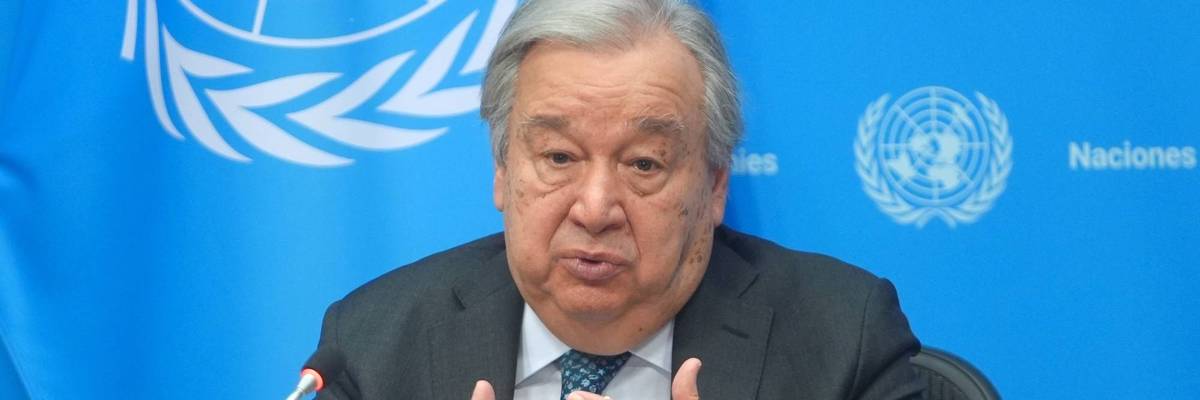
United Nations Secretary-General António Guterres holds a press briefing outlining his priorities for 2026 at the United Nations headquarters in New York, United States, on January 29, 2026.
As the world's largest economy, the US provided nearly a quarter of the UN's funding. That is, until earlier this month, when Trump stripped hundreds of millions of dollars from dozens of treaties.
Weeks after President Donald Trump withdrew the US from dozens of United Nations organizations, the UN's chief warns that the UN is at risk of an "imminent financial collapse."
"The crisis is deepening, threatening program delivery and risking financial collapse. And the situation will deteriorate further in the near future," UN Secretary-General António Guterres wrote in a letter to ambassadors dated January 28, according to a Friday report from Reuters.
While he did not reference the United States explicitly, Guterres called out the fact that "decisions not to honor assessed contributions that finance a significant share of the approved regular budget have now been formally announced," which almost certainly referenced Trump's pullout from at least 66 international treaties earlier this month, including 31 within the UN system.
With the stroke of a pen, Trump reneged on the US commitment to the UN Framework Convention on Climate Change, which it has been part of for more than 30 years. He also took the US out of the UN International Law Commission, the UN Democracy Fund, UN Oceans, UN Women, and dozens of other global bodies, deeming them "contrary to the interests of the United States."
As the world's largest economy, the US was the largest source of funding for the UN, providing 22% of its regular and peacekeeping budgets as of 2025—about $820 million per year.
The largest single financial cut as a result of the US pullout was the termination of dozens of grants worth approximately $377 million for the UN Population Fund, which focuses on family planning and preventing maternal mortality and sexual violence in developing nations. The organization is estimated to have prevented 39,000 maternal deaths and 18 million unwanted pregnancies in 2024, according to an annual report.
Warning that cash could run out by July, Guterres said, “Either all member states honor their obligations to pay in full and on time–or member states must fundamentally overhaul our financial rules to prevent an imminent financial collapse."
Dear Common Dreams reader, It’s been nearly 30 years since I co-founded Common Dreams with my late wife, Lina Newhouser. We had the radical notion that journalism should serve the public good, not corporate profits. It was clear to us from the outset what it would take to build such a project. No paid advertisements. No corporate sponsors. No millionaire publisher telling us what to think or do. Many people said we wouldn't last a year, but we proved those doubters wrong. Together with a tremendous team of journalists and dedicated staff, we built an independent media outlet free from the constraints of profits and corporate control. Our mission has always been simple: To inform. To inspire. To ignite change for the common good. Building Common Dreams was not easy. Our survival was never guaranteed. When you take on the most powerful forces—Wall Street greed, fossil fuel industry destruction, Big Tech lobbyists, and uber-rich oligarchs who have spent billions upon billions rigging the economy and democracy in their favor—the only bulwark you have is supporters who believe in your work. But here’s the urgent message from me today. It's never been this bad out there. And it's never been this hard to keep us going. At the very moment Common Dreams is most needed, the threats we face are intensifying. We need your support now more than ever. We don't accept corporate advertising and never will. We don't have a paywall because we don't think people should be blocked from critical news based on their ability to pay. Everything we do is funded by the donations of readers like you. When everyone does the little they can afford, we are strong. But if that support retreats or dries up, so do we. Will you donate now to make sure Common Dreams not only survives but thrives? —Craig Brown, Co-founder |
Weeks after President Donald Trump withdrew the US from dozens of United Nations organizations, the UN's chief warns that the UN is at risk of an "imminent financial collapse."
"The crisis is deepening, threatening program delivery and risking financial collapse. And the situation will deteriorate further in the near future," UN Secretary-General António Guterres wrote in a letter to ambassadors dated January 28, according to a Friday report from Reuters.
While he did not reference the United States explicitly, Guterres called out the fact that "decisions not to honor assessed contributions that finance a significant share of the approved regular budget have now been formally announced," which almost certainly referenced Trump's pullout from at least 66 international treaties earlier this month, including 31 within the UN system.
With the stroke of a pen, Trump reneged on the US commitment to the UN Framework Convention on Climate Change, which it has been part of for more than 30 years. He also took the US out of the UN International Law Commission, the UN Democracy Fund, UN Oceans, UN Women, and dozens of other global bodies, deeming them "contrary to the interests of the United States."
As the world's largest economy, the US was the largest source of funding for the UN, providing 22% of its regular and peacekeeping budgets as of 2025—about $820 million per year.
The largest single financial cut as a result of the US pullout was the termination of dozens of grants worth approximately $377 million for the UN Population Fund, which focuses on family planning and preventing maternal mortality and sexual violence in developing nations. The organization is estimated to have prevented 39,000 maternal deaths and 18 million unwanted pregnancies in 2024, according to an annual report.
Warning that cash could run out by July, Guterres said, “Either all member states honor their obligations to pay in full and on time–or member states must fundamentally overhaul our financial rules to prevent an imminent financial collapse."
Weeks after President Donald Trump withdrew the US from dozens of United Nations organizations, the UN's chief warns that the UN is at risk of an "imminent financial collapse."
"The crisis is deepening, threatening program delivery and risking financial collapse. And the situation will deteriorate further in the near future," UN Secretary-General António Guterres wrote in a letter to ambassadors dated January 28, according to a Friday report from Reuters.
While he did not reference the United States explicitly, Guterres called out the fact that "decisions not to honor assessed contributions that finance a significant share of the approved regular budget have now been formally announced," which almost certainly referenced Trump's pullout from at least 66 international treaties earlier this month, including 31 within the UN system.
With the stroke of a pen, Trump reneged on the US commitment to the UN Framework Convention on Climate Change, which it has been part of for more than 30 years. He also took the US out of the UN International Law Commission, the UN Democracy Fund, UN Oceans, UN Women, and dozens of other global bodies, deeming them "contrary to the interests of the United States."
As the world's largest economy, the US was the largest source of funding for the UN, providing 22% of its regular and peacekeeping budgets as of 2025—about $820 million per year.
The largest single financial cut as a result of the US pullout was the termination of dozens of grants worth approximately $377 million for the UN Population Fund, which focuses on family planning and preventing maternal mortality and sexual violence in developing nations. The organization is estimated to have prevented 39,000 maternal deaths and 18 million unwanted pregnancies in 2024, according to an annual report.
Warning that cash could run out by July, Guterres said, “Either all member states honor their obligations to pay in full and on time–or member states must fundamentally overhaul our financial rules to prevent an imminent financial collapse."