SUBSCRIBE TO OUR FREE NEWSLETTER
Daily news & progressive opinion—funded by the people, not the corporations—delivered straight to your inbox.
5
#000000
#FFFFFF
To donate by check, phone, or other method, see our More Ways to Give page.
Daily news & progressive opinion—funded by the people, not the corporations—delivered straight to your inbox.
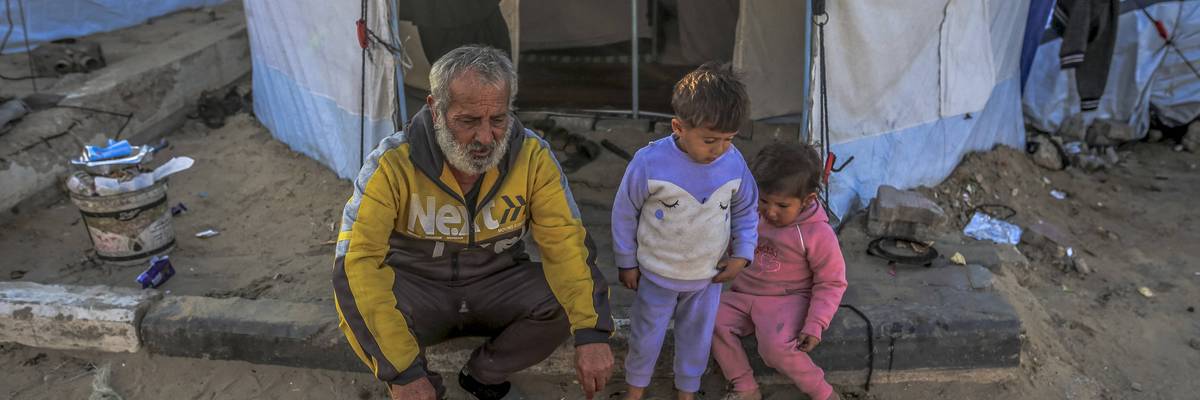
Displaced Palestinians gather around a fire to keep warm along the Gaza Port on January 16, 2026, after severe winter winds struck the enclave.
A UN official said a proposal to provide food, water, medicine, and shelter to tens of millions of those facing war and poverty could have been funded “in less than a fortnight of this reckless war.”
US President Donald Trump’s war in Iran is costing nearly $2 billion per day, according to a Harvard analysis based on estimates from the Pentagon. The head of the United Nations’ humanitarian agency said the money could instead be used to save more than 87 million lives around the world.
Tom Fletcher, the undersecretary-general for humanitarian affairs and emergency relief coordinator at the UN Office for the Coordination of Humanitarian Affairs (OCHA), spoke at Chatham House on Monday about a “cataclysmic” funding crisis for the UN, in large part due to the termination of billions of dollars in funding from the US and other major powers such as the UK. Fletcher said his agency has seen its budget cut by around 50%.
"We're already overstretched, underresourced, and literally under attack," Fletcher said, citing the more than 1,000 humanitarians who have been killed in conflicts around the world over the past three years.
The Iran war, launched at the end of February by the US and Israel, Fletcher said, has stretched UN budgets even further, both by causing chaos within Iran and Lebanon—where more than 5,000 people in total have been killed, including thousands of civilians, and more than 4 million displaced collectively—but also by creating economic upheaval that has exacerbated crises elsewhere.
"You have the [Strait] of Hormuz—fuel prices up 20%, food prices up almost 20%, our humanitarian convoys blocked," Fletcher said. "We've had to take those convoys by air and by land. And the impact, which I think we'll be feeling for years, of those price rises on Sub-Saharan and East Africa, pushing way more people into poverty."
Fletcher said that just a fraction of what the US has spent waging the war could have been used to provide a full year of funding for a plan he laid out in January to provide lifesaving food, water, medicine, and shelter to those in dozens of countries facing war and poverty.
“For every day of this conflict, $2 billion is being spent. My entire target for a hyper-prioritized plan to save 87 million lives is $23 billion," he said. "We could have funded that in less than a fortnight of this reckless war. Now, of course, we cannot.”
Beyond the financial toll, he said, US actions may have done irreparable damage to the authority of international humanitarian law and to UN bodies tasked with enforcing it.
He noted the dramatic increase in the number of humanitarian workers killed around the world over the past three years. According to a UN report earlier this month, of the more than 1,010 of them who were killed in the line of duty, over half were killed during Israel's genocide in Gaza and escalating attacks in the West Bank.
"A thousand dead humanitarians in three years," Fletcher said. "When did that become normal?"
He called out the UN Security Council, where the US is one of the permanent members with veto power, for its weak responses to the killing of humanitarians and other flagrant violations of the laws of war.
"Don't just give us a generic statement where you say humanitarian workers should be protected," he said. "Make the phone call, call out the people killing us, stop arming those who are doing it."
He said "big powers" view geopolitics in a highly "transactional" way and do not use the Security Council as a mechanism for defending international humanitarian law.
"I wouldn't have thought I'd need to say that a couple of years ago, that the Security Council should be defending international humanitarian law, and yet here we are," he said.
He said that Trump’s recent violent rhetoric toward Iran—which again verged into outright genocidal territory over the weekend when he pledged to “blow up the entire country” with overwhelming attacks on civilian infrastructure—has only further corroded international law.
“The idea that suddenly it’s okay to say, ‘We’re going to blow stuff up,’ ‘We’re going to bomb you back to the Stone Age,’ ‘We’re going to destroy your civilization,’ that kind of language is really dangerous,” Fletcher said. “It gives more freedom to all the other wannabe autocrats around the world to use that sort of language.”
But he said the aggression of the US and its allies has also made the world more warlike and less "generous," leading countries to put more money into defense that could otherwise go toward alleviating global suffering.
"Whether you're making the cuts [to UN funding] for ideological reasons or because you're too busy bombing someone else or because now you feel more insecure at home and so you have to invest more of your money in defense and less in generosity," he said, "all of that ultimately has an impact on the over 300 million people that we're here to serve."
Dear Common Dreams reader, It’s been nearly 30 years since I co-founded Common Dreams with my late wife, Lina Newhouser. We had the radical notion that journalism should serve the public good, not corporate profits. It was clear to us from the outset what it would take to build such a project. No paid advertisements. No corporate sponsors. No millionaire publisher telling us what to think or do. Many people said we wouldn't last a year, but we proved those doubters wrong. Together with a tremendous team of journalists and dedicated staff, we built an independent media outlet free from the constraints of profits and corporate control. Our mission has always been simple: To inform. To inspire. To ignite change for the common good. Building Common Dreams was not easy. Our survival was never guaranteed. When you take on the most powerful forces—Wall Street greed, fossil fuel industry destruction, Big Tech lobbyists, and uber-rich oligarchs who have spent billions upon billions rigging the economy and democracy in their favor—the only bulwark you have is supporters who believe in your work. But here’s the urgent message from me today. It's never been this bad out there. And it's never been this hard to keep us going. At the very moment Common Dreams is most needed, the threats we face are intensifying. We need your support now more than ever. We don't accept corporate advertising and never will. We don't have a paywall because we don't think people should be blocked from critical news based on their ability to pay. Everything we do is funded by the donations of readers like you. When everyone does the little they can afford, we are strong. But if that support retreats or dries up, so do we. Will you donate now to make sure Common Dreams not only survives but thrives? —Craig Brown, Co-founder |
US President Donald Trump’s war in Iran is costing nearly $2 billion per day, according to a Harvard analysis based on estimates from the Pentagon. The head of the United Nations’ humanitarian agency said the money could instead be used to save more than 87 million lives around the world.
Tom Fletcher, the undersecretary-general for humanitarian affairs and emergency relief coordinator at the UN Office for the Coordination of Humanitarian Affairs (OCHA), spoke at Chatham House on Monday about a “cataclysmic” funding crisis for the UN, in large part due to the termination of billions of dollars in funding from the US and other major powers such as the UK. Fletcher said his agency has seen its budget cut by around 50%.
"We're already overstretched, underresourced, and literally under attack," Fletcher said, citing the more than 1,000 humanitarians who have been killed in conflicts around the world over the past three years.
The Iran war, launched at the end of February by the US and Israel, Fletcher said, has stretched UN budgets even further, both by causing chaos within Iran and Lebanon—where more than 5,000 people in total have been killed, including thousands of civilians, and more than 4 million displaced collectively—but also by creating economic upheaval that has exacerbated crises elsewhere.
"You have the [Strait] of Hormuz—fuel prices up 20%, food prices up almost 20%, our humanitarian convoys blocked," Fletcher said. "We've had to take those convoys by air and by land. And the impact, which I think we'll be feeling for years, of those price rises on Sub-Saharan and East Africa, pushing way more people into poverty."
Fletcher said that just a fraction of what the US has spent waging the war could have been used to provide a full year of funding for a plan he laid out in January to provide lifesaving food, water, medicine, and shelter to those in dozens of countries facing war and poverty.
“For every day of this conflict, $2 billion is being spent. My entire target for a hyper-prioritized plan to save 87 million lives is $23 billion," he said. "We could have funded that in less than a fortnight of this reckless war. Now, of course, we cannot.”
Beyond the financial toll, he said, US actions may have done irreparable damage to the authority of international humanitarian law and to UN bodies tasked with enforcing it.
He noted the dramatic increase in the number of humanitarian workers killed around the world over the past three years. According to a UN report earlier this month, of the more than 1,010 of them who were killed in the line of duty, over half were killed during Israel's genocide in Gaza and escalating attacks in the West Bank.
"A thousand dead humanitarians in three years," Fletcher said. "When did that become normal?"
He called out the UN Security Council, where the US is one of the permanent members with veto power, for its weak responses to the killing of humanitarians and other flagrant violations of the laws of war.
"Don't just give us a generic statement where you say humanitarian workers should be protected," he said. "Make the phone call, call out the people killing us, stop arming those who are doing it."
He said "big powers" view geopolitics in a highly "transactional" way and do not use the Security Council as a mechanism for defending international humanitarian law.
"I wouldn't have thought I'd need to say that a couple of years ago, that the Security Council should be defending international humanitarian law, and yet here we are," he said.
He said that Trump’s recent violent rhetoric toward Iran—which again verged into outright genocidal territory over the weekend when he pledged to “blow up the entire country” with overwhelming attacks on civilian infrastructure—has only further corroded international law.
“The idea that suddenly it’s okay to say, ‘We’re going to blow stuff up,’ ‘We’re going to bomb you back to the Stone Age,’ ‘We’re going to destroy your civilization,’ that kind of language is really dangerous,” Fletcher said. “It gives more freedom to all the other wannabe autocrats around the world to use that sort of language.”
But he said the aggression of the US and its allies has also made the world more warlike and less "generous," leading countries to put more money into defense that could otherwise go toward alleviating global suffering.
"Whether you're making the cuts [to UN funding] for ideological reasons or because you're too busy bombing someone else or because now you feel more insecure at home and so you have to invest more of your money in defense and less in generosity," he said, "all of that ultimately has an impact on the over 300 million people that we're here to serve."
US President Donald Trump’s war in Iran is costing nearly $2 billion per day, according to a Harvard analysis based on estimates from the Pentagon. The head of the United Nations’ humanitarian agency said the money could instead be used to save more than 87 million lives around the world.
Tom Fletcher, the undersecretary-general for humanitarian affairs and emergency relief coordinator at the UN Office for the Coordination of Humanitarian Affairs (OCHA), spoke at Chatham House on Monday about a “cataclysmic” funding crisis for the UN, in large part due to the termination of billions of dollars in funding from the US and other major powers such as the UK. Fletcher said his agency has seen its budget cut by around 50%.
"We're already overstretched, underresourced, and literally under attack," Fletcher said, citing the more than 1,000 humanitarians who have been killed in conflicts around the world over the past three years.
The Iran war, launched at the end of February by the US and Israel, Fletcher said, has stretched UN budgets even further, both by causing chaos within Iran and Lebanon—where more than 5,000 people in total have been killed, including thousands of civilians, and more than 4 million displaced collectively—but also by creating economic upheaval that has exacerbated crises elsewhere.
"You have the [Strait] of Hormuz—fuel prices up 20%, food prices up almost 20%, our humanitarian convoys blocked," Fletcher said. "We've had to take those convoys by air and by land. And the impact, which I think we'll be feeling for years, of those price rises on Sub-Saharan and East Africa, pushing way more people into poverty."
Fletcher said that just a fraction of what the US has spent waging the war could have been used to provide a full year of funding for a plan he laid out in January to provide lifesaving food, water, medicine, and shelter to those in dozens of countries facing war and poverty.
“For every day of this conflict, $2 billion is being spent. My entire target for a hyper-prioritized plan to save 87 million lives is $23 billion," he said. "We could have funded that in less than a fortnight of this reckless war. Now, of course, we cannot.”
Beyond the financial toll, he said, US actions may have done irreparable damage to the authority of international humanitarian law and to UN bodies tasked with enforcing it.
He noted the dramatic increase in the number of humanitarian workers killed around the world over the past three years. According to a UN report earlier this month, of the more than 1,010 of them who were killed in the line of duty, over half were killed during Israel's genocide in Gaza and escalating attacks in the West Bank.
"A thousand dead humanitarians in three years," Fletcher said. "When did that become normal?"
He called out the UN Security Council, where the US is one of the permanent members with veto power, for its weak responses to the killing of humanitarians and other flagrant violations of the laws of war.
"Don't just give us a generic statement where you say humanitarian workers should be protected," he said. "Make the phone call, call out the people killing us, stop arming those who are doing it."
He said "big powers" view geopolitics in a highly "transactional" way and do not use the Security Council as a mechanism for defending international humanitarian law.
"I wouldn't have thought I'd need to say that a couple of years ago, that the Security Council should be defending international humanitarian law, and yet here we are," he said.
He said that Trump’s recent violent rhetoric toward Iran—which again verged into outright genocidal territory over the weekend when he pledged to “blow up the entire country” with overwhelming attacks on civilian infrastructure—has only further corroded international law.
“The idea that suddenly it’s okay to say, ‘We’re going to blow stuff up,’ ‘We’re going to bomb you back to the Stone Age,’ ‘We’re going to destroy your civilization,’ that kind of language is really dangerous,” Fletcher said. “It gives more freedom to all the other wannabe autocrats around the world to use that sort of language.”
But he said the aggression of the US and its allies has also made the world more warlike and less "generous," leading countries to put more money into defense that could otherwise go toward alleviating global suffering.
"Whether you're making the cuts [to UN funding] for ideological reasons or because you're too busy bombing someone else or because now you feel more insecure at home and so you have to invest more of your money in defense and less in generosity," he said, "all of that ultimately has an impact on the over 300 million people that we're here to serve."