

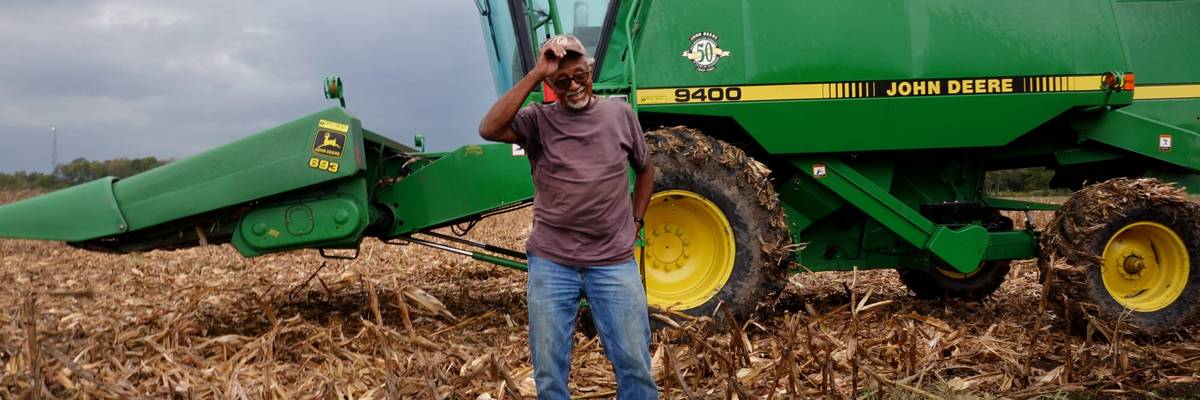
Glenn Morris, 83, harvests corn on October 11, 2021 in Princeton, Indiana.
It's Time for a Progressive Policy to Protect Agricultural Supply Chains
Price floors and supply management programs seem common sense to policymakers when it comes to oil and minerals, but what about US farmers and our overall food system?
The race to obtain critical minerals and the war in Iran have not only exposed a dangerous dependence on fossil fuels and mining, but they have also uncovered something more surprising—Republicans in Congress actually understand progressive agriculture policy. They just don’t want to admit it.
In February, Vice President JD Vance announced at the State Department that the administration must institute a price floor to protect the US critical mineral market. “This morning, the Trump administration is proposing a concrete mechanism to return the global critical minerals market to a healthier, more competitive state: a preferential trade zone for critical minerals protected from external disruptions through enforceable price floors,” Vance explained. Meanwhile, the US—and other countries around the world—are deploying oil reserves to buffer price shocks caused by the Israel-US attacks on Iran. Price floors and supply management programs seem common sense to these policymakers when it comes to oil and minerals, but what about US farmers and our overall food system?
Like oil and critical minerals, food and agriculture supply chains, such as corn, soy, and dairy, are vulnerable to global shocks, including extreme weather events, wars, and other supply disruptions. The public also needs to understand that without inflation-adjusted price floors, agricultural commodity prices may sink to disastrously low levels, leaving farmers no choice but to increase production with more chemicals and GMO seeds at the expense of our land and water. Congress and the US Department of Agriculture can avoid low prices by creating reserves accumulated during large harvests and, just like the federal petroleum reserve, bringing them back on the market to stabilize prices in times of shortage. We can all agree that food shortages would be disastrous, so guaranteeing its citizens food security should be imperative for any democratic government.
So while Republicans can recognize the importance of price floors and supply management during this administration, Democrats should look at history to understand how the same instruments were developed for agriculture during the Great Depression under the Democratic Party’s New Deal. The twin crises of farm bankruptcies and the Dust Bowl spurred militant farm organizations to demand a response from the federal government. The response was parity farm bills that stopped farm bankruptcies and stabilized the farm economy so that conservation measures and preservation of diversified farming could lead to food security and a balanced economy. Federal leadership in the White House and Congress recognized that price and supply management benefited both farmers and society as a whole. The policy was simple and transparent: The farm bill would ensure that during years of good harvests, public grain reserves would purchase the surplus at the parity rate (price floor adjusted for inflation) and store it to protect consumers in future times of shortage.
A productive agricultural economy that conserves our resources, challenges agricultural consolidation, and offers economic opportunity in rural communities should be a top priority for all our citizens.
However, both parties abandoned this common-sense approach to farm policy in the early 1950s, so that costs of farming have totally outpaced commodity prices. Subsequently, headlines warning of a farm crisis in 2026, like during the Great Depression and the 1980s, are not uncommon. The prices paid to farmers for commodities such as corn, soybeans, wheat, and dairy have dropped to record lows in real dollars. Over the years, this imbalance has led to the loss of family farms, the consolidation of agribusiness and food processing monopolies, along with their profits benefiting handsomely. Stabilizing the ratio of farm prices to farm costs (the correct goal of any Farm Bill) is the key to a sustainable agriculture that avoids soil loss, water pollution, and the decline of rural communities.
A supply management program would not only help revive family operations and rural economies but would also be essential to combat the expansion of confined animal feeding operations (CAFOs) and lower costs for taxpayers. As reported by Food & Water Watch, CAFOs are a disaster for our climate, air, and water, especially for nearby communities. CAFOs are among the most egregious features of today’s low-price, commodity-based industrial agriculture. Thousands of livestock (owned or vertically integrated with large food processors) are confined in small facilities without fresh air or sunlight and fed cheap corn and soy.
CAFOs have been replacing conscientious family farmers who are stewards of the soil and their animals. When family farmers are forced out of livestock production, they face the dilemma of “get big or get out” and often have no farming alternatives other than to tear up their pastures to grow corn and soybeans that will end up feeding animals in CAFOs.
The Trump administration is applying often-forgotten policy instruments to sustain our fossil fuel dependence and our high-tech future, rather than prioritizing a resilient, sustainable economy. Managing a price floor and creating federal food reserves in the agriculture sector are necessary to combat the adverse effects of food processor monopolization, farm consolidation, soil and water degradation, and external shocks, such as wars.
A productive agricultural economy that conserves our resources, challenges agricultural consolidation, and offers economic opportunity in rural communities should be a top priority for all our citizens. “We love farmers” and “We put America’s farmers first” are just political slogans to get votes with no substance behind them. These slogans lead to the usual sleight of hand to send taxpayer dollars to get some farmers through the next planting season. This policy leaves the disastrous cheap commodity regime in place—encouraging CAFO production and exporting commodities at a loss.
The administration’s discovery of the logical policy of price floors and reserves for oil and minerals must open new doors to applying these logical and transparent mechanisms to agriculture to restore the security of family farmers and conservation of our precious resources—after all, we can’t eat petroleum or precious minerals.
We are at a crossroads
This country and this world are at a monumental crossroads. In a few short weeks, US voters will have an opportunity to beat back the forces of fascism and confront the billionaires who are rigging the economy, our media system, and our democracy, making it increasingly impossible for ordinary people to get by. We’re not just talking about the election. We’re talking about what must be done once these fascist elements are vanquished from power. We need a bolder set of solutions than what either major party has so far been willing to offer and a working-class movement ready to fight like hell for it. Trump didn't emerge from nowhere. The conditions that fueled MAGA authoritarianism were created by decades of radical neoliberal economic policies and a corrupt political system dominated by corporate interests. They slashed taxes on the super-rich, promising that the benefits would trickle down. They said giveaways to the corporate titans would make life more affordable for the rest of us. It was all bullshit. And when a bitter, betrayed populace searches for someone to blame, right-wing demagogues have little trouble finding scapegoats. People know when they're being lied to, but you won't hear any of this from the corporate media. Only independent journalism—powered and funded by people who believe in building a better world—can deliver truly trustworthy daily news. Our Fall Campaign is underway, and we need your help. To power our newsroom through the rest of the year, we need to raise $125,000 by midnight on October 31. So if you share our vision, please contribute whatever you can to sustain our work. |
The race to obtain critical minerals and the war in Iran have not only exposed a dangerous dependence on fossil fuels and mining, but they have also uncovered something more surprising—Republicans in Congress actually understand progressive agriculture policy. They just don’t want to admit it.
In February, Vice President JD Vance announced at the State Department that the administration must institute a price floor to protect the US critical mineral market. “This morning, the Trump administration is proposing a concrete mechanism to return the global critical minerals market to a healthier, more competitive state: a preferential trade zone for critical minerals protected from external disruptions through enforceable price floors,” Vance explained. Meanwhile, the US—and other countries around the world—are deploying oil reserves to buffer price shocks caused by the Israel-US attacks on Iran. Price floors and supply management programs seem common sense to these policymakers when it comes to oil and minerals, but what about US farmers and our overall food system?
Like oil and critical minerals, food and agriculture supply chains, such as corn, soy, and dairy, are vulnerable to global shocks, including extreme weather events, wars, and other supply disruptions. The public also needs to understand that without inflation-adjusted price floors, agricultural commodity prices may sink to disastrously low levels, leaving farmers no choice but to increase production with more chemicals and GMO seeds at the expense of our land and water. Congress and the US Department of Agriculture can avoid low prices by creating reserves accumulated during large harvests and, just like the federal petroleum reserve, bringing them back on the market to stabilize prices in times of shortage. We can all agree that food shortages would be disastrous, so guaranteeing its citizens food security should be imperative for any democratic government.
So while Republicans can recognize the importance of price floors and supply management during this administration, Democrats should look at history to understand how the same instruments were developed for agriculture during the Great Depression under the Democratic Party’s New Deal. The twin crises of farm bankruptcies and the Dust Bowl spurred militant farm organizations to demand a response from the federal government. The response was parity farm bills that stopped farm bankruptcies and stabilized the farm economy so that conservation measures and preservation of diversified farming could lead to food security and a balanced economy. Federal leadership in the White House and Congress recognized that price and supply management benefited both farmers and society as a whole. The policy was simple and transparent: The farm bill would ensure that during years of good harvests, public grain reserves would purchase the surplus at the parity rate (price floor adjusted for inflation) and store it to protect consumers in future times of shortage.
A productive agricultural economy that conserves our resources, challenges agricultural consolidation, and offers economic opportunity in rural communities should be a top priority for all our citizens.
However, both parties abandoned this common-sense approach to farm policy in the early 1950s, so that costs of farming have totally outpaced commodity prices. Subsequently, headlines warning of a farm crisis in 2026, like during the Great Depression and the 1980s, are not uncommon. The prices paid to farmers for commodities such as corn, soybeans, wheat, and dairy have dropped to record lows in real dollars. Over the years, this imbalance has led to the loss of family farms, the consolidation of agribusiness and food processing monopolies, along with their profits benefiting handsomely. Stabilizing the ratio of farm prices to farm costs (the correct goal of any Farm Bill) is the key to a sustainable agriculture that avoids soil loss, water pollution, and the decline of rural communities.
A supply management program would not only help revive family operations and rural economies but would also be essential to combat the expansion of confined animal feeding operations (CAFOs) and lower costs for taxpayers. As reported by Food & Water Watch, CAFOs are a disaster for our climate, air, and water, especially for nearby communities. CAFOs are among the most egregious features of today’s low-price, commodity-based industrial agriculture. Thousands of livestock (owned or vertically integrated with large food processors) are confined in small facilities without fresh air or sunlight and fed cheap corn and soy.
CAFOs have been replacing conscientious family farmers who are stewards of the soil and their animals. When family farmers are forced out of livestock production, they face the dilemma of “get big or get out” and often have no farming alternatives other than to tear up their pastures to grow corn and soybeans that will end up feeding animals in CAFOs.
The Trump administration is applying often-forgotten policy instruments to sustain our fossil fuel dependence and our high-tech future, rather than prioritizing a resilient, sustainable economy. Managing a price floor and creating federal food reserves in the agriculture sector are necessary to combat the adverse effects of food processor monopolization, farm consolidation, soil and water degradation, and external shocks, such as wars.
A productive agricultural economy that conserves our resources, challenges agricultural consolidation, and offers economic opportunity in rural communities should be a top priority for all our citizens. “We love farmers” and “We put America’s farmers first” are just political slogans to get votes with no substance behind them. These slogans lead to the usual sleight of hand to send taxpayer dollars to get some farmers through the next planting season. This policy leaves the disastrous cheap commodity regime in place—encouraging CAFO production and exporting commodities at a loss.
The administration’s discovery of the logical policy of price floors and reserves for oil and minerals must open new doors to applying these logical and transparent mechanisms to agriculture to restore the security of family farmers and conservation of our precious resources—after all, we can’t eat petroleum or precious minerals.
The race to obtain critical minerals and the war in Iran have not only exposed a dangerous dependence on fossil fuels and mining, but they have also uncovered something more surprising—Republicans in Congress actually understand progressive agriculture policy. They just don’t want to admit it.
In February, Vice President JD Vance announced at the State Department that the administration must institute a price floor to protect the US critical mineral market. “This morning, the Trump administration is proposing a concrete mechanism to return the global critical minerals market to a healthier, more competitive state: a preferential trade zone for critical minerals protected from external disruptions through enforceable price floors,” Vance explained. Meanwhile, the US—and other countries around the world—are deploying oil reserves to buffer price shocks caused by the Israel-US attacks on Iran. Price floors and supply management programs seem common sense to these policymakers when it comes to oil and minerals, but what about US farmers and our overall food system?
Like oil and critical minerals, food and agriculture supply chains, such as corn, soy, and dairy, are vulnerable to global shocks, including extreme weather events, wars, and other supply disruptions. The public also needs to understand that without inflation-adjusted price floors, agricultural commodity prices may sink to disastrously low levels, leaving farmers no choice but to increase production with more chemicals and GMO seeds at the expense of our land and water. Congress and the US Department of Agriculture can avoid low prices by creating reserves accumulated during large harvests and, just like the federal petroleum reserve, bringing them back on the market to stabilize prices in times of shortage. We can all agree that food shortages would be disastrous, so guaranteeing its citizens food security should be imperative for any democratic government.
So while Republicans can recognize the importance of price floors and supply management during this administration, Democrats should look at history to understand how the same instruments were developed for agriculture during the Great Depression under the Democratic Party’s New Deal. The twin crises of farm bankruptcies and the Dust Bowl spurred militant farm organizations to demand a response from the federal government. The response was parity farm bills that stopped farm bankruptcies and stabilized the farm economy so that conservation measures and preservation of diversified farming could lead to food security and a balanced economy. Federal leadership in the White House and Congress recognized that price and supply management benefited both farmers and society as a whole. The policy was simple and transparent: The farm bill would ensure that during years of good harvests, public grain reserves would purchase the surplus at the parity rate (price floor adjusted for inflation) and store it to protect consumers in future times of shortage.
A productive agricultural economy that conserves our resources, challenges agricultural consolidation, and offers economic opportunity in rural communities should be a top priority for all our citizens.
However, both parties abandoned this common-sense approach to farm policy in the early 1950s, so that costs of farming have totally outpaced commodity prices. Subsequently, headlines warning of a farm crisis in 2026, like during the Great Depression and the 1980s, are not uncommon. The prices paid to farmers for commodities such as corn, soybeans, wheat, and dairy have dropped to record lows in real dollars. Over the years, this imbalance has led to the loss of family farms, the consolidation of agribusiness and food processing monopolies, along with their profits benefiting handsomely. Stabilizing the ratio of farm prices to farm costs (the correct goal of any Farm Bill) is the key to a sustainable agriculture that avoids soil loss, water pollution, and the decline of rural communities.
A supply management program would not only help revive family operations and rural economies but would also be essential to combat the expansion of confined animal feeding operations (CAFOs) and lower costs for taxpayers. As reported by Food & Water Watch, CAFOs are a disaster for our climate, air, and water, especially for nearby communities. CAFOs are among the most egregious features of today’s low-price, commodity-based industrial agriculture. Thousands of livestock (owned or vertically integrated with large food processors) are confined in small facilities without fresh air or sunlight and fed cheap corn and soy.
CAFOs have been replacing conscientious family farmers who are stewards of the soil and their animals. When family farmers are forced out of livestock production, they face the dilemma of “get big or get out” and often have no farming alternatives other than to tear up their pastures to grow corn and soybeans that will end up feeding animals in CAFOs.
The Trump administration is applying often-forgotten policy instruments to sustain our fossil fuel dependence and our high-tech future, rather than prioritizing a resilient, sustainable economy. Managing a price floor and creating federal food reserves in the agriculture sector are necessary to combat the adverse effects of food processor monopolization, farm consolidation, soil and water degradation, and external shocks, such as wars.
A productive agricultural economy that conserves our resources, challenges agricultural consolidation, and offers economic opportunity in rural communities should be a top priority for all our citizens. “We love farmers” and “We put America’s farmers first” are just political slogans to get votes with no substance behind them. These slogans lead to the usual sleight of hand to send taxpayer dollars to get some farmers through the next planting season. This policy leaves the disastrous cheap commodity regime in place—encouraging CAFO production and exporting commodities at a loss.
The administration’s discovery of the logical policy of price floors and reserves for oil and minerals must open new doors to applying these logical and transparent mechanisms to agriculture to restore the security of family farmers and conservation of our precious resources—after all, we can’t eat petroleum or precious minerals.