SUBSCRIBE TO OUR FREE NEWSLETTER
Daily news & progressive opinion—funded by the people, not the corporations—delivered straight to your inbox.
5
#000000
#FFFFFF
To donate by check, phone, or other method, see our More Ways to Give page.
Daily news & progressive opinion—funded by the people, not the corporations—delivered straight to your inbox.
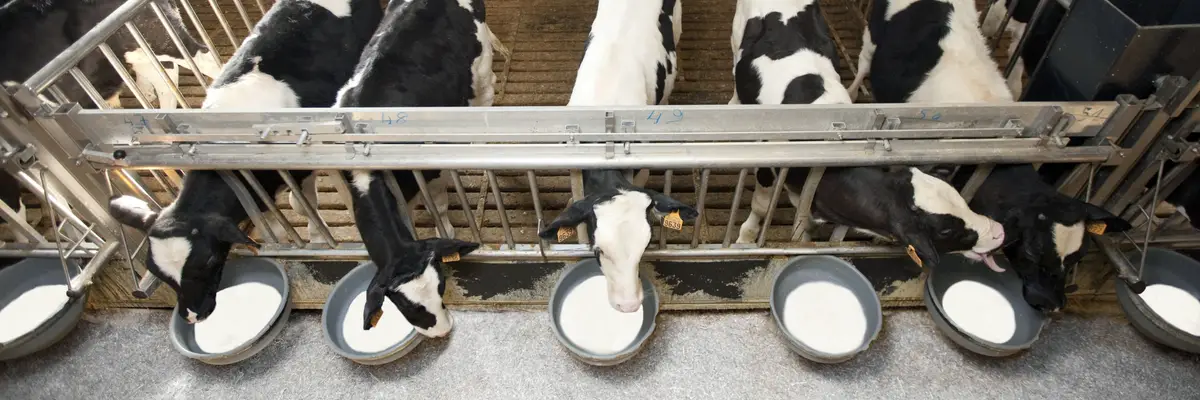
Calves drinking milk in a factory farm.
America prides itself on supporting small and local businesses, yet decades of agricultural policy decisions signal nothing but disdain for our small and local farms.
Three years behind schedule, the US House of Representatives passed a Farm Bill last month. Despite thousands of independent, humane farmers sounding the alarm that American livestock production is hurtling toward a breaking point, Congress chose to ignore those voices in favor of propping up corporate profits with more handouts to industrial agriculture.
America prides itself on supporting small and local businesses, yet decades of agricultural policy decisions signal nothing but disdain for our small and local farms. The overwhelming majority of taxpayer dollars in the House Farm Bill will funnel directly into the hands of the largest farms and agricultural corporations, while neglecting the needs of the small, independent producers who make up over 85% of all farms in our country. As a result, since the most recent Farm Bill in 2018, over 158,000 farms have had to close their gates, while shareholder value has skyrocketed for the few meatpacking monopolies that maintain a vertically-integrated vice grip on our nation’s meat supply.
Here’s the real kicker—even with access to the endless handouts industrial agriculture has received for decades, we have an increasingly fragile food system. Far from the safe, abundant, and affordable food supply their taglines promise, the factory farming of animals in confinement systems is responsible for major public health threats, the degradation of our soil and waterways, and the hollowing out of our rural communities. Cancer rates in industrial ag-heavy states are rising at alarming rates, and once-thriving small towns are falling victim to corporate capture.
The House Farm Bill includes a provision that independent farmers have made clear drives meat-packer consolidation and robs us of markets that voters in several states demanded: the “Save Our Bacon” (SOB) Act, which, far from saving any bacon, would further entrench a fragile system that profits from cruel confinement and extreme overcrowding of pigs. When our current food system faces extreme stressors like the pandemic or bird flu, these supply chains break down and supermarket shelves quickly empty of meat, eggs, and dairy products. Meanwhile smaller independent farmers like us who use more humane, resilient practices that prioritize the welfare of animals, people, and the environment are able to continue feeding our communities without disruptions.
The Senate now has the opportunity to right the House’s Farm Bill wrongs, restoring and expanding funding for local and regional food systems, and removing favors to industry lobby groups like the Save Our Bacon Act.
What we know is that consumers are fed up, and no longer buy the tired argument that more humane and healthy farming methods are unrealistic, or that smaller farms can’t feed America. Consumers know that pasture-raised animals are healthier for both themselves and the environment, and that resilient local farms are critical for their communities.
Government policy chooses what food gets to be accessible and which types of farms survive, and we must start making better choices. Expanding investment into independent, local meat processing; ensuring the regulation of dubious and misleading label claims; and increasing fair funding opportunities and access to capital for pasture-based farms are just a handful of commonsense reforms that would help level the playing field. The Senate now has the opportunity to right the House’s Farm Bill wrongs, restoring and expanding funding for local and regional food systems, and removing favors to industry lobby groups like the Save Our Bacon Act.
We already know how to raise healthy animals in more humane, pasture-based systems. That these farms are better for all involved than factory farms is clear to anyone on the ground in farming communities across America. And we believe it would be obvious to legislators in Congress if they took the time to come see them, which is why we have joined with other pasture-based farmers across the country to form the FACE Ag Network (Farmers for Animals, Communities, and the Environment).
We may not have the deep pockets of industrial agriculture interests, but we have power in the real stories of how our farms in Delaware County, Iowa, and St. Helena Parish, Louisiana are feeding our communities and revitalizing our local economies. In a recent letter to House and Senate leadership, we outlined a Farm Bill policy platform that would help uplift thousands of farmers, inviting lawmakers to visit our farms and witness firsthand how pasture-based farming systems are building a more resilient food system. And we have a message for the lawmakers about to decide our future in the Farm Bill:
Agribusiness interests have had their chance to design farm policy, and it isn’t working. It’s time to listen to independent farmers who know what their communities, animals, and land need. It’s time to rethink the way we invest federal dollars, and finally support farms producing the kind of food Americans want and deserve, rather than subsidizing products that actively harm our communities.
We invite you to come stand in our pastures and learn first-hand why backing the farms that produce the most humane, healthy, and high-quality food is the soundest investment you could make in our nation’s food system.
Dear Common Dreams reader, It’s been nearly 30 years since I co-founded Common Dreams with my late wife, Lina Newhouser. We had the radical notion that journalism should serve the public good, not corporate profits. It was clear to us from the outset what it would take to build such a project. No paid advertisements. No corporate sponsors. No millionaire publisher telling us what to think or do. Many people said we wouldn't last a year, but we proved those doubters wrong. Together with a tremendous team of journalists and dedicated staff, we built an independent media outlet free from the constraints of profits and corporate control. Our mission has always been simple: To inform. To inspire. To ignite change for the common good. Building Common Dreams was not easy. Our survival was never guaranteed. When you take on the most powerful forces—Wall Street greed, fossil fuel industry destruction, Big Tech lobbyists, and uber-rich oligarchs who have spent billions upon billions rigging the economy and democracy in their favor—the only bulwark you have is supporters who believe in your work. But here’s the urgent message from me today. It's never been this bad out there. And it's never been this hard to keep us going. At the very moment Common Dreams is most needed, the threats we face are intensifying. We need your support now more than ever. We don't accept corporate advertising and never will. We don't have a paywall because we don't think people should be blocked from critical news based on their ability to pay. Everything we do is funded by the donations of readers like you. When everyone does the little they can afford, we are strong. But if that support retreats or dries up, so do we. Will you donate now to make sure Common Dreams not only survives but thrives? —Craig Brown, Co-founder |
Three years behind schedule, the US House of Representatives passed a Farm Bill last month. Despite thousands of independent, humane farmers sounding the alarm that American livestock production is hurtling toward a breaking point, Congress chose to ignore those voices in favor of propping up corporate profits with more handouts to industrial agriculture.
America prides itself on supporting small and local businesses, yet decades of agricultural policy decisions signal nothing but disdain for our small and local farms. The overwhelming majority of taxpayer dollars in the House Farm Bill will funnel directly into the hands of the largest farms and agricultural corporations, while neglecting the needs of the small, independent producers who make up over 85% of all farms in our country. As a result, since the most recent Farm Bill in 2018, over 158,000 farms have had to close their gates, while shareholder value has skyrocketed for the few meatpacking monopolies that maintain a vertically-integrated vice grip on our nation’s meat supply.
Here’s the real kicker—even with access to the endless handouts industrial agriculture has received for decades, we have an increasingly fragile food system. Far from the safe, abundant, and affordable food supply their taglines promise, the factory farming of animals in confinement systems is responsible for major public health threats, the degradation of our soil and waterways, and the hollowing out of our rural communities. Cancer rates in industrial ag-heavy states are rising at alarming rates, and once-thriving small towns are falling victim to corporate capture.
The House Farm Bill includes a provision that independent farmers have made clear drives meat-packer consolidation and robs us of markets that voters in several states demanded: the “Save Our Bacon” (SOB) Act, which, far from saving any bacon, would further entrench a fragile system that profits from cruel confinement and extreme overcrowding of pigs. When our current food system faces extreme stressors like the pandemic or bird flu, these supply chains break down and supermarket shelves quickly empty of meat, eggs, and dairy products. Meanwhile smaller independent farmers like us who use more humane, resilient practices that prioritize the welfare of animals, people, and the environment are able to continue feeding our communities without disruptions.
The Senate now has the opportunity to right the House’s Farm Bill wrongs, restoring and expanding funding for local and regional food systems, and removing favors to industry lobby groups like the Save Our Bacon Act.
What we know is that consumers are fed up, and no longer buy the tired argument that more humane and healthy farming methods are unrealistic, or that smaller farms can’t feed America. Consumers know that pasture-raised animals are healthier for both themselves and the environment, and that resilient local farms are critical for their communities.
Government policy chooses what food gets to be accessible and which types of farms survive, and we must start making better choices. Expanding investment into independent, local meat processing; ensuring the regulation of dubious and misleading label claims; and increasing fair funding opportunities and access to capital for pasture-based farms are just a handful of commonsense reforms that would help level the playing field. The Senate now has the opportunity to right the House’s Farm Bill wrongs, restoring and expanding funding for local and regional food systems, and removing favors to industry lobby groups like the Save Our Bacon Act.
We already know how to raise healthy animals in more humane, pasture-based systems. That these farms are better for all involved than factory farms is clear to anyone on the ground in farming communities across America. And we believe it would be obvious to legislators in Congress if they took the time to come see them, which is why we have joined with other pasture-based farmers across the country to form the FACE Ag Network (Farmers for Animals, Communities, and the Environment).
We may not have the deep pockets of industrial agriculture interests, but we have power in the real stories of how our farms in Delaware County, Iowa, and St. Helena Parish, Louisiana are feeding our communities and revitalizing our local economies. In a recent letter to House and Senate leadership, we outlined a Farm Bill policy platform that would help uplift thousands of farmers, inviting lawmakers to visit our farms and witness firsthand how pasture-based farming systems are building a more resilient food system. And we have a message for the lawmakers about to decide our future in the Farm Bill:
Agribusiness interests have had their chance to design farm policy, and it isn’t working. It’s time to listen to independent farmers who know what their communities, animals, and land need. It’s time to rethink the way we invest federal dollars, and finally support farms producing the kind of food Americans want and deserve, rather than subsidizing products that actively harm our communities.
We invite you to come stand in our pastures and learn first-hand why backing the farms that produce the most humane, healthy, and high-quality food is the soundest investment you could make in our nation’s food system.
Three years behind schedule, the US House of Representatives passed a Farm Bill last month. Despite thousands of independent, humane farmers sounding the alarm that American livestock production is hurtling toward a breaking point, Congress chose to ignore those voices in favor of propping up corporate profits with more handouts to industrial agriculture.
America prides itself on supporting small and local businesses, yet decades of agricultural policy decisions signal nothing but disdain for our small and local farms. The overwhelming majority of taxpayer dollars in the House Farm Bill will funnel directly into the hands of the largest farms and agricultural corporations, while neglecting the needs of the small, independent producers who make up over 85% of all farms in our country. As a result, since the most recent Farm Bill in 2018, over 158,000 farms have had to close their gates, while shareholder value has skyrocketed for the few meatpacking monopolies that maintain a vertically-integrated vice grip on our nation’s meat supply.
Here’s the real kicker—even with access to the endless handouts industrial agriculture has received for decades, we have an increasingly fragile food system. Far from the safe, abundant, and affordable food supply their taglines promise, the factory farming of animals in confinement systems is responsible for major public health threats, the degradation of our soil and waterways, and the hollowing out of our rural communities. Cancer rates in industrial ag-heavy states are rising at alarming rates, and once-thriving small towns are falling victim to corporate capture.
The House Farm Bill includes a provision that independent farmers have made clear drives meat-packer consolidation and robs us of markets that voters in several states demanded: the “Save Our Bacon” (SOB) Act, which, far from saving any bacon, would further entrench a fragile system that profits from cruel confinement and extreme overcrowding of pigs. When our current food system faces extreme stressors like the pandemic or bird flu, these supply chains break down and supermarket shelves quickly empty of meat, eggs, and dairy products. Meanwhile smaller independent farmers like us who use more humane, resilient practices that prioritize the welfare of animals, people, and the environment are able to continue feeding our communities without disruptions.
The Senate now has the opportunity to right the House’s Farm Bill wrongs, restoring and expanding funding for local and regional food systems, and removing favors to industry lobby groups like the Save Our Bacon Act.
What we know is that consumers are fed up, and no longer buy the tired argument that more humane and healthy farming methods are unrealistic, or that smaller farms can’t feed America. Consumers know that pasture-raised animals are healthier for both themselves and the environment, and that resilient local farms are critical for their communities.
Government policy chooses what food gets to be accessible and which types of farms survive, and we must start making better choices. Expanding investment into independent, local meat processing; ensuring the regulation of dubious and misleading label claims; and increasing fair funding opportunities and access to capital for pasture-based farms are just a handful of commonsense reforms that would help level the playing field. The Senate now has the opportunity to right the House’s Farm Bill wrongs, restoring and expanding funding for local and regional food systems, and removing favors to industry lobby groups like the Save Our Bacon Act.
We already know how to raise healthy animals in more humane, pasture-based systems. That these farms are better for all involved than factory farms is clear to anyone on the ground in farming communities across America. And we believe it would be obvious to legislators in Congress if they took the time to come see them, which is why we have joined with other pasture-based farmers across the country to form the FACE Ag Network (Farmers for Animals, Communities, and the Environment).
We may not have the deep pockets of industrial agriculture interests, but we have power in the real stories of how our farms in Delaware County, Iowa, and St. Helena Parish, Louisiana are feeding our communities and revitalizing our local economies. In a recent letter to House and Senate leadership, we outlined a Farm Bill policy platform that would help uplift thousands of farmers, inviting lawmakers to visit our farms and witness firsthand how pasture-based farming systems are building a more resilient food system. And we have a message for the lawmakers about to decide our future in the Farm Bill:
Agribusiness interests have had their chance to design farm policy, and it isn’t working. It’s time to listen to independent farmers who know what their communities, animals, and land need. It’s time to rethink the way we invest federal dollars, and finally support farms producing the kind of food Americans want and deserve, rather than subsidizing products that actively harm our communities.
We invite you to come stand in our pastures and learn first-hand why backing the farms that produce the most humane, healthy, and high-quality food is the soundest investment you could make in our nation’s food system.