SUBSCRIBE TO OUR FREE NEWSLETTER
Daily news & progressive opinion—funded by the people, not the corporations—delivered straight to your inbox.
5
#000000
#FFFFFF
To donate by check, phone, or other method, see our More Ways to Give page.
Daily news & progressive opinion—funded by the people, not the corporations—delivered straight to your inbox.
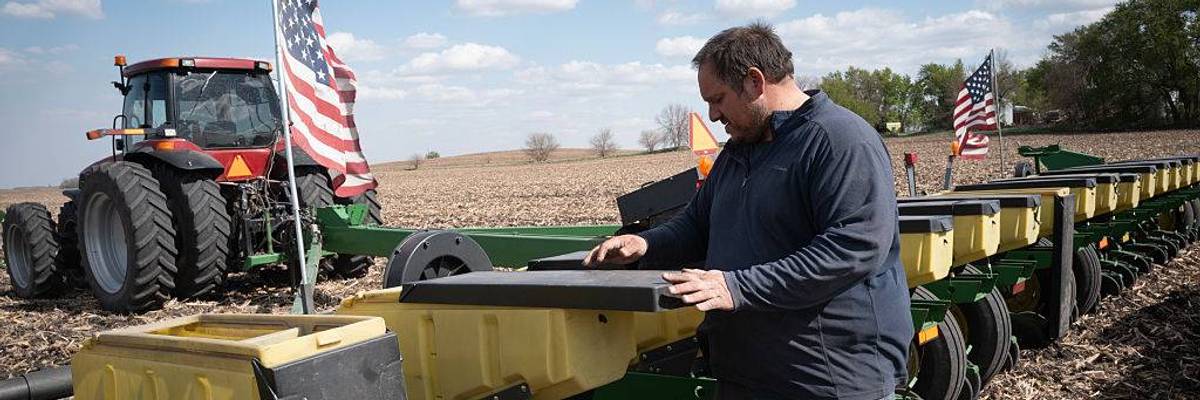
Farmer Alan Montag loads soybeans into his planter on May 6, 2026 near West Bend, Iowa.
"These rising costs are hitting us at the wrong time here," said one farmer of the high prices of diesel and fertilizer.
US Agriculture Secretary Brooke Rollins on Thursday claimed American farmers are heading toward a "golden age," even as President Donald Trump's policies are increasingly driving them into financial distress.
During an appearance on Fox Business, Rollins discussed Trump's upcoming meeting with Chinese President Xi Jinping to talk trade between the two countries.
"For our farmers and our ranchers, for farm security, for food security, making sure our farmers can prosper as they move into what will hopefully be a golden age under this president, these trade deals are very important," Rollins said. "But the president also understands that the over-reliance on a country like China has massive implications from a national security standpoint."
Brooke Rollins: "Farmers are moving into hopefully what will be a golden age under this president" pic.twitter.com/y2FRfZZVR3
— Aaron Rupar (@atrupar) May 7, 2026
American farmers took a big financial hit in 2025 after China cut off purchases of US soybeans in retaliation for Trump's "Liberation Day" tariffs.
The problems facing US farmers have gotten even worse since Trump illegally launched a war with Iran in late February, as the prices of fertilizer and diesel soared after Iran shut down the Strait of Hormuz.
According to a Monday report from Wisconsin Public Radio, there is little immediate relief coming for US farmers even if Trump ends his war with Iran and the Strait of Hormuz immediately reopens.
Shawn Arita, associate director of the Agricultural Risk Policy Center, told WPR that price projections show fertilizer prices will likely remain high throughout the rest of the year.
In fact, even if the strait were to reopen soon, the center projects that fertilizer prices will remain 13% higher than they were before the war started through all of next year and into 2028.
"We have seen that even in the most optimistic scenario," Arita explained, "we're going to see elevated prices on the nitrogen as well as phosphate side that continues on through the fall and moving into 2027."
Bill Knudson, agriculture economist at Michigan State University, told WPR that it will also take time to get shipping back to normal should the strait reopen soon because there are still an estimated 2,000 vessels stranded there that will take time to clear out.
"You’re not going to see a return to normal for several months, even if the Strait of Hormuz was opened relatively quickly," Knudson explained, "because you’ve got to get all those ships out of there."
The Guardian on Thursday published interviews with US farmers who explained how the combined hit of the president's trade wars and the Iran war have hurt them financially.
New York-based farmer Blake Gendebien told The Guardian that "these rising costs are hitting us at the wrong time here," as the price of offroad diesel has nearly doubled since last April.
"It’s a massive cost for farmers that are already barely, barely getting by," Gendebien explained.
North Carolina-based cotton farmer Julius Tillery told The Guardian that he's had to overhaul his planting process this year to minimize his use of diesel fuel.
“I’m very careful on my planting dates," said Tillery, who also revealed he's been eating more ramen noodles to save money. “I can’t afford to plant crops in bad climates, so the production window becomes smaller.”
Dear Common Dreams reader, It’s been nearly 30 years since I co-founded Common Dreams with my late wife, Lina Newhouser. We had the radical notion that journalism should serve the public good, not corporate profits. It was clear to us from the outset what it would take to build such a project. No paid advertisements. No corporate sponsors. No millionaire publisher telling us what to think or do. Many people said we wouldn't last a year, but we proved those doubters wrong. Together with a tremendous team of journalists and dedicated staff, we built an independent media outlet free from the constraints of profits and corporate control. Our mission has always been simple: To inform. To inspire. To ignite change for the common good. Building Common Dreams was not easy. Our survival was never guaranteed. When you take on the most powerful forces—Wall Street greed, fossil fuel industry destruction, Big Tech lobbyists, and uber-rich oligarchs who have spent billions upon billions rigging the economy and democracy in their favor—the only bulwark you have is supporters who believe in your work. But here’s the urgent message from me today. It's never been this bad out there. And it's never been this hard to keep us going. At the very moment Common Dreams is most needed, the threats we face are intensifying. We need your support now more than ever. We don't accept corporate advertising and never will. We don't have a paywall because we don't think people should be blocked from critical news based on their ability to pay. Everything we do is funded by the donations of readers like you. When everyone does the little they can afford, we are strong. But if that support retreats or dries up, so do we. Will you donate now to make sure Common Dreams not only survives but thrives? —Craig Brown, Co-founder |
US Agriculture Secretary Brooke Rollins on Thursday claimed American farmers are heading toward a "golden age," even as President Donald Trump's policies are increasingly driving them into financial distress.
During an appearance on Fox Business, Rollins discussed Trump's upcoming meeting with Chinese President Xi Jinping to talk trade between the two countries.
"For our farmers and our ranchers, for farm security, for food security, making sure our farmers can prosper as they move into what will hopefully be a golden age under this president, these trade deals are very important," Rollins said. "But the president also understands that the over-reliance on a country like China has massive implications from a national security standpoint."
Brooke Rollins: "Farmers are moving into hopefully what will be a golden age under this president" pic.twitter.com/y2FRfZZVR3
— Aaron Rupar (@atrupar) May 7, 2026
American farmers took a big financial hit in 2025 after China cut off purchases of US soybeans in retaliation for Trump's "Liberation Day" tariffs.
The problems facing US farmers have gotten even worse since Trump illegally launched a war with Iran in late February, as the prices of fertilizer and diesel soared after Iran shut down the Strait of Hormuz.
According to a Monday report from Wisconsin Public Radio, there is little immediate relief coming for US farmers even if Trump ends his war with Iran and the Strait of Hormuz immediately reopens.
Shawn Arita, associate director of the Agricultural Risk Policy Center, told WPR that price projections show fertilizer prices will likely remain high throughout the rest of the year.
In fact, even if the strait were to reopen soon, the center projects that fertilizer prices will remain 13% higher than they were before the war started through all of next year and into 2028.
"We have seen that even in the most optimistic scenario," Arita explained, "we're going to see elevated prices on the nitrogen as well as phosphate side that continues on through the fall and moving into 2027."
Bill Knudson, agriculture economist at Michigan State University, told WPR that it will also take time to get shipping back to normal should the strait reopen soon because there are still an estimated 2,000 vessels stranded there that will take time to clear out.
"You’re not going to see a return to normal for several months, even if the Strait of Hormuz was opened relatively quickly," Knudson explained, "because you’ve got to get all those ships out of there."
The Guardian on Thursday published interviews with US farmers who explained how the combined hit of the president's trade wars and the Iran war have hurt them financially.
New York-based farmer Blake Gendebien told The Guardian that "these rising costs are hitting us at the wrong time here," as the price of offroad diesel has nearly doubled since last April.
"It’s a massive cost for farmers that are already barely, barely getting by," Gendebien explained.
North Carolina-based cotton farmer Julius Tillery told The Guardian that he's had to overhaul his planting process this year to minimize his use of diesel fuel.
“I’m very careful on my planting dates," said Tillery, who also revealed he's been eating more ramen noodles to save money. “I can’t afford to plant crops in bad climates, so the production window becomes smaller.”
US Agriculture Secretary Brooke Rollins on Thursday claimed American farmers are heading toward a "golden age," even as President Donald Trump's policies are increasingly driving them into financial distress.
During an appearance on Fox Business, Rollins discussed Trump's upcoming meeting with Chinese President Xi Jinping to talk trade between the two countries.
"For our farmers and our ranchers, for farm security, for food security, making sure our farmers can prosper as they move into what will hopefully be a golden age under this president, these trade deals are very important," Rollins said. "But the president also understands that the over-reliance on a country like China has massive implications from a national security standpoint."
Brooke Rollins: "Farmers are moving into hopefully what will be a golden age under this president" pic.twitter.com/y2FRfZZVR3
— Aaron Rupar (@atrupar) May 7, 2026
American farmers took a big financial hit in 2025 after China cut off purchases of US soybeans in retaliation for Trump's "Liberation Day" tariffs.
The problems facing US farmers have gotten even worse since Trump illegally launched a war with Iran in late February, as the prices of fertilizer and diesel soared after Iran shut down the Strait of Hormuz.
According to a Monday report from Wisconsin Public Radio, there is little immediate relief coming for US farmers even if Trump ends his war with Iran and the Strait of Hormuz immediately reopens.
Shawn Arita, associate director of the Agricultural Risk Policy Center, told WPR that price projections show fertilizer prices will likely remain high throughout the rest of the year.
In fact, even if the strait were to reopen soon, the center projects that fertilizer prices will remain 13% higher than they were before the war started through all of next year and into 2028.
"We have seen that even in the most optimistic scenario," Arita explained, "we're going to see elevated prices on the nitrogen as well as phosphate side that continues on through the fall and moving into 2027."
Bill Knudson, agriculture economist at Michigan State University, told WPR that it will also take time to get shipping back to normal should the strait reopen soon because there are still an estimated 2,000 vessels stranded there that will take time to clear out.
"You’re not going to see a return to normal for several months, even if the Strait of Hormuz was opened relatively quickly," Knudson explained, "because you’ve got to get all those ships out of there."
The Guardian on Thursday published interviews with US farmers who explained how the combined hit of the president's trade wars and the Iran war have hurt them financially.
New York-based farmer Blake Gendebien told The Guardian that "these rising costs are hitting us at the wrong time here," as the price of offroad diesel has nearly doubled since last April.
"It’s a massive cost for farmers that are already barely, barely getting by," Gendebien explained.
North Carolina-based cotton farmer Julius Tillery told The Guardian that he's had to overhaul his planting process this year to minimize his use of diesel fuel.
“I’m very careful on my planting dates," said Tillery, who also revealed he's been eating more ramen noodles to save money. “I can’t afford to plant crops in bad climates, so the production window becomes smaller.”