

SUBSCRIBE TO OUR FREE NEWSLETTER
Daily news & progressive opinion—funded by the people, not the corporations—delivered straight to your inbox.
5
#000000
#FFFFFF
To donate by check, phone, or other method, see our More Ways to Give page.
Daily news & progressive opinion—funded by the people, not the corporations—delivered straight to your inbox.
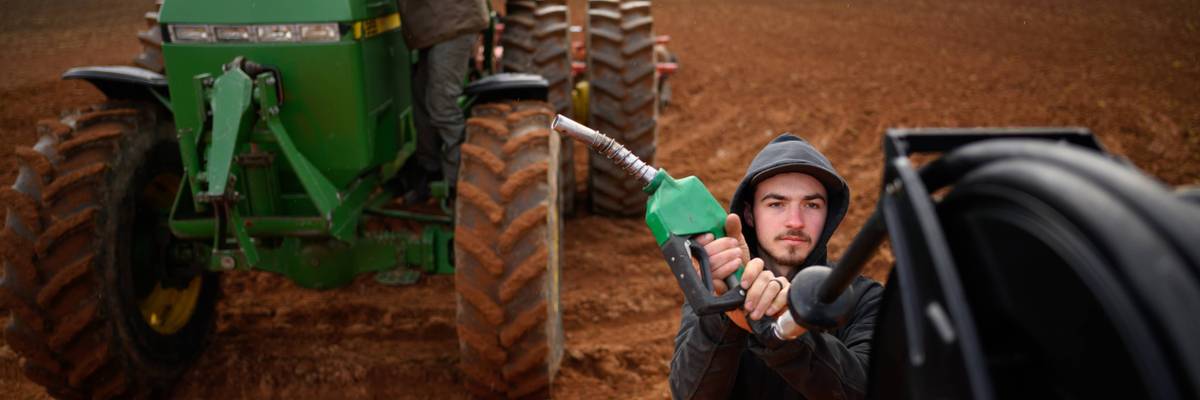
A worker fuels a tractor on a farm in Rocky Hill, Connecticut on April 2, 2026.
A Center for American Progress analysis found that the war is "forcing rural households to pay at least $26 more per week at the pump and threatening to push grocery prices even higher in the months ahead."
President Donald Trump won the 2024 election largely on a promise to alleviate the affordability crisis, but an analysis published Friday underscores how rural Americans—the bedrock of the MAGA base—are disproportionately paying the price for the US-Israeli war of choice on Iran.
"Rising gas and fertilizer prices tied to the Trump administration’s war in Iran are driving up costs for rural families, farmers, and consumers across the country," notes the analysis from the Center for American Progress (CAP), a liberal think tank.
"Gas prices rose 52% between February 27, the day before the war with Iran began, and May 14, forcing rural households to pay at least $26 more per week at the pump and threatening to push grocery prices even higher in the months ahead," the publication continues.
"The economic fallout from the conflict is disproportionately affecting rural America, where households already spend significantly more on gasoline and energy and where farm operations depend heavily on diesel fuel and fertilizer," CAP added. "As oil prices rise and shipping through the Strait of Hormuz remains disrupted, farmers are facing mounting input costs during an already difficult economic period."
CAP researchers also found that the gap between urban and rural fuel costs has increased from $46 to $70 per month since the start of the war.
With diesel fuel accounting for over 60% of their fuel expenditures, farmers are facing the prospect of paying at least $350 more per day to operate a single tractor.
"There are 453 farming-dependent counties across the country, and rising fuel and fertilizer costs could force more small and medium-sized farms out of business if disruptions continue," the analysis warns.
As Common Dreams reported this week, Trump's illegal war of choice and erratic tariff policies are hurting farmers and consumers while Big Ag profits from fast-rising fertilizer and food prices.
Likewise, while consumers feel the pain of skyrocketing pump prices, Big Oil is reaping prodigious profits fueled by scarcity and market uncertainty due to the closure of the Strait of Hormuz and other war-related causes.
A report published earlier this month by the office of Sen. Ed Markey (D-Mass.) projects that US drivers could pay an additional $876 per year—or $1,753 for a family with two cars—on gasoline per year if pump prices remain at their current levels.
The CAP analysis comes on the heels of the latest consumer price index, released earlier this week, which revealed that inflation has risen to its highest level in three years largely due to rising fuel and food costs.
According to CAP, lower-income households—which spent a third of their pretax income on food in 2024—"will be hit hardest" by rising grocery prices, as the highest-income households spent just 6.4% of their before-tax earnings on food.
“Families in rural communities are already stretched thin, and this conflict is making everyday necessities even more expensive,” CAP senior fellow and analysis co-author Anne Knapke said Friday. “Higher gas prices, rising fertilizer costs, and more expensive groceries are all contributing to an affordability crisis that this president is making worse every day.”
Asked earlier this week if he thinks about the financial hardship his war is inflicting on Americans, Trump flippantly replied, "Not even a little bit."
Dear Common Dreams reader, It’s been nearly 30 years since I co-founded Common Dreams with my late wife, Lina Newhouser. We had the radical notion that journalism should serve the public good, not corporate profits. It was clear to us from the outset what it would take to build such a project. No paid advertisements. No corporate sponsors. No millionaire publisher telling us what to think or do. Many people said we wouldn't last a year, but we proved those doubters wrong. Together with a tremendous team of journalists and dedicated staff, we built an independent media outlet free from the constraints of profits and corporate control. Our mission has always been simple: To inform. To inspire. To ignite change for the common good. Building Common Dreams was not easy. Our survival was never guaranteed. When you take on the most powerful forces—Wall Street greed, fossil fuel industry destruction, Big Tech lobbyists, and uber-rich oligarchs who have spent billions upon billions rigging the economy and democracy in their favor—the only bulwark you have is supporters who believe in your work. But here’s the urgent message from me today. It's never been this bad out there. And it's never been this hard to keep us going. At the very moment Common Dreams is most needed, the threats we face are intensifying. We need your support now more than ever. We don't accept corporate advertising and never will. We don't have a paywall because we don't think people should be blocked from critical news based on their ability to pay. Everything we do is funded by the donations of readers like you. When everyone does the little they can afford, we are strong. But if that support retreats or dries up, so do we. Will you donate now to make sure Common Dreams not only survives but thrives? —Craig Brown, Co-founder |
President Donald Trump won the 2024 election largely on a promise to alleviate the affordability crisis, but an analysis published Friday underscores how rural Americans—the bedrock of the MAGA base—are disproportionately paying the price for the US-Israeli war of choice on Iran.
"Rising gas and fertilizer prices tied to the Trump administration’s war in Iran are driving up costs for rural families, farmers, and consumers across the country," notes the analysis from the Center for American Progress (CAP), a liberal think tank.
"Gas prices rose 52% between February 27, the day before the war with Iran began, and May 14, forcing rural households to pay at least $26 more per week at the pump and threatening to push grocery prices even higher in the months ahead," the publication continues.
"The economic fallout from the conflict is disproportionately affecting rural America, where households already spend significantly more on gasoline and energy and where farm operations depend heavily on diesel fuel and fertilizer," CAP added. "As oil prices rise and shipping through the Strait of Hormuz remains disrupted, farmers are facing mounting input costs during an already difficult economic period."
CAP researchers also found that the gap between urban and rural fuel costs has increased from $46 to $70 per month since the start of the war.
With diesel fuel accounting for over 60% of their fuel expenditures, farmers are facing the prospect of paying at least $350 more per day to operate a single tractor.
"There are 453 farming-dependent counties across the country, and rising fuel and fertilizer costs could force more small and medium-sized farms out of business if disruptions continue," the analysis warns.
As Common Dreams reported this week, Trump's illegal war of choice and erratic tariff policies are hurting farmers and consumers while Big Ag profits from fast-rising fertilizer and food prices.
Likewise, while consumers feel the pain of skyrocketing pump prices, Big Oil is reaping prodigious profits fueled by scarcity and market uncertainty due to the closure of the Strait of Hormuz and other war-related causes.
A report published earlier this month by the office of Sen. Ed Markey (D-Mass.) projects that US drivers could pay an additional $876 per year—or $1,753 for a family with two cars—on gasoline per year if pump prices remain at their current levels.
The CAP analysis comes on the heels of the latest consumer price index, released earlier this week, which revealed that inflation has risen to its highest level in three years largely due to rising fuel and food costs.
According to CAP, lower-income households—which spent a third of their pretax income on food in 2024—"will be hit hardest" by rising grocery prices, as the highest-income households spent just 6.4% of their before-tax earnings on food.
“Families in rural communities are already stretched thin, and this conflict is making everyday necessities even more expensive,” CAP senior fellow and analysis co-author Anne Knapke said Friday. “Higher gas prices, rising fertilizer costs, and more expensive groceries are all contributing to an affordability crisis that this president is making worse every day.”
Asked earlier this week if he thinks about the financial hardship his war is inflicting on Americans, Trump flippantly replied, "Not even a little bit."
President Donald Trump won the 2024 election largely on a promise to alleviate the affordability crisis, but an analysis published Friday underscores how rural Americans—the bedrock of the MAGA base—are disproportionately paying the price for the US-Israeli war of choice on Iran.
"Rising gas and fertilizer prices tied to the Trump administration’s war in Iran are driving up costs for rural families, farmers, and consumers across the country," notes the analysis from the Center for American Progress (CAP), a liberal think tank.
"Gas prices rose 52% between February 27, the day before the war with Iran began, and May 14, forcing rural households to pay at least $26 more per week at the pump and threatening to push grocery prices even higher in the months ahead," the publication continues.
"The economic fallout from the conflict is disproportionately affecting rural America, where households already spend significantly more on gasoline and energy and where farm operations depend heavily on diesel fuel and fertilizer," CAP added. "As oil prices rise and shipping through the Strait of Hormuz remains disrupted, farmers are facing mounting input costs during an already difficult economic period."
CAP researchers also found that the gap between urban and rural fuel costs has increased from $46 to $70 per month since the start of the war.
With diesel fuel accounting for over 60% of their fuel expenditures, farmers are facing the prospect of paying at least $350 more per day to operate a single tractor.
"There are 453 farming-dependent counties across the country, and rising fuel and fertilizer costs could force more small and medium-sized farms out of business if disruptions continue," the analysis warns.
As Common Dreams reported this week, Trump's illegal war of choice and erratic tariff policies are hurting farmers and consumers while Big Ag profits from fast-rising fertilizer and food prices.
Likewise, while consumers feel the pain of skyrocketing pump prices, Big Oil is reaping prodigious profits fueled by scarcity and market uncertainty due to the closure of the Strait of Hormuz and other war-related causes.
A report published earlier this month by the office of Sen. Ed Markey (D-Mass.) projects that US drivers could pay an additional $876 per year—or $1,753 for a family with two cars—on gasoline per year if pump prices remain at their current levels.
The CAP analysis comes on the heels of the latest consumer price index, released earlier this week, which revealed that inflation has risen to its highest level in three years largely due to rising fuel and food costs.
According to CAP, lower-income households—which spent a third of their pretax income on food in 2024—"will be hit hardest" by rising grocery prices, as the highest-income households spent just 6.4% of their before-tax earnings on food.
“Families in rural communities are already stretched thin, and this conflict is making everyday necessities even more expensive,” CAP senior fellow and analysis co-author Anne Knapke said Friday. “Higher gas prices, rising fertilizer costs, and more expensive groceries are all contributing to an affordability crisis that this president is making worse every day.”
Asked earlier this week if he thinks about the financial hardship his war is inflicting on Americans, Trump flippantly replied, "Not even a little bit."

