SUBSCRIBE TO OUR FREE NEWSLETTER
Daily news & progressive opinion—funded by the people, not the corporations—delivered straight to your inbox.
5
#000000
#FFFFFF
To donate by check, phone, or other method, see our More Ways to Give page.
In late March, President Donald Trump addressed hundreds of farmers, ranchers, and agribusiness executives on the White House South Lawn at what he hyperbolically called “the single largest gathering of American farmers that the White House has ever seen.” In a rambling 35-minute speech that was ostensibly about the Farm Bill, he lambasted the Biden administration and “environmental terrorists,” lauded US military might, boasted that his ballroom will be the finest in the world, and gushed over a gold-wrapped tractor parked nearby. But he dedicated most of his speech to impress upon the crowd that “American farmers, ranchers, growers, and producers once again have a true friend and champion in the Oval Office.”
“You’re very, very special people,” Trump concluded. “I’ll never forget we won like such a number like nobody’s ever won before. You voted for me. I will never forget that. I’ll never forget the friendship—the great friendship that we’ve had.”
Indeed, the overwhelming majority of the nation’s 3.4 million farmers, 95% of whom are white, went for Trump in the 2024 election. He received nearly 78% of the votes in the 444 counties most dependent on agriculture.
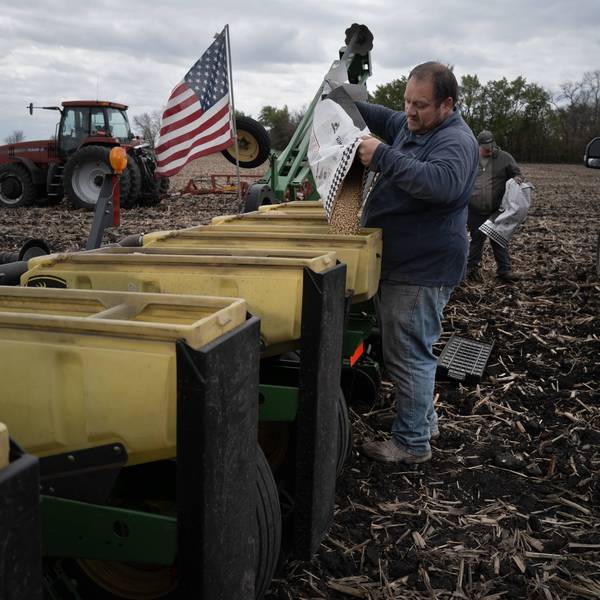
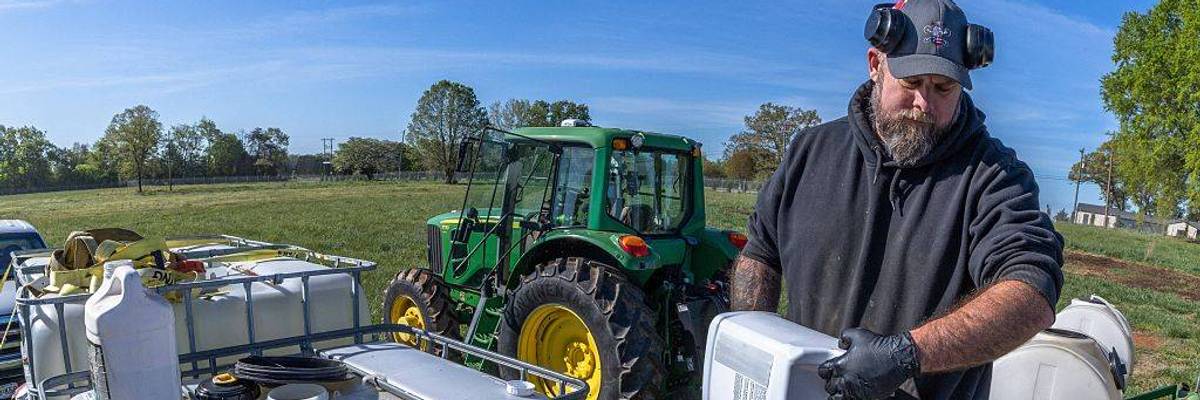
But now, an increasing number of farmers are experiencing buyer’s remorse. Buffeted by tariffs and an unprovoked war against Iran that sent the price of fertilizer through the roof, they easily stand out as the voting bloc most betrayed by Trump. The resulting inflation has pushed many small farms to the brink of financial ruin. It has gotten so bad that even conservative think tanks generally aligned with Trump are griping.
It is virtually impossible to predict how farm country voters’ dissatisfaction with Trump administration policies will play out in the November midterm elections.
Earlier this year, researchers at the libertarian Cato Institute, founded by billionaire industrialist Charles Koch, bemoaned the impact Trump’s tariffs are having on farmers. “The Trump administration continues to tell America’s farm community that this is a golden age and that the administration’s tariffs are working,” they wrote. “The data tell a different story.”
More recently, Marc Short, a former Koch network official who now chairs Advancing American Freedom, a right-wing advocacy group founded by former Vice President Mike Pence, was even more explicit. In a June opinion piece in The Washington Post, he charged that “President Trump’s policies have punched farmers in the mouth.”
In April, the American Farm Bureau Federation published a survey of 5,700 farmers detailing the pain they are experiencing due to Trump administration policies. Nearly 60% said their financial situation has worsened since last year. Only 6% said they were doing better. Nationwide, 70% said they could not afford the fertilizer they needed, while in the Farm Bureau’s southern region, where Trump won 12 of 13 states, nearly 80% said they could not afford it. Smaller farms, which “are less likely to secure fertilizer ahead of the season” than larger operations, the Farm Bureau noted, were hardest hit.
Based on US Department of Agriculture (USDA) forecasts, Farm Bureau economist Faith Parum predicted that farmers may not receive any “meaningful” relief next year. Even if fuel and fertilizer prices drop, they will still face “higher prices for seed, chemicals, repairs, labor, machinery, and cash rents expenses,” she pointed out, concluding that at “a time when commodity prices remain under pressure and margins are already thin, higher operating expenses will place additional strain on farm viability.”
Many farmers have already lost their struggle for viability. Last year there were 315 Chapter 12 family farm bankruptcies across the country, a 46% increase from 2024. This year, according to the Trump administration’s own data, farm insolvency is expected to grow to as many as 330 bankruptcies and a record debt of $625 billion. In April alone, there were 62 farm-related bankruptcies, the highest one-month total since 2020 during the first Trump administration.
“Each year that we don’t start on the upswing is just more and more stress on farmers, and I think the higher diesel prices, the higher fertilizer prices, it’s just made 2026 the breaking point,” Robert E. Moore, an attorney at Ohio State University’s Agricultural & Resource Law Program, told Ag Daily in May. “I think farm bankruptcies are more likely to increase than decrease over the next few years.”
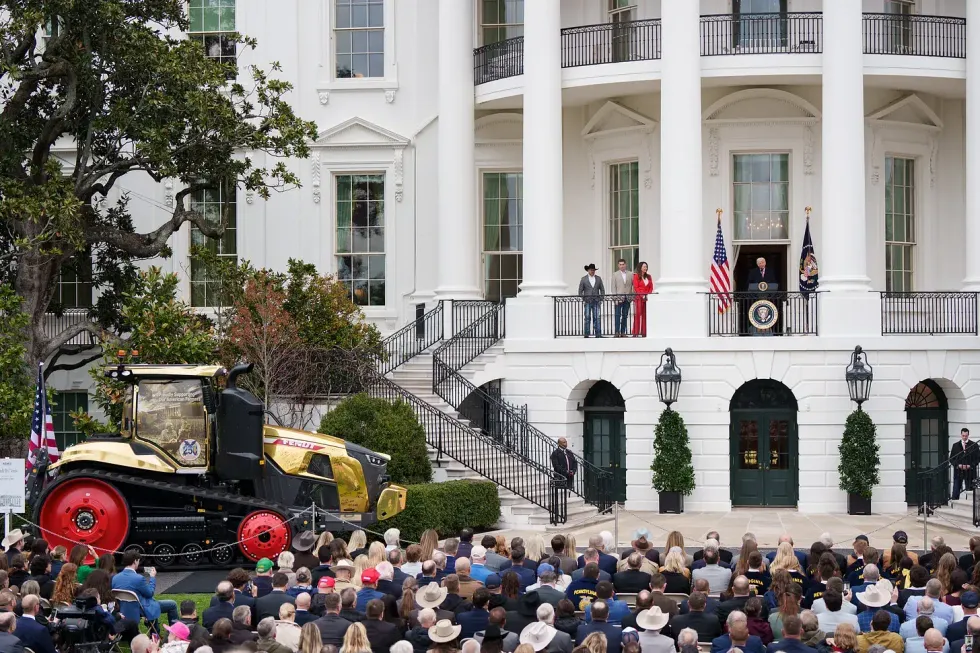 On March 27, Donald Trump thanked the farmers, ranchers, and agribusiness executives gathered at the White House profusely for their votes. (Photo by Abe McNatt/White House)
Farmers voted overwhelmingly for Trump in 2016 only to see him launch a tariff war against China and other US trading partners that cost them $13.2 billion in annualized export losses from 2018 through the end of 2019, according to the USDA’s Economic Research Service. That debacle prompted the first Trump administration to give farmers $28 billion in direct payments to compensate them for their losses.
By contrast, farmers largely benefited from Biden administration policies. During their first three years in office, according to a January 2024 Politico analysis, the Biden and first Trump administration each authorized roughly $57 billion in direct USDA payments to farmers. But there was a crucial difference: Much of Trump’s aid was emergency compensation for losses caused by his own trade war with China, while the Biden administration focused more on supporting agriculture through conservation, rural development, and other long-term investments.
“Biden has been better for farmers than Trump,” Politico concluded. “Net farm income has actually gone up since the Democrat entered the White House. On average, net farm income has totaled $165 billion between 2021 and 2023, compared to $94 billion between 2017 and 2019. Farm income reached a record high of nearly $189 billion in 2022.”
Nevertheless, nearly 4 out of 5 voters in agriculture-dependent communities backed Trump in 2024, and this time around, farm losses could be much worse than during Trump’s first term. To be sure, Trump’s policies don’t bear all blame for their woes—farmers have been struggling with high production costs and low crop prices for years—but he is certainly piling on.
In 2025, even before Trump’s war against Iran, the Agricultural Risk Policy Center at North Dakota State University estimated losses of $35 billion to $44 billion for major commodity crops. The center also calculated that Trump’s most recent tariff war with China resulted in nearly $15 billion in annualized losses between March 2025 and February 2026, alone, 40% more than the loss of $10.6 billion due to Trump’s 2018-2019 trade war with China during his first term.
Trump and the Republican-controlled Congress are now trying to mollify farmers with bailouts and price protections that could amount to a record $55 billion this year, The Wall Street Journal reported late last month. But it is not clear how quickly or efficiently that aid could get to farmers given Elon Musk’s Department of Government Efficiency cut 24,000 USDA staff members, many of whom assisted farmers with paperwork at the local level.
During a June trip to Wisconsin farm country, Trump urged farmers to be patient. “Your fertilizer prices are going to go way down, just like they were four months ago,” he promised. “Your fertilizer’s down, your energy’s down, your oil, your gas is all coming way down.”
So far, that hasn’t happened, but luckily for Trump, he has been able to depend on farmers’ patience, perhaps because they are aligned with him on so many other issues. Surveys show that white rural voters are more likely to believe that the 2020 presidential election was stolen; more likely to support political violence; and less likely to support democracy, racial diversity, and the idea that immigrants strengthen the nation—even though countless farming operations would fail without cheap immigrant labor.
Trump’s hold on farm country also is largely due to the real and imagined grievances rural whites have against “liberal urban elites” that Republicans have been stoking for decades, according to Nicholas Jacobs, an assistant professor at Colby College and co-author of the 2023 book The Rural Voter: The Politics of Place and the Disuniting of America. “It’s easy for an outsider to ask, ‘Why the hell are you still with this guy?’” Jacobs told the BBC. “But you have to understand that across rural America, the move toward Republicans long predates Donald Trump.”
On June 19, a Washington Post article quoted a Nebraska cattle rancher who questioned how much the agricultural sector can endure as more farmers go belly up. Farmers, he said, “have been rationalizing all of this chaos and saying it’s all going to be better later, but now they’re seeing that they may not be in the business any longer later.”
Four days before the Post story ran, Reuters/Ipsos posted a survey showing that Trump’s approval rating in rural America had hit a new low. Fifty percent of respondents approved of Trump, a 10% decline from February 2025. Trump’s disapproval rating among rural Americans, meanwhile, jumped from 34% to 48% over the same period.
A subsequent Harvard CAPS/Harris poll released last week, however, suggests that Trump’s falling support among rural voters may have stabilized. Trump had a 44% disapproval and a 52% approval rating, compared to an overall national approval rating of only 42%. For now, Trump’s appeal in rural America appears to be relatively strong.
It is virtually impossible to predict how farm country voters’ dissatisfaction with Trump administration policies will play out in the November midterm elections. Trump may not be on the ballot, but many of his Republican enablers in Congress and state governments will be. Will disillusioned farmers and their neighbors simply stay home, or has their “great friendship” with Trump soured enough that they pull the lever for Democrats? We will soon find out.
This article first appeared at the Money Trail blog and is reposted here at Common Dreams with permission.
In late March, President Donald Trump addressed hundreds of farmers, ranchers, and agribusiness executives on the White House South Lawn at what he hyperbolically called “the single largest gathering of American farmers that the White House has ever seen.” In a rambling 35-minute speech that was ostensibly about the Farm Bill, he lambasted the Biden administration and “environmental terrorists,” lauded US military might, boasted that his ballroom will be the finest in the world, and gushed over a gold-wrapped tractor parked nearby. But he dedicated most of his speech to impress upon the crowd that “American farmers, ranchers, growers, and producers once again have a true friend and champion in the Oval Office.”
“You’re very, very special people,” Trump concluded. “I’ll never forget we won like such a number like nobody’s ever won before. You voted for me. I will never forget that. I’ll never forget the friendship—the great friendship that we’ve had.”
Indeed, the overwhelming majority of the nation’s 3.4 million farmers, 95% of whom are white, went for Trump in the 2024 election. He received nearly 78% of the votes in the 444 counties most dependent on agriculture.
But now, an increasing number of farmers are experiencing buyer’s remorse. Buffeted by tariffs and an unprovoked war against Iran that sent the price of fertilizer through the roof, they easily stand out as the voting bloc most betrayed by Trump. The resulting inflation has pushed many small farms to the brink of financial ruin. It has gotten so bad that even conservative think tanks generally aligned with Trump are griping.
It is virtually impossible to predict how farm country voters’ dissatisfaction with Trump administration policies will play out in the November midterm elections.
Earlier this year, researchers at the libertarian Cato Institute, founded by billionaire industrialist Charles Koch, bemoaned the impact Trump’s tariffs are having on farmers. “The Trump administration continues to tell America’s farm community that this is a golden age and that the administration’s tariffs are working,” they wrote. “The data tell a different story.”
More recently, Marc Short, a former Koch network official who now chairs Advancing American Freedom, a right-wing advocacy group founded by former Vice President Mike Pence, was even more explicit. In a June opinion piece in The Washington Post, he charged that “President Trump’s policies have punched farmers in the mouth.”
In April, the American Farm Bureau Federation published a survey of 5,700 farmers detailing the pain they are experiencing due to Trump administration policies. Nearly 60% said their financial situation has worsened since last year. Only 6% said they were doing better. Nationwide, 70% said they could not afford the fertilizer they needed, while in the Farm Bureau’s southern region, where Trump won 12 of 13 states, nearly 80% said they could not afford it. Smaller farms, which “are less likely to secure fertilizer ahead of the season” than larger operations, the Farm Bureau noted, were hardest hit.
Based on US Department of Agriculture (USDA) forecasts, Farm Bureau economist Faith Parum predicted that farmers may not receive any “meaningful” relief next year. Even if fuel and fertilizer prices drop, they will still face “higher prices for seed, chemicals, repairs, labor, machinery, and cash rents expenses,” she pointed out, concluding that at “a time when commodity prices remain under pressure and margins are already thin, higher operating expenses will place additional strain on farm viability.”
Many farmers have already lost their struggle for viability. Last year there were 315 Chapter 12 family farm bankruptcies across the country, a 46% increase from 2024. This year, according to the Trump administration’s own data, farm insolvency is expected to grow to as many as 330 bankruptcies and a record debt of $625 billion. In April alone, there were 62 farm-related bankruptcies, the highest one-month total since 2020 during the first Trump administration.
“Each year that we don’t start on the upswing is just more and more stress on farmers, and I think the higher diesel prices, the higher fertilizer prices, it’s just made 2026 the breaking point,” Robert E. Moore, an attorney at Ohio State University’s Agricultural & Resource Law Program, told Ag Daily in May. “I think farm bankruptcies are more likely to increase than decrease over the next few years.”
On March 27, Donald Trump thanked the farmers, ranchers, and agribusiness executives gathered at the White House profusely for their votes. (Photo by Abe McNatt/White House)
Farmers voted overwhelmingly for Trump in 2016 only to see him launch a tariff war against China and other US trading partners that cost them $13.2 billion in annualized export losses from 2018 through the end of 2019, according to the USDA’s Economic Research Service. That debacle prompted the first Trump administration to give farmers $28 billion in direct payments to compensate them for their losses.
By contrast, farmers largely benefited from Biden administration policies. During their first three years in office, according to a January 2024 Politico analysis, the Biden and first Trump administration each authorized roughly $57 billion in direct USDA payments to farmers. But there was a crucial difference: Much of Trump’s aid was emergency compensation for losses caused by his own trade war with China, while the Biden administration focused more on supporting agriculture through conservation, rural development, and other long-term investments.
“Biden has been better for farmers than Trump,” Politico concluded. “Net farm income has actually gone up since the Democrat entered the White House. On average, net farm income has totaled $165 billion between 2021 and 2023, compared to $94 billion between 2017 and 2019. Farm income reached a record high of nearly $189 billion in 2022.”
Nevertheless, nearly 4 out of 5 voters in agriculture-dependent communities backed Trump in 2024, and this time around, farm losses could be much worse than during Trump’s first term. To be sure, Trump’s policies don’t bear all blame for their woes—farmers have been struggling with high production costs and low crop prices for years—but he is certainly piling on.
In 2025, even before Trump’s war against Iran, the Agricultural Risk Policy Center at North Dakota State University estimated losses of $35 billion to $44 billion for major commodity crops. The center also calculated that Trump’s most recent tariff war with China resulted in nearly $15 billion in annualized losses between March 2025 and February 2026, alone, 40% more than the loss of $10.6 billion due to Trump’s 2018-2019 trade war with China during his first term.
Trump and the Republican-controlled Congress are now trying to mollify farmers with bailouts and price protections that could amount to a record $55 billion this year, The Wall Street Journal reported late last month. But it is not clear how quickly or efficiently that aid could get to farmers given Elon Musk’s Department of Government Efficiency cut 24,000 USDA staff members, many of whom assisted farmers with paperwork at the local level.
During a June trip to Wisconsin farm country, Trump urged farmers to be patient. “Your fertilizer prices are going to go way down, just like they were four months ago,” he promised. “Your fertilizer’s down, your energy’s down, your oil, your gas is all coming way down.”
So far, that hasn’t happened, but luckily for Trump, he has been able to depend on farmers’ patience, perhaps because they are aligned with him on so many other issues. Surveys show that white rural voters are more likely to believe that the 2020 presidential election was stolen; more likely to support political violence; and less likely to support democracy, racial diversity, and the idea that immigrants strengthen the nation—even though countless farming operations would fail without cheap immigrant labor.
Trump’s hold on farm country also is largely due to the real and imagined grievances rural whites have against “liberal urban elites” that Republicans have been stoking for decades, according to Nicholas Jacobs, an assistant professor at Colby College and co-author of the 2023 book The Rural Voter: The Politics of Place and the Disuniting of America. “It’s easy for an outsider to ask, ‘Why the hell are you still with this guy?’” Jacobs told the BBC. “But you have to understand that across rural America, the move toward Republicans long predates Donald Trump.”
On June 19, a Washington Post article quoted a Nebraska cattle rancher who questioned how much the agricultural sector can endure as more farmers go belly up. Farmers, he said, “have been rationalizing all of this chaos and saying it’s all going to be better later, but now they’re seeing that they may not be in the business any longer later.”
Four days before the Post story ran, Reuters/Ipsos posted a survey showing that Trump’s approval rating in rural America had hit a new low. Fifty percent of respondents approved of Trump, a 10% decline from February 2025. Trump’s disapproval rating among rural Americans, meanwhile, jumped from 34% to 48% over the same period.
A subsequent Harvard CAPS/Harris poll released last week, however, suggests that Trump’s falling support among rural voters may have stabilized. Trump had a 44% disapproval and a 52% approval rating, compared to an overall national approval rating of only 42%. For now, Trump’s appeal in rural America appears to be relatively strong.
It is virtually impossible to predict how farm country voters’ dissatisfaction with Trump administration policies will play out in the November midterm elections. Trump may not be on the ballot, but many of his Republican enablers in Congress and state governments will be. Will disillusioned farmers and their neighbors simply stay home, or has their “great friendship” with Trump soured enough that they pull the lever for Democrats? We will soon find out.
This article first appeared at the Money Trail blog and is reposted here at Common Dreams with permission.
In late March, President Donald Trump addressed hundreds of farmers, ranchers, and agribusiness executives on the White House South Lawn at what he hyperbolically called “the single largest gathering of American farmers that the White House has ever seen.” In a rambling 35-minute speech that was ostensibly about the Farm Bill, he lambasted the Biden administration and “environmental terrorists,” lauded US military might, boasted that his ballroom will be the finest in the world, and gushed over a gold-wrapped tractor parked nearby. But he dedicated most of his speech to impress upon the crowd that “American farmers, ranchers, growers, and producers once again have a true friend and champion in the Oval Office.”
“You’re very, very special people,” Trump concluded. “I’ll never forget we won like such a number like nobody’s ever won before. You voted for me. I will never forget that. I’ll never forget the friendship—the great friendship that we’ve had.”
Indeed, the overwhelming majority of the nation’s 3.4 million farmers, 95% of whom are white, went for Trump in the 2024 election. He received nearly 78% of the votes in the 444 counties most dependent on agriculture.
But now, an increasing number of farmers are experiencing buyer’s remorse. Buffeted by tariffs and an unprovoked war against Iran that sent the price of fertilizer through the roof, they easily stand out as the voting bloc most betrayed by Trump. The resulting inflation has pushed many small farms to the brink of financial ruin. It has gotten so bad that even conservative think tanks generally aligned with Trump are griping.
It is virtually impossible to predict how farm country voters’ dissatisfaction with Trump administration policies will play out in the November midterm elections.
Earlier this year, researchers at the libertarian Cato Institute, founded by billionaire industrialist Charles Koch, bemoaned the impact Trump’s tariffs are having on farmers. “The Trump administration continues to tell America’s farm community that this is a golden age and that the administration’s tariffs are working,” they wrote. “The data tell a different story.”
More recently, Marc Short, a former Koch network official who now chairs Advancing American Freedom, a right-wing advocacy group founded by former Vice President Mike Pence, was even more explicit. In a June opinion piece in The Washington Post, he charged that “President Trump’s policies have punched farmers in the mouth.”
In April, the American Farm Bureau Federation published a survey of 5,700 farmers detailing the pain they are experiencing due to Trump administration policies. Nearly 60% said their financial situation has worsened since last year. Only 6% said they were doing better. Nationwide, 70% said they could not afford the fertilizer they needed, while in the Farm Bureau’s southern region, where Trump won 12 of 13 states, nearly 80% said they could not afford it. Smaller farms, which “are less likely to secure fertilizer ahead of the season” than larger operations, the Farm Bureau noted, were hardest hit.
Based on US Department of Agriculture (USDA) forecasts, Farm Bureau economist Faith Parum predicted that farmers may not receive any “meaningful” relief next year. Even if fuel and fertilizer prices drop, they will still face “higher prices for seed, chemicals, repairs, labor, machinery, and cash rents expenses,” she pointed out, concluding that at “a time when commodity prices remain under pressure and margins are already thin, higher operating expenses will place additional strain on farm viability.”
Many farmers have already lost their struggle for viability. Last year there were 315 Chapter 12 family farm bankruptcies across the country, a 46% increase from 2024. This year, according to the Trump administration’s own data, farm insolvency is expected to grow to as many as 330 bankruptcies and a record debt of $625 billion. In April alone, there were 62 farm-related bankruptcies, the highest one-month total since 2020 during the first Trump administration.
“Each year that we don’t start on the upswing is just more and more stress on farmers, and I think the higher diesel prices, the higher fertilizer prices, it’s just made 2026 the breaking point,” Robert E. Moore, an attorney at Ohio State University’s Agricultural & Resource Law Program, told Ag Daily in May. “I think farm bankruptcies are more likely to increase than decrease over the next few years.”
On March 27, Donald Trump thanked the farmers, ranchers, and agribusiness executives gathered at the White House profusely for their votes. (Photo by Abe McNatt/White House)
Farmers voted overwhelmingly for Trump in 2016 only to see him launch a tariff war against China and other US trading partners that cost them $13.2 billion in annualized export losses from 2018 through the end of 2019, according to the USDA’s Economic Research Service. That debacle prompted the first Trump administration to give farmers $28 billion in direct payments to compensate them for their losses.
By contrast, farmers largely benefited from Biden administration policies. During their first three years in office, according to a January 2024 Politico analysis, the Biden and first Trump administration each authorized roughly $57 billion in direct USDA payments to farmers. But there was a crucial difference: Much of Trump’s aid was emergency compensation for losses caused by his own trade war with China, while the Biden administration focused more on supporting agriculture through conservation, rural development, and other long-term investments.
“Biden has been better for farmers than Trump,” Politico concluded. “Net farm income has actually gone up since the Democrat entered the White House. On average, net farm income has totaled $165 billion between 2021 and 2023, compared to $94 billion between 2017 and 2019. Farm income reached a record high of nearly $189 billion in 2022.”
Nevertheless, nearly 4 out of 5 voters in agriculture-dependent communities backed Trump in 2024, and this time around, farm losses could be much worse than during Trump’s first term. To be sure, Trump’s policies don’t bear all blame for their woes—farmers have been struggling with high production costs and low crop prices for years—but he is certainly piling on.
In 2025, even before Trump’s war against Iran, the Agricultural Risk Policy Center at North Dakota State University estimated losses of $35 billion to $44 billion for major commodity crops. The center also calculated that Trump’s most recent tariff war with China resulted in nearly $15 billion in annualized losses between March 2025 and February 2026, alone, 40% more than the loss of $10.6 billion due to Trump’s 2018-2019 trade war with China during his first term.
Trump and the Republican-controlled Congress are now trying to mollify farmers with bailouts and price protections that could amount to a record $55 billion this year, The Wall Street Journal reported late last month. But it is not clear how quickly or efficiently that aid could get to farmers given Elon Musk’s Department of Government Efficiency cut 24,000 USDA staff members, many of whom assisted farmers with paperwork at the local level.
During a June trip to Wisconsin farm country, Trump urged farmers to be patient. “Your fertilizer prices are going to go way down, just like they were four months ago,” he promised. “Your fertilizer’s down, your energy’s down, your oil, your gas is all coming way down.”
So far, that hasn’t happened, but luckily for Trump, he has been able to depend on farmers’ patience, perhaps because they are aligned with him on so many other issues. Surveys show that white rural voters are more likely to believe that the 2020 presidential election was stolen; more likely to support political violence; and less likely to support democracy, racial diversity, and the idea that immigrants strengthen the nation—even though countless farming operations would fail without cheap immigrant labor.
Trump’s hold on farm country also is largely due to the real and imagined grievances rural whites have against “liberal urban elites” that Republicans have been stoking for decades, according to Nicholas Jacobs, an assistant professor at Colby College and co-author of the 2023 book The Rural Voter: The Politics of Place and the Disuniting of America. “It’s easy for an outsider to ask, ‘Why the hell are you still with this guy?’” Jacobs told the BBC. “But you have to understand that across rural America, the move toward Republicans long predates Donald Trump.”
On June 19, a Washington Post article quoted a Nebraska cattle rancher who questioned how much the agricultural sector can endure as more farmers go belly up. Farmers, he said, “have been rationalizing all of this chaos and saying it’s all going to be better later, but now they’re seeing that they may not be in the business any longer later.”
Four days before the Post story ran, Reuters/Ipsos posted a survey showing that Trump’s approval rating in rural America had hit a new low. Fifty percent of respondents approved of Trump, a 10% decline from February 2025. Trump’s disapproval rating among rural Americans, meanwhile, jumped from 34% to 48% over the same period.
A subsequent Harvard CAPS/Harris poll released last week, however, suggests that Trump’s falling support among rural voters may have stabilized. Trump had a 44% disapproval and a 52% approval rating, compared to an overall national approval rating of only 42%. For now, Trump’s appeal in rural America appears to be relatively strong.
It is virtually impossible to predict how farm country voters’ dissatisfaction with Trump administration policies will play out in the November midterm elections. Trump may not be on the ballot, but many of his Republican enablers in Congress and state governments will be. Will disillusioned farmers and their neighbors simply stay home, or has their “great friendship” with Trump soured enough that they pull the lever for Democrats? We will soon find out.
This article first appeared at the Money Trail blog and is reposted here at Common Dreams with permission.