SUBSCRIBE TO OUR FREE NEWSLETTER
Daily news & progressive opinion—funded by the people, not the corporations—delivered straight to your inbox.
5
#000000
#FFFFFF
To donate by check, phone, or other method, see our More Ways to Give page.
Daily news & progressive opinion—funded by the people, not the corporations—delivered straight to your inbox.
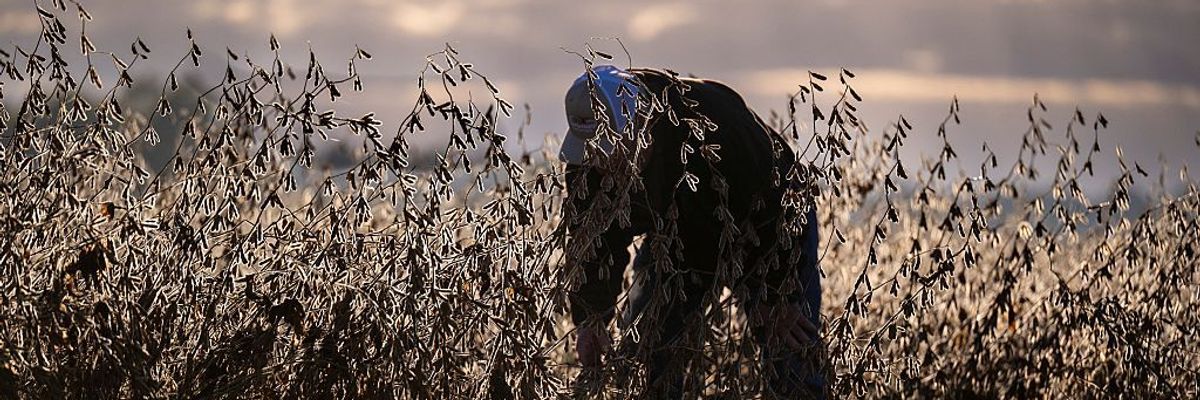
Travis Hutchison, a soybean farmer, inspects a soybean field ready for harvesting on one of his family's farms in Cordova, Maryland, on October 10, 2025.
"Placing a tariff or a tax on any kind of food item makes absolutely no sense."
US farmers warned on Tuesday that they are under increasing strain thanks to President Donald Trump's tariffs, and they predicted more price increases were coming for American consumers during the holiday season.
As reported by The Packer, representatives from the Kansas Farmers Union, supermarket chain supplier Royal Food, and North Carolina-based Red Scout Farm detailed during a conference call how Trump's tariffs on nearly all imported goods were raising prices on vegetables, fruits, grains, and meats.
Mary Carol Dodd, owner of Red Scout Farm, said during the call that her farm depends on products imported from other countries, including greenhouse materials, insect netting, and produce bags. With no low-cost domestic substitutes for these products available, said Dodd, she will have no choice but to raise prices.
"When the price of everything it takes to grow vegetables goes up, from soil to tools to fertilizer, packaging, transportation, then the vegetables on the holiday table go up as well,” Dodd explained. “For a small, diversified farm like us, those costs add up quickly. Our profit margins are already very thin, so every increase means tough choices."
For Dodd, those tough choices have taken the form of a 50% price hike on collard greens and kale, and a 50-cent price increase on mixed-lettuce bags.
Nick Levendofsky, executive director of the Kansas Farmers Union, said during the call that price increases were inevitable given that most farms already operate on razor-thin profit margins.
"Every added cost in the supply chain eventually shows up at the checkout line," he said. "Tariffs stack up on top of already high input costs, and families end up paying more for the same ingredients they bought last year."
Colin Tuthill, president of Royal Food, expressed bewilderment that the president would enact policies that raised Americans' food prices, especially after he won an election last year on the promise to reduce grocery prices starting on his first day in office.
"Placing a tariff or a tax on any kind of food item makes absolutely no sense to me," he said. "We're raising the price of food for the most in need."
The American Federation of Teachers, Century Foundation, and Groundwork Collaborative last week issued a report estimating that Thanksgiving costs for US consumers have gone up by roughly 10% over the last year, with staples such as onions, spiral hams, and cranberry sauce all recording increases of 22% or higher.
The groups also found that Trump's policies were squarely to blame for the price increases, and not just the tariffs. Specifically, they pointed to chaos at agencies such as the US Department of Agriculture that have weakened efforts to contain bird flu on US farms, which has in turn hurt the supply of poultry heading into the holiday season.
Although Trump has walked back some of his tariffs on staples such as coffee, bananas, and chocolate, the groups noted that this rollback likely came too late to offer relief to US families this year.
"Trump campaigned on bringing down the price of groceries on day one," they wrote. "Yet in the biggest grocery week of the year, families across the country aren’t seeing any savings. Instead, their budgets are being carved up alongside the Thanksgiving turkey."
Dear Common Dreams reader, It’s been nearly 30 years since I co-founded Common Dreams with my late wife, Lina Newhouser. We had the radical notion that journalism should serve the public good, not corporate profits. It was clear to us from the outset what it would take to build such a project. No paid advertisements. No corporate sponsors. No millionaire publisher telling us what to think or do. Many people said we wouldn't last a year, but we proved those doubters wrong. Together with a tremendous team of journalists and dedicated staff, we built an independent media outlet free from the constraints of profits and corporate control. Our mission has always been simple: To inform. To inspire. To ignite change for the common good. Building Common Dreams was not easy. Our survival was never guaranteed. When you take on the most powerful forces—Wall Street greed, fossil fuel industry destruction, Big Tech lobbyists, and uber-rich oligarchs who have spent billions upon billions rigging the economy and democracy in their favor—the only bulwark you have is supporters who believe in your work. But here’s the urgent message from me today. It's never been this bad out there. And it's never been this hard to keep us going. At the very moment Common Dreams is most needed, the threats we face are intensifying. We need your support now more than ever. We don't accept corporate advertising and never will. We don't have a paywall because we don't think people should be blocked from critical news based on their ability to pay. Everything we do is funded by the donations of readers like you. When everyone does the little they can afford, we are strong. But if that support retreats or dries up, so do we. Will you donate now to make sure Common Dreams not only survives but thrives? —Craig Brown, Co-founder |
US farmers warned on Tuesday that they are under increasing strain thanks to President Donald Trump's tariffs, and they predicted more price increases were coming for American consumers during the holiday season.
As reported by The Packer, representatives from the Kansas Farmers Union, supermarket chain supplier Royal Food, and North Carolina-based Red Scout Farm detailed during a conference call how Trump's tariffs on nearly all imported goods were raising prices on vegetables, fruits, grains, and meats.
Mary Carol Dodd, owner of Red Scout Farm, said during the call that her farm depends on products imported from other countries, including greenhouse materials, insect netting, and produce bags. With no low-cost domestic substitutes for these products available, said Dodd, she will have no choice but to raise prices.
"When the price of everything it takes to grow vegetables goes up, from soil to tools to fertilizer, packaging, transportation, then the vegetables on the holiday table go up as well,” Dodd explained. “For a small, diversified farm like us, those costs add up quickly. Our profit margins are already very thin, so every increase means tough choices."
For Dodd, those tough choices have taken the form of a 50% price hike on collard greens and kale, and a 50-cent price increase on mixed-lettuce bags.
Nick Levendofsky, executive director of the Kansas Farmers Union, said during the call that price increases were inevitable given that most farms already operate on razor-thin profit margins.
"Every added cost in the supply chain eventually shows up at the checkout line," he said. "Tariffs stack up on top of already high input costs, and families end up paying more for the same ingredients they bought last year."
Colin Tuthill, president of Royal Food, expressed bewilderment that the president would enact policies that raised Americans' food prices, especially after he won an election last year on the promise to reduce grocery prices starting on his first day in office.
"Placing a tariff or a tax on any kind of food item makes absolutely no sense to me," he said. "We're raising the price of food for the most in need."
The American Federation of Teachers, Century Foundation, and Groundwork Collaborative last week issued a report estimating that Thanksgiving costs for US consumers have gone up by roughly 10% over the last year, with staples such as onions, spiral hams, and cranberry sauce all recording increases of 22% or higher.
The groups also found that Trump's policies were squarely to blame for the price increases, and not just the tariffs. Specifically, they pointed to chaos at agencies such as the US Department of Agriculture that have weakened efforts to contain bird flu on US farms, which has in turn hurt the supply of poultry heading into the holiday season.
Although Trump has walked back some of his tariffs on staples such as coffee, bananas, and chocolate, the groups noted that this rollback likely came too late to offer relief to US families this year.
"Trump campaigned on bringing down the price of groceries on day one," they wrote. "Yet in the biggest grocery week of the year, families across the country aren’t seeing any savings. Instead, their budgets are being carved up alongside the Thanksgiving turkey."
US farmers warned on Tuesday that they are under increasing strain thanks to President Donald Trump's tariffs, and they predicted more price increases were coming for American consumers during the holiday season.
As reported by The Packer, representatives from the Kansas Farmers Union, supermarket chain supplier Royal Food, and North Carolina-based Red Scout Farm detailed during a conference call how Trump's tariffs on nearly all imported goods were raising prices on vegetables, fruits, grains, and meats.
Mary Carol Dodd, owner of Red Scout Farm, said during the call that her farm depends on products imported from other countries, including greenhouse materials, insect netting, and produce bags. With no low-cost domestic substitutes for these products available, said Dodd, she will have no choice but to raise prices.
"When the price of everything it takes to grow vegetables goes up, from soil to tools to fertilizer, packaging, transportation, then the vegetables on the holiday table go up as well,” Dodd explained. “For a small, diversified farm like us, those costs add up quickly. Our profit margins are already very thin, so every increase means tough choices."
For Dodd, those tough choices have taken the form of a 50% price hike on collard greens and kale, and a 50-cent price increase on mixed-lettuce bags.
Nick Levendofsky, executive director of the Kansas Farmers Union, said during the call that price increases were inevitable given that most farms already operate on razor-thin profit margins.
"Every added cost in the supply chain eventually shows up at the checkout line," he said. "Tariffs stack up on top of already high input costs, and families end up paying more for the same ingredients they bought last year."
Colin Tuthill, president of Royal Food, expressed bewilderment that the president would enact policies that raised Americans' food prices, especially after he won an election last year on the promise to reduce grocery prices starting on his first day in office.
"Placing a tariff or a tax on any kind of food item makes absolutely no sense to me," he said. "We're raising the price of food for the most in need."
The American Federation of Teachers, Century Foundation, and Groundwork Collaborative last week issued a report estimating that Thanksgiving costs for US consumers have gone up by roughly 10% over the last year, with staples such as onions, spiral hams, and cranberry sauce all recording increases of 22% or higher.
The groups also found that Trump's policies were squarely to blame for the price increases, and not just the tariffs. Specifically, they pointed to chaos at agencies such as the US Department of Agriculture that have weakened efforts to contain bird flu on US farms, which has in turn hurt the supply of poultry heading into the holiday season.
Although Trump has walked back some of his tariffs on staples such as coffee, bananas, and chocolate, the groups noted that this rollback likely came too late to offer relief to US families this year.
"Trump campaigned on bringing down the price of groceries on day one," they wrote. "Yet in the biggest grocery week of the year, families across the country aren’t seeing any savings. Instead, their budgets are being carved up alongside the Thanksgiving turkey."