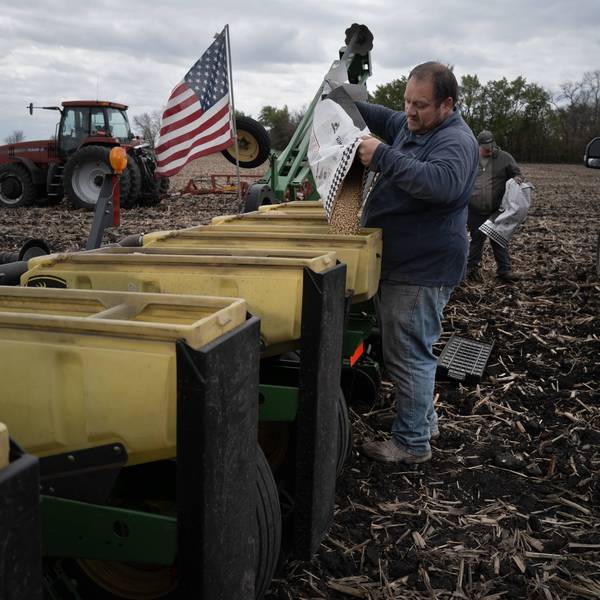
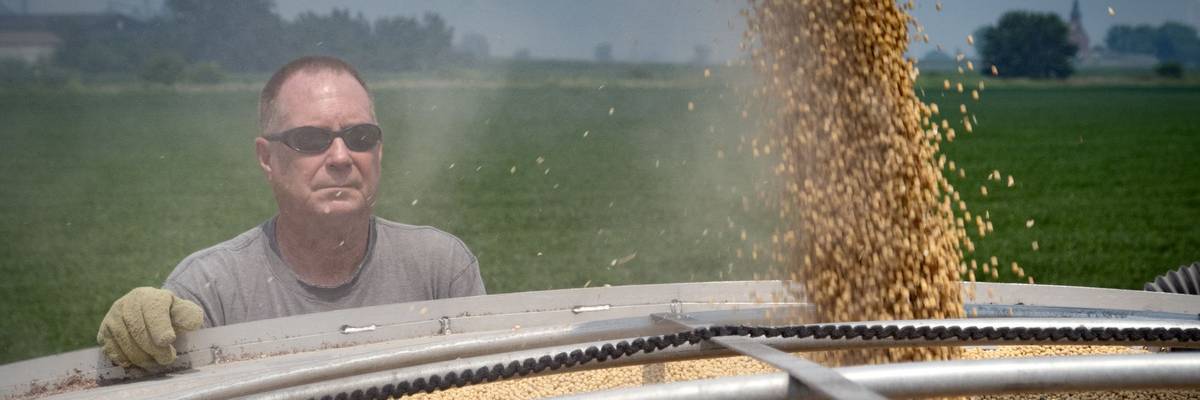
A farmer loads soybeans from grain bins into a truck on August 1, 2025 in Dwight, Illinois.
Wyden Says Trump's $12 Billion Farmer Bailout Exposes Folly of 'Destructive Tariff Spree'
"Donald Trump’s trade war is taxing families, killing markets for our farm goods, and driving farmers into bankruptcy," said Democratic Sen. Ron Wyden.
Democratic US Sen. Ron Wyden was among those who emphasized Monday that President Donald Trump's erratic tariff policies have helped create the very conditions the White House is now citing to justify its new $12 billion relief plan for American farmers.
“Instead of proposing government handouts, Donald Trump should end his destructive tariff spree so American farmers can compete and win on a level playing field," said Wyden (D-Ore.), the top Democrat on the Senate Finance Committee. "Donald Trump’s trade war is taxing families, killing markets for our farm goods, and driving farmers into bankruptcy."
"Trump’s plan to bail out farmers won’t even get agriculture communities back to even," the senator added. "They’re still paying more for fertilizer, equipment, and seeds, while grown-in-the-USA farm goods are facing more obstacles than ever in foreign markets. Don’t forget that all of this trade destruction and taxing was to raise money for Trump’s massive handouts to billionaires and the ultra-wealthy.”
Trump formally unveiled the relief plan Monday afternoon at a White House roundtable with top officials, lawmakers, and farmers of corn, soybeans, and other crops. Reuters reported that up to $11 billion of the funds are "meant for a newly designed Farmer Bridge Assistance program for row crop farmers hurt by trade disputes and higher costs." The other $1 billion is earmarked for commodities not covered by the program.
"Quite an admission that his policies have hurt Americans," economist Justin Wolfers wrote in response to the plan.
Farm Action, a farmer-led agricultural watchdog group, welcomed the relief package but said it's not enough to end suffering caused by "tariffs, soaring input costs, and years of volatile markets."
"The current problems facing our agriculture system have been decades in the making due to failed policy that prioritizes commodity crops for export, which only benefits global grain traders and meatpackers," said Joe Maxwell, Farm Action’s co-founder and chief strategy officer. "Without addressing the root causes of this issue, farmers will be left to continue relying on government assistance into the future. That is why Congress must take action and fix our failed subsidy system in the next farm bill."
Rebecca Wolf, senior food policy analyst at Food & Water Watch, said that "bailouts are a denigrating Band-Aid to farmers whom decades of misguided domestic policy have left vulnerable to trade wars."
"Trump’s tariff tantrum and belittling bailouts will deepen agricultural sector consolidation, funneling money to a powerful few corporations, while running farmers further into the ground," said Wolf. "If Trump is serious about helping farmers, lowering sector consolidation and dropping food prices, he needs to look in the mirror. Chaotic tariff tantrums are no way to run farm policy. US farmers need fair prices, regional food markets, and policies that reward sustainable, humane production models—not trade wars.”
The $12 billion relief program comes after months of Trump tariffs and retaliatory actions by key nations—particularly China—that have amplified challenges facing US farmers, a key political constituency for the president.
Farmers and organizations representing them have been vocal in their criticism of Trump's tariffs and his proposed policy responses to the problems that the duties have intensified. As the Washington Post summarized:
Earlier this spring, Trump’s tariffs on China prompted the country to halt purchases of US soybeans. Then, the president offered a $20 billion bailout to Argentina, whose soybean crop sales to China have replaced those from US farmers. Later, Trump announced that the United States would buy beef from Argentina to bring down prices for US consumers, opening a new rift between Trump and cattle ranchers.
The new assistance package is particularly aimed at helping soybean farmers, who have seen a precipitous drop in sales this year, leaving them with extra supply, as the price of soybeans fell.
In October, Illinois soybean producer John Bartman said in a message to the Trump administration that "we don't want a bailout, we want a market."
"Bailouts don't work. Bailouts are band-aids," Bartman added. "What Trump is doing is destroying our markets, and when those markets disappear, we're not gonna get them back."
Ryan Mulholland and Mark Haggerty of the Center for American Progress echoed that sentiment in an analysis last month, noting that "writing a check to farmers helps in the short term, but even in the most optimistic scenario, input costs are likely to remain high, demand volatile, the climate ever-changing, and corporate consolidation and investor ownership of land firmly entrenched."
"Planning for next year’s planting season will be extremely difficult, but without a comprehensive plan to make farming a more sustainable, more prosperous enterprise, planning in subsequent years likely will not be any easier," they added. "President Trump’s 'solution' is to simply pay off farmers. Farmers want trade, not aid. And they want government policy that supports farmers and the communities where they live over the long term."
We are at a crossroads
This country and this world are at a monumental crossroads. In a few short weeks, US voters will have an opportunity to beat back the forces of fascism and confront the billionaires who are rigging the economy, our media system, and our democracy, making it increasingly impossible for ordinary people to get by. We’re not just talking about the election. We’re talking about what must be done once these fascist elements are vanquished from power. We need a bolder set of solutions than what either major party has so far been willing to offer and a working-class movement ready to fight like hell for it. Trump didn't emerge from nowhere. The conditions that fueled MAGA authoritarianism were created by decades of radical neoliberal economic policies and a corrupt political system dominated by corporate interests. They slashed taxes on the super-rich, promising that the benefits would trickle down. They said giveaways to the corporate titans would make life more affordable for the rest of us. It was all bullshit. And when a bitter, betrayed populace searches for someone to blame, right-wing demagogues have little trouble finding scapegoats. People know when they're being lied to, but you won't hear any of this from the corporate media. Only independent journalism—powered and funded by people who believe in building a better world—can deliver truly trustworthy daily news. Our Fall Campaign is underway, and we need your help. To power our newsroom through the rest of the year, we need to raise $125,000 by midnight on October 31. So if you share our vision, please contribute whatever you can to sustain our work. |
Democratic US Sen. Ron Wyden was among those who emphasized Monday that President Donald Trump's erratic tariff policies have helped create the very conditions the White House is now citing to justify its new $12 billion relief plan for American farmers.
“Instead of proposing government handouts, Donald Trump should end his destructive tariff spree so American farmers can compete and win on a level playing field," said Wyden (D-Ore.), the top Democrat on the Senate Finance Committee. "Donald Trump’s trade war is taxing families, killing markets for our farm goods, and driving farmers into bankruptcy."
"Trump’s plan to bail out farmers won’t even get agriculture communities back to even," the senator added. "They’re still paying more for fertilizer, equipment, and seeds, while grown-in-the-USA farm goods are facing more obstacles than ever in foreign markets. Don’t forget that all of this trade destruction and taxing was to raise money for Trump’s massive handouts to billionaires and the ultra-wealthy.”
Trump formally unveiled the relief plan Monday afternoon at a White House roundtable with top officials, lawmakers, and farmers of corn, soybeans, and other crops. Reuters reported that up to $11 billion of the funds are "meant for a newly designed Farmer Bridge Assistance program for row crop farmers hurt by trade disputes and higher costs." The other $1 billion is earmarked for commodities not covered by the program.
"Quite an admission that his policies have hurt Americans," economist Justin Wolfers wrote in response to the plan.
Farm Action, a farmer-led agricultural watchdog group, welcomed the relief package but said it's not enough to end suffering caused by "tariffs, soaring input costs, and years of volatile markets."
"The current problems facing our agriculture system have been decades in the making due to failed policy that prioritizes commodity crops for export, which only benefits global grain traders and meatpackers," said Joe Maxwell, Farm Action’s co-founder and chief strategy officer. "Without addressing the root causes of this issue, farmers will be left to continue relying on government assistance into the future. That is why Congress must take action and fix our failed subsidy system in the next farm bill."
Rebecca Wolf, senior food policy analyst at Food & Water Watch, said that "bailouts are a denigrating Band-Aid to farmers whom decades of misguided domestic policy have left vulnerable to trade wars."
"Trump’s tariff tantrum and belittling bailouts will deepen agricultural sector consolidation, funneling money to a powerful few corporations, while running farmers further into the ground," said Wolf. "If Trump is serious about helping farmers, lowering sector consolidation and dropping food prices, he needs to look in the mirror. Chaotic tariff tantrums are no way to run farm policy. US farmers need fair prices, regional food markets, and policies that reward sustainable, humane production models—not trade wars.”
The $12 billion relief program comes after months of Trump tariffs and retaliatory actions by key nations—particularly China—that have amplified challenges facing US farmers, a key political constituency for the president.
Farmers and organizations representing them have been vocal in their criticism of Trump's tariffs and his proposed policy responses to the problems that the duties have intensified. As the Washington Post summarized:
Earlier this spring, Trump’s tariffs on China prompted the country to halt purchases of US soybeans. Then, the president offered a $20 billion bailout to Argentina, whose soybean crop sales to China have replaced those from US farmers. Later, Trump announced that the United States would buy beef from Argentina to bring down prices for US consumers, opening a new rift between Trump and cattle ranchers.
The new assistance package is particularly aimed at helping soybean farmers, who have seen a precipitous drop in sales this year, leaving them with extra supply, as the price of soybeans fell.
In October, Illinois soybean producer John Bartman said in a message to the Trump administration that "we don't want a bailout, we want a market."
"Bailouts don't work. Bailouts are band-aids," Bartman added. "What Trump is doing is destroying our markets, and when those markets disappear, we're not gonna get them back."
Ryan Mulholland and Mark Haggerty of the Center for American Progress echoed that sentiment in an analysis last month, noting that "writing a check to farmers helps in the short term, but even in the most optimistic scenario, input costs are likely to remain high, demand volatile, the climate ever-changing, and corporate consolidation and investor ownership of land firmly entrenched."
"Planning for next year’s planting season will be extremely difficult, but without a comprehensive plan to make farming a more sustainable, more prosperous enterprise, planning in subsequent years likely will not be any easier," they added. "President Trump’s 'solution' is to simply pay off farmers. Farmers want trade, not aid. And they want government policy that supports farmers and the communities where they live over the long term."
- Decimated by Tariffs, US Farmers Warn Trump Bailout Not Nearly Enough to Ease Pain He Caused | Common Dreams ›
- Investigation Shows How Decades of Corporate Consolidation Have Devastated US Cattle Ranchers | Common Dreams ›
- 214 House Republicans Just Tried to Give 'Mad King' Trump Even More Tariff Powers | Common Dreams ›
- Opinion | How Much More Hurt Can Farmers Take Before They Abandon Trump? | Common Dreams ›
- Opinion | Hey, Republicans: Farmers Can't Build a Future on Constant Uncertainty | Common Dreams ›
Democratic US Sen. Ron Wyden was among those who emphasized Monday that President Donald Trump's erratic tariff policies have helped create the very conditions the White House is now citing to justify its new $12 billion relief plan for American farmers.
“Instead of proposing government handouts, Donald Trump should end his destructive tariff spree so American farmers can compete and win on a level playing field," said Wyden (D-Ore.), the top Democrat on the Senate Finance Committee. "Donald Trump’s trade war is taxing families, killing markets for our farm goods, and driving farmers into bankruptcy."
"Trump’s plan to bail out farmers won’t even get agriculture communities back to even," the senator added. "They’re still paying more for fertilizer, equipment, and seeds, while grown-in-the-USA farm goods are facing more obstacles than ever in foreign markets. Don’t forget that all of this trade destruction and taxing was to raise money for Trump’s massive handouts to billionaires and the ultra-wealthy.”
Trump formally unveiled the relief plan Monday afternoon at a White House roundtable with top officials, lawmakers, and farmers of corn, soybeans, and other crops. Reuters reported that up to $11 billion of the funds are "meant for a newly designed Farmer Bridge Assistance program for row crop farmers hurt by trade disputes and higher costs." The other $1 billion is earmarked for commodities not covered by the program.
"Quite an admission that his policies have hurt Americans," economist Justin Wolfers wrote in response to the plan.
Farm Action, a farmer-led agricultural watchdog group, welcomed the relief package but said it's not enough to end suffering caused by "tariffs, soaring input costs, and years of volatile markets."
"The current problems facing our agriculture system have been decades in the making due to failed policy that prioritizes commodity crops for export, which only benefits global grain traders and meatpackers," said Joe Maxwell, Farm Action’s co-founder and chief strategy officer. "Without addressing the root causes of this issue, farmers will be left to continue relying on government assistance into the future. That is why Congress must take action and fix our failed subsidy system in the next farm bill."
Rebecca Wolf, senior food policy analyst at Food & Water Watch, said that "bailouts are a denigrating Band-Aid to farmers whom decades of misguided domestic policy have left vulnerable to trade wars."
"Trump’s tariff tantrum and belittling bailouts will deepen agricultural sector consolidation, funneling money to a powerful few corporations, while running farmers further into the ground," said Wolf. "If Trump is serious about helping farmers, lowering sector consolidation and dropping food prices, he needs to look in the mirror. Chaotic tariff tantrums are no way to run farm policy. US farmers need fair prices, regional food markets, and policies that reward sustainable, humane production models—not trade wars.”
The $12 billion relief program comes after months of Trump tariffs and retaliatory actions by key nations—particularly China—that have amplified challenges facing US farmers, a key political constituency for the president.
Farmers and organizations representing them have been vocal in their criticism of Trump's tariffs and his proposed policy responses to the problems that the duties have intensified. As the Washington Post summarized:
Earlier this spring, Trump’s tariffs on China prompted the country to halt purchases of US soybeans. Then, the president offered a $20 billion bailout to Argentina, whose soybean crop sales to China have replaced those from US farmers. Later, Trump announced that the United States would buy beef from Argentina to bring down prices for US consumers, opening a new rift between Trump and cattle ranchers.
The new assistance package is particularly aimed at helping soybean farmers, who have seen a precipitous drop in sales this year, leaving them with extra supply, as the price of soybeans fell.
In October, Illinois soybean producer John Bartman said in a message to the Trump administration that "we don't want a bailout, we want a market."
"Bailouts don't work. Bailouts are band-aids," Bartman added. "What Trump is doing is destroying our markets, and when those markets disappear, we're not gonna get them back."
Ryan Mulholland and Mark Haggerty of the Center for American Progress echoed that sentiment in an analysis last month, noting that "writing a check to farmers helps in the short term, but even in the most optimistic scenario, input costs are likely to remain high, demand volatile, the climate ever-changing, and corporate consolidation and investor ownership of land firmly entrenched."
"Planning for next year’s planting season will be extremely difficult, but without a comprehensive plan to make farming a more sustainable, more prosperous enterprise, planning in subsequent years likely will not be any easier," they added. "President Trump’s 'solution' is to simply pay off farmers. Farmers want trade, not aid. And they want government policy that supports farmers and the communities where they live over the long term."
- Decimated by Tariffs, US Farmers Warn Trump Bailout Not Nearly Enough to Ease Pain He Caused | Common Dreams ›
- Investigation Shows How Decades of Corporate Consolidation Have Devastated US Cattle Ranchers | Common Dreams ›
- 214 House Republicans Just Tried to Give 'Mad King' Trump Even More Tariff Powers | Common Dreams ›
- Opinion | How Much More Hurt Can Farmers Take Before They Abandon Trump? | Common Dreams ›
- Opinion | Hey, Republicans: Farmers Can't Build a Future on Constant Uncertainty | Common Dreams ›