SUBSCRIBE TO OUR FREE NEWSLETTER
Daily news & progressive opinion—funded by the people, not the corporations—delivered straight to your inbox.
5
#000000
#FFFFFF
To donate by check, phone, or other method, see our More Ways to Give page.
Daily news & progressive opinion—funded by the people, not the corporations—delivered straight to your inbox.
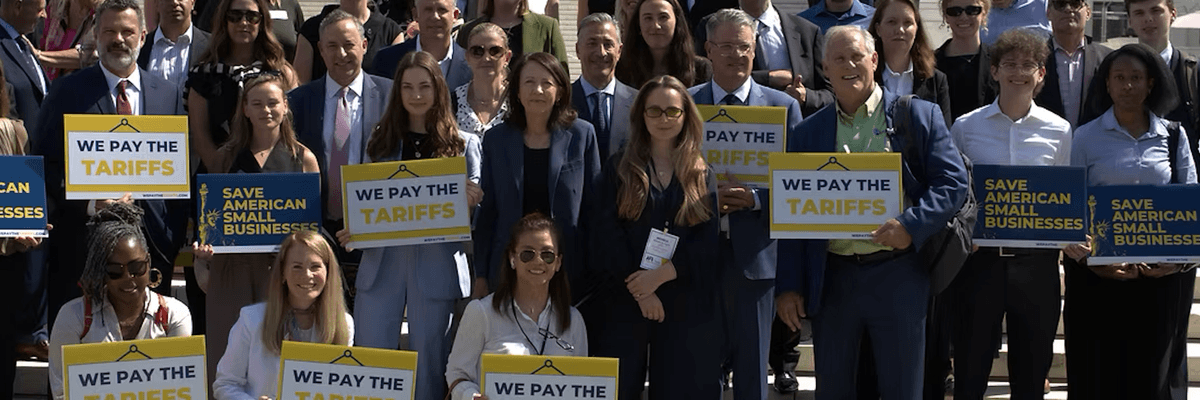
Small business owners hold signs reading "Save American Small Businesses" and "We Pay the Tariffs" during a September 2025 protest outside the US Supreme Court in Washington, DC.
The head of the group behind the analysis called the report "a damning indictment of tariffs’ impact on the US economy."
A US small business coalition on Wednesday released a state-by-state analysis detailing how President Donald Trump's capricious tariffs have cost American businesses and consumers upward of $317 billion since March 2025.
We Pay the Tariffs launched an interactive map, which uses data compiled by the international research firm Trade Partnership Worldwide, LLC to show the costs from additional tariffs the Trump administration has imposed by illegally invoking the International Emergency Economic Powers Act—a move blocked by the US Supreme Court in February—and by using Sections 122, 232, and 301 of the Trade Act of 1974.
With Section 122 tariffs—which impose a 10% surcharge on imports from almost all countries—set to expire on July 24, the Trump administration has said it will replace them with permanent Section 301 tariffs, which, according to We Pay the Tariffs will add "new costs on top of the hundreds of billions of dollars businesses have already paid."
"The latest figures are a damning indictment of tariffs’ impact on the US economy, with lots of pain but little gains for American workers, businesses, and families," We Pay the Tariffs executive director Dan Anthony said on Wednesday. "The trade deficit is up, goods exports and manufacturing jobs are down, and inflation is at its highest level in years. It’s disappointing that the administration is barreling ahead with a flurry of new tariffs despite the results to date."
In an open letter to members of Congress signed by small businesses across the country, the coalition noted that "once new tariffs take effect, history shows they are rarely undone."
"The Section 301 statute says tariffs should terminate after four years. Yet Section 301 tariffs imposed by the first Trump administration in 2018 were continued by the Biden administration, and remain in effect today," the letter states. "So do many Section 232 tariffs imposed in 2018 and expanded upon in 2025. There is no reason to expect this pattern to change."
The coalition argued that this is why "Congress must act before more Section 301 and 232 tariffs take effect."
"This is not a partisan issue. Tariffs are deeply and broadly unpopular with American voters," the letter asserts. "They are hurting small businesses in every state. Tariffs are taxes, and no president should be able to unilaterally impose hundreds of billions in permanent new taxes without a vote of Congress."
Progressive economists and consumer advocates argue that tariffs function as a regressive tax, falling disproportionately on working-class families who spend a larger share of their income on consumer goods. They warn that Trump administration tariff policies have also aided large corporations at the expense of smaller competitors.
Critics also note that the tariffs have failed to deliver the manufacturing renaissance promised by Trump, noting that the sector has still shed tens of thousands of jobs even as output increases due to automation, and that workers have seen few benefits from the hundreds of billions of dollars in additional import taxes paid by businesses and consumers.
"We paid—and will be forced to keep paying—the tariffs," the coalition letter concludes. "We need Congress to act now, before a permanent tariff regime is imposed on small businesses across America."
Dear Common Dreams reader, It’s been nearly 30 years since I co-founded Common Dreams with my late wife, Lina Newhouser. We had the radical notion that journalism should serve the public good, not corporate profits. It was clear to us from the outset what it would take to build such a project. No paid advertisements. No corporate sponsors. No millionaire publisher telling us what to think or do. Many people said we wouldn't last a year, but we proved those doubters wrong. Together with a tremendous team of journalists and dedicated staff, we built an independent media outlet free from the constraints of profits and corporate control. Our mission has always been simple: To inform. To inspire. To ignite change for the common good. Building Common Dreams was not easy. Our survival was never guaranteed. When you take on the most powerful forces—Wall Street greed, fossil fuel industry destruction, Big Tech lobbyists, and uber-rich oligarchs who have spent billions upon billions rigging the economy and democracy in their favor—the only bulwark you have is supporters who believe in your work. But here’s the urgent message from me today. It's never been this bad out there. And it's never been this hard to keep us going. At the very moment Common Dreams is most needed, the threats we face are intensifying. We need your support now more than ever. We don't accept corporate advertising and never will. We don't have a paywall because we don't think people should be blocked from critical news based on their ability to pay. Everything we do is funded by the donations of readers like you. When everyone does the little they can afford, we are strong. But if that support retreats or dries up, so do we. Will you donate now to make sure Common Dreams not only survives but thrives? —Craig Brown, Co-founder |
A US small business coalition on Wednesday released a state-by-state analysis detailing how President Donald Trump's capricious tariffs have cost American businesses and consumers upward of $317 billion since March 2025.
We Pay the Tariffs launched an interactive map, which uses data compiled by the international research firm Trade Partnership Worldwide, LLC to show the costs from additional tariffs the Trump administration has imposed by illegally invoking the International Emergency Economic Powers Act—a move blocked by the US Supreme Court in February—and by using Sections 122, 232, and 301 of the Trade Act of 1974.
With Section 122 tariffs—which impose a 10% surcharge on imports from almost all countries—set to expire on July 24, the Trump administration has said it will replace them with permanent Section 301 tariffs, which, according to We Pay the Tariffs will add "new costs on top of the hundreds of billions of dollars businesses have already paid."
"The latest figures are a damning indictment of tariffs’ impact on the US economy, with lots of pain but little gains for American workers, businesses, and families," We Pay the Tariffs executive director Dan Anthony said on Wednesday. "The trade deficit is up, goods exports and manufacturing jobs are down, and inflation is at its highest level in years. It’s disappointing that the administration is barreling ahead with a flurry of new tariffs despite the results to date."
In an open letter to members of Congress signed by small businesses across the country, the coalition noted that "once new tariffs take effect, history shows they are rarely undone."
"The Section 301 statute says tariffs should terminate after four years. Yet Section 301 tariffs imposed by the first Trump administration in 2018 were continued by the Biden administration, and remain in effect today," the letter states. "So do many Section 232 tariffs imposed in 2018 and expanded upon in 2025. There is no reason to expect this pattern to change."
The coalition argued that this is why "Congress must act before more Section 301 and 232 tariffs take effect."
"This is not a partisan issue. Tariffs are deeply and broadly unpopular with American voters," the letter asserts. "They are hurting small businesses in every state. Tariffs are taxes, and no president should be able to unilaterally impose hundreds of billions in permanent new taxes without a vote of Congress."
Progressive economists and consumer advocates argue that tariffs function as a regressive tax, falling disproportionately on working-class families who spend a larger share of their income on consumer goods. They warn that Trump administration tariff policies have also aided large corporations at the expense of smaller competitors.
Critics also note that the tariffs have failed to deliver the manufacturing renaissance promised by Trump, noting that the sector has still shed tens of thousands of jobs even as output increases due to automation, and that workers have seen few benefits from the hundreds of billions of dollars in additional import taxes paid by businesses and consumers.
"We paid—and will be forced to keep paying—the tariffs," the coalition letter concludes. "We need Congress to act now, before a permanent tariff regime is imposed on small businesses across America."
A US small business coalition on Wednesday released a state-by-state analysis detailing how President Donald Trump's capricious tariffs have cost American businesses and consumers upward of $317 billion since March 2025.
We Pay the Tariffs launched an interactive map, which uses data compiled by the international research firm Trade Partnership Worldwide, LLC to show the costs from additional tariffs the Trump administration has imposed by illegally invoking the International Emergency Economic Powers Act—a move blocked by the US Supreme Court in February—and by using Sections 122, 232, and 301 of the Trade Act of 1974.
With Section 122 tariffs—which impose a 10% surcharge on imports from almost all countries—set to expire on July 24, the Trump administration has said it will replace them with permanent Section 301 tariffs, which, according to We Pay the Tariffs will add "new costs on top of the hundreds of billions of dollars businesses have already paid."
"The latest figures are a damning indictment of tariffs’ impact on the US economy, with lots of pain but little gains for American workers, businesses, and families," We Pay the Tariffs executive director Dan Anthony said on Wednesday. "The trade deficit is up, goods exports and manufacturing jobs are down, and inflation is at its highest level in years. It’s disappointing that the administration is barreling ahead with a flurry of new tariffs despite the results to date."
In an open letter to members of Congress signed by small businesses across the country, the coalition noted that "once new tariffs take effect, history shows they are rarely undone."
"The Section 301 statute says tariffs should terminate after four years. Yet Section 301 tariffs imposed by the first Trump administration in 2018 were continued by the Biden administration, and remain in effect today," the letter states. "So do many Section 232 tariffs imposed in 2018 and expanded upon in 2025. There is no reason to expect this pattern to change."
The coalition argued that this is why "Congress must act before more Section 301 and 232 tariffs take effect."
"This is not a partisan issue. Tariffs are deeply and broadly unpopular with American voters," the letter asserts. "They are hurting small businesses in every state. Tariffs are taxes, and no president should be able to unilaterally impose hundreds of billions in permanent new taxes without a vote of Congress."
Progressive economists and consumer advocates argue that tariffs function as a regressive tax, falling disproportionately on working-class families who spend a larger share of their income on consumer goods. They warn that Trump administration tariff policies have also aided large corporations at the expense of smaller competitors.
Critics also note that the tariffs have failed to deliver the manufacturing renaissance promised by Trump, noting that the sector has still shed tens of thousands of jobs even as output increases due to automation, and that workers have seen few benefits from the hundreds of billions of dollars in additional import taxes paid by businesses and consumers.
"We paid—and will be forced to keep paying—the tariffs," the coalition letter concludes. "We need Congress to act now, before a permanent tariff regime is imposed on small businesses across America."