SUBSCRIBE TO OUR FREE NEWSLETTER
Daily news & progressive opinion—funded by the people, not the corporations—delivered straight to your inbox.
5
#000000
#FFFFFF
To donate by check, phone, or other method, see our More Ways to Give page.
Daily news & progressive opinion—funded by the people, not the corporations—delivered straight to your inbox.
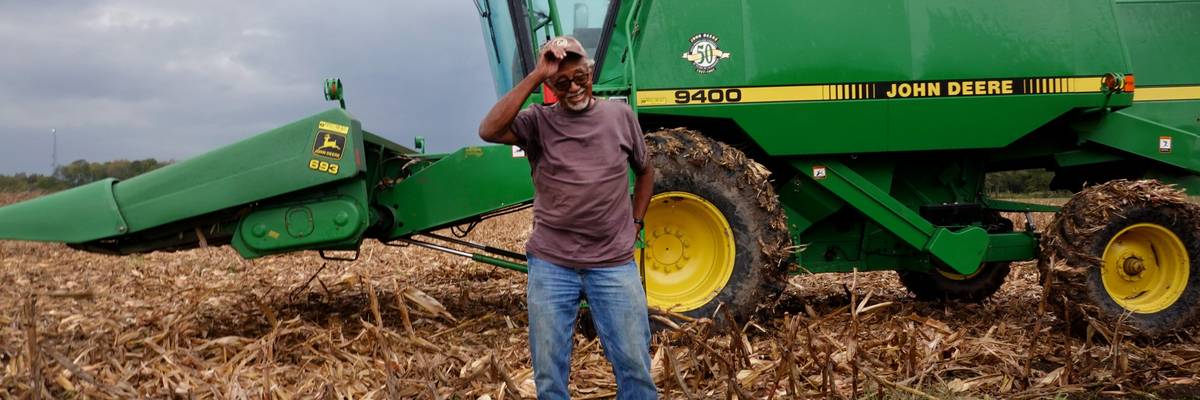
Glenn Morris, 83, harvests corn on October 11, 2021 in Princeton, Indiana.
"These disruptions are... financially squeezing food and agriculture businesses and sowing the seeds of division in rural communities."
A large group of agriculture experts warned that US farms are taking a financial beating thanks to President Donald Trump's global trade war.
In a letter sent to the chairs and ranking members of the House and Senate Agriculture Committees on Tuesday, the experts warned of a potential "widespread collapse of American agriculture and our rural communities" caused in no small part by Trump administration policies.
The letter's signatories—which include former leaders of American agricultural commodity and biofuels associations, farm leaders, and former USDA officials—pointed to Trump's tariffs on imported goods and his mass deportation policies as particularly harmful.
"It is clear that the current administration's actions, along with congressional inaction," the letter states, "have increased costs for farm inputs, disrupted overseas and domestic markets, denied agriculture its reliable labor pool, and defunded critical [agricultural] research and staffing."
The letter goes on to describe Trump's tariffs as "indiscriminate and haphazard," noting they "have not revitalized American manufacturing and have significantly damaged American farm economy."
The tariffs have also hurt farmers' access to overseas markets, the letter continues, as foreign nations have reacted with retaliatory tariffs.
"Consider the impact of the China trade war on soybeans alone," the letter says. "In 2018, when the China tariffs were initially imposed, whole US soybean exports represented 47% of the world market. Today, whole US soybeans represent just 24.4%—a 50% reduction in market share. Meanwhile, Brazil's share of the world export market grew by more than 20%."
When it comes to the administration's immigration policies, the letter says that "mass deportations, removal of protected status, and failure to reform the H-2A visa program is wreaking havoc with dairy, fruit and produce, and meat processing."
"Those disruptions are causing food to go to waste and driving up food costs for consumers," the letter adds. "These disruptions are also financially squeezing food and agriculture businesses and sowing the seeds of division in rural communities. Farmers need these workers."
The letter offers several policy proposals that the administration and Congress could take to help US farmers, including ending tariffs on farm inputs, repealing tariffs that have blocked access to overseas markets, passing reform to the H-2A visa program to help ensure farmers have sufficient workers, and extending trade agreements with Mexico and Canada for the next 16 years.
The letter also urges Congress to "convene meetings with farmers to discuss challenges that they are facing gather input on additional policy solutions and build momentum to address the farm crisis."
One of the letter's signatories, former National Corn Growers Association chief executive Jon Doggett, told the New York Times on Tuesday that he felt he had to speak out because "we’re not having those conversations" about the struggles facing US farmers "in an open and meaningful way."
The agriculture experts who signed the letter aren't alone in their concerns about US farmers' financial condition, as Reuters reported that US Sen. John Boozman (R-Ark.), the chairman of the Senate Agriculture Committee, said during a Tuesday conference call that he was aware that US farmers are "losing money, lots of money."
Dear Common Dreams reader, It’s been nearly 30 years since I co-founded Common Dreams with my late wife, Lina Newhouser. We had the radical notion that journalism should serve the public good, not corporate profits. It was clear to us from the outset what it would take to build such a project. No paid advertisements. No corporate sponsors. No millionaire publisher telling us what to think or do. Many people said we wouldn't last a year, but we proved those doubters wrong. Together with a tremendous team of journalists and dedicated staff, we built an independent media outlet free from the constraints of profits and corporate control. Our mission has always been simple: To inform. To inspire. To ignite change for the common good. Building Common Dreams was not easy. Our survival was never guaranteed. When you take on the most powerful forces—Wall Street greed, fossil fuel industry destruction, Big Tech lobbyists, and uber-rich oligarchs who have spent billions upon billions rigging the economy and democracy in their favor—the only bulwark you have is supporters who believe in your work. But here’s the urgent message from me today. It's never been this bad out there. And it's never been this hard to keep us going. At the very moment Common Dreams is most needed, the threats we face are intensifying. We need your support now more than ever. We don't accept corporate advertising and never will. We don't have a paywall because we don't think people should be blocked from critical news based on their ability to pay. Everything we do is funded by the donations of readers like you. When everyone does the little they can afford, we are strong. But if that support retreats or dries up, so do we. Will you donate now to make sure Common Dreams not only survives but thrives? —Craig Brown, Co-founder |
A large group of agriculture experts warned that US farms are taking a financial beating thanks to President Donald Trump's global trade war.
In a letter sent to the chairs and ranking members of the House and Senate Agriculture Committees on Tuesday, the experts warned of a potential "widespread collapse of American agriculture and our rural communities" caused in no small part by Trump administration policies.
The letter's signatories—which include former leaders of American agricultural commodity and biofuels associations, farm leaders, and former USDA officials—pointed to Trump's tariffs on imported goods and his mass deportation policies as particularly harmful.
"It is clear that the current administration's actions, along with congressional inaction," the letter states, "have increased costs for farm inputs, disrupted overseas and domestic markets, denied agriculture its reliable labor pool, and defunded critical [agricultural] research and staffing."
The letter goes on to describe Trump's tariffs as "indiscriminate and haphazard," noting they "have not revitalized American manufacturing and have significantly damaged American farm economy."
The tariffs have also hurt farmers' access to overseas markets, the letter continues, as foreign nations have reacted with retaliatory tariffs.
"Consider the impact of the China trade war on soybeans alone," the letter says. "In 2018, when the China tariffs were initially imposed, whole US soybean exports represented 47% of the world market. Today, whole US soybeans represent just 24.4%—a 50% reduction in market share. Meanwhile, Brazil's share of the world export market grew by more than 20%."
When it comes to the administration's immigration policies, the letter says that "mass deportations, removal of protected status, and failure to reform the H-2A visa program is wreaking havoc with dairy, fruit and produce, and meat processing."
"Those disruptions are causing food to go to waste and driving up food costs for consumers," the letter adds. "These disruptions are also financially squeezing food and agriculture businesses and sowing the seeds of division in rural communities. Farmers need these workers."
The letter offers several policy proposals that the administration and Congress could take to help US farmers, including ending tariffs on farm inputs, repealing tariffs that have blocked access to overseas markets, passing reform to the H-2A visa program to help ensure farmers have sufficient workers, and extending trade agreements with Mexico and Canada for the next 16 years.
The letter also urges Congress to "convene meetings with farmers to discuss challenges that they are facing gather input on additional policy solutions and build momentum to address the farm crisis."
One of the letter's signatories, former National Corn Growers Association chief executive Jon Doggett, told the New York Times on Tuesday that he felt he had to speak out because "we’re not having those conversations" about the struggles facing US farmers "in an open and meaningful way."
The agriculture experts who signed the letter aren't alone in their concerns about US farmers' financial condition, as Reuters reported that US Sen. John Boozman (R-Ark.), the chairman of the Senate Agriculture Committee, said during a Tuesday conference call that he was aware that US farmers are "losing money, lots of money."
A large group of agriculture experts warned that US farms are taking a financial beating thanks to President Donald Trump's global trade war.
In a letter sent to the chairs and ranking members of the House and Senate Agriculture Committees on Tuesday, the experts warned of a potential "widespread collapse of American agriculture and our rural communities" caused in no small part by Trump administration policies.
The letter's signatories—which include former leaders of American agricultural commodity and biofuels associations, farm leaders, and former USDA officials—pointed to Trump's tariffs on imported goods and his mass deportation policies as particularly harmful.
"It is clear that the current administration's actions, along with congressional inaction," the letter states, "have increased costs for farm inputs, disrupted overseas and domestic markets, denied agriculture its reliable labor pool, and defunded critical [agricultural] research and staffing."
The letter goes on to describe Trump's tariffs as "indiscriminate and haphazard," noting they "have not revitalized American manufacturing and have significantly damaged American farm economy."
The tariffs have also hurt farmers' access to overseas markets, the letter continues, as foreign nations have reacted with retaliatory tariffs.
"Consider the impact of the China trade war on soybeans alone," the letter says. "In 2018, when the China tariffs were initially imposed, whole US soybean exports represented 47% of the world market. Today, whole US soybeans represent just 24.4%—a 50% reduction in market share. Meanwhile, Brazil's share of the world export market grew by more than 20%."
When it comes to the administration's immigration policies, the letter says that "mass deportations, removal of protected status, and failure to reform the H-2A visa program is wreaking havoc with dairy, fruit and produce, and meat processing."
"Those disruptions are causing food to go to waste and driving up food costs for consumers," the letter adds. "These disruptions are also financially squeezing food and agriculture businesses and sowing the seeds of division in rural communities. Farmers need these workers."
The letter offers several policy proposals that the administration and Congress could take to help US farmers, including ending tariffs on farm inputs, repealing tariffs that have blocked access to overseas markets, passing reform to the H-2A visa program to help ensure farmers have sufficient workers, and extending trade agreements with Mexico and Canada for the next 16 years.
The letter also urges Congress to "convene meetings with farmers to discuss challenges that they are facing gather input on additional policy solutions and build momentum to address the farm crisis."
One of the letter's signatories, former National Corn Growers Association chief executive Jon Doggett, told the New York Times on Tuesday that he felt he had to speak out because "we’re not having those conversations" about the struggles facing US farmers "in an open and meaningful way."
The agriculture experts who signed the letter aren't alone in their concerns about US farmers' financial condition, as Reuters reported that US Sen. John Boozman (R-Ark.), the chairman of the Senate Agriculture Committee, said during a Tuesday conference call that he was aware that US farmers are "losing money, lots of money."