SUBSCRIBE TO OUR FREE NEWSLETTER
Daily news & progressive opinion—funded by the people, not the corporations—delivered straight to your inbox.
5
#000000
#FFFFFF
To donate by check, phone, or other method, see our More Ways to Give page.
Daily news & progressive opinion—funded by the people, not the corporations—delivered straight to your inbox.
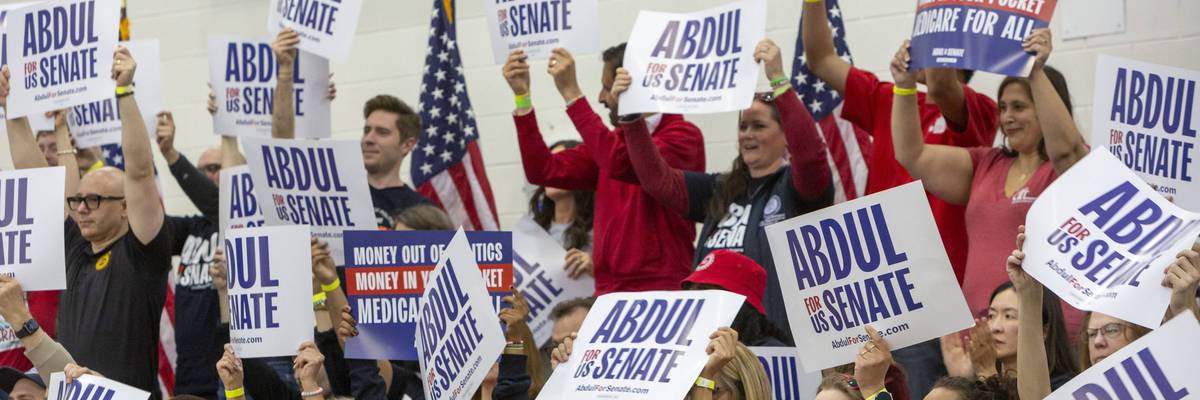
A crowd holds signs supporting Abdul El-Sayed for US Senate at a rally in Detroit on May 3, 2026.
"He’s the strongest and safest candidate to not only hold the seat but use it to pass transformative legislation to get money out of politics, put money in pockets, and pass Medicare for All," said Abdul El-Sayed's campaign.
Opponents of progressive former Detroit public health official Abdul El-Sayed have insisted he would be a risky candidate to face Republican contender Mike Rogers, with state Sen. Mallory McMorrow, who is running against El-Sayed in the Democratic primary, suggesting his support for Medicare for All is too radical, and a centrist think tank attacking him for campaigning with an outspoken critic of Israel.
But polls released Wednesday revealed that not only is El-Sayed continuing to surge ahead of McMorrow and US Rep. Haley Stevens, but he also appears to have a better chance of beating Rogers in a statewide race.
A new poll taken by Mitchell Research and Communications between June 11-13 found El-Sayed received the support of 42% of respondents, nine points ahead of Stevens. McMorrow, who has positioned herself as a "moderate" middle ground between her two opponents, had 6% support.
The survey found that El-Sayed continued to build his support among voters under the age of 45, with the candidate 83 points ahead of his opponents in the race that has been called a "millennial showdown" by local media. All three candidates are between the ages of 39 and 42.
Last month, another survey by Mitchell Research and Communications found El-Sayed with the support of 80% of voters ages 18-44.
A separate poll released by Zenith Research on behalf of Common Defense—a grassroots organization of military veterans and their families—found El-Sayed three points ahead of Rogers, a former congressman.
Forty-five percent of respondents backed El-Sayed in a hypothetical matchup with the Republican, who had polled at 42%.
In a hypothetical McMorrow-Rogers matchup, the Democrat had 44% support compared the Republican's 42%, while Stevens was just one point ahead of Rogers.
"The difference between El-Sayed and Stevens’ vote shares—45% and 43%, respectively—appears to be due to Stevens’ relative unpopularity among voters who self-identify as 'very progressive or liberal,'" said Adam Carlson, founding partner of Zenith Polls. "Thirty-one percent of progressive/liberal voters hold a 'strongly unfavorable' view of Stevens."
Several respondents, said Carlson, cited Stevens' ties to the American Israel Public Affairs Committee "as the driving cause, which coincides with AIPAC taking a more active role in the campaign in recent weeks."
Polls have shown that since Israel began its US-backed assault on Gaza in October 2023, public support for Israel and AIPAC, the powerful pro-Israel lobby group, has plummeted, particularly among Democratic voters.
The pollster found that 51% of respondents would support a candidate who backs Medicare for All—a top focus of El-Sayed's policy platform—while 33% said they would prefer a candidate who supports maintaining the for-profit healthcare system as it is. Stevens and McMorrow have said they support a "public option" to compete with for-profit insurers. McMorrow falsely claimed in a recent interview that Medicare for All does not have significant public support.
"Abdul is the ONLY one who can turn out a broad coalition to beat Rogers in November," said El-Sayed's campaign in response to the poll. "He’s the strongest and safest candidate to not only hold the seat but use it to pass transformative legislation to get money out of politics, put money in pockets, and pass Medicare for All."
At MeidasTouch on Wednesday, correspondent Scott MacFarlane asked El-Sayed why his critics continue to claim he would not be electable in the general election.
“I think my party doesn’t really know what electability is any more," said El-Sayed. "They think electability is about being the most middle-of-the-road Democrat."
Question from @MacFarlaneNews: “You hear these concerns in your party that you’re the least electable in a general election. Why do people say that?”
Dr. @AbdulElSayed (D-MI): “I think my party doesn’t really know what electability is any more.” @MeidasTouch https://t.co/EqsPlLuyuD pic.twitter.com/3dRxenuDYv
— Luke Radel (@lukeradel) June 17, 2026
"What they don't realize," said El-Sayed, "is that the Democratic Party's brand has been destroyed by Democrats who take money from corporations to water down a message, and then wonder why our base doesn't show up for us."
Dear Common Dreams reader, It’s been nearly 30 years since I co-founded Common Dreams with my late wife, Lina Newhouser. We had the radical notion that journalism should serve the public good, not corporate profits. It was clear to us from the outset what it would take to build such a project. No paid advertisements. No corporate sponsors. No millionaire publisher telling us what to think or do. Many people said we wouldn't last a year, but we proved those doubters wrong. Together with a tremendous team of journalists and dedicated staff, we built an independent media outlet free from the constraints of profits and corporate control. Our mission has always been simple: To inform. To inspire. To ignite change for the common good. Building Common Dreams was not easy. Our survival was never guaranteed. When you take on the most powerful forces—Wall Street greed, fossil fuel industry destruction, Big Tech lobbyists, and uber-rich oligarchs who have spent billions upon billions rigging the economy and democracy in their favor—the only bulwark you have is supporters who believe in your work. But here’s the urgent message from me today. It's never been this bad out there. And it's never been this hard to keep us going. At the very moment Common Dreams is most needed, the threats we face are intensifying. We need your support now more than ever. We don't accept corporate advertising and never will. We don't have a paywall because we don't think people should be blocked from critical news based on their ability to pay. Everything we do is funded by the donations of readers like you. When everyone does the little they can afford, we are strong. But if that support retreats or dries up, so do we. Will you donate now to make sure Common Dreams not only survives but thrives? —Craig Brown, Co-founder |
Opponents of progressive former Detroit public health official Abdul El-Sayed have insisted he would be a risky candidate to face Republican contender Mike Rogers, with state Sen. Mallory McMorrow, who is running against El-Sayed in the Democratic primary, suggesting his support for Medicare for All is too radical, and a centrist think tank attacking him for campaigning with an outspoken critic of Israel.
But polls released Wednesday revealed that not only is El-Sayed continuing to surge ahead of McMorrow and US Rep. Haley Stevens, but he also appears to have a better chance of beating Rogers in a statewide race.
A new poll taken by Mitchell Research and Communications between June 11-13 found El-Sayed received the support of 42% of respondents, nine points ahead of Stevens. McMorrow, who has positioned herself as a "moderate" middle ground between her two opponents, had 6% support.
The survey found that El-Sayed continued to build his support among voters under the age of 45, with the candidate 83 points ahead of his opponents in the race that has been called a "millennial showdown" by local media. All three candidates are between the ages of 39 and 42.
Last month, another survey by Mitchell Research and Communications found El-Sayed with the support of 80% of voters ages 18-44.
A separate poll released by Zenith Research on behalf of Common Defense—a grassroots organization of military veterans and their families—found El-Sayed three points ahead of Rogers, a former congressman.
Forty-five percent of respondents backed El-Sayed in a hypothetical matchup with the Republican, who had polled at 42%.
In a hypothetical McMorrow-Rogers matchup, the Democrat had 44% support compared the Republican's 42%, while Stevens was just one point ahead of Rogers.
"The difference between El-Sayed and Stevens’ vote shares—45% and 43%, respectively—appears to be due to Stevens’ relative unpopularity among voters who self-identify as 'very progressive or liberal,'" said Adam Carlson, founding partner of Zenith Polls. "Thirty-one percent of progressive/liberal voters hold a 'strongly unfavorable' view of Stevens."
Several respondents, said Carlson, cited Stevens' ties to the American Israel Public Affairs Committee "as the driving cause, which coincides with AIPAC taking a more active role in the campaign in recent weeks."
Polls have shown that since Israel began its US-backed assault on Gaza in October 2023, public support for Israel and AIPAC, the powerful pro-Israel lobby group, has plummeted, particularly among Democratic voters.
The pollster found that 51% of respondents would support a candidate who backs Medicare for All—a top focus of El-Sayed's policy platform—while 33% said they would prefer a candidate who supports maintaining the for-profit healthcare system as it is. Stevens and McMorrow have said they support a "public option" to compete with for-profit insurers. McMorrow falsely claimed in a recent interview that Medicare for All does not have significant public support.
"Abdul is the ONLY one who can turn out a broad coalition to beat Rogers in November," said El-Sayed's campaign in response to the poll. "He’s the strongest and safest candidate to not only hold the seat but use it to pass transformative legislation to get money out of politics, put money in pockets, and pass Medicare for All."
At MeidasTouch on Wednesday, correspondent Scott MacFarlane asked El-Sayed why his critics continue to claim he would not be electable in the general election.
“I think my party doesn’t really know what electability is any more," said El-Sayed. "They think electability is about being the most middle-of-the-road Democrat."
Question from @MacFarlaneNews: “You hear these concerns in your party that you’re the least electable in a general election. Why do people say that?”
Dr. @AbdulElSayed (D-MI): “I think my party doesn’t really know what electability is any more.” @MeidasTouch https://t.co/EqsPlLuyuD pic.twitter.com/3dRxenuDYv
— Luke Radel (@lukeradel) June 17, 2026
"What they don't realize," said El-Sayed, "is that the Democratic Party's brand has been destroyed by Democrats who take money from corporations to water down a message, and then wonder why our base doesn't show up for us."
Opponents of progressive former Detroit public health official Abdul El-Sayed have insisted he would be a risky candidate to face Republican contender Mike Rogers, with state Sen. Mallory McMorrow, who is running against El-Sayed in the Democratic primary, suggesting his support for Medicare for All is too radical, and a centrist think tank attacking him for campaigning with an outspoken critic of Israel.
But polls released Wednesday revealed that not only is El-Sayed continuing to surge ahead of McMorrow and US Rep. Haley Stevens, but he also appears to have a better chance of beating Rogers in a statewide race.
A new poll taken by Mitchell Research and Communications between June 11-13 found El-Sayed received the support of 42% of respondents, nine points ahead of Stevens. McMorrow, who has positioned herself as a "moderate" middle ground between her two opponents, had 6% support.
The survey found that El-Sayed continued to build his support among voters under the age of 45, with the candidate 83 points ahead of his opponents in the race that has been called a "millennial showdown" by local media. All three candidates are between the ages of 39 and 42.
Last month, another survey by Mitchell Research and Communications found El-Sayed with the support of 80% of voters ages 18-44.
A separate poll released by Zenith Research on behalf of Common Defense—a grassroots organization of military veterans and their families—found El-Sayed three points ahead of Rogers, a former congressman.
Forty-five percent of respondents backed El-Sayed in a hypothetical matchup with the Republican, who had polled at 42%.
In a hypothetical McMorrow-Rogers matchup, the Democrat had 44% support compared the Republican's 42%, while Stevens was just one point ahead of Rogers.
"The difference between El-Sayed and Stevens’ vote shares—45% and 43%, respectively—appears to be due to Stevens’ relative unpopularity among voters who self-identify as 'very progressive or liberal,'" said Adam Carlson, founding partner of Zenith Polls. "Thirty-one percent of progressive/liberal voters hold a 'strongly unfavorable' view of Stevens."
Several respondents, said Carlson, cited Stevens' ties to the American Israel Public Affairs Committee "as the driving cause, which coincides with AIPAC taking a more active role in the campaign in recent weeks."
Polls have shown that since Israel began its US-backed assault on Gaza in October 2023, public support for Israel and AIPAC, the powerful pro-Israel lobby group, has plummeted, particularly among Democratic voters.
The pollster found that 51% of respondents would support a candidate who backs Medicare for All—a top focus of El-Sayed's policy platform—while 33% said they would prefer a candidate who supports maintaining the for-profit healthcare system as it is. Stevens and McMorrow have said they support a "public option" to compete with for-profit insurers. McMorrow falsely claimed in a recent interview that Medicare for All does not have significant public support.
"Abdul is the ONLY one who can turn out a broad coalition to beat Rogers in November," said El-Sayed's campaign in response to the poll. "He’s the strongest and safest candidate to not only hold the seat but use it to pass transformative legislation to get money out of politics, put money in pockets, and pass Medicare for All."
At MeidasTouch on Wednesday, correspondent Scott MacFarlane asked El-Sayed why his critics continue to claim he would not be electable in the general election.
“I think my party doesn’t really know what electability is any more," said El-Sayed. "They think electability is about being the most middle-of-the-road Democrat."
Question from @MacFarlaneNews: “You hear these concerns in your party that you’re the least electable in a general election. Why do people say that?”
Dr. @AbdulElSayed (D-MI): “I think my party doesn’t really know what electability is any more.” @MeidasTouch https://t.co/EqsPlLuyuD pic.twitter.com/3dRxenuDYv
— Luke Radel (@lukeradel) June 17, 2026
"What they don't realize," said El-Sayed, "is that the Democratic Party's brand has been destroyed by Democrats who take money from corporations to water down a message, and then wonder why our base doesn't show up for us."