SUBSCRIBE TO OUR FREE NEWSLETTER
Daily news & progressive opinion—funded by the people, not the corporations—delivered straight to your inbox.
5
#000000
#FFFFFF
To donate by check, phone, or other method, see our More Ways to Give page.
Daily news & progressive opinion—funded by the people, not the corporations—delivered straight to your inbox.
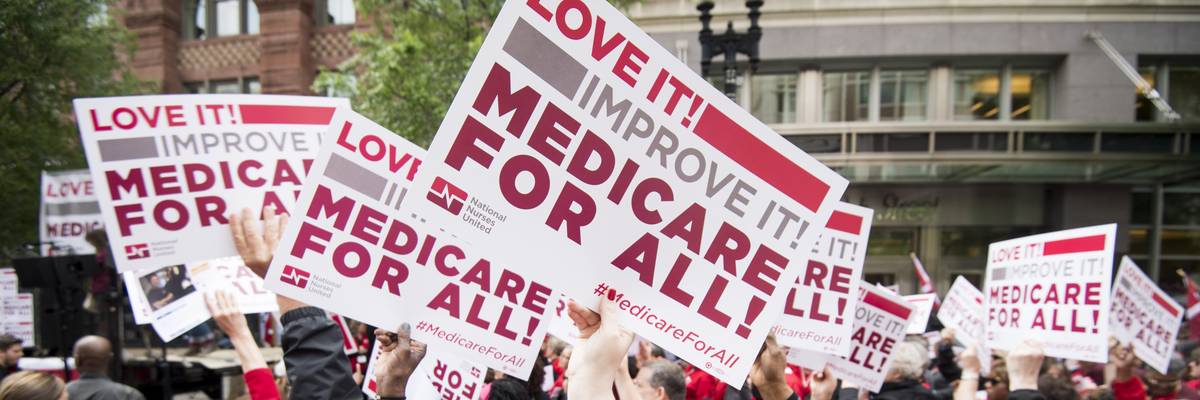
Members of National Nurses United union members wave "Medicare for All" signs during a rally in front of the Pharmaceutical Research and Manufacturers of America in Washington calling for "Medicare for All" on Monday, April 29, 2019.
Medicare has become living proof that public, universal health insurance is superior to private insurance in every way.
Sixty one years ago, July 30, 1965, Congress enacted Medicare to provide health insurance for people ages 65 and older and the disabled regardless of income or medical history. At the Harry S. Truman Presidential Library in Independence, Missouri, former President Harry S. Truman and his wife, former First Lady Bess Truman, became the first recipients of the new Medicare health insurance program. President Lyndon Johnson and the US Congress enacted Medicare under Title XVIII of the Social Security Act.
Medicare was a momentous act because it provided new health insurance for people ages 65 and older and the disabled regardless of income or medical history. In the years since, Medicare has become living proof that public, universal health insurance is superior to private insurance in every way. Medicare is more efficient than private health insurance and is administered at a cost of 3-4%, as opposed to private, for-profit health insurance, which has administrative costs above 15%.
Following the successful 1965 grassroots campaign to enact Medicare, many also believed that the dream of a full national, single-payer health insurance system that included all age groups, “Medicare for All,” was right around the corner. Unfortunately decades later, Medicare still has not been expanded. Most of the changes have been contractions with higher out-of-pocket costs for beneficiaries and repeated attempts at privatization by Big Pharma, Big health insurance industry companies-oligarchs-profiteers, and their champions in the White House and Congress.
Big insurance and Big Pharma continue opposing legislation for the new, improved Medicare for All because these resistant, self-serving industries have the most to lose if their huge profits are redirected to direct patient care for all. Individual and corporate predators regard democracy, government, and community as obstacles to their greed and avarice, always placing profits over individual patients, families, and public health. It’s no wonder so many beholden members of Congress want to protect the interests of Big Insurance and Big Pharma, industries that spent $371 million on lobbying in 2017 alone.
The Heritage Foundation’s Project 2025, framed by former Trump administration staffers and secretly endorsed by President Donald Trump himself, proposes changes in Medicare benefits that could destroy Medicare as we know it. Instead, we must fight back and expand Medicare. Although health insurance affordability for the majority of US citizens still remains elusive, President Trump’s health insurance plan still wants to shift many more dollars into private, Wall Street insurance industry hands. The takeover of public health insurance, as with Medicare Advantage plans and others, by private Wall Street entities continues apace as Republicans and Trump propose to increase taxes and give it to the private profit insurance industry—the basic source of our profound administrative waste, along with the costly administrative burdens they place on the delivery system that requires large profits. Profiteering continues unabated as private insurance sells us services we don’t need or want, such as deductibles and other cost sharing and maintenance of narrow networks, requiring prior authorization with increased administrative costs, excessive ongoing paperwork, and documentation requirements, all while avoiding paying for surprise bills and other denied benefits.
No greater disconnect exists between the public good and private interests than in the voracious US system of for-profit Big Insurance and Big Pharma.
Dealing with Covid-19 could have been more lifesaving if Medicare for All had been in place. A New York Times editorial, "Health Care for Some is a Recipe for Disaster," stresses the importance of covering everyone. Even before Covid-19 was known to humans, Northeastern University professor of public health, Wendy Parmet, presciently warned that the push to exclude immigrants from access to healthcare services would be both dangerous and quixotic. “None of us can be self-sufficient in the face of a widespread epidemic,” she wrote in 2018. “That is just as true for noncitizen immigrants as everyone.” In any pandemic, self-sufficiency can be self-deluding; everyone’s health, citizens, immigrants, etc. alike is only as good as our most vulnerable neighbor’s.
Truly a recipe for disaster, vested interests reject the science of public health epidemiology by asserting that only a slow, incremental approach to health insurance reform is possible or acceptable. So, what are we willing to settle for, should we just settle for what we can get? Lower the expectations, turn down the public heat, and keep waiting?. Gradualism, baby steps, extending health insurance coverage to some, but not all, is the mantra of the day; "Medicare for Some," but not "Medicare for All," is fawned over by politicians, profiteers, and advocacy groups alike while reducing communities resources to deal with dangerous epidemics and other health problems.
Virtually all the risky gradual reforms being touted would reinforce a dysfunctional health insurance system with as many standards of insurance as there are dollars to purchase them. It would further lock us into an obsolete private insurance-based model that holds everyone's health hostage to profiteering HMOs and unaccountable big insurance companies for years to come. For these proponents of political expediency, the question remains: Who will be left behind while we wait? Every year many unnecessary deaths are linked to lack of health insurance coverage. Pandemics can quickly increase these numbers.
Big Insurance and Big Pharma dominate our government, and public health takes a back seat to the need for private profit. Many government leaders from both political parties share the same "profits over public health" ideology, even though the Covid-19 pandemic clearly showed how our economic system failed to serve our citizens by allowing these groups to privatize, sabotage, fragment, and cripple our health, public health, and other social services. Many of the changes in traditional Medicare have been contractions with higher out-of-pocket costs for beneficiaries and repeated attempts at privatization by Big Pharma, and Big Health insurance. No greater disconnect exists between the public good and private interests than in the voracious US system of for-profit Big Insurance and Big Pharma and their inherent tendency to invent new needs, disregard all boundaries, and turn everything into an object for sale and big profit.
Medicare for All Act (M4A)-2026 is best solution because it meets eight basic standards:
To continue our 61 years of progress, it’s time to upgrade Medicare by establishing a 21st century improved “Medicare for All” health insurance system that covers all age groups, cradle to grave. Newborns will leave the hospital with their new Medicare card, and drop it off years later at life’s end. Two comprehensive M4A bills now filed in Congress, H.R. 3069 and S.1506, propose to insure or cover all medically necessary services. Patients have their choice of physicians, mental health professionals, other healthcare professionals, hospitals, and clinics.
M4A insured health services include:Because our government, instead of private profit health insurance companies, serves us as the health insurance financing authority, co-pays and deductibles paid at health professionals' offices are ended because payment for health insurance is fully prepaid directly into Medicare, much like Social Security, and covered at first dollar amounts. This means the obsolete 80%-20% payment split between private health insurance companies and Medicare is eliminated, with Medicare for All covering 100%.
The major reason private health insurers are more expensive than government health programs in the US is due to profiteering and administrative costs. Those extra taxpayer funds going to private insurers include costs such as advertising and marketing of their plans, costs of contracting for restrictive provider networks, administering prior authorization requirements, complex systems of processing claims including denial of benefits, simple administrative costs of operating large corporate entities, and distributing generous profits to their executives and passive high profiteering by Wall Street investors.
The Medicare for All Act-2026, now filed in Congress, would much better fill our healthcare financing needs without wasting hundreds of billions of dollars on superfluous administrative costs and end immense profiteering by private insurers and Big Pharma. The USA is a country where health insurance for medical and mental healthcare is a function of socioeconomic status. Everyone knows that this inhumane system should have been corrected long ago.
Please tell your legislators that it’s time to end inadequate and dangerous health insurance programs. Insist on real health insurance reform essential for individuals and families. American history is filled with examples of fundamental, democratic change brought about by successful mass action and public pressure against the counseling of the go-slow, vested-interest crowd. No more waiting! Ask your legislators to fully support Medicare For All 2026 now: H.R. 3069 and S. 1506
Dear Common Dreams reader, It’s been nearly 30 years since I co-founded Common Dreams with my late wife, Lina Newhouser. We had the radical notion that journalism should serve the public good, not corporate profits. It was clear to us from the outset what it would take to build such a project. No paid advertisements. No corporate sponsors. No millionaire publisher telling us what to think or do. Many people said we wouldn't last a year, but we proved those doubters wrong. Together with a tremendous team of journalists and dedicated staff, we built an independent media outlet free from the constraints of profits and corporate control. Our mission has always been simple: To inform. To inspire. To ignite change for the common good. Building Common Dreams was not easy. Our survival was never guaranteed. When you take on the most powerful forces—Wall Street greed, fossil fuel industry destruction, Big Tech lobbyists, and uber-rich oligarchs who have spent billions upon billions rigging the economy and democracy in their favor—the only bulwark you have is supporters who believe in your work. But here’s the urgent message from me today. It's never been this bad out there. And it's never been this hard to keep us going. At the very moment Common Dreams is most needed, the threats we face are intensifying. We need your support now more than ever. We don't accept corporate advertising and never will. We don't have a paywall because we don't think people should be blocked from critical news based on their ability to pay. Everything we do is funded by the donations of readers like you. When everyone does the little they can afford, we are strong. But if that support retreats or dries up, so do we. Will you donate now to make sure Common Dreams not only survives but thrives? —Craig Brown, Co-founder |
Sixty one years ago, July 30, 1965, Congress enacted Medicare to provide health insurance for people ages 65 and older and the disabled regardless of income or medical history. At the Harry S. Truman Presidential Library in Independence, Missouri, former President Harry S. Truman and his wife, former First Lady Bess Truman, became the first recipients of the new Medicare health insurance program. President Lyndon Johnson and the US Congress enacted Medicare under Title XVIII of the Social Security Act.
Medicare was a momentous act because it provided new health insurance for people ages 65 and older and the disabled regardless of income or medical history. In the years since, Medicare has become living proof that public, universal health insurance is superior to private insurance in every way. Medicare is more efficient than private health insurance and is administered at a cost of 3-4%, as opposed to private, for-profit health insurance, which has administrative costs above 15%.
Following the successful 1965 grassroots campaign to enact Medicare, many also believed that the dream of a full national, single-payer health insurance system that included all age groups, “Medicare for All,” was right around the corner. Unfortunately decades later, Medicare still has not been expanded. Most of the changes have been contractions with higher out-of-pocket costs for beneficiaries and repeated attempts at privatization by Big Pharma, Big health insurance industry companies-oligarchs-profiteers, and their champions in the White House and Congress.
Big insurance and Big Pharma continue opposing legislation for the new, improved Medicare for All because these resistant, self-serving industries have the most to lose if their huge profits are redirected to direct patient care for all. Individual and corporate predators regard democracy, government, and community as obstacles to their greed and avarice, always placing profits over individual patients, families, and public health. It’s no wonder so many beholden members of Congress want to protect the interests of Big Insurance and Big Pharma, industries that spent $371 million on lobbying in 2017 alone.
The Heritage Foundation’s Project 2025, framed by former Trump administration staffers and secretly endorsed by President Donald Trump himself, proposes changes in Medicare benefits that could destroy Medicare as we know it. Instead, we must fight back and expand Medicare. Although health insurance affordability for the majority of US citizens still remains elusive, President Trump’s health insurance plan still wants to shift many more dollars into private, Wall Street insurance industry hands. The takeover of public health insurance, as with Medicare Advantage plans and others, by private Wall Street entities continues apace as Republicans and Trump propose to increase taxes and give it to the private profit insurance industry—the basic source of our profound administrative waste, along with the costly administrative burdens they place on the delivery system that requires large profits. Profiteering continues unabated as private insurance sells us services we don’t need or want, such as deductibles and other cost sharing and maintenance of narrow networks, requiring prior authorization with increased administrative costs, excessive ongoing paperwork, and documentation requirements, all while avoiding paying for surprise bills and other denied benefits.
No greater disconnect exists between the public good and private interests than in the voracious US system of for-profit Big Insurance and Big Pharma.
Dealing with Covid-19 could have been more lifesaving if Medicare for All had been in place. A New York Times editorial, "Health Care for Some is a Recipe for Disaster," stresses the importance of covering everyone. Even before Covid-19 was known to humans, Northeastern University professor of public health, Wendy Parmet, presciently warned that the push to exclude immigrants from access to healthcare services would be both dangerous and quixotic. “None of us can be self-sufficient in the face of a widespread epidemic,” she wrote in 2018. “That is just as true for noncitizen immigrants as everyone.” In any pandemic, self-sufficiency can be self-deluding; everyone’s health, citizens, immigrants, etc. alike is only as good as our most vulnerable neighbor’s.
Truly a recipe for disaster, vested interests reject the science of public health epidemiology by asserting that only a slow, incremental approach to health insurance reform is possible or acceptable. So, what are we willing to settle for, should we just settle for what we can get? Lower the expectations, turn down the public heat, and keep waiting?. Gradualism, baby steps, extending health insurance coverage to some, but not all, is the mantra of the day; "Medicare for Some," but not "Medicare for All," is fawned over by politicians, profiteers, and advocacy groups alike while reducing communities resources to deal with dangerous epidemics and other health problems.
Virtually all the risky gradual reforms being touted would reinforce a dysfunctional health insurance system with as many standards of insurance as there are dollars to purchase them. It would further lock us into an obsolete private insurance-based model that holds everyone's health hostage to profiteering HMOs and unaccountable big insurance companies for years to come. For these proponents of political expediency, the question remains: Who will be left behind while we wait? Every year many unnecessary deaths are linked to lack of health insurance coverage. Pandemics can quickly increase these numbers.
Big Insurance and Big Pharma dominate our government, and public health takes a back seat to the need for private profit. Many government leaders from both political parties share the same "profits over public health" ideology, even though the Covid-19 pandemic clearly showed how our economic system failed to serve our citizens by allowing these groups to privatize, sabotage, fragment, and cripple our health, public health, and other social services. Many of the changes in traditional Medicare have been contractions with higher out-of-pocket costs for beneficiaries and repeated attempts at privatization by Big Pharma, and Big Health insurance. No greater disconnect exists between the public good and private interests than in the voracious US system of for-profit Big Insurance and Big Pharma and their inherent tendency to invent new needs, disregard all boundaries, and turn everything into an object for sale and big profit.
Medicare for All Act (M4A)-2026 is best solution because it meets eight basic standards:
To continue our 61 years of progress, it’s time to upgrade Medicare by establishing a 21st century improved “Medicare for All” health insurance system that covers all age groups, cradle to grave. Newborns will leave the hospital with their new Medicare card, and drop it off years later at life’s end. Two comprehensive M4A bills now filed in Congress, H.R. 3069 and S.1506, propose to insure or cover all medically necessary services. Patients have their choice of physicians, mental health professionals, other healthcare professionals, hospitals, and clinics.
M4A insured health services include:Because our government, instead of private profit health insurance companies, serves us as the health insurance financing authority, co-pays and deductibles paid at health professionals' offices are ended because payment for health insurance is fully prepaid directly into Medicare, much like Social Security, and covered at first dollar amounts. This means the obsolete 80%-20% payment split between private health insurance companies and Medicare is eliminated, with Medicare for All covering 100%.
The major reason private health insurers are more expensive than government health programs in the US is due to profiteering and administrative costs. Those extra taxpayer funds going to private insurers include costs such as advertising and marketing of their plans, costs of contracting for restrictive provider networks, administering prior authorization requirements, complex systems of processing claims including denial of benefits, simple administrative costs of operating large corporate entities, and distributing generous profits to their executives and passive high profiteering by Wall Street investors.
The Medicare for All Act-2026, now filed in Congress, would much better fill our healthcare financing needs without wasting hundreds of billions of dollars on superfluous administrative costs and end immense profiteering by private insurers and Big Pharma. The USA is a country where health insurance for medical and mental healthcare is a function of socioeconomic status. Everyone knows that this inhumane system should have been corrected long ago.
Please tell your legislators that it’s time to end inadequate and dangerous health insurance programs. Insist on real health insurance reform essential for individuals and families. American history is filled with examples of fundamental, democratic change brought about by successful mass action and public pressure against the counseling of the go-slow, vested-interest crowd. No more waiting! Ask your legislators to fully support Medicare For All 2026 now: H.R. 3069 and S. 1506
Sixty one years ago, July 30, 1965, Congress enacted Medicare to provide health insurance for people ages 65 and older and the disabled regardless of income or medical history. At the Harry S. Truman Presidential Library in Independence, Missouri, former President Harry S. Truman and his wife, former First Lady Bess Truman, became the first recipients of the new Medicare health insurance program. President Lyndon Johnson and the US Congress enacted Medicare under Title XVIII of the Social Security Act.
Medicare was a momentous act because it provided new health insurance for people ages 65 and older and the disabled regardless of income or medical history. In the years since, Medicare has become living proof that public, universal health insurance is superior to private insurance in every way. Medicare is more efficient than private health insurance and is administered at a cost of 3-4%, as opposed to private, for-profit health insurance, which has administrative costs above 15%.
Following the successful 1965 grassroots campaign to enact Medicare, many also believed that the dream of a full national, single-payer health insurance system that included all age groups, “Medicare for All,” was right around the corner. Unfortunately decades later, Medicare still has not been expanded. Most of the changes have been contractions with higher out-of-pocket costs for beneficiaries and repeated attempts at privatization by Big Pharma, Big health insurance industry companies-oligarchs-profiteers, and their champions in the White House and Congress.
Big insurance and Big Pharma continue opposing legislation for the new, improved Medicare for All because these resistant, self-serving industries have the most to lose if their huge profits are redirected to direct patient care for all. Individual and corporate predators regard democracy, government, and community as obstacles to their greed and avarice, always placing profits over individual patients, families, and public health. It’s no wonder so many beholden members of Congress want to protect the interests of Big Insurance and Big Pharma, industries that spent $371 million on lobbying in 2017 alone.
The Heritage Foundation’s Project 2025, framed by former Trump administration staffers and secretly endorsed by President Donald Trump himself, proposes changes in Medicare benefits that could destroy Medicare as we know it. Instead, we must fight back and expand Medicare. Although health insurance affordability for the majority of US citizens still remains elusive, President Trump’s health insurance plan still wants to shift many more dollars into private, Wall Street insurance industry hands. The takeover of public health insurance, as with Medicare Advantage plans and others, by private Wall Street entities continues apace as Republicans and Trump propose to increase taxes and give it to the private profit insurance industry—the basic source of our profound administrative waste, along with the costly administrative burdens they place on the delivery system that requires large profits. Profiteering continues unabated as private insurance sells us services we don’t need or want, such as deductibles and other cost sharing and maintenance of narrow networks, requiring prior authorization with increased administrative costs, excessive ongoing paperwork, and documentation requirements, all while avoiding paying for surprise bills and other denied benefits.
No greater disconnect exists between the public good and private interests than in the voracious US system of for-profit Big Insurance and Big Pharma.
Dealing with Covid-19 could have been more lifesaving if Medicare for All had been in place. A New York Times editorial, "Health Care for Some is a Recipe for Disaster," stresses the importance of covering everyone. Even before Covid-19 was known to humans, Northeastern University professor of public health, Wendy Parmet, presciently warned that the push to exclude immigrants from access to healthcare services would be both dangerous and quixotic. “None of us can be self-sufficient in the face of a widespread epidemic,” she wrote in 2018. “That is just as true for noncitizen immigrants as everyone.” In any pandemic, self-sufficiency can be self-deluding; everyone’s health, citizens, immigrants, etc. alike is only as good as our most vulnerable neighbor’s.
Truly a recipe for disaster, vested interests reject the science of public health epidemiology by asserting that only a slow, incremental approach to health insurance reform is possible or acceptable. So, what are we willing to settle for, should we just settle for what we can get? Lower the expectations, turn down the public heat, and keep waiting?. Gradualism, baby steps, extending health insurance coverage to some, but not all, is the mantra of the day; "Medicare for Some," but not "Medicare for All," is fawned over by politicians, profiteers, and advocacy groups alike while reducing communities resources to deal with dangerous epidemics and other health problems.
Virtually all the risky gradual reforms being touted would reinforce a dysfunctional health insurance system with as many standards of insurance as there are dollars to purchase them. It would further lock us into an obsolete private insurance-based model that holds everyone's health hostage to profiteering HMOs and unaccountable big insurance companies for years to come. For these proponents of political expediency, the question remains: Who will be left behind while we wait? Every year many unnecessary deaths are linked to lack of health insurance coverage. Pandemics can quickly increase these numbers.
Big Insurance and Big Pharma dominate our government, and public health takes a back seat to the need for private profit. Many government leaders from both political parties share the same "profits over public health" ideology, even though the Covid-19 pandemic clearly showed how our economic system failed to serve our citizens by allowing these groups to privatize, sabotage, fragment, and cripple our health, public health, and other social services. Many of the changes in traditional Medicare have been contractions with higher out-of-pocket costs for beneficiaries and repeated attempts at privatization by Big Pharma, and Big Health insurance. No greater disconnect exists between the public good and private interests than in the voracious US system of for-profit Big Insurance and Big Pharma and their inherent tendency to invent new needs, disregard all boundaries, and turn everything into an object for sale and big profit.
Medicare for All Act (M4A)-2026 is best solution because it meets eight basic standards:
To continue our 61 years of progress, it’s time to upgrade Medicare by establishing a 21st century improved “Medicare for All” health insurance system that covers all age groups, cradle to grave. Newborns will leave the hospital with their new Medicare card, and drop it off years later at life’s end. Two comprehensive M4A bills now filed in Congress, H.R. 3069 and S.1506, propose to insure or cover all medically necessary services. Patients have their choice of physicians, mental health professionals, other healthcare professionals, hospitals, and clinics.
M4A insured health services include:Because our government, instead of private profit health insurance companies, serves us as the health insurance financing authority, co-pays and deductibles paid at health professionals' offices are ended because payment for health insurance is fully prepaid directly into Medicare, much like Social Security, and covered at first dollar amounts. This means the obsolete 80%-20% payment split between private health insurance companies and Medicare is eliminated, with Medicare for All covering 100%.
The major reason private health insurers are more expensive than government health programs in the US is due to profiteering and administrative costs. Those extra taxpayer funds going to private insurers include costs such as advertising and marketing of their plans, costs of contracting for restrictive provider networks, administering prior authorization requirements, complex systems of processing claims including denial of benefits, simple administrative costs of operating large corporate entities, and distributing generous profits to their executives and passive high profiteering by Wall Street investors.
The Medicare for All Act-2026, now filed in Congress, would much better fill our healthcare financing needs without wasting hundreds of billions of dollars on superfluous administrative costs and end immense profiteering by private insurers and Big Pharma. The USA is a country where health insurance for medical and mental healthcare is a function of socioeconomic status. Everyone knows that this inhumane system should have been corrected long ago.
Please tell your legislators that it’s time to end inadequate and dangerous health insurance programs. Insist on real health insurance reform essential for individuals and families. American history is filled with examples of fundamental, democratic change brought about by successful mass action and public pressure against the counseling of the go-slow, vested-interest crowd. No more waiting! Ask your legislators to fully support Medicare For All 2026 now: H.R. 3069 and S. 1506