SUBSCRIBE TO OUR FREE NEWSLETTER
Daily news & progressive opinion—funded by the people, not the corporations—delivered straight to your inbox.
5
#000000
#FFFFFF
To donate by check, phone, or other method, see our More Ways to Give page.
Daily news & progressive opinion—funded by the people, not the corporations—delivered straight to your inbox.
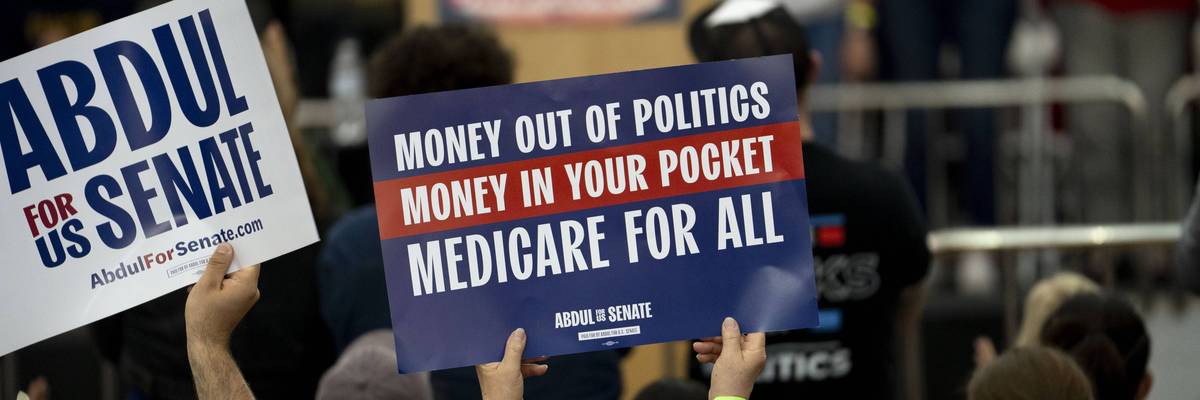
The audience cheers for a speaker before US Sen. Bernie Sanders (I-Vt.) takes the stage at Mumford High School on May 3, 2026 in Detroit, Michigan.
"My votes will never be influenced by AIPAC or any corporate PAC because I don't take money from them," said Abdul El-Sayed.
At Thursday evening's Democratic primary debate on Mackinac Island, Michigan, former public health official and US Senate candidate Abdul El-Sayed suggested the three contenders play a game: "If you're on the stage and you have never taken a corporate PAC check from Blue Cross Blue Shield, raise your hand."
The progressive Medicare for All advocate put his hand up, while his two opponents—US Rep. Haley Stevens and state Sen. Mallory McMorrow—looked on.
El-Sayed's challenge on campaign donations from the for-profit healthcare industry followed McMorrow's comment that "people can't afford to wait for a revolution that may never come"—a remark on progressives' push to expand the existing Medicare program to the entire population that, as journalist David Sirota said, appeared recycled nearly verbatim from former US presidential candidate "Hillary Clinton's talking points from a decade ago."
The people of Michigan are sick and tired of politicians who tell us what we can't have and shouldn't fight for...
We can fight for a world where everybody can be guaranteed healthcare. pic.twitter.com/AoqNVoI4zl
— Dr. Abdul El-Sayed (@AbdulElSayed) May 28, 2026
"Well, I'll tell you this, the revolution is definitely not coming if we're not fighting for it," El-Sayed said in response to McMorrow. "Anyway, all of that is to say, I think we really can fight for a world where everybody can be guaranteed healthcare."
"It is important for us to recognize that all of these issues go back to how we finance campaigns," he added.
According to state and federal campaign finance records, Stevens' US House campaign took $2,500 from Blue Cross Blue Shield's political action committee (PAC) last year, while McMorrow took $5,500 from the PAC over the course of six years.
"The only reason we do not have Medicare for All," said Rep. Ro Khanna (D-Calif.), who has endorsed El-Sayed, "is the corruption of private health insurance money and Democrats who have been unwilling to fight for it."
One observer pointed to a recent poll showing 65% of voters support a Medicare for All system, and emphasized that "the revolution in healthcare is here despite what Mallory McMorrow thinks."
"We just need dedicated fighters like Abdul El-Sayed to make it a reality," they said.
Along with campaign donations from the for-profit healthcare industry, the topic of the powerful but increasingly toxic pro-Israel lobby came up when moderator Nolan Finley asked the candidates how they decide "how much influence" their donors have "over what you do, how you cast your vote."
"Haley Stevens, you take money from [the American Israel Public Affairs Committee]," said Finley. "Walk us through what that money means, and what it buys, and maybe what it doesn't buy."
Stevens responded by expressing her gratitude to various people whom she said had donated to her Senate campaign, including "grocery store workers" and "retired teachers," as well as pointing to political leaders who have endorsed her candidacy—but said nothing in reply to Finley's direct question about how she might be influenced by the more than $5.4 million she's received from pro-Israel lobby groups, including AIPAC, over her political career.
During a Michigan Democratic Senate debate, moderator Nolan Finley calls out Haley Stevens for completely dodging a question on how AIPAC's support of her campaign could influence her votes in the Senate.
"You're also just not answering the question." pic.twitter.com/3dGpQJ6F5R
— Heartland Signal (@HeartlandSignal) May 29, 2026
El-Sayed confronted Stevens for "just not answering the question" before offering his view on what AIPAC and other pro-Israel lobby donations "buys" from lawmakers.
Such contributions ultimately pay for "$3.5 billion sent to a foreign military that can be used here to give classes here, to provide healthcare here, to build schools here," said El-Sayed, referring to the military funding the US provides to Israel each year—including at least $16.3 billion the government has sent to Israel since it began its assault on Gaza in October 2023, helping the Israel Defense Forces to kill more than 75,000 Palestinians as the country blocked humanitarian aid and destroyed over 90% of residential buildings.
Resources for Michigan and other US states, said El-Sayed, is "where our money should be used.”
As The Detroit News reported Thursday, AIPAC has not directly sent donations to Stevens' campaign during the Senate election, but has instead appealed to its direct donors to also send contributions to Stevens.
More than 30% of donors who gave at least $200 to Stevens' campaign also donated to AIPAC since the beginning of 2025, according to The Detroit News' investigation—"well above her current primary opponents and her own benchmarks from prior US House bids."
AIPAC's apparent effort to direct its supporters to also back Stevens is legal under campaign finance law, but Ryan Grim of Drop Site News argued that the group's use of "obvious backdoor vehicles to move money to Haley Stevens only ends up making her look more corrupt."
AIPAC is hosting a fundraising page on its website, "paid for and authorized by Stevens' campaign," according to The Detroit News, while ensuring its name is not attached to the donations that are sent to the candidate through the page. Since Israel began attacking Gaza, approval of both the Israeli government and AIPAC have plummeted, particularly among Democratic voters.
Ahead of the debate, Stevens took umbrage at being asked about AIPAC's efforts to direct contributions to her campaign.
“I’m not breaking [Federal Elections Communications] laws by any stretch of the means," said Stevens. "Look, why would you ask me that question, first of all?”
Haley Stevens when pressed about AIPAC quietly funneling a massive chunk of donations to her camping and tens of millions of outside expenditures:
"Why would you ask me that question?" 💀 pic.twitter.com/LGGBeU9bJK
— umichvoter (@umichvoter) May 28, 2026
At the debate on Thursday, El-Sayed—who has rejected donations from corporate PACs—explained "what would absolutely not shape my perception" should he win the US Senate race.
"It's AIPAC money, which is being spent already in this race to pump up one of my colleagues on this stage," said El-Sayed. "I'm the only candidate today who didn't ask AIPAC for their support. I don't think that our taxpayer dollars which we pay every April ought to be going to bomb children, to fund bombs and tanks for other countries, when we got kids who can't afford basic things in our own."
Should he be elected to the Senate, he said on social media, "my votes will never be influenced by AIPAC or any corporate PAC because I don't take money from them."
Dear Common Dreams reader, It’s been nearly 30 years since I co-founded Common Dreams with my late wife, Lina Newhouser. We had the radical notion that journalism should serve the public good, not corporate profits. It was clear to us from the outset what it would take to build such a project. No paid advertisements. No corporate sponsors. No millionaire publisher telling us what to think or do. Many people said we wouldn't last a year, but we proved those doubters wrong. Together with a tremendous team of journalists and dedicated staff, we built an independent media outlet free from the constraints of profits and corporate control. Our mission has always been simple: To inform. To inspire. To ignite change for the common good. Building Common Dreams was not easy. Our survival was never guaranteed. When you take on the most powerful forces—Wall Street greed, fossil fuel industry destruction, Big Tech lobbyists, and uber-rich oligarchs who have spent billions upon billions rigging the economy and democracy in their favor—the only bulwark you have is supporters who believe in your work. But here’s the urgent message from me today. It's never been this bad out there. And it's never been this hard to keep us going. At the very moment Common Dreams is most needed, the threats we face are intensifying. We need your support now more than ever. We don't accept corporate advertising and never will. We don't have a paywall because we don't think people should be blocked from critical news based on their ability to pay. Everything we do is funded by the donations of readers like you. When everyone does the little they can afford, we are strong. But if that support retreats or dries up, so do we. Will you donate now to make sure Common Dreams not only survives but thrives? —Craig Brown, Co-founder |
At Thursday evening's Democratic primary debate on Mackinac Island, Michigan, former public health official and US Senate candidate Abdul El-Sayed suggested the three contenders play a game: "If you're on the stage and you have never taken a corporate PAC check from Blue Cross Blue Shield, raise your hand."
The progressive Medicare for All advocate put his hand up, while his two opponents—US Rep. Haley Stevens and state Sen. Mallory McMorrow—looked on.
El-Sayed's challenge on campaign donations from the for-profit healthcare industry followed McMorrow's comment that "people can't afford to wait for a revolution that may never come"—a remark on progressives' push to expand the existing Medicare program to the entire population that, as journalist David Sirota said, appeared recycled nearly verbatim from former US presidential candidate "Hillary Clinton's talking points from a decade ago."
The people of Michigan are sick and tired of politicians who tell us what we can't have and shouldn't fight for...
We can fight for a world where everybody can be guaranteed healthcare. pic.twitter.com/AoqNVoI4zl
— Dr. Abdul El-Sayed (@AbdulElSayed) May 28, 2026
"Well, I'll tell you this, the revolution is definitely not coming if we're not fighting for it," El-Sayed said in response to McMorrow. "Anyway, all of that is to say, I think we really can fight for a world where everybody can be guaranteed healthcare."
"It is important for us to recognize that all of these issues go back to how we finance campaigns," he added.
According to state and federal campaign finance records, Stevens' US House campaign took $2,500 from Blue Cross Blue Shield's political action committee (PAC) last year, while McMorrow took $5,500 from the PAC over the course of six years.
"The only reason we do not have Medicare for All," said Rep. Ro Khanna (D-Calif.), who has endorsed El-Sayed, "is the corruption of private health insurance money and Democrats who have been unwilling to fight for it."
One observer pointed to a recent poll showing 65% of voters support a Medicare for All system, and emphasized that "the revolution in healthcare is here despite what Mallory McMorrow thinks."
"We just need dedicated fighters like Abdul El-Sayed to make it a reality," they said.
Along with campaign donations from the for-profit healthcare industry, the topic of the powerful but increasingly toxic pro-Israel lobby came up when moderator Nolan Finley asked the candidates how they decide "how much influence" their donors have "over what you do, how you cast your vote."
"Haley Stevens, you take money from [the American Israel Public Affairs Committee]," said Finley. "Walk us through what that money means, and what it buys, and maybe what it doesn't buy."
Stevens responded by expressing her gratitude to various people whom she said had donated to her Senate campaign, including "grocery store workers" and "retired teachers," as well as pointing to political leaders who have endorsed her candidacy—but said nothing in reply to Finley's direct question about how she might be influenced by the more than $5.4 million she's received from pro-Israel lobby groups, including AIPAC, over her political career.
During a Michigan Democratic Senate debate, moderator Nolan Finley calls out Haley Stevens for completely dodging a question on how AIPAC's support of her campaign could influence her votes in the Senate.
"You're also just not answering the question." pic.twitter.com/3dGpQJ6F5R
— Heartland Signal (@HeartlandSignal) May 29, 2026
El-Sayed confronted Stevens for "just not answering the question" before offering his view on what AIPAC and other pro-Israel lobby donations "buys" from lawmakers.
Such contributions ultimately pay for "$3.5 billion sent to a foreign military that can be used here to give classes here, to provide healthcare here, to build schools here," said El-Sayed, referring to the military funding the US provides to Israel each year—including at least $16.3 billion the government has sent to Israel since it began its assault on Gaza in October 2023, helping the Israel Defense Forces to kill more than 75,000 Palestinians as the country blocked humanitarian aid and destroyed over 90% of residential buildings.
Resources for Michigan and other US states, said El-Sayed, is "where our money should be used.”
As The Detroit News reported Thursday, AIPAC has not directly sent donations to Stevens' campaign during the Senate election, but has instead appealed to its direct donors to also send contributions to Stevens.
More than 30% of donors who gave at least $200 to Stevens' campaign also donated to AIPAC since the beginning of 2025, according to The Detroit News' investigation—"well above her current primary opponents and her own benchmarks from prior US House bids."
AIPAC's apparent effort to direct its supporters to also back Stevens is legal under campaign finance law, but Ryan Grim of Drop Site News argued that the group's use of "obvious backdoor vehicles to move money to Haley Stevens only ends up making her look more corrupt."
AIPAC is hosting a fundraising page on its website, "paid for and authorized by Stevens' campaign," according to The Detroit News, while ensuring its name is not attached to the donations that are sent to the candidate through the page. Since Israel began attacking Gaza, approval of both the Israeli government and AIPAC have plummeted, particularly among Democratic voters.
Ahead of the debate, Stevens took umbrage at being asked about AIPAC's efforts to direct contributions to her campaign.
“I’m not breaking [Federal Elections Communications] laws by any stretch of the means," said Stevens. "Look, why would you ask me that question, first of all?”
Haley Stevens when pressed about AIPAC quietly funneling a massive chunk of donations to her camping and tens of millions of outside expenditures:
"Why would you ask me that question?" 💀 pic.twitter.com/LGGBeU9bJK
— umichvoter (@umichvoter) May 28, 2026
At the debate on Thursday, El-Sayed—who has rejected donations from corporate PACs—explained "what would absolutely not shape my perception" should he win the US Senate race.
"It's AIPAC money, which is being spent already in this race to pump up one of my colleagues on this stage," said El-Sayed. "I'm the only candidate today who didn't ask AIPAC for their support. I don't think that our taxpayer dollars which we pay every April ought to be going to bomb children, to fund bombs and tanks for other countries, when we got kids who can't afford basic things in our own."
Should he be elected to the Senate, he said on social media, "my votes will never be influenced by AIPAC or any corporate PAC because I don't take money from them."
At Thursday evening's Democratic primary debate on Mackinac Island, Michigan, former public health official and US Senate candidate Abdul El-Sayed suggested the three contenders play a game: "If you're on the stage and you have never taken a corporate PAC check from Blue Cross Blue Shield, raise your hand."
The progressive Medicare for All advocate put his hand up, while his two opponents—US Rep. Haley Stevens and state Sen. Mallory McMorrow—looked on.
El-Sayed's challenge on campaign donations from the for-profit healthcare industry followed McMorrow's comment that "people can't afford to wait for a revolution that may never come"—a remark on progressives' push to expand the existing Medicare program to the entire population that, as journalist David Sirota said, appeared recycled nearly verbatim from former US presidential candidate "Hillary Clinton's talking points from a decade ago."
The people of Michigan are sick and tired of politicians who tell us what we can't have and shouldn't fight for...
We can fight for a world where everybody can be guaranteed healthcare. pic.twitter.com/AoqNVoI4zl
— Dr. Abdul El-Sayed (@AbdulElSayed) May 28, 2026
"Well, I'll tell you this, the revolution is definitely not coming if we're not fighting for it," El-Sayed said in response to McMorrow. "Anyway, all of that is to say, I think we really can fight for a world where everybody can be guaranteed healthcare."
"It is important for us to recognize that all of these issues go back to how we finance campaigns," he added.
According to state and federal campaign finance records, Stevens' US House campaign took $2,500 from Blue Cross Blue Shield's political action committee (PAC) last year, while McMorrow took $5,500 from the PAC over the course of six years.
"The only reason we do not have Medicare for All," said Rep. Ro Khanna (D-Calif.), who has endorsed El-Sayed, "is the corruption of private health insurance money and Democrats who have been unwilling to fight for it."
One observer pointed to a recent poll showing 65% of voters support a Medicare for All system, and emphasized that "the revolution in healthcare is here despite what Mallory McMorrow thinks."
"We just need dedicated fighters like Abdul El-Sayed to make it a reality," they said.
Along with campaign donations from the for-profit healthcare industry, the topic of the powerful but increasingly toxic pro-Israel lobby came up when moderator Nolan Finley asked the candidates how they decide "how much influence" their donors have "over what you do, how you cast your vote."
"Haley Stevens, you take money from [the American Israel Public Affairs Committee]," said Finley. "Walk us through what that money means, and what it buys, and maybe what it doesn't buy."
Stevens responded by expressing her gratitude to various people whom she said had donated to her Senate campaign, including "grocery store workers" and "retired teachers," as well as pointing to political leaders who have endorsed her candidacy—but said nothing in reply to Finley's direct question about how she might be influenced by the more than $5.4 million she's received from pro-Israel lobby groups, including AIPAC, over her political career.
During a Michigan Democratic Senate debate, moderator Nolan Finley calls out Haley Stevens for completely dodging a question on how AIPAC's support of her campaign could influence her votes in the Senate.
"You're also just not answering the question." pic.twitter.com/3dGpQJ6F5R
— Heartland Signal (@HeartlandSignal) May 29, 2026
El-Sayed confronted Stevens for "just not answering the question" before offering his view on what AIPAC and other pro-Israel lobby donations "buys" from lawmakers.
Such contributions ultimately pay for "$3.5 billion sent to a foreign military that can be used here to give classes here, to provide healthcare here, to build schools here," said El-Sayed, referring to the military funding the US provides to Israel each year—including at least $16.3 billion the government has sent to Israel since it began its assault on Gaza in October 2023, helping the Israel Defense Forces to kill more than 75,000 Palestinians as the country blocked humanitarian aid and destroyed over 90% of residential buildings.
Resources for Michigan and other US states, said El-Sayed, is "where our money should be used.”
As The Detroit News reported Thursday, AIPAC has not directly sent donations to Stevens' campaign during the Senate election, but has instead appealed to its direct donors to also send contributions to Stevens.
More than 30% of donors who gave at least $200 to Stevens' campaign also donated to AIPAC since the beginning of 2025, according to The Detroit News' investigation—"well above her current primary opponents and her own benchmarks from prior US House bids."
AIPAC's apparent effort to direct its supporters to also back Stevens is legal under campaign finance law, but Ryan Grim of Drop Site News argued that the group's use of "obvious backdoor vehicles to move money to Haley Stevens only ends up making her look more corrupt."
AIPAC is hosting a fundraising page on its website, "paid for and authorized by Stevens' campaign," according to The Detroit News, while ensuring its name is not attached to the donations that are sent to the candidate through the page. Since Israel began attacking Gaza, approval of both the Israeli government and AIPAC have plummeted, particularly among Democratic voters.
Ahead of the debate, Stevens took umbrage at being asked about AIPAC's efforts to direct contributions to her campaign.
“I’m not breaking [Federal Elections Communications] laws by any stretch of the means," said Stevens. "Look, why would you ask me that question, first of all?”
Haley Stevens when pressed about AIPAC quietly funneling a massive chunk of donations to her camping and tens of millions of outside expenditures:
"Why would you ask me that question?" 💀 pic.twitter.com/LGGBeU9bJK
— umichvoter (@umichvoter) May 28, 2026
At the debate on Thursday, El-Sayed—who has rejected donations from corporate PACs—explained "what would absolutely not shape my perception" should he win the US Senate race.
"It's AIPAC money, which is being spent already in this race to pump up one of my colleagues on this stage," said El-Sayed. "I'm the only candidate today who didn't ask AIPAC for their support. I don't think that our taxpayer dollars which we pay every April ought to be going to bomb children, to fund bombs and tanks for other countries, when we got kids who can't afford basic things in our own."
Should he be elected to the Senate, he said on social media, "my votes will never be influenced by AIPAC or any corporate PAC because I don't take money from them."