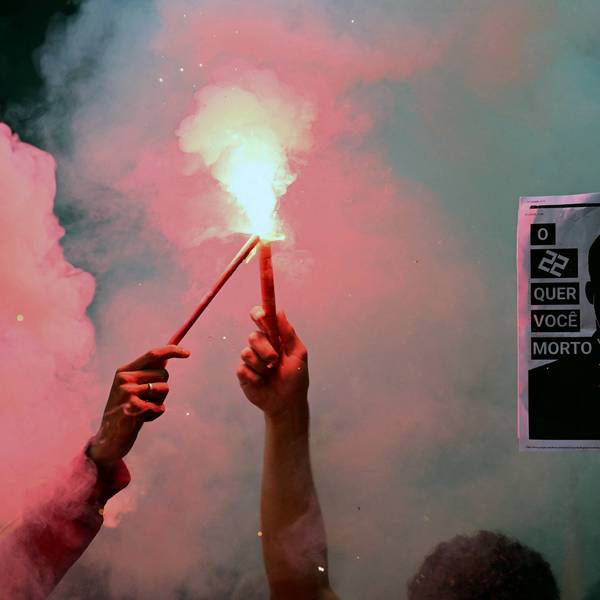
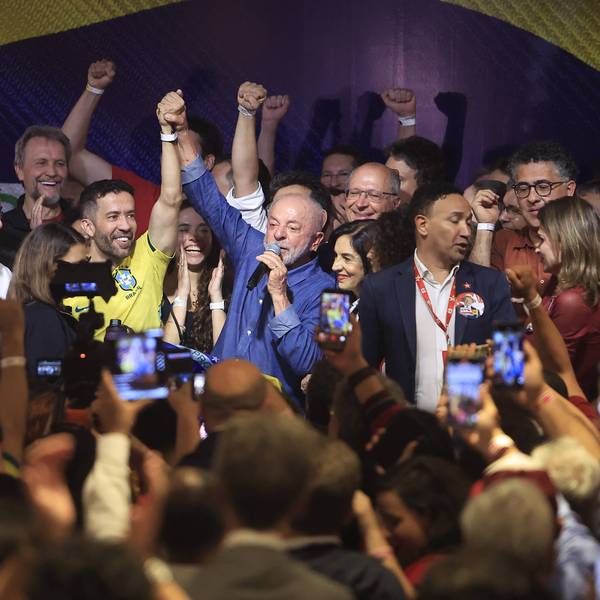
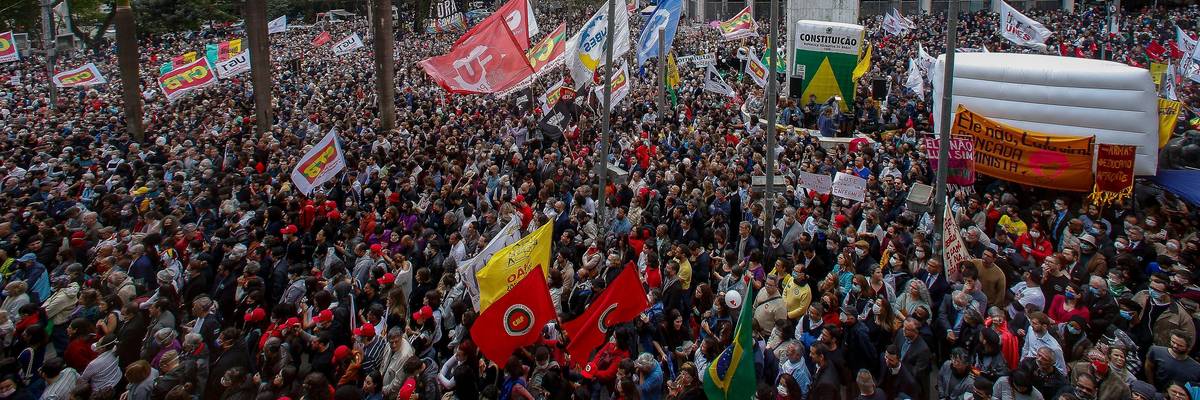
A massive pro-democracy demonstration takes place at the University of Sao Paulo School of Law in Sao Paulo, Brazil, on August 11, 2022. (Photo: Miguel Schincariol/AFP via Getty Images)
'Dictatorship Never Again': Massive Pro-Democracy Protests Sweep Brazil
"Democracy involves changing the government and eliminating neo-fascism," said one prominent protester, "but above all, ensuring that the working class, the people, have the rights guaranteed in the Constitution."
Protests--some of them massive--in defense of democracy and education and against far-right President Jair Bolsonaro's coup-mongering were held in cities across Brazil Thursday, less than two months before the first round of the South American nation's presidential election.
"Bolsonaro is much closer to jail than to the coup."
Demonstrations took place in at least 23 of Brazil's 26 state capitals, as well as in the national capital of Brasilia. Many of the protests featured readings of a pair of pro-democracy manifestos, including the "Letter to Brazilians in Defense of Democracy and Rule of Law." The missive, which has been signed by nearly one million people, was inspired by a similar 1977 document that helped bring down a 21-year, U.S.-backed military dictatorship admired by Bolsonaro, who served in its army.
During the reading event at the University of Sao Paulo (USP) School of Law--where large banners read "dictatorship never again" and "state of rights, always"--presidential candidates spoke out in defense of Brazil's electronic voting system, which has been the target of baseless allegations of fraud by Bolsonaro and his allies. The right-wing president, who is pushing for paper ballots, has threatened to reject the results of October's first-round presidential election if he loses under the current electronic voting system.
"Defending democracy is defending the right to quality food, a good job, fair wages, access to healthcare, and education," said Luiz Inacio Lula da Silva, the former leftist president who is running again representing the Workers' Party and leads Bolsonaro by double digits in aggregate polling.
"[This is] what the Brazilian people should have," da Silva added. "Our country was sovereign and respected. We need to get it back together."
Bolsonaro mocked the massive nationwide rebuke of his rule, tweeting that "today, a very important act took place on behalf of Brazil and of great relevance to the Brazilian people: Petrobras once again reduced the price of diesel."
A broad range of leftist activists spoke at and about the demonstrations across Brazil.
"Running over democracy is not as simple as the militiaman imagined," tweeted Ivan Valente, leader of the Socialism and Liberty Party (PSOL) in Brazil's Chamber of Deputies, the lower house of Congress. "Bolsonaro is much closer to jail than to the coup... Brazilian society does not accept setbacks or coup bravado."
Beatriz Lourenco do Nascimento of Black Coalition for Rights--one of the few Black faces in the room during the USP reading--recited her group's anti-racist manifesto during the event.
"Brazil is a country in debt to the Black population," she asserted. "We call on the democratic sectors of Brazilian society, institutions, and people who today show emotion over the ills of racism and claim to be anti-racist: Be consistent. Practice what you speak. As long as there is racism, there will be no democracy."
Economist and social activist Joao Pedro Stedile, a co-founder of the Landless Workers' Movement (MST), said members of the group took part in Thursday's "historic event" in "defense of Brazilian society."
"We are in the process of building this broad front, representing all Brazilians who defend democracy," he continued. "Democracy involves changing the government and eliminating neo-fascism, but above all, ensuring that the working class, the people, have the rights guaranteed in the Constitution. Right to work, income, land, education, health."
"Today's act is just the start of a great journey of activities centered around 200 years of Brazilian independence," Stedile added, referring to Brazil's bicentennial on September 7. "We are organizing to continue with demonstrations and mobilizations, especially in the week of September 7th to 10th, when we take to the streets to defend democracy, sovereignty, and the Brazilian people."
We are at a crossroads
This country and this world are at a monumental crossroads. In a few short weeks, US voters will have an opportunity to beat back the forces of fascism and confront the billionaires who are rigging the economy, our media system, and our democracy, making it increasingly impossible for ordinary people to get by. We’re not just talking about the election. We’re talking about what must be done once these fascist elements are vanquished from power. We need a bolder set of solutions than what either major party has so far been willing to offer and a working-class movement ready to fight like hell for it. Trump didn't emerge from nowhere. The conditions that fueled MAGA authoritarianism were created by decades of radical neoliberal economic policies and a corrupt political system dominated by corporate interests. They slashed taxes on the super-rich, promising that the benefits would trickle down. They said giveaways to the corporate titans would make life more affordable for the rest of us. It was all bullshit. And when a bitter, betrayed populace searches for someone to blame, right-wing demagogues have little trouble finding scapegoats. People know when they're being lied to, but you won't hear any of this from the corporate media. Only independent journalism—powered and funded by people who believe in building a better world—can deliver truly trustworthy daily news. Our Fall Campaign is underway, and we need your help. To power our newsroom through the rest of the year, we need to raise $125,000 by midnight on October 31. So if you share our vision, please contribute whatever you can to sustain our work. |
Protests--some of them massive--in defense of democracy and education and against far-right President Jair Bolsonaro's coup-mongering were held in cities across Brazil Thursday, less than two months before the first round of the South American nation's presidential election.
"Bolsonaro is much closer to jail than to the coup."
Demonstrations took place in at least 23 of Brazil's 26 state capitals, as well as in the national capital of Brasilia. Many of the protests featured readings of a pair of pro-democracy manifestos, including the "Letter to Brazilians in Defense of Democracy and Rule of Law." The missive, which has been signed by nearly one million people, was inspired by a similar 1977 document that helped bring down a 21-year, U.S.-backed military dictatorship admired by Bolsonaro, who served in its army.
During the reading event at the University of Sao Paulo (USP) School of Law--where large banners read "dictatorship never again" and "state of rights, always"--presidential candidates spoke out in defense of Brazil's electronic voting system, which has been the target of baseless allegations of fraud by Bolsonaro and his allies. The right-wing president, who is pushing for paper ballots, has threatened to reject the results of October's first-round presidential election if he loses under the current electronic voting system.
"Defending democracy is defending the right to quality food, a good job, fair wages, access to healthcare, and education," said Luiz Inacio Lula da Silva, the former leftist president who is running again representing the Workers' Party and leads Bolsonaro by double digits in aggregate polling.
"[This is] what the Brazilian people should have," da Silva added. "Our country was sovereign and respected. We need to get it back together."
Bolsonaro mocked the massive nationwide rebuke of his rule, tweeting that "today, a very important act took place on behalf of Brazil and of great relevance to the Brazilian people: Petrobras once again reduced the price of diesel."
A broad range of leftist activists spoke at and about the demonstrations across Brazil.
"Running over democracy is not as simple as the militiaman imagined," tweeted Ivan Valente, leader of the Socialism and Liberty Party (PSOL) in Brazil's Chamber of Deputies, the lower house of Congress. "Bolsonaro is much closer to jail than to the coup... Brazilian society does not accept setbacks or coup bravado."
Beatriz Lourenco do Nascimento of Black Coalition for Rights--one of the few Black faces in the room during the USP reading--recited her group's anti-racist manifesto during the event.
"Brazil is a country in debt to the Black population," she asserted. "We call on the democratic sectors of Brazilian society, institutions, and people who today show emotion over the ills of racism and claim to be anti-racist: Be consistent. Practice what you speak. As long as there is racism, there will be no democracy."
Economist and social activist Joao Pedro Stedile, a co-founder of the Landless Workers' Movement (MST), said members of the group took part in Thursday's "historic event" in "defense of Brazilian society."
"We are in the process of building this broad front, representing all Brazilians who defend democracy," he continued. "Democracy involves changing the government and eliminating neo-fascism, but above all, ensuring that the working class, the people, have the rights guaranteed in the Constitution. Right to work, income, land, education, health."
"Today's act is just the start of a great journey of activities centered around 200 years of Brazilian independence," Stedile added, referring to Brazil's bicentennial on September 7. "We are organizing to continue with demonstrations and mobilizations, especially in the week of September 7th to 10th, when we take to the streets to defend democracy, sovereignty, and the Brazilian people."
- Brazil's Lula Vows to 'Put an End to Illegal Mining' if Elected President ›
- Lula Holds 12-Point Lead Over Bolsonaro as Brazil's Presidential Race Heats Up ›
- Opinion | To Defeat Fascism in Brazil, Lula Must Learn From the Past | Common Dreams ›
- Opinion | What Other Countries Can Teach Us About Defending a Democracy in Crisis | Common Dreams ›
- Opinion | 7 Lessons From the US and Brazil for Durable Democracy | Common Dreams ›
- Thousands March Against Far Right in Brazil Ahead of Runoff Election | Common Dreams ›
Protests--some of them massive--in defense of democracy and education and against far-right President Jair Bolsonaro's coup-mongering were held in cities across Brazil Thursday, less than two months before the first round of the South American nation's presidential election.
"Bolsonaro is much closer to jail than to the coup."
Demonstrations took place in at least 23 of Brazil's 26 state capitals, as well as in the national capital of Brasilia. Many of the protests featured readings of a pair of pro-democracy manifestos, including the "Letter to Brazilians in Defense of Democracy and Rule of Law." The missive, which has been signed by nearly one million people, was inspired by a similar 1977 document that helped bring down a 21-year, U.S.-backed military dictatorship admired by Bolsonaro, who served in its army.
During the reading event at the University of Sao Paulo (USP) School of Law--where large banners read "dictatorship never again" and "state of rights, always"--presidential candidates spoke out in defense of Brazil's electronic voting system, which has been the target of baseless allegations of fraud by Bolsonaro and his allies. The right-wing president, who is pushing for paper ballots, has threatened to reject the results of October's first-round presidential election if he loses under the current electronic voting system.
"Defending democracy is defending the right to quality food, a good job, fair wages, access to healthcare, and education," said Luiz Inacio Lula da Silva, the former leftist president who is running again representing the Workers' Party and leads Bolsonaro by double digits in aggregate polling.
"[This is] what the Brazilian people should have," da Silva added. "Our country was sovereign and respected. We need to get it back together."
Bolsonaro mocked the massive nationwide rebuke of his rule, tweeting that "today, a very important act took place on behalf of Brazil and of great relevance to the Brazilian people: Petrobras once again reduced the price of diesel."
A broad range of leftist activists spoke at and about the demonstrations across Brazil.
"Running over democracy is not as simple as the militiaman imagined," tweeted Ivan Valente, leader of the Socialism and Liberty Party (PSOL) in Brazil's Chamber of Deputies, the lower house of Congress. "Bolsonaro is much closer to jail than to the coup... Brazilian society does not accept setbacks or coup bravado."
Beatriz Lourenco do Nascimento of Black Coalition for Rights--one of the few Black faces in the room during the USP reading--recited her group's anti-racist manifesto during the event.
"Brazil is a country in debt to the Black population," she asserted. "We call on the democratic sectors of Brazilian society, institutions, and people who today show emotion over the ills of racism and claim to be anti-racist: Be consistent. Practice what you speak. As long as there is racism, there will be no democracy."
Economist and social activist Joao Pedro Stedile, a co-founder of the Landless Workers' Movement (MST), said members of the group took part in Thursday's "historic event" in "defense of Brazilian society."
"We are in the process of building this broad front, representing all Brazilians who defend democracy," he continued. "Democracy involves changing the government and eliminating neo-fascism, but above all, ensuring that the working class, the people, have the rights guaranteed in the Constitution. Right to work, income, land, education, health."
"Today's act is just the start of a great journey of activities centered around 200 years of Brazilian independence," Stedile added, referring to Brazil's bicentennial on September 7. "We are organizing to continue with demonstrations and mobilizations, especially in the week of September 7th to 10th, when we take to the streets to defend democracy, sovereignty, and the Brazilian people."
- Brazil's Lula Vows to 'Put an End to Illegal Mining' if Elected President ›
- Lula Holds 12-Point Lead Over Bolsonaro as Brazil's Presidential Race Heats Up ›
- Opinion | To Defeat Fascism in Brazil, Lula Must Learn From the Past | Common Dreams ›
- Opinion | What Other Countries Can Teach Us About Defending a Democracy in Crisis | Common Dreams ›
- Opinion | 7 Lessons From the US and Brazil for Durable Democracy | Common Dreams ›
- Thousands March Against Far Right in Brazil Ahead of Runoff Election | Common Dreams ›