SUBSCRIBE TO OUR FREE NEWSLETTER
Daily news & progressive opinion—funded by the people, not the corporations—delivered straight to your inbox.
5
#000000
#FFFFFF
To donate by check, phone, or other method, see our More Ways to Give page.
Daily news & progressive opinion—funded by the people, not the corporations—delivered straight to your inbox.
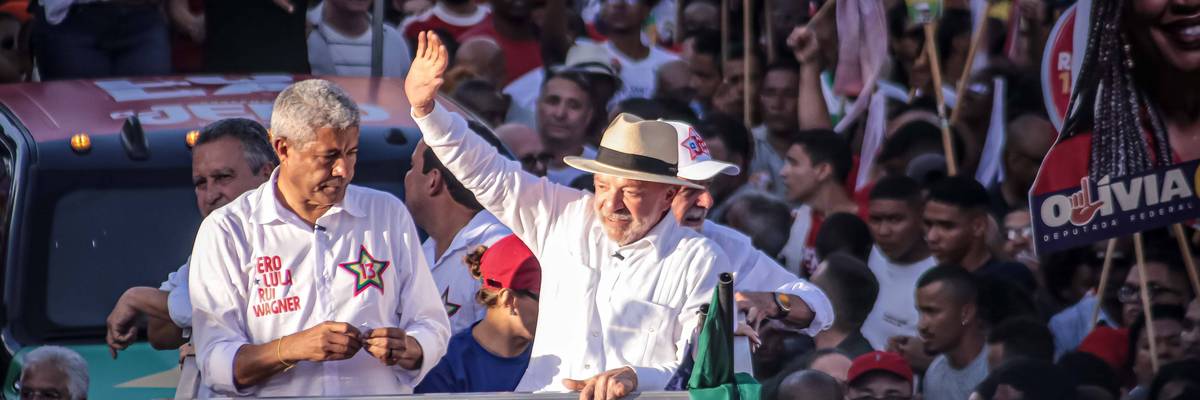
Brazilian President Luiz Inacio Lula da Silva, Bahia Gov. Jeronimo Rodrigues, Sen. Jaques Wagner, and Senate candidate Rui Costa attend a campaign event on August 28, 2026 in Salvador, Brazil.
"The past almost four years have seen Brazil accomplish a great deal in terms of bringing people out of poverty, creating jobs, curbing hunger, and raising standards of living."
An analysis released Wednesday documents some of the major economic gains that Brazil has made over the past four years during the third term of President Luiz Inácio Lula da Silva, who is currently in a close battle for reelection against rival Flávio Bolsonaro.
The analysis, published by the US-based Center for Economic and Policy Research (CEPR), finds that, between 2022 and 2025, the Brazilian economy grew by a cumulative 8.9%, easily outpacing the average rate of growth in other South American countries.
This growth has been coupled with a drop in the unemployment rate, which has fallen from more than 9% in the second quarter of 2022 to just 5.4% in the second quarter of 2026.
Both poverty and food insecurity fell dramatically in the first two year's of Lula's term, the analysis finds, and in 2025, "Brazil was removed from the Food and Agriculture Organization’s Hunger Map after chronic undernourishment fell below 2.5%."
CEPR's report also gives credit to Lula's policies for improved economic conditions, including a new minimum wage law, an expanded maternity leave program, and increased average payments to low-income families given through the Bolsa Família program.
The economy during Lula's term is far from perfect, however, and the report flags high interest rates set by Brazil's central bank as a key factor in raising consumers' borrowing costs and increasing the rate of household delinquency.
CEPR also noted the negative impact of online betting apps, which Lula has pledged to ban starting next month, on Brazilian workers.
"Brazilian households lost an estimated R$62.5 billion (US$11.2 billion) to online betting in 2025," the report says, "while some 802,000 Bolsa Família households spent more than 2% of their income on betting in January 2025."
Jake Johnston, CEPR's director of international research, said that "the past almost four years have seen Brazil accomplish a great deal in terms of bringing people out of poverty, creating jobs, curbing hunger, and raising standards of living."
"This was done," Johnston added, "despite the lingering impact of the Covid pandemic, external economic shocks that affected the global economy, and excessively high interest rates."
The first round of Brazil's presidential election is set to take place on Sunday, and recent polls show Lula with a narrow lead over Bolsonaro, son of former Brazilian President Jair Bolsonaro, who is still serving a criminal sentence for efforts to instigate a coup after his loss in the 2022 election.
Dear Common Dreams reader, It’s been nearly 30 years since I co-founded Common Dreams with my late wife, Lina Newhouser. We had the radical notion that journalism should serve the public good, not corporate profits. It was clear to us from the outset what it would take to build such a project. No paid advertisements. No corporate sponsors. No millionaire publisher telling us what to think or do. Many people said we wouldn't last a year, but we proved those doubters wrong. Together with a tremendous team of journalists and dedicated staff, we built an independent media outlet free from the constraints of profits and corporate control. Our mission has always been simple: To inform. To inspire. To ignite change for the common good. Building Common Dreams was not easy. Our survival was never guaranteed. When you take on the most powerful forces—Wall Street greed, fossil fuel industry destruction, Big Tech lobbyists, and uber-rich oligarchs who have spent billions upon billions rigging the economy and democracy in their favor—the only bulwark you have is supporters who believe in your work. But here’s the urgent message from me today. It's never been this bad out there. And it's never been this hard to keep us going. At the very moment Common Dreams is most needed, the threats we face are intensifying. We need your support now more than ever. We don't accept corporate advertising and never will. We don't have a paywall because we don't think people should be blocked from critical news based on their ability to pay. Everything we do is funded by the donations of readers like you. When everyone does the little they can afford, we are strong. But if that support retreats or dries up, so do we. Will you donate now to make sure Common Dreams not only survives but thrives? —Craig Brown, Co-founder |
An analysis released Wednesday documents some of the major economic gains that Brazil has made over the past four years during the third term of President Luiz Inácio Lula da Silva, who is currently in a close battle for reelection against rival Flávio Bolsonaro.
The analysis, published by the US-based Center for Economic and Policy Research (CEPR), finds that, between 2022 and 2025, the Brazilian economy grew by a cumulative 8.9%, easily outpacing the average rate of growth in other South American countries.
This growth has been coupled with a drop in the unemployment rate, which has fallen from more than 9% in the second quarter of 2022 to just 5.4% in the second quarter of 2026.
Both poverty and food insecurity fell dramatically in the first two year's of Lula's term, the analysis finds, and in 2025, "Brazil was removed from the Food and Agriculture Organization’s Hunger Map after chronic undernourishment fell below 2.5%."
CEPR's report also gives credit to Lula's policies for improved economic conditions, including a new minimum wage law, an expanded maternity leave program, and increased average payments to low-income families given through the Bolsa Família program.
The economy during Lula's term is far from perfect, however, and the report flags high interest rates set by Brazil's central bank as a key factor in raising consumers' borrowing costs and increasing the rate of household delinquency.
CEPR also noted the negative impact of online betting apps, which Lula has pledged to ban starting next month, on Brazilian workers.
"Brazilian households lost an estimated R$62.5 billion (US$11.2 billion) to online betting in 2025," the report says, "while some 802,000 Bolsa Família households spent more than 2% of their income on betting in January 2025."
Jake Johnston, CEPR's director of international research, said that "the past almost four years have seen Brazil accomplish a great deal in terms of bringing people out of poverty, creating jobs, curbing hunger, and raising standards of living."
"This was done," Johnston added, "despite the lingering impact of the Covid pandemic, external economic shocks that affected the global economy, and excessively high interest rates."
The first round of Brazil's presidential election is set to take place on Sunday, and recent polls show Lula with a narrow lead over Bolsonaro, son of former Brazilian President Jair Bolsonaro, who is still serving a criminal sentence for efforts to instigate a coup after his loss in the 2022 election.
An analysis released Wednesday documents some of the major economic gains that Brazil has made over the past four years during the third term of President Luiz Inácio Lula da Silva, who is currently in a close battle for reelection against rival Flávio Bolsonaro.
The analysis, published by the US-based Center for Economic and Policy Research (CEPR), finds that, between 2022 and 2025, the Brazilian economy grew by a cumulative 8.9%, easily outpacing the average rate of growth in other South American countries.
This growth has been coupled with a drop in the unemployment rate, which has fallen from more than 9% in the second quarter of 2022 to just 5.4% in the second quarter of 2026.
Both poverty and food insecurity fell dramatically in the first two year's of Lula's term, the analysis finds, and in 2025, "Brazil was removed from the Food and Agriculture Organization’s Hunger Map after chronic undernourishment fell below 2.5%."
CEPR's report also gives credit to Lula's policies for improved economic conditions, including a new minimum wage law, an expanded maternity leave program, and increased average payments to low-income families given through the Bolsa Família program.
The economy during Lula's term is far from perfect, however, and the report flags high interest rates set by Brazil's central bank as a key factor in raising consumers' borrowing costs and increasing the rate of household delinquency.
CEPR also noted the negative impact of online betting apps, which Lula has pledged to ban starting next month, on Brazilian workers.
"Brazilian households lost an estimated R$62.5 billion (US$11.2 billion) to online betting in 2025," the report says, "while some 802,000 Bolsa Família households spent more than 2% of their income on betting in January 2025."
Jake Johnston, CEPR's director of international research, said that "the past almost four years have seen Brazil accomplish a great deal in terms of bringing people out of poverty, creating jobs, curbing hunger, and raising standards of living."
"This was done," Johnston added, "despite the lingering impact of the Covid pandemic, external economic shocks that affected the global economy, and excessively high interest rates."
The first round of Brazil's presidential election is set to take place on Sunday, and recent polls show Lula with a narrow lead over Bolsonaro, son of former Brazilian President Jair Bolsonaro, who is still serving a criminal sentence for efforts to instigate a coup after his loss in the 2022 election.